English




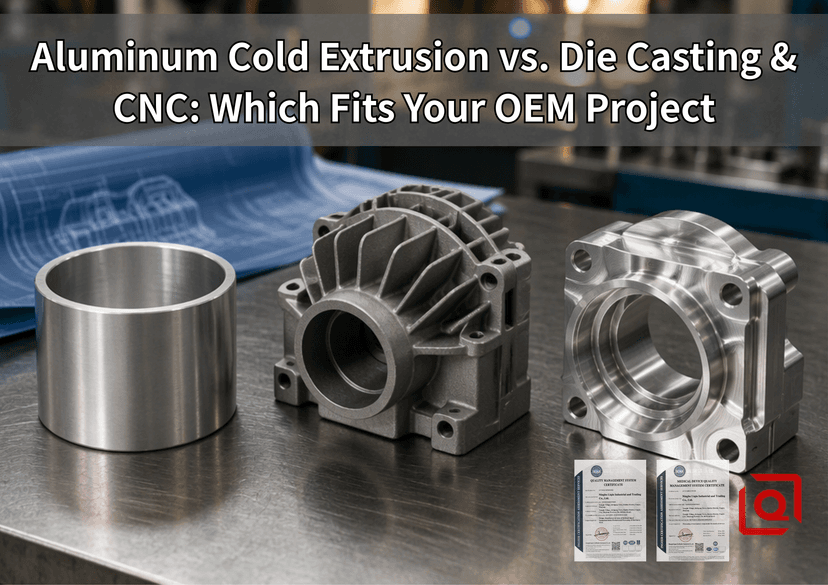
Every hardware build runs into the same bottleneck. The CAD model is locked, tolerancing is checked, and sourcing now faces a tough trade-off: how do we scale this aluminum housing without wrecking piece costs or fighting field failures?
Most engineering teams stick with multi-axis CNC during prototyping. Once release orders scale up, they reflexively shift to high-pressure die casting (HPDC), skipping cold extrusion entirely. That jump often backfires. For deep-cavity, symmetrical, or cylindrical shells, jumping straight from bar stock to die casting introduces hidden porosity, scrap spikes during pressure decay tests, and blotchy anodizing.
Let us look at how cold extrusion, die casting, and billet CNC behave under real production conditions on the factory floor.
What Actually Happens Inside the Tooling
A 3D CAD viewer will not show you how metal deforms under tonnage. Choosing the right route requires tracking metal displacement, strain, and thermal history during the cycle.
Aluminum Cold Extrusion (Impact Forging / Cold Forming)
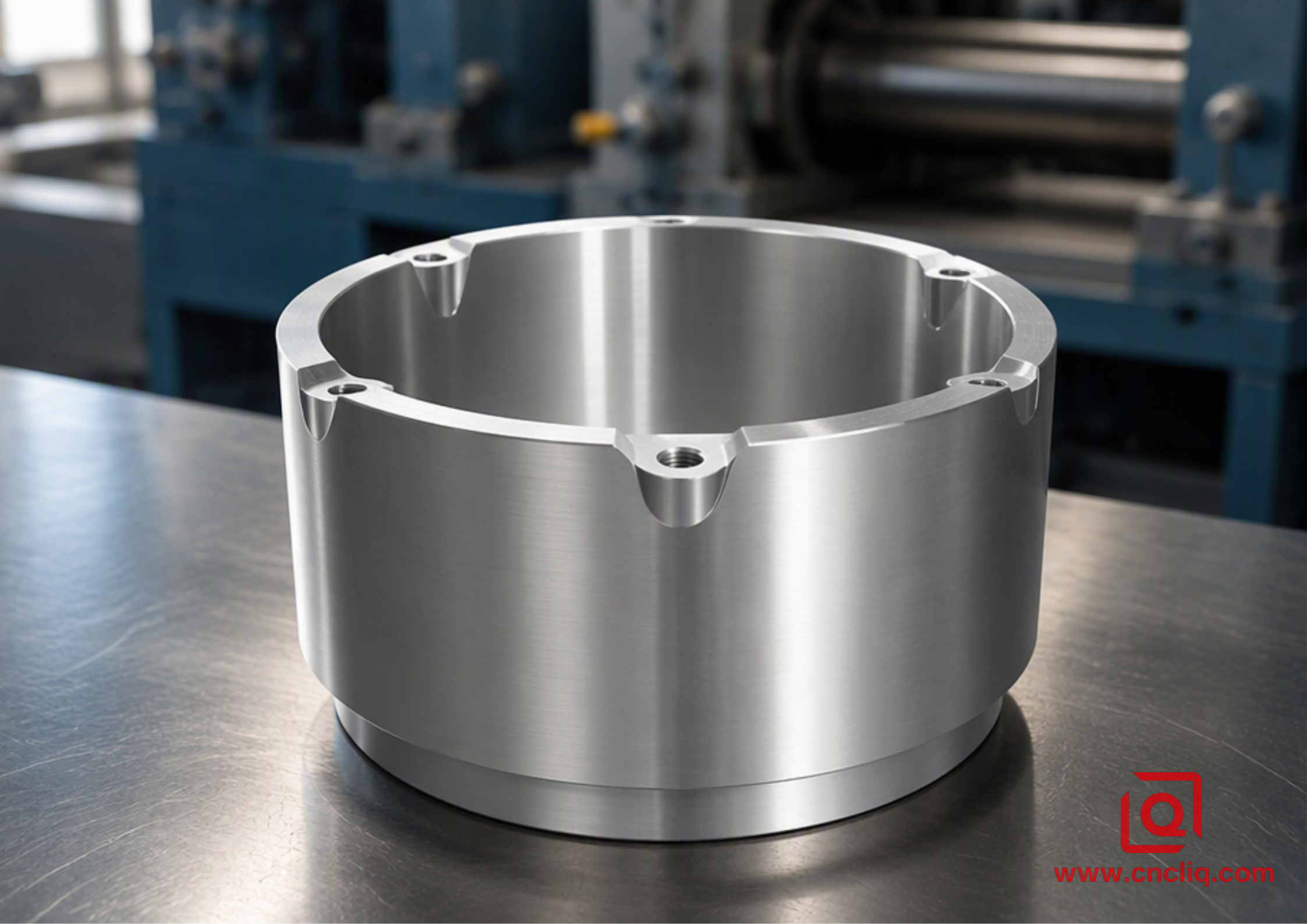
Production starts with an annealed, coated cylindrical slug cropped from continuous cast rod. Loaded into a tungsten carbide die at ambient room temperature, the slug takes an impact from a tool-steel punch driven by a 250 to 1200 metric ton mechanical press.
The slug yields instantly past its plastic limit, surging backward over the punch tip, pushing forward through the die throat, or filling bottom cavity features. Because forming occurs well below the recrystallization threshold, the process induces severe work hardening.
-
The Result: Longitudinal grain flow lines bend and wrap continuously along the part geometry without shearing.
-
Cycle Speed: One press stroke forms the near-net hollow body in 2 to 4 seconds before the knockout pin kicks it clear.
-
Secondary Operations: A single-clamping lathe pass trims the mouth, cuts O-ring grooves, and single-points threads to pitch.
High-Pressure Die Casting (HPDC)
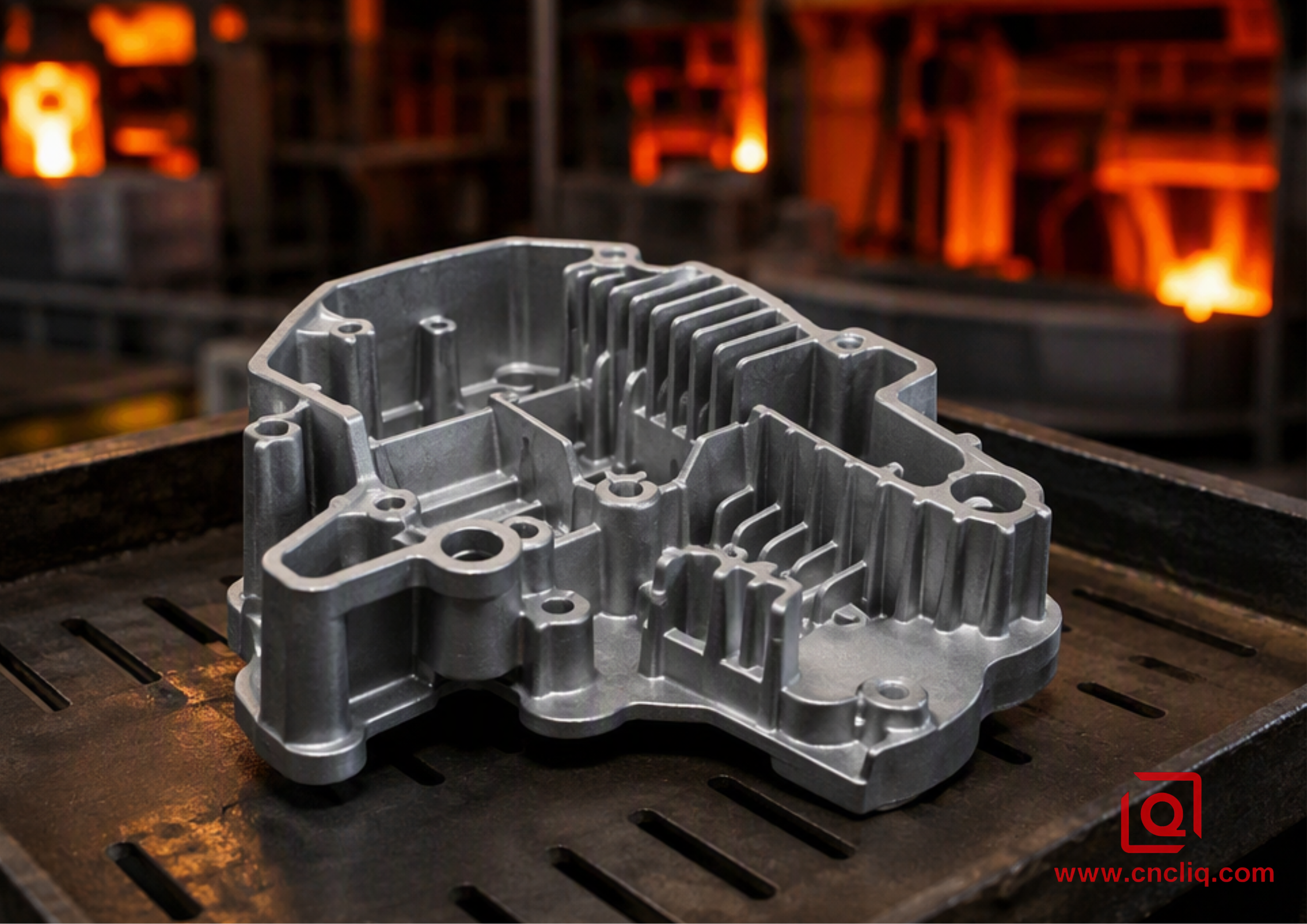
Foundries melt secondary aluminum ingots (silicon-heavy blends like A380 or ADC12) to roughly 660 to 700 degrees Celsius. A hydraulic shot sleeve forces the liquid alloy into an H13 steel tool at 40 to 60 meters per second under 30 to 100 MPa of intensifier pressure.
-
The Result: Excellent freedom for irregular webbing, internal heat fins, bosses, and thin walls down to 1.5 mm.
-
The Problem: Turbulent filling entraps shot-sleeve air and burned release agents in the melt. Under hydraulic pressure pulses or continuous vibration, these internal bubbles create leak paths and early fatigue tears.
Subtractive CNC Machining
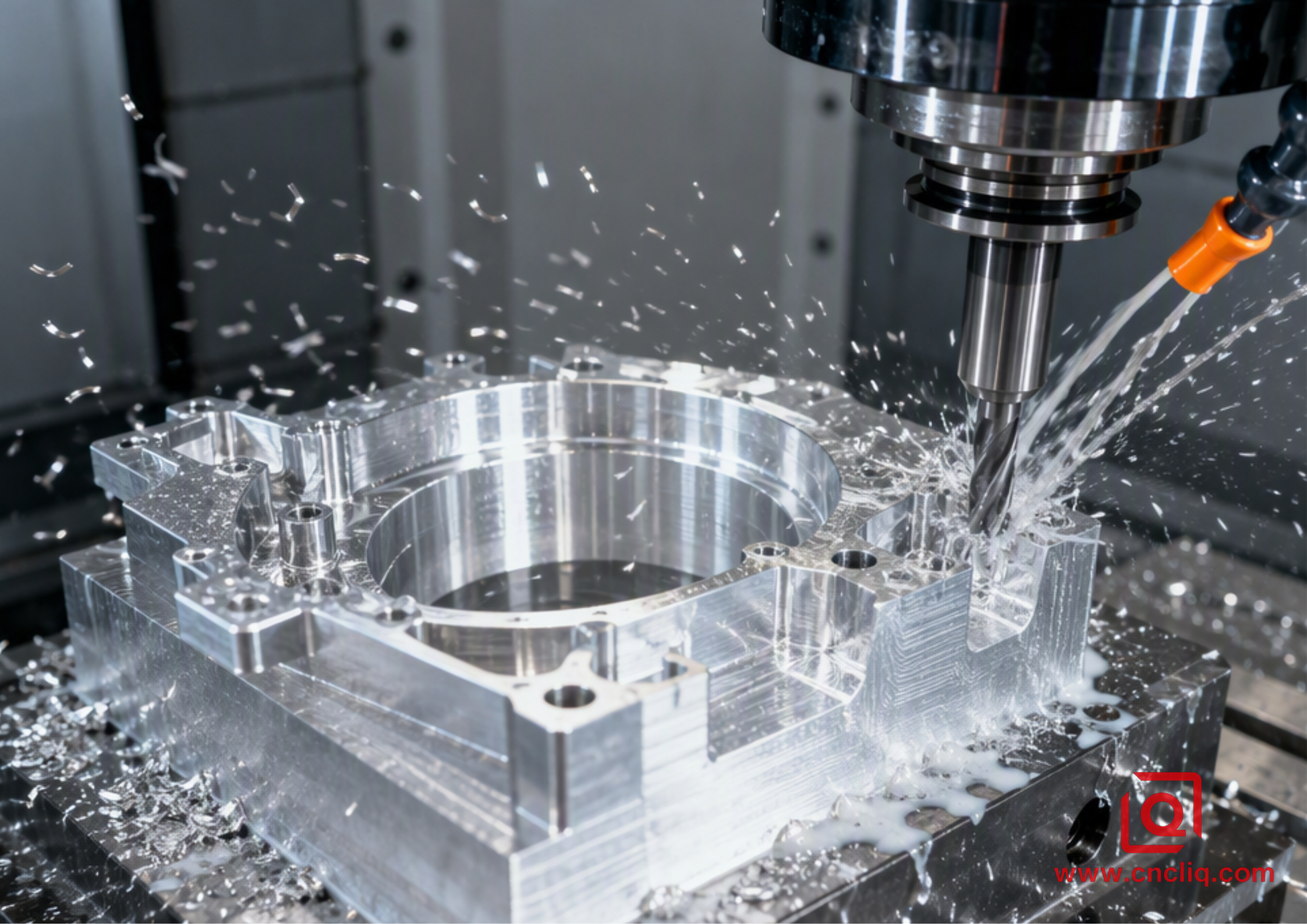
Operators mount extruded 6061-T6511 wrought bar in custom chucks on a mill-turn center. Carbide endmills spin between 8000 and 18000 RPM, clearing raw stock until the finished geometry emerges.
-
The Result: Tight bores holding 0.005 mm tolerances, crisp edges, and zero front-loaded tooling lead time.
-
The Problem: Deep hollow profiles turn 65 to 80 percent of expensive bar stock directly into chips, stretching spindle cycle times to 6 to 15 minutes per part.
Structural Reliability: Grain Fibers, Porosity, and Burst Strength
Datasheet tensile numbers mean very little once a housing holds hydraulic fluid or cycles under EV thermal loads. Long-term reliability comes down to internal microstructure.
Cold Extrusion (Continuous Flow)    Die Cast (Dendritic + Pores)    CNC Solid Billet (Cut Flow)
┌──────────────────────────────┐    ┌───────────────────────────┐   ┌───────────────────────────┐
│ ══════════════════════════ │    │  ·   ·   ○  ·   ·   ·   · │   │ ───────────────────────── │
│ ══════════════════════════ │    │ ·   ·   ·   ·   ○  ·   ·  │   │ ──────────── [Cut] ────── │
│ ═══════╗        ╔═════════ │    │  ·  ○   ·   ·   ·   ·   · │   │ ═══════╗        ╔════════ │
│        ║ Flow   ║          │    │         [Micro-porosity]    │   │        ║ Cut    ║         │
│        ║ Lines  ║          │    │                             │   │        ║ Lines  ║         │
└────────╨────────╨──────────┘    └─────────────────────────────┘   └────────╨────────╨─────────┘
Cold‑forming 6061 or 6082 preserves continuous metal grain flow along component sidewalls. This lets the workpiece withstand abrupt pressure surges and cyclic shock loads. HPDC operates under distinct mechanics: rapid solidification builds dendritic formations prone to gas entrapment and micro‑shrinkage voids. Parts fully processed via CNC machining originate from bar stock featuring uniform grain. Deep cavities and stepped geometries disrupt grain orientation instead, forming high‑stress zones near internal radii.
Process Comparison Matrix
| Parameter | Aluminum Cold Extrusion | High-Pressure Die Casting (HPDC) | Precision CNC (From Billet) |
| Material Grades | 1070, 6061, 6082, 7075 | A380, A383, ADC12, AlSi10Mg | 6061-T6, 7075-T6, 2024, 5083 |
| Material Utilization | 88 to 96 percent (Near-net) | 82 to 90 percent (Remelted runners) | 20 to 45 percent (High chip loss) |
| Primary Cycle Time | 2 to 6 seconds per stroke | 25 to 60 seconds per shot | 4 to 20 minutes per piece |
| As-Formed Tolerance | 0.03 to 0.08 mm | 0.10 to 0.25 mm | 0.005 to 0.02 mm |
| Surface Roughness (Ra) | 0.4 to 1.6 µm (Burnished) | 1.6 to 3.2 µm (Cast skin) | 0.8 to 3.2 µm (Cutter marks) |
| Internal Density | 100 percent dense; continuous fiber | Micro-porosity present (Class 1 to 4) | 100 percent dense; cut fiber |
| Anodizing Cosmetic Quality | Uniform, clean, bright finish | Dull grey, cloudy silicon patches | Uniform, clean, bright finish |
| Tooling Investment | 3500 to 15000 USD (Punch and die) | 15000 to 65000 USD (Steel mold) | 0 USD (Standard soft jaws) |
| Economic Batch Window | 3000 to 200000+ pcs/year | 10000 to 500000+ pcs/year | 1 to 2500 pcs/year |
Practical DFM Rules for Cold Extrusion
To keep punches from snapping and metal from shearing during high-tonnage runs, anchor your part prints to these five shop-tested rules:
-
Limit Extrusion Ratios: Figure your cross-sectional reduction from slug to finished wall. Hold this metric between 3.0 and 8.0 when cold-forming 6000-series alloys. Exceeding 10.0 spikes punch loads past 1800 MPa, grinding tooling down in short order.
-
Match Wall-to-Floor Proportions: Severe dimensional steps—such as pairing a 1.2 mm side with an 18 mm solid bottom—trigger uneven flow resistance that wrinkles or rips the can body. Aim for a wall-to-base thickness ratio of 0.6:1 to 1.5:1 instead.
-
Ease Entry Radii: Hard 90-degree steps throttle backward extrusion. Give internal corners at least 1.0 mm of radius and open die entry transitions to 1.5 mm or wider so material won't shear off mid-stroke.
-
Demand Proper Temper and Lubrication: Feed 6061 or 6082 blanks in fully dead-soft O-temper, prepped with zinc phosphate or reactive polymer soap. Post-forming, run solution heat treatment and precipitation hardening (soak at 530 degrees Celsius for 2 hours, quench into water in under 15 seconds, then age at 175 degrees Celsius for 8 hours) to hit yield and tensile ratings over 310 MPa.
-
Use the Extrusion + CNC Hybrid Approach: Let cold extrusion handle 90 percent of the bulk shape—cavities, stepped barrels, bottom drive hexes—in seconds. Then pass the raw shell to a high-speed lathe for a 30 to 50 second clean-up pass across thread surfaces and O-ring grooves.
Shop Floor Case Study: Automotive Sensor Housing
A Tier-1 fluid system supplier required an aluminum sensor enclosure (48 mm outer diameter, 40 mm bore, 85 mm depth, internal M38×1.5 thread, bottom external drive hex).
   Raw Billet Slug (Ø46mm x 32mm)
                 │
                 ▼  [1. Cold Extrusion Strike - 3.2s]
   Near-Net Cup (Ø48mm x 88mm, Wall 4mm)
                 │
                 ▼  [2. T6 Heat Treatment]
   Homogenized 6061-T6 Mechanical Matrix
                 │
                 ▼  [3. Secondary CNC Lathe - 42s]
   Final Product: Thread M38x1.5 + O-Ring Groove + Face Trim
The Original Process (Solid Bar CNC)
Turning and milling from solid 55 mm diameter by 95 mm 6061-T6 bar stock consumed 610 grams of raw material to yield a 138-gram housing. Spindle time ran 8 minutes and 45 seconds per piece. The shop converted 77.3 percent of the stock (472 grams) into scrap chips, driving unit costs to 6.85 USD over a 45000-piece annual program.
The Failed Foundry Run (ADC12 Die Casting)
Switching to cast ADC12 lowered raw cycle time, but the housing had to pass a 3.5 MPa helium leak-down test. Casting turbulence caused an 8.4 percent leak scrap rate near thread roots and sidewall cold shuts. To make matters worse, the silicon-rich alloy turned blotchy dark grey in the anodizing tank, failing cosmetic quality checks.
The Hybrid Fix (Cold Formed 6061 + CNC Lathe)
The engineering team switched to a cold-headed 6061 blanking setup:
-
Slug Preparation: 6061-O aluminum blanks are sheared and edge-chamfered, with a dimension of 46 mm in diameter and 32 mm in length, and a total weight of 146 grams.
-
Reverse Cold Extrusion: A 400-ton press completes one-shot stamping to shape the cup part. The finished part features a 3.8 mm-thick wall and integral bottom hex structure, with the whole process finished in 3.2 seconds.
-
Thermal Processing: Conventional T6 solution treatment and artificial aging are adopted to adjust material performance, delivering a yield strength of 275 MPa and tensile strength of 310 MPa.
-
Post CNC Machining: The finishing turning process is accomplished in one clamping operation within 42 seconds. This procedure machines the O-ring groove, trims the end face edge, and taps the M38×1.5 inner thread hole.
Cost Breakdown Comparison (Per Part at 45,000 Units/Year)
Pure CNC Machining:   ████████████████████ 6.85 USD
Die Casting (w/ scrap):████████████ 4.20 USD (High defect rate)
Cold Extrusion+CNC:   ███████ 2.95 USD (0% burst leaks)
Final piece costs dropped to 2.95 USD—a 56.9 percent cost reduction compared to pure CNC. Tooling expenses totaled 5800 USD for the punch and tungsten carbide die insert, fully amortized over the first 1500 parts. Across the entire 45000-unit run, helium leak scrap remained at 0.00 percent.
Sourcing Guide
Choose Pure Multi-Axis CNC When:
-
Annual production stays below 2000 units.
-
The geometry is asymmetric and lacks axial or planar balance.
-
The design expects frequent mid-run revisions.
-
True position and runout must hold tighter than 0.010 mm across multiple reference datums.
Choose High-Pressure Die Casting When:
-
Annual volume exceeds 15000 parts.
-
The geometry contains non-symmetrical mounting brackets, variable wall sections down to 1.5 mm, and deep cooling fins.
-
The part does not retain pressurized fluid, making micro-porosity harmless.
-
Exterior finishes rely on powder coating or e-coating rather than bright decorative anodizing.
Choose Cold Extrusion (or Cold Extrusion + CNC) When:
-
Annual volume is above 3000 parts.
-
The component is tubular, cup-shaped, cylindrical, or rotationally balanced.
-
Application requirements call for dense 6000 or 7000 series wrought strength with zero leak porosity.
-
The cosmetic specification requires clean, uniform anodizing.
-
You want to slash raw material chip waste by 50 to 75 percent compared to hogging out billet on a mill.
FAQs
1. Can high-strength 7000-series aluminum alloys (like 7075) be cold-extruded, or are we limited to 1000 and 6000 series?
Yes, 7075 forms cold, but your processing margin shrinks drastically compared to 6061 or 1070. The slug demands a full O-temper anneal paired with multi-layer conversion lube to dodge galling. You also need heavy corner radii on the punch so extreme stresses do not snap the tool steel. Punch and die wear climbs quickly; when running deep or tricky 7075 cup geometries, shops bump slug temps to 200 to 250 degrees Celsius (warm forming) to drop tonnage without trashing grain alignment.
2. How does the upfront tooling cost and lead time of cold extrusion compare directly with die casting?
Cold forming tooling is lighter on the budget and turns around quicker. Sinking a hardened tool steel punch alongside a carbide insert usually prices out at 3,500 to 15,000 USD, needing 3 to 5 weeks from drawings to first articles. Conversely, HPDC tooling involves complex slides, internal cooling, and knock-out pins—driving costs up to 15,000 to 65,000 USD while delivery stretches across 8 to 14 weeks.
3. Why does cold extrusion yield a cleaner anodized finish than high-pressure die casting? Silicon levels and void-free metal explain the difference. Die cast grades like A380 and ADC12 carry 9 to 12 percent silicon for melt fluidity in thin sections. That silicon resists sulfuric bath dissolution, muddying the part with a dull, splotchy gray film. Extrusion uses wrought bar (like 6061 or 6082) with minimal silicon and zero internal voids, hitting crisp, bright anodized color every pass.
4. What happens if our part has an asymmetrical side bracket or perpendicular mounting hole? Cold forming depends on symmetric radial flow, making off-center tabs or cross holes impossible during the downstroke. The go-to route is a two-step hybrid method: punch the symmetric can, body, or shell to near-net shape in 3 seconds, then drop it into a 4-axis or 5-axis CNC setup to cut the cross holes, flats, or side tabs.
5. How long do cold extrusion punches and carbide dies last before needing replacement? Keep your slugs annealed, apply zinc-phosphate soap, and hold extrusion ratios under 8.0, and solid carbide inserts hit 200,000 to 500,000 hits before drifting out of spec. Tool steel punches (like CPM-10V or Vanadis 4 Extra) usually see 50,000 to 150,000 cycles before fatigue or profile erosion forces a swap.
Summary
Picking the right path hinges on part geometry, batch size, and target specs. Multi-axis CNC fits short runs with irregular, freeform shapes where setup speed matters. High-pressure die casting rules massive runs of intricate parts, provided trapped air and subsurface voids are not a concern. For deep, round enclosures needing solid burst resistance, clean anodized cosmetic finishes, and rock-bottom piece-part pricing, run cold extrusion backed by quick secondary machining cleanups.
Contact Information
Disclaimer
All technical articles, material specifications, machining recommendations, and surface treatment details published on this blog are for informational and reference purposes only. Please note that general blog insights do not replace signed technical agreements. Because custom parts vary by material heat numbers, machine calibrations, and specific tolerances, binding quality specs are governed solely by your approved CAD drawings, signed contracts, and formal quality plans.
All customer case studies featured on this blog have been thoroughly anonymized and sanitized. The performance metrics, manufacturing workflows, and imagery displayed serve solely to demonstrate our custom machining capabilities and do not represent a single universal standard for all orders.
Liqin Manufacturing Team
Built on 18 years of precision engineering experience, Ningbo Liqin Industry manufactures high-tolerance metal components for demanding global markets. We operate out of a 6,500 m² production hub equipped with over 150 machines, running 4-axis and 5-axis CNC machining, mill-turn machining, cold extrusion, and pressure die casting under one roof. This setup allows us to manage projects seamlessly, taking parts from initial CAD concepts directly to finalized shipments.
We handle quality control with zero compromise. We treat tight tolerances with the engineering discipline they require. Backed by ISO 9001, ISO 13485, and IATF 16949 certifications, our QA engineers run strict IPQC, FQC, and OQC checks on every single production batch. From CMM dimensional mapping and optical profiling to hardness and salt-spray testing, we validate your critical specs upfront—so you receive drop-in ready components with zero assembly headaches or costly line stoppages. On top of manufacturing, you can rely on us for two-hour response times on new RFQs, direct support for prototype sampling, and smooth export shipping across Europe, North America, Asia, and Oceania.
Welcome your inquiries and samples. Visit our website or contact us directly for a competitive quote!