English




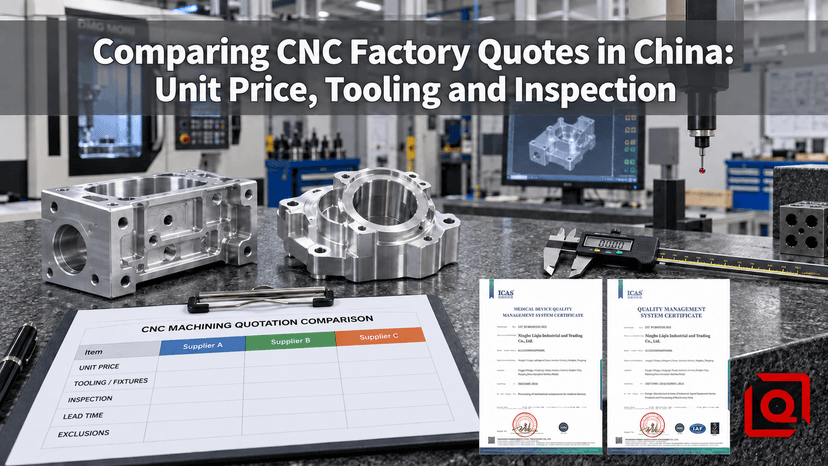
Short answer: do not rank CNC quotes by the unit-price column until every supplier is pricing the same revision, material, quantity, finish, tooling scope, inspection evidence, packaging and delivery basis. A quotation that looks cheaper may simply move setup, gauges, CMM reporting, outside processing or freight into a later charge. The best comparison is a normalized one: identical technical scope, separate non-recurring costs, explicit exclusions and a believable manufacturing-and-inspection plan.
When three China CNC machining suppliers receive the same drawing, three different prices are normal. One shop may plan two simple setups and standard hand-tool checks. Another may include custom soft jaws, a first-article report and CMM data. A third may quote only machining and leave anodizing, packaging or freight open. Those offers are not yet comparable, even if each supplier has answered the RFQ honestly.
From the shop floor, the price is the last line in a chain of decisions. Stock size drives material yield. Datums drive workholding. Pocket depth and tool access drive cycle time. Tolerances drive finishing passes and measurement. Quantity decides whether a quick flexible fixture or a more productive dedicated fixture makes sense. Your job as a buyer is to make that chain visible before you award the order.
If you are still building the enquiry package, start with our CNC machining RFQ checklist for China factory quotes. It explains the files and requirements that let suppliers price the same job. This article begins at the next step: comparing the quotations after they come back.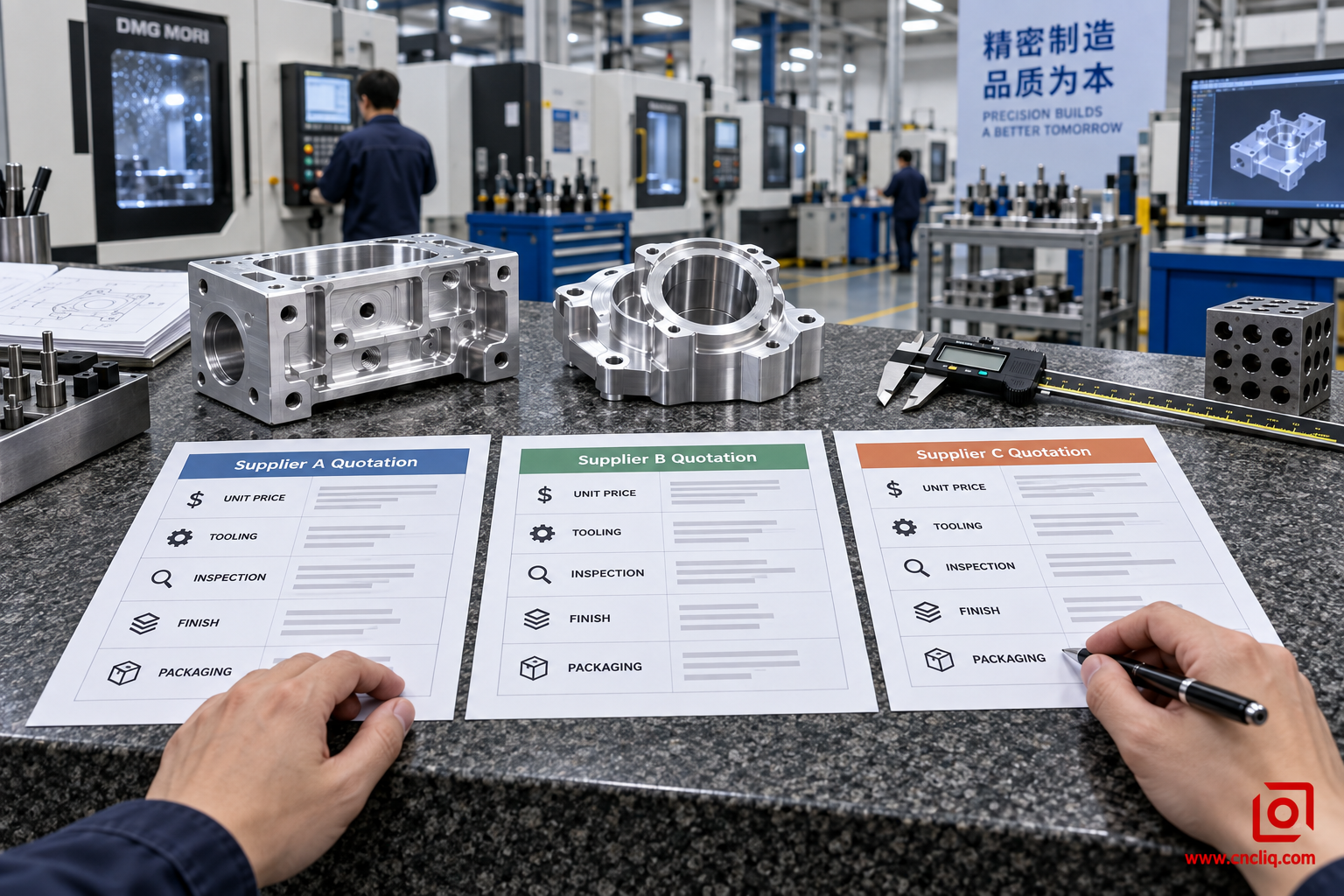
The quote-comparison matrix to build before choosing a supplier
Copy every offer into one worksheet. Do not copy only the total. Record the scope behind it and send one clarification round where entries are blank or different.
| Cost or risk block | What must match across quotes | What to ask when it is unclear |
|---|---|---|
| Part definition | Part number, drawing and CAD revision, units | Which file and revision did you price? |
| Material | Exact grade, condition, stock form, certificate | Is substitution allowed or assumed? |
| Quantity | Prototype, batch and annual-volume assumptions | Is setup amortized into each quantity break? |
| Unit price | Machining, deburring and included operations | Which operations are inside this number? |
| Tooling and fixtures | Soft jaws, fixtures, special cutters, gauges | Is the charge recurring, and who owns the tooling? |
| Finish | Process, specification, masking and cosmetic criteria | Is outside processing included and documented? |
| Inspection | Characteristics, frequency, method and report | Does inspection mean visual, sampling, FAI or full report? |
| Packaging | Protection, labels, cleanliness and export packing | Is individual protection included? |
| Delivery | Lead-time starting point, Incoterm and destination | Does lead time start at PO, drawing approval or material receipt? |
| Exclusions | Taxes, freight, duties, tests and certificates | What could become a change charge later? |
This matrix does more than make purchasing tidy. It exposes where a low CNC machining quote is based on a different assumption. It also gives the engineering team something concrete to review. If Supplier B proposes a simpler datum strategy or questions an inspection callout, you can decide whether the drawing should change before comparing price again.
Why the lowest unit price is often not the lowest project cost
Unit price usually combines raw material, machine time, direct labor, ordinary cutting-tool consumption, deburring, routine in-process checks, overhead and margin. But there is no universal rule about what stays inside that number. That is why price per part must be read with the scope notes beside it.
Material assumptions can change the starting line
Aluminum is not a complete buying description. Grade, temper, plate or bar form, certificate requirements and usable stock size all affect the quote. Two suppliers may choose different blank dimensions or machining allowances. Their material yield will differ before the first cutter enters the stock.
Ask the supplier to repeat the material callout in the quotation. If an approved equivalent is possible, request it as a separate option rather than allowing a silent substitution. For aluminum buyers, our guide to custom aluminum OEM parts, alloy selection and anodizing provides useful context for discussing grade and finish together.
Setup count can matter more than the machine’s hourly rate
A part with features on several faces may require multiple orientations. Each orientation brings loading, indicating, work-offset confirmation and a new chance for datum-transfer error. A supplier may quote conventional three-axis setups; another may use multi-axis positioning to reach more faces in one clamping. Neither route is automatically better. The right question is whether the route is stable for the geometry, tolerance and volume.
When a supplier proposes multi-axis machining, ask which relationships become easier to hold and how those features will be inspected. Our explanation of 3-axis versus 5-axis CNC machining can help a buyer distinguish a useful process choice from a machine-list sales pitch.
Tight tolerances create work outside the cutting cycle
An unnecessarily tight general tolerance can require more stable stock, careful roughing, extra finishing passes, tool-offset checks, temperature stabilization and longer final inspection. The cost response is rarely linear. Tightening one functional bore may be manageable; tightening every non-functional face may change the whole process plan.
ASME describes Y14.5-2018 (R2024) as the authoritative language for geometric dimensioning and tolerancing. In purchasing terms, consistent GD&T reduces interpretation gaps. Use datums and controls to communicate function, then ask each factory to state any interpretation or measurement concern. For more detail, see our CNC machining tolerances and cost guide.
Separate tooling, fixtures and gauges from recurring unit price
In CNC machining, tooling is an overloaded word. It may refer to ordinary end mills and inserts consumed during production, a special form cutter, machined soft jaws, a dedicated fixture, a checking fixture or a custom gauge. Those items behave differently commercially, so one tooling line is not enough.
Ordinary cutter wear is normally part of production cost. A special cutter purchased only for your geometry may be a non-recurring or project-specific charge. Soft jaws may be inexpensive to make but still carry setup and prove-out time. A dedicated fixture can improve loading repeatability or allow several parts per cycle, yet it also needs design, manufacturing, validation, storage and maintenance.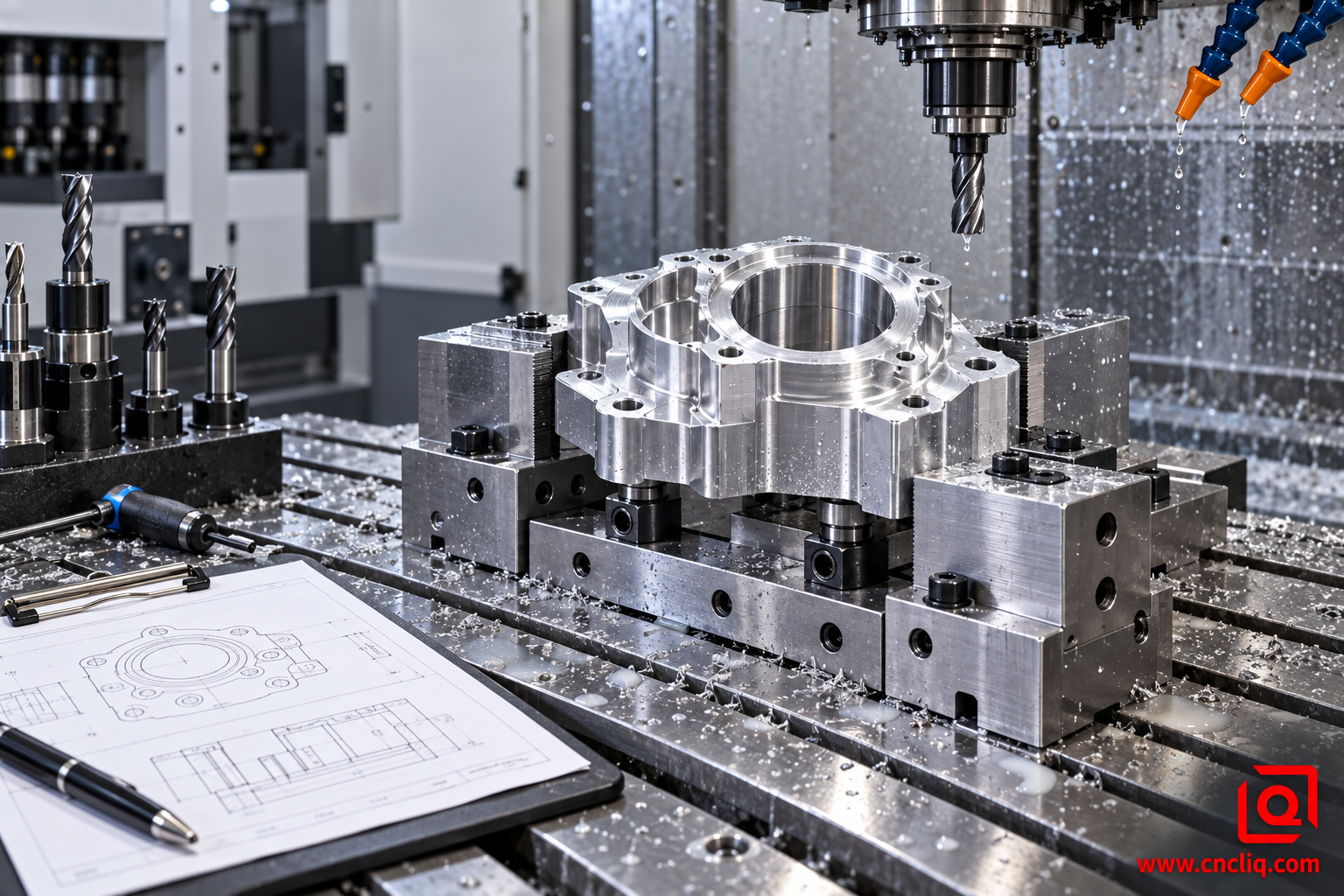
Ask five questions for every tooling or fixture charge:
- What physical item or engineering work does the charge cover?
- Is it paid once, repeated per batch or amortized into unit price?
- Who owns it after payment, and where will it be stored?
- What drawing revision and expected volume was it designed for?
- Who pays for wear, damage, modification, calibration or replacement?
This matters even for low-volume CNC machining in China. A flexible modular setup may be economical for ten pieces and inefficient for a repeat order. A dedicated fixture may increase launch cost but reduce future loading time and variation. Request two commercial options when volume is uncertain: a low-NRE prototype route and a production route with the fixture cost shown separately.
Do not assume no tooling charge means no tooling work. The supplier may have absorbed it into the unit price. That can be reasonable, but it changes the repeat-order comparison. If the next order is larger, ask whether the original unit price still carries launch cost that should now be removed.
Define inspection by evidence, not by a vague percentage
100% inspection sounds reassuring and tells you almost nothing. It could mean every part receives a visual check. It could mean every critical characteristic is measured. It could also mean every drawing dimension is reported, which is a much larger job. A serious CNC machining quotation should define what is checked, how often, with what method and what record travels with the shipment.
Separate four layers:
- In-process control: measurements used by the operator to keep the process centered.
- First-article verification: evidence that the planned process can produce the drawing requirements before full release.
- Production acceptance: the agreed frequency and method for critical and non-critical characteristics.
- Customer documentation: the ballooned drawing, dimensional report, CMM output, material certificate or special-process certificate you actually receive.
A CMM report is not automatically superior to a micrometer result. The measurement method must fit the feature, datum scheme, tolerance and access. Ask how the part will be aligned, which characteristics will be reported, and whether the measurement program has been reviewed against the controlled drawing.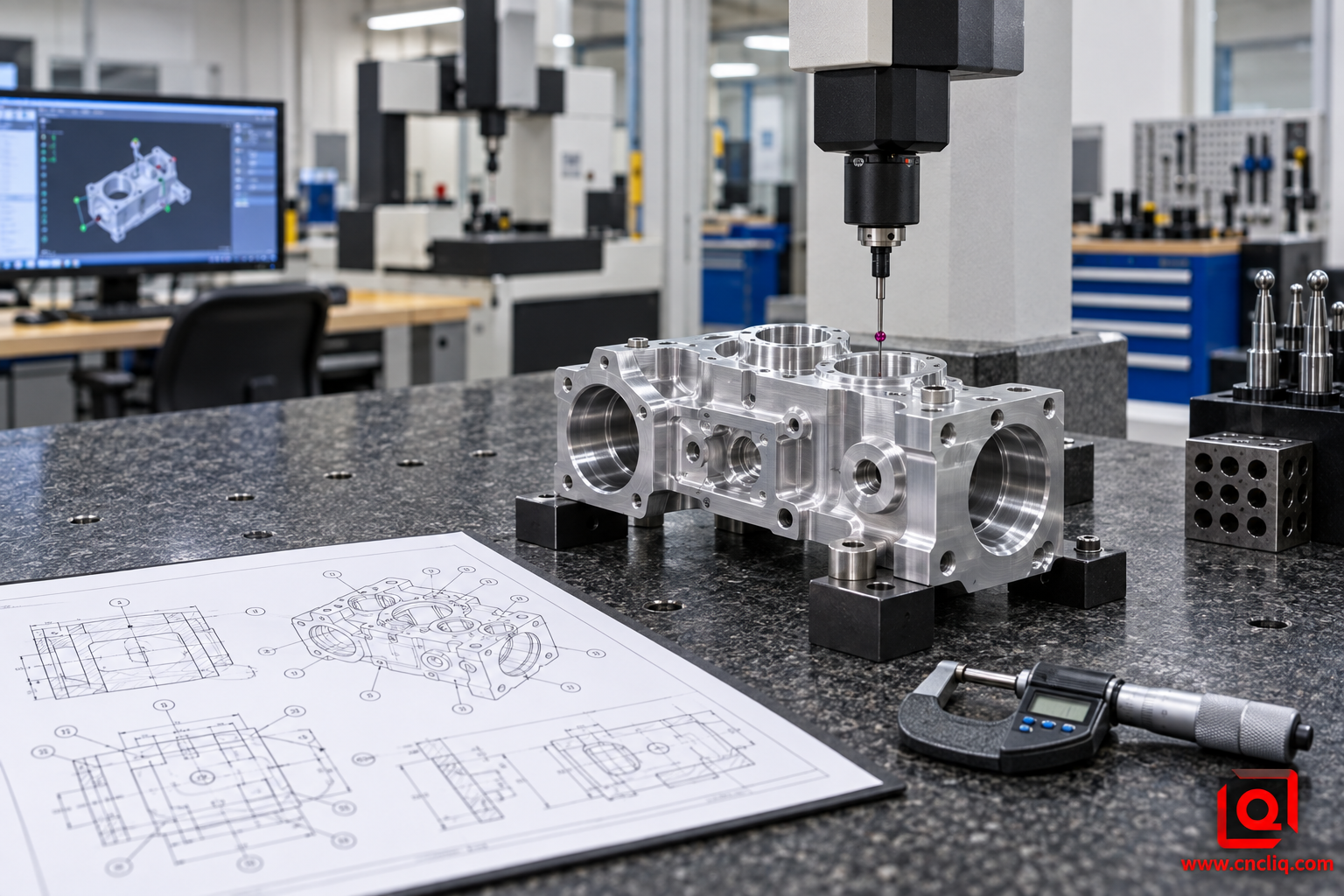
NIST’s metrological traceability guidance makes an important distinction: traceability belongs to a measurement result and depends on a documented, unbroken calibration chain; a calibrated instrument alone does not make every result traceable. For an RFQ, request calibration status and method where they affect acceptance, but avoid demanding paperwork that has no relationship to part risk.
For lot-by-lot attribute inspection, ISO 2859-1:2026 defines AQL-indexed sampling schemes. An AQL value by itself is incomplete. The RFQ should also define defect classes, inspection level, lot formation and how critical characteristics are treated. Dimensional process control and attribute acceptance sampling are not interchangeable.
Normalize landed cost and commercial risk
Once technical scope is aligned, compare the cost of receiving usable parts at your facility. The purchase price is only one component.
| Quote element | Supplier A | Supplier B | Supplier C |
|---|---|---|---|
| Recurring unit price at each quantity break | Record | Record | Record |
| One-time engineering, fixtures and gauges | Record | Record | Record |
| Material and process certificates | Included / excluded | Included / excluded | Included / excluded |
| Finishing and inspection reports | Included / excluded | Included / excluded | Included / excluded |
| Packaging and labeling | Included / excluded | Included / excluded | Included / excluded |
| Freight basis and Incoterm | Record | Record | Record |
| Quotation validity and requote triggers | Record | Record | Record |
| Technical exceptions and open questions | Record | Record | Record |
Avoid converting everything into one artificial score too early. A price gap is measurable; a weak answer about datum control is a technical risk that deserves engineering review. Keep cost, capability evidence and open risk as separate columns until the team has resolved the critical questions.
Also compare lead time on the same definition. One factory may count from purchase order. Another may count from drawing approval and receipt of material. Clarify whether the quoted time includes fixture prove-out, finishing, final inspection and transport. An optimistic date that excludes outside processing is not faster delivery.
A verified, anonymized product example: the quotation behind a manifold block
Liqin’s published precision aluminum manifold block is a useful real-product example because its features connect machining, workholding and inspection. The page describes a custom integrated manifold for fluid distribution and lists aluminum options including 6061-T6 and 7075-T6, with stainless or carbon steel alternatives for different environments. It also describes multi-face CNC machining and an inspection-led production route. The customer identity is not disclosed, so the example remains anonymous. The page does not publish order quantity, quoted price or savings; we do not invent them here.
How should a buyer compare quotes for this kind of part? First, confirm that every supplier prices the same material and finish. Next, ask how intersecting passages, sealing faces, threads and multi-face relationships will be machined and deburred. Then review whether the fixture locates from functional datums and whether the inspection method can verify the specified relationships. Finally, separate any dedicated fixture, special plugging or test requirement from the recurring unit price.
The useful lesson is not that one route always wins. It is that the quote must connect part features to a credible process. A low unit price without a deburring, cleaning and inspection story leaves too much risk unpriced. A higher offer with unexplained equipment names is not automatically better. The best quotation makes the logic reviewable.
Red flags when comparing a precision CNC machining factory in China
Watch for gaps rather than hunting for one dramatic warning sign.
- The quotation omits the part revision, material condition or quantity basis.
- The unit price is clear, but finish, inspection, packaging or freight is silent.
- Tooling appears as one lump sum with no ownership or recurrence terms.
- The supplier accepts every tolerance without a single technical question on a difficult drawing.
- A CMM is advertised, but no one can explain the datum alignment or report scope.
- Lead time has no starting event and does not mention outside processing.
- The legal entity, manufacturing site and invoicing entity are unclear.
- A requested certificate is promised, but the quotation does not name the document or covered process.
- Substitution is assumed rather than offered for written approval.
None of these automatically disqualifies a supplier. They trigger clarification. A capable factory may issue a short quote first and provide detail after engineering review. What matters is whether the answers become specific, consistent and documented before the purchase order.
The eight questions that turn quotations into an engineering comparison
Send the same questions to every shortlisted China CNC machining supplier:
- Please confirm the priced part number, revision, material condition, finish and quantities.
- What manufacturing route and setup count are assumed?
- Which tooling, fixtures, special cutters or gauges are project-specific?
- Which charges are non-recurring, and what remains in repeat-order unit price?
- Which drawing characteristics will be checked, at what frequency and by which methods?
- What reports and certificates are included with shipment?
- What is excluded, subcontracted or still subject to technical approval?
- What event starts lead time, and what changes would trigger a requote?
The answers do not need to expose confidential shop rates. They need to show that the supplier has read the drawing and can explain the scope. If you want Liqin’s engineering team to review a real comparison, send the controlled 3D CAD, 2D drawing, quantities, material and finish, then include the competing scope rows with supplier names removed. We can respond to manufacturing questions without needing another factory’s identity.
Make the award decision on total clarity, not presentation polish
A polished PDF is not a process plan. A long machine list is not inspection evidence. And the cheapest unit price is not a saving until conforming parts arrive, assemble and repeat reliably.
Choose the offer that gives your team the clearest controlled baseline: same revision, complete inclusions, sensible workholding, inspection tied to drawing risk, separated non-recurring cost and realistic delivery terms. If two quotations remain close, place more weight on the supplier’s technical questions and change-control discipline. Those behaviors often reveal how the factory will respond when production meets an unexpected edge condition.
Ready for a quote that is easier to compare? Send Liqin your CAD model, controlled drawing, target quantities, material, finish, critical characteristics, report needs and destination through our contact page. Ask us to separate recurring unit price, tooling or fixture charges, inspection documentation and logistics assumptions. That makes the first conversation more useful for both engineering and purchasing.
FAQ
1. Why can CNC factory quotes from China vary so much for the same drawing?
The suppliers may not be pricing the same process assumptions. Differences in stock size, material condition, setup count, fixture strategy, tool access, finishing, inspection evidence, packaging, volume and Incoterm can all change the result. Normalize those items first; only then does the unit-price comparison become meaningful.
2. Should tooling cost be included in the CNC unit price?
Routine cutting-tool consumption is commonly absorbed into production cost, while a special cutter, soft jaws, dedicated fixture or custom gauge may be shown separately. Either structure can work if it is transparent. Then get the commercial detail in writing: is it a one-off or recurring charge? Note the owner of the item, too, and check whether launch work is still buried in repeat pricing.
3. When is a full CMM report worth paying for?
Not always. The appropriate evidence depends on drawing risk, feature type, tolerance, process stability, regulatory needs and the cost of failure. Define the critical characteristics, measurement method, frequency and report format. A focused, traceable inspection plan can be more useful than a large report that measures non-critical dimensions without a clear acceptance purpose.
4. How do I compare a low prototype price with a production quotation?
Keep prototype and production intent separate. A prototype route may use flexible workholding and more operator time, while production may justify dedicated fixtures, tool-life control and different loading. Request realistic quantity breaks and show non-recurring charges separately so you can see when the process changes rather than extrapolating a one-piece price.
5. What should I send to receive a firm CNC machining quote from China?
Send the controlled 3D model and 2D drawing, part and revision identity, exact material and condition, requested quantities, finish, critical dimensions and GD&T, inspection and certificate needs, packaging, destination, Incoterm preference and target date. Mark unknowns openly and state which file governs if CAD and drawing information differ.
Summary
Put every offer on the same technical and commercial footing before you rank the prices. Match the revision, material, quantity, finish and delivery terms. Pull one-time tooling and gauges out of repeat pricing, and write down exactly what inspection evidence will arrive. The winning quote should leave you with a process you can understand, costs you can repeat, and far fewer surprises after the purchase order.
Contact Information
Company: Ningbo Liqin Industry Co., Ltd.
Daily customer maintenance & after-sales support:service@shturl. zhuwanying@cncliq.com
New inquiry, quotation & order discussion:business@shturl. zhouli@chinaliqin.com
Hotline: +86 18757148656
Disclaimer
All technical articles, material specifications, machining recommendations, and surface treatment details published on this blog are for informational and reference purposes only. Please note that general blog insights do not replace signed technical agreements. Because custom parts vary by material heat numbers, machine calibrations, and specific tolerances, binding quality specs are governed solely by your approved CAD drawings, signed contracts, and formal quality plans.
All customer case studies featured on this blog have been thoroughly anonymized and sanitized. The performance metrics, manufacturing workflows, and imagery displayed serve solely to demonstrate our custom machining capabilities and do not represent a single universal standard for all orders.
Liqin Manufacturing Team
Built on 18 years of precision engineering experience, Ningbo Liqin Industry manufactures high-tolerance metal components for demanding global markets. We operate out of a 6,500 m² production hub equipped with over 150 machines, running 4-axis and 5-axis CNC machining, mill-turn machining, cold extrusion, and pressure die casting under one roof. This setup allows us to manage projects seamlessly, taking parts from initial CAD concepts directly to finalized shipments.
We handle quality control with zero compromise. We treat tight tolerances with the engineering discipline they require. Backed by ISO 9001, ISO 13485, and IATF 16949 certifications, our QA engineers run strict IPQC, FQC, and OQC checks on every single production batch. From CMM dimensional mapping and optical profiling to hardness and salt-spray testing, we validate your critical specs upfront—so you receive drop-in ready components with zero assembly headaches or costly line stoppages. On top of manufacturing, you can rely on us for two-hour response times on new RFQs, direct support for prototype sampling, and smooth export shipping across Europe, North America, Asia, and Oceania.
Welcome your inquiries and samples. Visit our website or contact us directly for a competitive quote!