 English




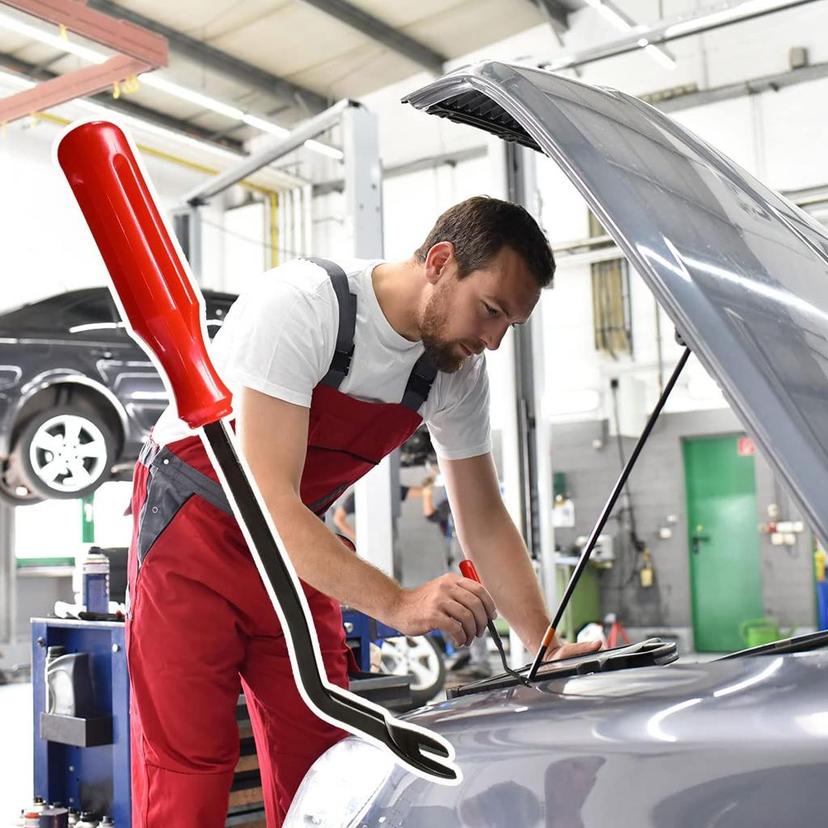

Professional Tools vs Hand Removal: Which Is Better for Automotive Clip Disassembly?
In workshops worldwide, clips are often removed quickly—sometimes too quickly. A flat screwdriver. A pair of pliers. Even bare hands. Minutes saved during removal may later result in loose panels, broken retention legs, or enlarged mounting holes.
Many installers assume removal method does not affect long-term performance. In reality, improper disassembly can reduce retention strength by 10–25% due to micro-deformation of the clip or distortion of the panel hole.
At QEEPEI, we frequently analyze failure cases where clip integrity was compromised during removal. As a professional Automotive Clips manufacturer, we understand that correct disassembly technique is part of fastening reliability.
How Clip Structure Reacts to Removal Stress
Automotive clips rely on elastic deformation. The retention legs compress when inserted and expand once seated. During removal, force must reverse that deformation without exceeding elastic limits.
Critical structural variables include:
- Barb angle (typically 12°–18°)
- Elastic recovery capacity
- Shaft wall thickness
- Polymer modulus (PA66 ≈ 2.8 GPa)
- Maximum recommended deformation angle
If removal force is concentrated at a single point, bending stress may exceed elastic recovery limits. Even if no crack is visible, internal stress whitening indicates partial structural fatigue.
According to SAE discussions on polymer fastener durability (https://www.sae.org), uneven removal force distribution increases long-term vibration failure risk.
Removal is mechanical engineering—not a casual action.
Professional Trim Tools: Controlled Force Distribution
Professional trim removal tools are designed to distribute load evenly across the clip head.
Advantages include:
- Bilateral lifting force
- Reduced hole ovalization
- Controlled extraction angle
- Lower panel surface damage
- Higher clip reuse rate
Laboratory pull-out testing shows that clips removed with fork-style trim tools retain approximately 90–95% of original retention strength when reused.
By contrast, screwdrivers concentrate force at one edge, increasing risk of shaft distortion.
An experienced Automotive Clips manufacturer considers removal stress during product design—but correct tools are still essential.
Manual Removal: Speed vs Structural Risk
Manual removal methods vary:
- Screwdriver prying
- Pliers twisting
- Direct pulling
While faster in some cases, manual removal increases:
- Panel hole enlargement (up to +0.3 mm)
- Clip leg overstretching
- Head surface cracking
- Paint damage
In vibration-sensitive areas such as door panels, even minor hole expansion can reduce retention force by 15–20%.
Cost savings during removal often translate into later rework costs.
Detailed Performance Comparison
| Factor | Professional Tool | Manual Removal |
|---|---|---|
| Force Distribution | Even bilateral | Concentrated point |
| Panel Hole Deformation | <0.05 mm typical | Up to 0.3 mm |
| Clip Reuse Rate | 85–95% | 60–75% |
| Surface Damage Risk | Low | Moderate–High |
| Long-Term Retention Stability | High | Reduced |
| Average Removal Time | 8–12 sec | 5–10 sec |
Time difference is minimal. Structural difference is significant.
Why Manufacturing Expertise Matters in Service Handling
At QEEPEI, our engineering team designs clips with:
- Balanced elastic recovery
- Controlled barb geometry
- Dimensional tolerance ±0.02–0.03 mm
- Moisture-controlled polymer processing (<0.2%)
- IATF 16949 certified quality systems
(https://www.iatfglobaloversight.org)
As a global Automotive Clips manufacturer, we also provide removal and installation guidance to distributors to minimize misuse-related failures.
Tooling discipline supports product longevity.
Real Case: Fleet Workshop Damage Reduction
A regional maintenance provider reported recurring interior trim noise after service operations.
Investigation revealed:
- Manual screwdriver removal
- Hole diameter increased by 0.2–0.3 mm
- Retention strength reduced from 210 N to 170 N
After switching to professional trim tools:
- Panel deformation reduced by 80%
- Clip reuse reliability improved
- Repeat service complaints decreased by 65%
The change required minimal investment—yet delivered measurable performance improvement.
When Manual Removal May Be Acceptable
Manual removal may be tolerable when:
- Clip is single-use only
- Panel replacement is planned
- Non-structural decorative trim
However, for reusable fastening systems, controlled extraction is recommended.
Professional tools protect both the clip and the mounting interface.
FAQ
Q: Can clips always be reused after removal?
A: Only if elastic deformation limits were not exceeded. Tool-assisted removal increases reuse reliability.
Q: Does hole damage affect retention?
A: Yes. Even +0.2 mm enlargement may reduce pull-out strength significantly.
Q: Are professional trim tools expensive?
A: No. Most tool sets are low-cost compared to panel repair expenses.
Conclusion
Professional removal tools provide controlled force distribution, protect panel tolerances, and preserve clip integrity. Manual removal may appear faster but increases structural risk.
An experienced Automotive Clips manufacturer understands that fastening performance depends not only on material and design—but also on service handling discipline.
At QEEPEI, we combine engineering-grade clip production with practical field guidance to ensure stable retention across installation and maintenance cycles.
Explore our clip catalog:
https://www.cnclip.com/
For bulk supply or technical consultation:
https://www.cnclip.com/contact-us/