English



Product Description
| thing | describe |
|---|---|
| Design/Size | According to customer's drawings or samples |
| Material | Aluminum: 6061, 6063, 6082, 7075, 5052, A380, etc.
|
| process | CNC machining, turning, milling, stamping, turning, cutting, etc. |
| Delivery time | Samples usually take 3-7 working days, and mass production will be carried out according to the detailed quantity after sample approval. |
| Surface treatment | Transparent anodizing, color anodizing, chemical coating, brushing, passivation, polishing, chrome plating, sandblasting, laser engraving, zinc plating, black oxide, nickel plating, chrome plating, carburizing, heat treatment, painting |
| Test equipment | Coordinate measuring machine (CMM), 2D measuring instrument, projector, altimeter, micrometer, thread gauge, hardness tester, caliper, pin gauge, salt spray tester, concentricity measuring instrument, spectrometer. |
| Quality Management System | ISO 9001:2015
|
| application | Auto parts, machinery parts, computer parts, medical parts, home appliance parts, electrical parts, electronic product parts, electronic parts, generator parts, alternator parts, generator parts, stationery, power switches, micro switches, construction, merchandise and A/V equipment. |
| File Format | Solidworks, Pro/Engineer, CAD, PDF, JPG, DXF, IGS |
| Package | Inner plastic bag, outer standard carton, or as per customer's requirements |
| Shipping | Sea freight, air freight, international express (DHL, FedEx, TNT, UPS). |
| Serve | The professional foreign trade team provides enthusiastic and fast response services.
|
Stainless Steel Pool Filter Clamp Bolt
A stainless steel fastener for segmented clamps on serviceable swimming pool filter tanks.
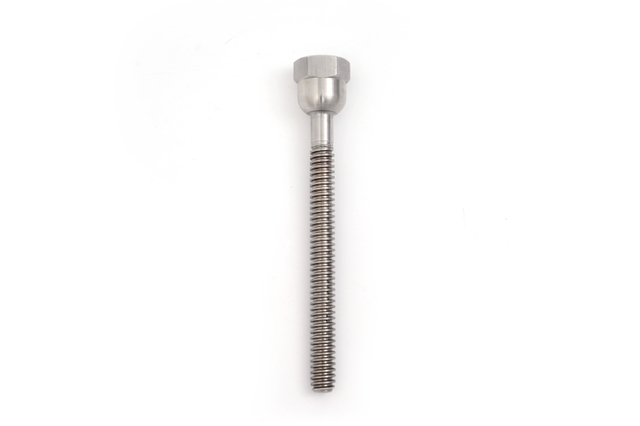
A pool filter clamp bolt draws together the ends of the segmented ring that holds the lid and lower body of a swimming pool filter tank together. It works with the clamp’s mating nut and associated hardware. The ring provides the mechanical closure, and the tank’s O-ring forms the seal at the joint. This bolt has an external hex head, a rounded shoulder, a short unthreaded neck and a long ACME thread. The drawing calls for a 3/8-12 ACME thread, and the nominal overall length is approximately 125.3 mm.
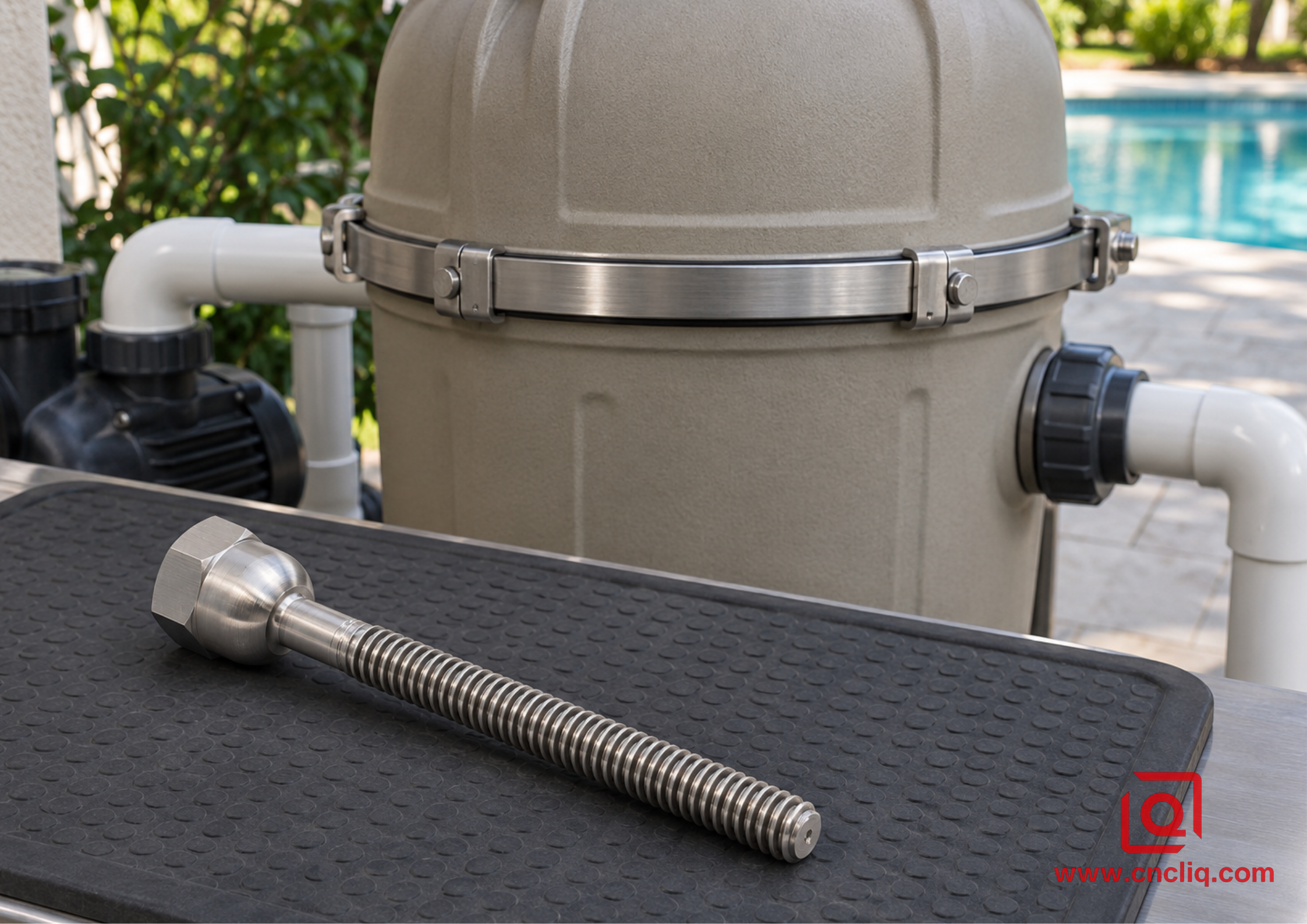 Application illustration showing a clamp bolt beside a swimming pool cartridge filter.
How the bolt works in the clamp
As the hex head turns, the threads advance through the mating nut and draw the clamp ends together. The long threaded section provides travel within the assembly’s designed range. The shoulder and neck establish the transition from the drive head to the working shank, so their dimensions matter for seating and clearance. Keeping the thread axis aligned with the mating hardware helps limit interference as the clamp closes.
For a pool filter clamp bolt, thread engagement is only one part of fit. The wrench still needs room to turn the head, and the smooth neck must pass through the mating hardware without catching. The rounded transition belongs to the shape of the original design and is worth reproducing when the clamp is made to drawing. For an equipment manufacturer, reviewing these features on the actual clamp can reveal clearance issues that would be easy to miss on the bolt drawing alone.
Stainless steel for pool equipment
Filter clamps often sit outdoors or in humid equipment rooms, where the bolt can encounter splashes, condensation and repeated wetting and drying. This design uses 316-series austenitic stainless steel. Its molybdenum content helps resist localized corrosion in chloride-bearing environments. Keeping the exposed surfaces in good condition helps preserve the wrench flats and usable threads through routine maintenance. Actual corrosion performance depends on exposure, including water chemistry, temperature, deposits and whether moisture can drain away.
Material control starts with the purchase specification. The order should identify the exact stainless grade on the approved drawing, especially where 316 or 316L certification is required. When a project calls for documented traceability, the supplier and buyer should agree on the material records that accompany each batch. Surface condition matters as well. Residue at the shoulder or in the thread roots can hold moisture or interfere with inspection, so the manufacturing route includes cleaning before packaging.
From prepared blanks to finished bolt
Production starts by preparing the hex head blank and the round shank separately. The documented route uses friction welding to join them. CNC facing and turning after joining establish the end faces, form the rounded shoulder and smooth neck, and bring the shank to its required profile. Centerless grinding controls the diameter of the designated shank section as part of preparation for the finished thread. See Liqin’s CNC turning guide for examples of how facing, profiling and diameter control work together.
The finished ACME thread has a trapezoidal profile that must match the nut specified for the clamp. The usable thread length, lead-in and surface condition affect how the parts engage. On a long, slender shank, alignment and dimensional consistency matter because a small change in the shaft or shoulder can shift the thread relative to the intended seating position. A related shop example is Liqin’s precision stainless steel stepped shaft, which illustrates how a turned shoulder and adjacent diameters serve distinct assembly functions.
A long threaded reach makes the working portion of the shank especially important. During production, checking the diameter at several locations along the shaft helps assess consistency. They help detect variation that an isolated measurement near the head would miss. Consistent measurements before thread finishing also give production staff a basis for tracing any change in the finished part back to the relevant machining step. The approved drawing remains the reference for how each finished feature is accepted.
Quality checks that support fit
The inspection plan follows the way the bolt works. Dimensional checks cover the head and its wrench flats, the shoulder and shank, and the overall length. Thread verification focuses on whether the finished thread meets its specified profile and can engage the approved mating component through the required travel. A visual check looks for burrs, damaged thread starts and handling marks that could affect fit. Protecting the thread during packing helps preserve the condition verified at final inspection.
The documented quality route also specifies a torque check on every finished bolt, with the head-to-shank transition examined for deformation or fracture. That is a factory acceptance check. Service technicians should use the equipment manufacturer’s instructions for the complete clamp and filter assembly. For OEM projects, the inspection plan can state which dimensions and test results are recorded and what documentation is supplied with the shipment. See Liqin’s custom precision manufacturing guide for more on defining those acceptance records.
Where it is used and why it matters
The primary application is the external closure clamp on compatible swimming pool cartridge or diatomaceous earth filters. A residential pool owner may encounter this hardware when a technician opens the tank for routine filter cleaning. Service teams for hotels, clubs and managed pools may keep approved clamp assemblies available for recurring maintenance on the same equipment models. In both settings, the bolt has to engage predictably after the filter has been serviced and the clamp has been checked.
The value of a pool filter clamp bolt comes from how closely it fits the rest of the closure hardware. The hex head gives the technician a defined wrenching surface. The shoulder and neck suit the space around the clamp ends, and the thread provides controlled adjustment against the matching nut. For filter manufacturers and service-parts suppliers, that combination helps reduce fit-related rework and makes stocking easier when parts are ordered against a verified clamp revision.
The same design approach can support custom fasteners for similar serviceable housings, including some spa filtration equipment. A new application requires its own review of nut engagement, shoulder clearance, material exposure and assembly loads. Providing the mating components or a drawing of the clamp ends helps the manufacturer assess those details before approving a sample.
For maintenance programs, a pool filter clamp bolt is best specified alongside its mating nut and the applicable clamp revision. If a nut is worn or the ring has been damaged, sourcing a bolt alone may leave the original fit problem unresolved. For new production, an approved sample assembled with the mating parts gives engineering, purchasing and inspection teams a common reference. That shared reference is particularly useful when orders repeat across seasons or several sites stock parts for the same equipment.
FAQs
What does a pool filter clamp bolt do?
It tensions the segmented ring around the joint between the lid and lower tank body. The bolt acts through the mating nut and clamp hardware, while the O-ring seals the joint. The bolt is one part of the complete closure assembly.
Can this bolt fit any pool filter clamp?
Compatibility depends on the filter model and clamp revision, the exact thread, the head and shoulder dimensions, and the matching nut. Verify the complete closure assembly against the equipment manufacturer’s parts information. For service work, follow the manufacturer’s instructions for depressurizing, inspecting and reassembling the filter.
What should I provide for a custom order?
Send the approved drawing and revision, the required stainless grade, the thread and mating-nut specifications, and the intended operating environment. Include your order quantity and any requirements for material certificates, dimensions, functional checks and packaging. For an existing design, a sample clamp and nut can help confirm the fit against the drawing.
TEL: +86 187 5714 8656
Email: zhouli@chinaliqin.com
WhatsApp:+86 187 5714 8656
Website:https://www.cncliq.com/