English



Product Description
| thing | describe |
|---|---|
| Design/Size | According to customer's drawings or samples |
| Material | Aluminum: 6061, 6063, 6082, 7075, 5052, A380, etc.
|
| process | CNC machining, turning, milling, stamping, turning, cutting, etc. |
| Delivery time | Samples usually take 3-7 working days, and mass production will be carried out according to the detailed quantity after sample approval. |
| Surface treatment | Transparent anodizing, color anodizing, chemical coating, brushing, passivation, polishing, chrome plating, sandblasting, laser engraving, zinc plating, black oxide, nickel plating, chrome plating, carburizing, heat treatment, painting |
| Test equipment | Coordinate measuring machine (CMM), 2D measuring instrument, projector, altimeter, micrometer, thread gauge, hardness tester, caliper, pin gauge, salt spray tester, concentricity measuring instrument, spectrometer. |
| Quality Management System | ISO 9001:2015
|
| application | Auto parts, machinery parts, computer parts, medical parts, home appliance parts, electrical parts, electronic product parts, electronic parts, generator parts, alternator parts, generator parts, stationery, power switches, micro switches, construction, merchandise and A/V equipment. |
| File Format | Solidworks, Pro/Engineer, CAD, PDF, JPG, DXF, IGS |
| Package | Inner plastic bag, outer standard carton, or as per customer's requirements |
| Shipping | Sea freight, air freight, international express (DHL, FedEx, TNT, UPS). |
| Serve | The professional foreign trade team provides enthusiastic and fast response services.
|
A Purpose-Built Shaft for Clean, Reliable Motion
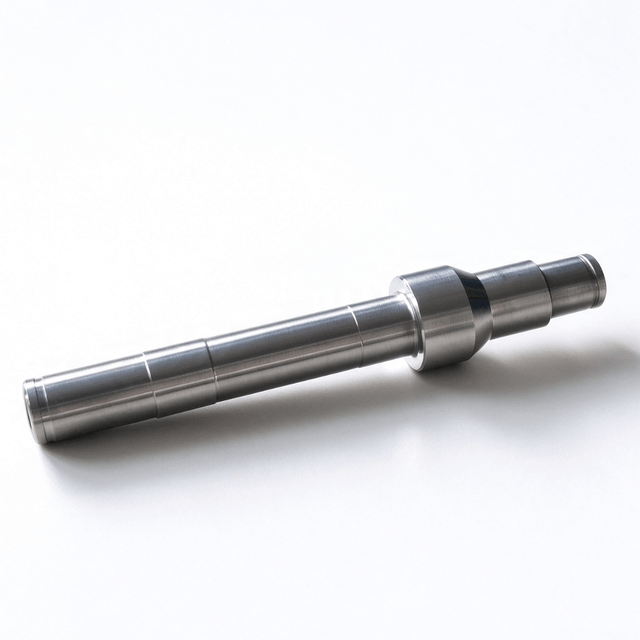
This precision stainless steel stepped shaft is a compact mechanical element designed to locate, support, and transmit controlled rotary motion. Its geometry combines a long cylindrical journal, short stepped journals, a pronounced locating collar, chamfered transitions, and retaining-ring grooves near the ends. Those features strongly suggest use as a roller spindle, pivot shaft, locating shaft, or light-duty drive shaft in automated machinery.
The most likely application field is hygienic food, beverage, pharmaceutical, or packaging equipment. In these machines, a shaft may pass through sealed bearings, support a guide roller, locate a movable arm, or transfer low-to-moderate torque while enduring repeated washdown and long production cycles. The simple external profile also suits industrial automation, pump accessories, inspection equipment, and other assemblies that need repeatable coaxial motion without a bulky coupling system.
For buyers developing a similar component, CNCliq provides drawing-based custom manufacturing rather than a fixed off-the-shelf configuration. Diameter, length, fit, hardness, surface condition, and inspection requirements can therefore be matched to the actual bearing, bushing, seal, roller, or housing used in the customer's assembly.
Material: 3Cr13 Martensitic Stainless Steel
The shaft is specified in 3Cr13, a martensitic stainless steel commonly selected for shafts, valve parts, wear components, and mechanical hardware. Its chemistry typically contains about 0.26-0.35% carbon and 12.0-14.0% chromium. This balance gives the alloy a useful combination of corrosion resistance, hardenability, strength, and wear behavior.
Compared with an unhardened low-carbon steel shaft, 3Cr13 offers better resistance to moisture, cleaning fluids, and mild process exposure. Compared with an austenitic stainless grade chosen mainly for corrosion resistance, it can be heat treated when greater surface hardness or journal durability is required. The final condition should always follow the approved drawing: a shaft for a lightly loaded guide roller may prioritize machinability and dimensional stability, while a shaft running against a bushing may require a controlled heat-treatment route and a harder bearing surface.
Material identity is only the beginning of quality. Production should be tied to a material certificate or an agreed incoming-inspection plan. Heat number, composition, stock diameter, straightness, and surface condition can be recorded when traceability is important. Any passivation, polishing, heat treatment, or protective packaging should be defined together because each step can affect appearance, dimensions, or corrosion performance.
Geometry That Supports Assembly Function
The enlarged collar is the functional center of the design. It provides a positive axial locating face, distributes thrust into a bearing or spacer, and helps an assembler place the shaft at the correct depth. The chamfered transition reduces sharp-edge damage during installation and creates a more gradual change in section than an abrupt square shoulder.
The long journal provides the working span for a roller, bushing, bearing, or guided component. Shorter journals at the opposite side can fit a second bearing, spacer, coupling, or retaining element. Fine grooves near the ends allow a circlip or retaining ring to secure the shaft without a threaded nut. This keeps the assembly compact and makes maintenance faster.
Because several diameters share 1 central axis, coaxiality, runout, straightness, and shoulder perpendicularity matter more than cosmetic shine alone. A journal may meet its diameter limit and still create vibration if it does not run true to the locating diameter. For a critical bearing seat, a drawing may call for a fit tolerance near ±0.01 mm or a controlled runout value; a less critical spacer diameter may use a wider tolerance. Requirements should follow the load, speed, mating part, and inspection method rather than applying the tightest limit everywhere. CNCliq's guide to CNC machining tolerances and cost explains why selective tolerancing is normally more economical than over-controlling every surface.
Controlled CNC Turning Process
Manufacturing begins with verified round bar cut to a controlled blank length. The process engineer reviews the 3D model and the revision-controlled 2D drawing, identifies the functional datum axis, and determines which diameters and shoulders should be finished in the same clamping. This planning step is essential because every unnecessary re-clamping event can introduce another small locating error.
The usual route includes facing and center preparation, rough turning, semi-finishing of the stepped profile, finish turning of the critical journals, controlled chamfering, and precision grooving for the retaining rings. Tool paths and stock allowance are balanced so that the long journal remains straight after material removal. Sharp tools, stable workholding, suitable coolant, and measured tool-life limits help prevent taper, chatter, work hardening, or torn surfaces.
If the shaft needs additional flats, holes, or slots, a live-tool or turn-mill platform can keep those features related to the turned axis. The live-tooling guide for CNC lathes gives useful context for deciding when integrated turning and milling reduce handoffs. For a purely rotational version, a well-planned CNC turning route is usually the most direct and economical solution.
After machining, edges are deburred without rounding functional shoulders or damaging retaining-ring grooves. Parts are cleaned to remove chips, abrasive particles, and residual coolant. Depending on the drawing, final finishing may include polishing, cylindrical grinding, passivation, or heat treatment followed by finish grinding. Bearing or seal journals can be produced to a smoother texture, such as Ra 0.8-1.6 µm, when the mating system requires it; this is a drawing-specific target, not a universal specification. 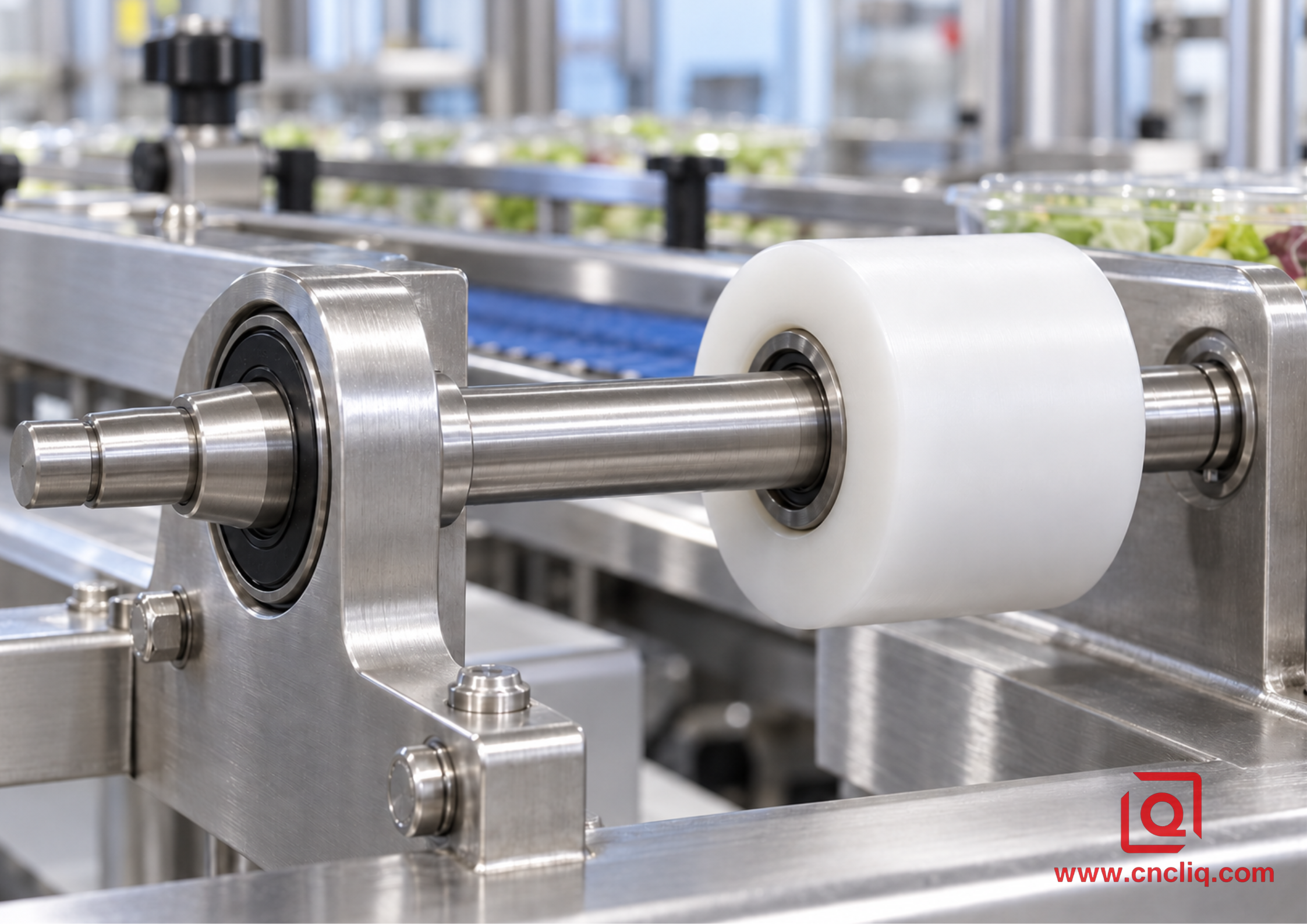
Application concept: a precision stainless steel shaft supporting a food-grade guide roller in hygienic packaging equipment.
Quality Assurance Focused on Function
A reliable inspection plan starts with the features that control assembly. Critical diameters can be checked with calibrated micrometers or air gauging. Overall length, shoulder position, and groove width can be verified with height, optical, or dedicated gauging methods. Runout is measured while the shaft is referenced from the same datum journals used by the assembly. Surface texture, hardness, and visual condition are added when required.
First-article inspection confirms the full dimensional chain before repeat production. During batch manufacturing, in-process checks track tool wear and thermal drift before they create a large quantity of nonconforming parts. Final inspection then verifies the agreed critical characteristics, cleanliness, finish, and packaging. Protective separators or sleeves keep journals from striking each other during transport.
This approach creates a useful quality record rather than a long list of measurements with no link to function. Buyers can specify the drawing revision, sampling plan, material documentation, hardness report, dimensional report, and any special gauge method in the purchase order. The CNC machining RFQ checklist is a practical reference for preparing that information.
Application Scenarios
The precision stainless steel shaft is especially suitable for guide rollers and transfer rollers in packaging lines, where a clean shaft-and-bearing arrangement supports films, trays, labels, pouches, or lightweight products. It can also serve as a pivot in adjustment arms, guarding mechanisms, indexing units, and compact linkage systems.
In food and pharmaceutical equipment, the stainless material and smooth turned surfaces support frequent cleaning and reduce the risk associated with exposed carbon-steel corrosion. In general automation, the locating collar and grooves simplify assembly into bearing blocks and polymer rollers. In pumps, valves, and test fixtures, the same geometry can be adapted as a locating spindle or actuator support where moderate corrosion resistance and dimensional stability are important.
The component is also appropriate for replacement and retrofit programs. A worn original can be recreated from a controlled drawing or qualified sample, while journal fits, groove geometry, surface finish, or material condition are reviewed against the actual failure mode. That turns a simple replacement into an opportunity to improve service life and maintenance consistency.
Product Advantages and Customer Value
The main advantage is functional simplicity. The shaft integrates axial location, bearing support, retention, and motion transfer into 1 turned component. Fewer separate spacers, nuts, or adapters mean fewer assembly interfaces and fewer opportunities for looseness.
The 3Cr13 material supports demanding environments without making the part unnecessarily exotic. CNC turning creates the stepped profile efficiently, while selective grinding or heat treatment can be added only where the application justifies it. This creates a practical balance between performance and cost.
A well-controlled precision stainless steel shaft can reduce roller wobble, bearing misalignment, premature seal wear, and maintenance interruptions. Repeatable grooves and shoulders shorten assembly time. Stable journals protect bearing life. Clear traceability and dimensional reporting make incoming inspection easier. For OEMs, these benefits translate into smoother production, more predictable spare-part supply, and lower total cost over the equipment lifecycle.
FAQ
1. What is the most likely use for this shaft?
Its stepped journals, locating collar, and retaining-ring grooves make it most suitable as a guide-roller spindle, pivot shaft, or light-duty drive shaft in hygienic packaging and automation equipment. The final application depends on the mating bearings, load, rotational speed, and drawing requirements.
2. Can the hardness and surface finish be customized?
Yes. 3Cr13 can be supplied in an agreed material condition and can be heat treated when additional hardness or wear resistance is needed. Critical journals may also be ground or polished. Required hardness, case or through-hardening condition, surface texture, and post-treatment dimensions should be stated on the controlled drawing.
3. What information is needed for a quotation?
Provide a STEP model, a revision-controlled 2D drawing, material and heat-treatment requirements, critical fits and geometric tolerances, surface-finish requirements, prototype quantity, annual demand, inspection documents, and packaging expectations. Identifying the bearing seats, seal surfaces, and assembly-stopping characteristics helps the manufacturer propose the most reliable process.
TEL: +86 187 5714 8656
Email: zhouli@chinaliqin.com
WhatsApp:+86 187 5714 8656
Website:https://www.cncliq.com/