 English



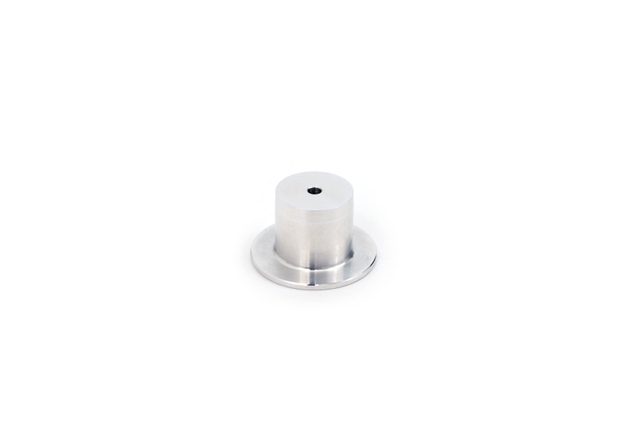
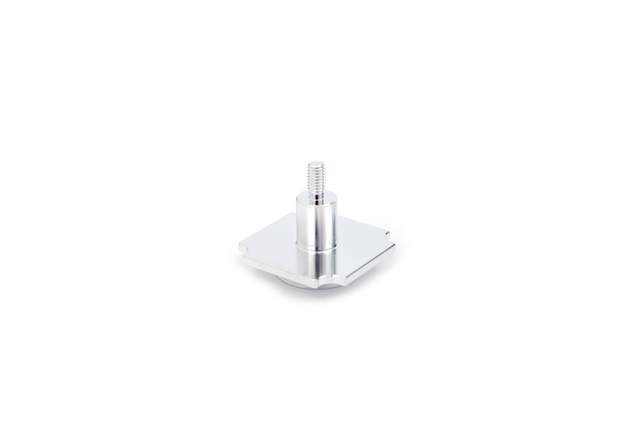
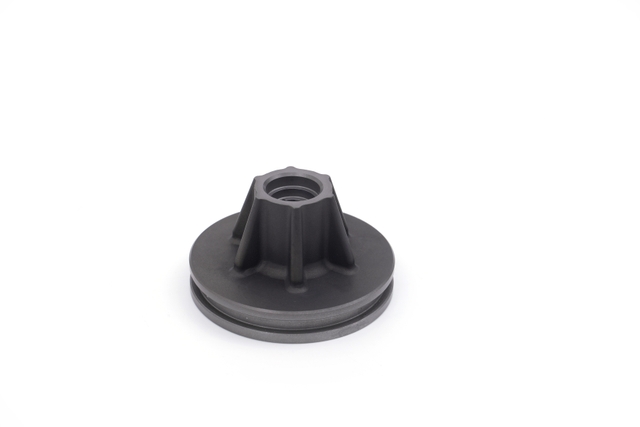
Product Description
| thing | describe |
|---|---|
| Design/Size | According to customer's drawings or samples |
| Material | Aluminum: 6061, 6063, 6082, 7075, 5052, A380, etc.
|
| process | CNC machining, turning, milling, stamping, turning, cutting, etc. |
| Delivery time | Samples usually take 3-7 working days, and mass production will be carried out according to the detailed quantity after sample approval. |
| Surface treatment | Transparent anodizing, color anodizing, chemical coating, brushing, passivation, polishing, chrome plating, sandblasting, laser engraving, zinc plating, black oxide, nickel plating, chrome plating, carburizing, heat treatment, painting |
| Test equipment | Coordinate measuring machine (CMM), 2D measuring instrument, projector, altimeter, micrometer, thread gauge, hardness tester, caliper, pin gauge, salt spray tester, concentricity measuring instrument, spectrometer. |
| Quality Management System | ISO 9001:2015
|
| application | Auto parts, machinery parts, computer parts, medical parts, home appliance parts, electrical parts, electronic product parts, electronic parts, generator parts, alternator parts, generator parts, stationery, power switches, micro switches, construction, merchandise and A/V equipment. |
| File Format | Solidworks, Pro/Engineer, CAD, PDF, JPG, DXF, IGS |
| Package | Inner plastic bag, outer standard carton, or as per customer's requirements |
| Shipping | Sea freight, air freight, international express (DHL, FedEx, TNT, UPS). |
| Serve | The professional foreign trade team provides enthusiastic and fast response services.
|
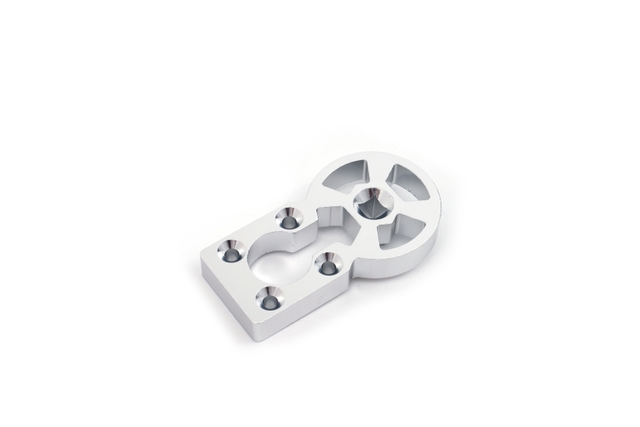
Industrial doors are expected to move smoothly, close accurately, and remain aligned after thousands of operating cycles. That performance often depends on a compact component that receives little attention: the lower hinge interface. This precision aluminum lower hinge bracket is designed to form a stable pivot and mounting point for access doors, machine guards, service panels, and enclosure systems. Its integrated circular hub, square drive socket, keyhole-shaped relief, and 4-hole mounting pattern combine several mechanical functions in one lightweight part.
The bracket is especially well suited to industrial equipment where space is limited but repeatable positioning matters. Rather than assembling a separate plate, hub, spacer, and drive feature, the designer can use one rigid component with controlled relationships between all critical surfaces. For a related example of this hardware family, see LIQUN’s industrial aluminum enclosure hinge.
Designed for Industrial Access and Motion Control
The application is the lower pivot of an industrial access door. The rectangular end fixes to the machine frame or door structure, while the round end carries the pivot or drive interface. A raised hexagonal boss provides local strength around the square socket, and the open 4-spoke pattern removes unnecessary mass without giving up the broad circular load path. The keyhole-shaped opening creates clearance for adjacent shafts, locking hardware, wiring, or a mating feature, depending on the final assembly.
In use, the bracket can support more than simple opening and closing. The square socket can transmit indexed motion, maintain angular orientation, or connect the hinge to a short drive shaft. The mounting holes locate the part and spread the reaction load into the surrounding frame. Countersunk features on the reverse face allow fastener heads to sit flush, reducing interference in compact assemblies.
A representative configuration is approximately 72 mm long, 30.3 mm wide, and up to 13 mm thick, with a finished mass of about 36.3 g. These figures describe a reference form only; the released drawing remains the authority for production dimensions, tolerances, coating, and inspection criteria.
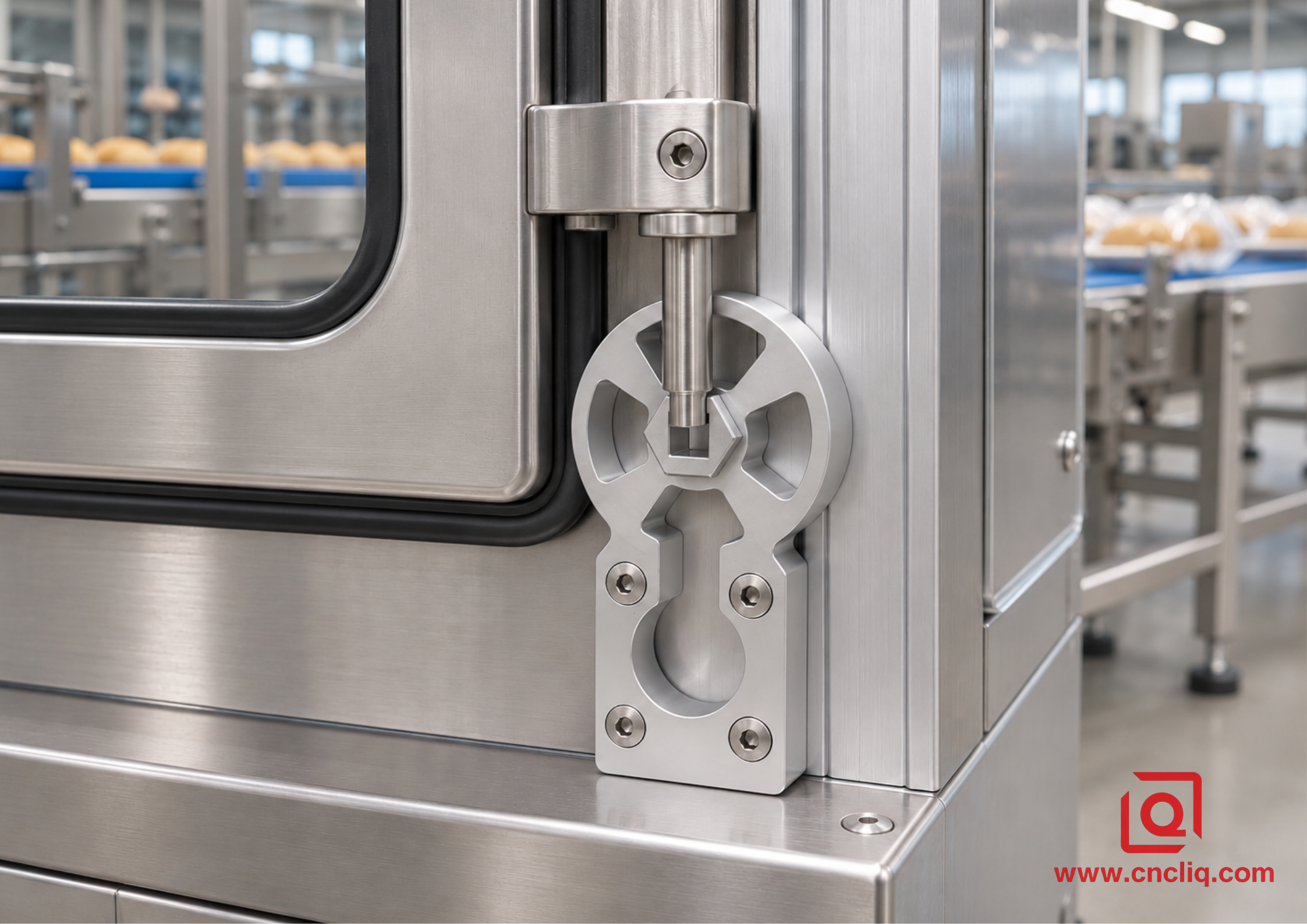
Precision aluminum lower hinge bracket installed on a stainless industrial enclosure
An original application visualization showing the bracket installed as the lower pivot interface of an industrial enclosure door.
6063-T6 Aluminum for a Balanced Structure
The reference material is 6063-T6 aluminum. This alloy is widely valued for its useful combination of low density, corrosion resistance, clean surface response, and dependable machinability. The T6 condition provides a stronger and more stable basis than a soft, untreated alloy, while retaining the material advantages that make aluminum attractive for doors and enclosures.
For this component, material choice affects more than weight. A lower hinge mounted near washdown zones, condensation, cleaning chemicals, or humid factory air must resist surface degradation. Properly prepared 6063-T6 accepts anodizing well, creating a durable oxide layer while preserving a professional metallic appearance. The alloy also allows sharp pocket edges, consistent mounting holes, and a well-defined square socket when the cutting strategy and tooling are controlled. LIQUN’s guide to aluminum CNC milling, material selection, and tolerances explains how alloy and tolerance decisions influence both performance and manufacturing cost.
The low mass of aluminum also reduces unnecessary load on the door structure. This matters in frequently operated guards and access panels, where lower moving mass can improve handling, reduce operator effort, and limit impact during closing. At the same time, the thick local sections around the hub and fastener pattern provide stiffness where it is needed.
Controlled Machining and Finishing Process
Production begins with material verification and a review of the drawing, mating components, and inspection requirements. The machining plan establishes stable datums so that the square drive socket, circular hub, keyhole opening, and 4 mounting holes remain correctly related.
The typical sequence includes facing the blank, roughing the outside profile and internal openings, then finish milling the functional surfaces. The spoke pockets are machined with attention to corner transitions and remaining wall thickness. Mounting holes are drilled and, where specified, countersunk from the reverse side. The square socket may be produced by precision milling, broaching, or wire EDM, depending on socket size, corner definition, tolerance, and order volume. The raised boss is finished to maintain alignment between the socket and the circular section.
After machining, every edge is deburred without rounding away functional geometry. The part is cleaned to remove chips, oils, and polishing residue before surface treatment. Anodizing can then improve corrosion resistance, wear behavior, and appearance. Masking may be applied when the square socket, contact faces, or tightly toleranced bores must remain free from coating buildup. A practical overview of this sequence is available in the aluminum OEM machining and surface-treatment workflow.
For low and medium volumes, machining from wrought 6063-T6 offers strong revision flexibility, repeatable material condition, and no dedicated casting-tool investment. For mature high-volume programs, a near-net casting followed by secondary CNC machining may be evaluated. The correct route depends on geometry, annual demand, quality risk, and tooling amortization; LIQUN’s CNC machining versus aluminum die-casting cost analysis provides a useful framework for that decision.
Quality Built Around Functional Relationships
Reliable hinge performance depends on the relationship between features, not merely on individual dimensions. Inspection therefore focuses on the mounting pattern, contact-face flatness, hub position, square-socket size and orientation, countersink depth, and the concentric relationship between the drive feature and circular profile.
Incoming material can be checked against the specified alloy and temper. During machining, calibrated gauges, height measurement, optical inspection, or coordinate measuring equipment can verify critical locations before value has been added through finishing. Pin gauges confirm holes, while a dedicated square gauge can quickly evaluate socket fit and angular alignment. Final inspection includes visual review for burrs, scratches, coating burns, clogged holes, color inconsistency, and handling damage.
Where the application is safety-related or exposed to aggressive cleaning, additional controls can include first-article inspection, lot traceability, coating-thickness measurement, torque validation, or corrosion testing. These controls should be selected from actual service risk rather than added automatically. A clear control plan keeps the product dependable without burdening the buyer with inspections that do not improve function.
Application Scenarios
The aluminum lower hinge bracket is a practical fit for:
· Packaging and food-processing equipment with frequently opened stainless access doors.
· Automated production cells and robotic guards that require repeatable door alignment.
· Electrical, telecom, and control cabinets where compact internal clearance is valuable.
· Refrigeration, cold-room, and climate-control service panels exposed to condensation.
· Laboratory and clean-room enclosures that benefit from corrosion-resistant, easy-to-clean hardware.
· Custom machinery, test equipment, and modular frames requiring a lightweight pivot interface.
In all these settings, designers should evaluate door mass, center of gravity, shock load, opening angle, shaft fit, fastener strength, and mounting-face stiffness. The bracket is a precision interface, but system performance still depends on the mating shaft, upper hinge, door geometry, and installation method.
Product Advantages
Integrated function. The profile combines a mounting plate, hub, drive socket, clearance opening, and weight-reduction pockets in one part. Fewer separate pieces mean fewer tolerance stacks and fewer assembly steps.
High stiffness at low mass. Material remains concentrated around the hub, perimeter, and fastener zones. The open spokes reduce weight where solid material contributes less to the load path.
Repeatable alignment. CNC-controlled feature relationships help the door return to the intended position, supporting consistent sealing, latching, and appearance.
Corrosion-resistant finish. 6063-T6 aluminum and an appropriate anodized surface are well matched to humid industrial environments and repeated handling.
Design flexibility. The mounting pattern, socket size, thickness, profile, coating, and datum strategy can be adapted to a specific enclosure platform without redesigning the entire hinge system.
Clean assembly. Flush fasteners and a compact envelope reduce snag points and interference around guards, gaskets, trim, and internal components.
Product Value
The greatest value of this component is not the amount of metal it contains; it is the precision it preserves across the assembly. Poor hinge alignment can cause rubbing, uneven gasket compression, difficult latching, visible door gaps, and premature wear. Correcting those problems after equipment assembly is expensive because technicians must diagnose an interaction between the frame, door, shaft, fasteners, and hinge hardware.
A well-controlled aluminum lower hinge bracket moves that risk upstream. Stable datums, consistent socket geometry, and verified hole locations simplify installation and reduce adjustment time. The integrated design can also lower purchasing complexity by replacing several small components with one traceable item. Over the equipment life cycle, smoother motion and dependable closure improve operator experience and help protect the machinery behind the door.
For OEM teams, the component offers a practical platform for customization. LIQUN can review the mating geometry, functional tolerances, machining route, inspection plan, and surface treatment as one connected problem. This approach makes the aluminum lower hinge bracket easier to source, assemble, and maintain while keeping the design focused on real operating needs. Learn more about LIQUN’s custom precision manufacturing capabilities.
FAQs
1. Why use 6063-T6 aluminum instead of steel?
6063-T6 provides a useful balance of stiffness, low weight, corrosion resistance, machinability, and anodizing quality. Steel may be preferred for extremely high loads or severe impact, but aluminum is often the better choice for access doors and machine enclosures where mass, appearance, and environmental resistance matter.
2. Can the square socket and mounting pattern be customized?
Yes. Socket dimensions, boss geometry, hole positions, countersinks, overall thickness, and outside profile can be produced to a released drawing. The mating shaft and installation stack should be reviewed together so that clearance, torque transfer, and coating allowance are correctly defined.
3. What should be confirmed before requesting a quotation?
Provide the drawing or 3D model, alloy and temper, annual quantity, critical tolerances, surface finish, mating-shaft details, inspection requirements, and operating environment. Door weight, opening frequency, washdown exposure, and any safety function are also useful because they influence process selection and quality planning.
TEL: +86 187 5714 8656
Email: zhouli@chinaliqin.com
WhatsApp:+86 187 5714 8656
Website:https://www.cncliq.com/