 English




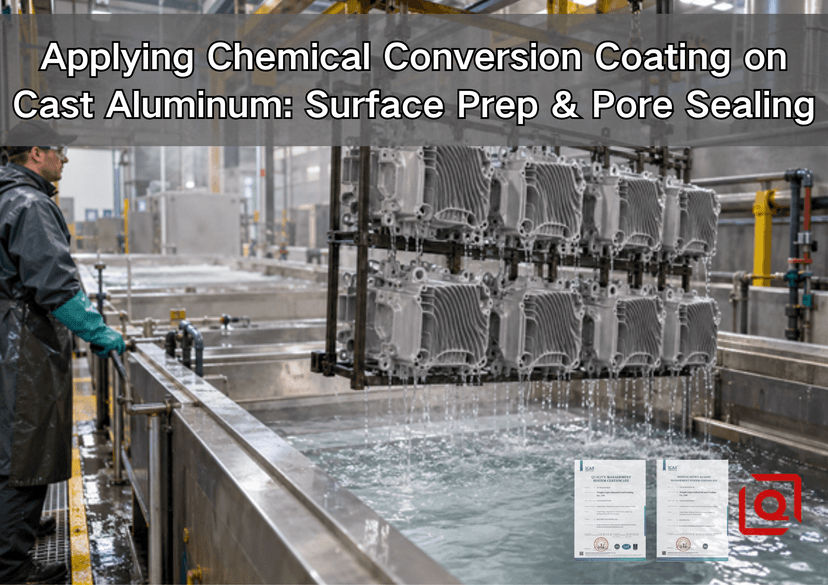
Pale edges again? Dark islands? Dust in a pocket, perhaps paint lifting beside a rib? Start here. One casting. Six surfaces. That is the catch.
On the bench: a die-cast cover. Dense casting skin on the wide wall. A fresh cut in the bore. Blasted metal at the logo. Release agent beside a rib. Coolant down the blind thread. The material list says A380 throughout. The chemical line sees something less tidy.
Chemical conversion coating on cast aluminum has a limited job. It changes exposed metal. It does not plug a path through a pressure wall. A leaking housing may need vacuum impregnation. First prove the leak after machining. Then choose the repair.
Read the Failure Before Touching the Bath
Watch a rack leave the rinse. Water runs off the front. It stops at a rib. A little collects in a counterbore. Ten seconds pass. Dry at first glance; wet in the hidden cup. That small detail can explain a white mark later blamed on the conversion tank.
|
What the shop sees |
Likely place to investigate |
Useful first check |
|
Mottled color |
Different reactions on cut and as-cast metal |
Alloy, cleaning record, deoxidizing window, and limit sample |
|
Beads after cleaning |
Oil, release agent, compound, or coolant |
Water-break-free wetting around ribs, bores, and pockets |
|
White ring after drying |
Rinse chemistry trapped in a low point |
Rack angle, water quality, exchange, and drain time |
|
Paint blister near a rib |
Soil, liquid, or gas emerged during cure |
Full pretreatment and cure trial on an actual casting |
|
Pressure housing leaks |
Connected porosity crosses the wall |
Post-machining leak test and qualified impregnation if needed |
|
Bonding pad reads high |
Wrong class, handling soil, or poor test control |
Finish callout, mask edge, electrode load, and test method |
Do not lengthen bath time on a hunch. Check wetting. Check drainage. Look at the raw casting. A local preparation fault can become a damaged batch when the operator chases color.
What Chem Film Does, and What It Cannot Do
Chem film reacts with aluminum. The result is thin. Very thin. It supports corrosion control, later paint, or a defined electrical contact. Not putty. Not a hard wear layer. It cannot level a pit, rebuild a gasket land, or close connected porosity.
Buyers use several names: chem film, chromate conversion coating, and Alodine. Good conversation starters. Poor drawing instructions on their own.
The public DLA record shows MIL-DTL-5541 Revision F, validated on February 7, 2024. Type is about chemistry. Class is about function. Separate decisions.
|
Drawing code |
What it tells the shop |
Usual purpose |
|
Type I |
Chemistry contains hexavalent chromium |
A controlled program allows it and names a qualified material |
|
Type II |
Chemistry contains no hexavalent chromium |
The program requires a non-hexavalent route |
|
Class 1A |
Maximum corrosion protection, painted or unpainted |
General corrosion duty or a base for an organic finish |
|
Class 3 |
Corrosion protection with low electrical resistance |
Grounding pads, bonding faces, connector lands, or EMI contacts |
“Clear Alodine” still appears on RFQs. It leaves questions. Which type? Which class? Where does the mask stop? Is touch-up allowed at rack points? Which certificate must ship? Our MIL-DTL-5541 chromate conversion coating guide explains those choices.
Why Cast Aluminum Needs Its Own Trial
Compare two parts at the loading table. One is milled 6061 plate. Its face is fairly uniform. The other is a die-cast shell with two bores, four ribs, a blasted field, and a blind pocket. Both are aluminum. Only one brings several surface conditions to the same tank.
A380 and ADC12 suit thin walls. They also suit near-net shapes. The tradeoff sits in their silicon-rich structure. Cleaning becomes less forgiving. So does deoxidizing. Gray patches often show up during anodizing. Our guide explains why A380 and ADC12 cast aluminum are hard to anodize.
Last week's A380 recipe is not today's A356 recipe. Write down the alloy. Add casting route and heat treatment. Note texture, cut zones, and repair limits. One batch wets well; the next one does not. Now the record becomes useful.
Geometry matters as much as alloy. A rib becomes a shelf. A cross-hole becomes a cup when the rack turns. A deep counterbore leaves the rinse full. During DFM, fill the pocket in your mind. Then find its way out.
Nine Checks Along the Line
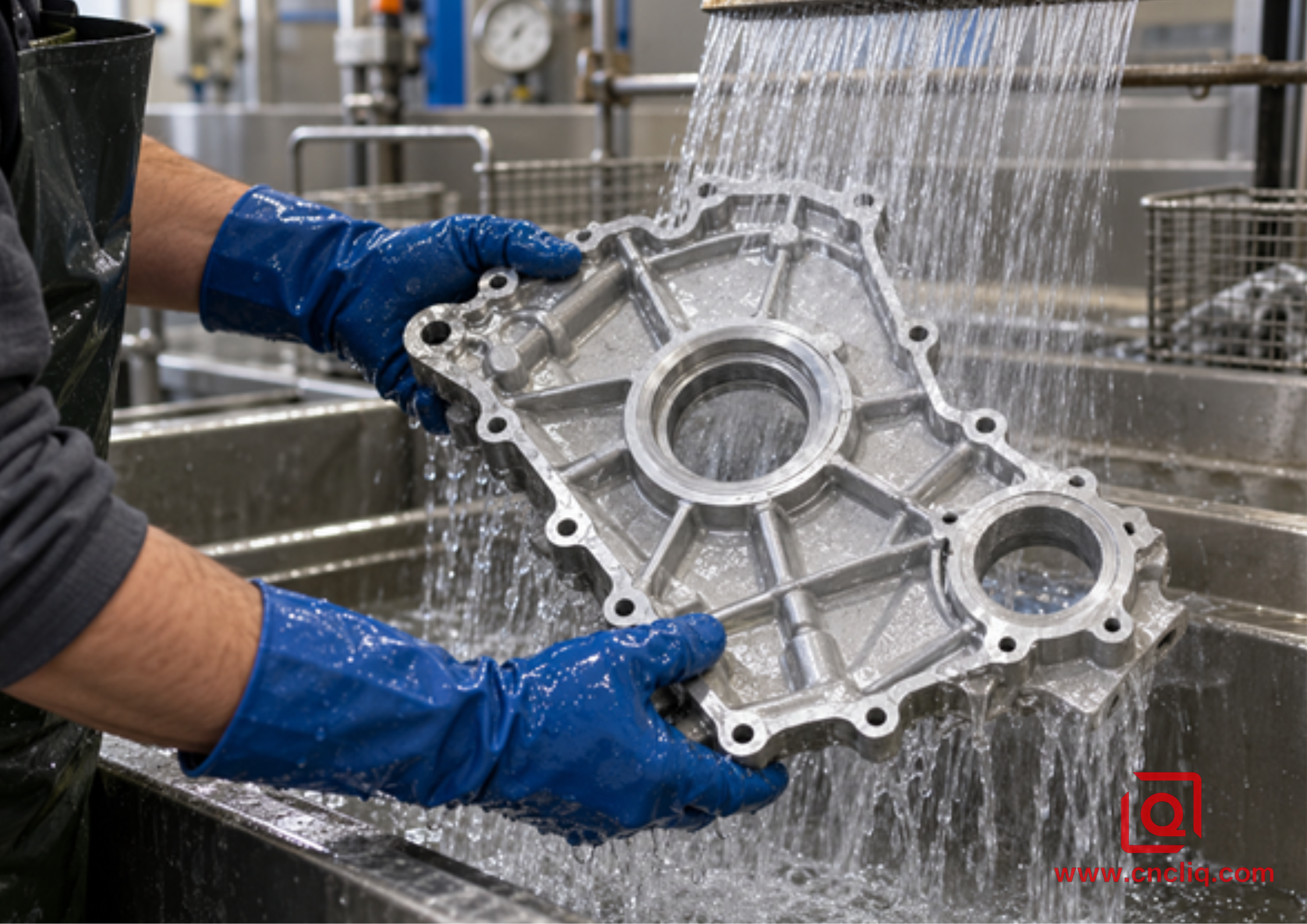
One recipe for every casting? No. Concentration and pH belong to the approved chemistry. Temperature and dwell belong there too. The qualified route and the contract set the boundary. Actual settings stay on the traveler.
1、Begin With Function
Shade painted faces on the drawing. Circle contact pads. Mark gasket lands, clean bores, mask edges, and rack points. State whether touch-up is permitted. Leave nothing important to memory.
Appearance important? Put an approved limit sample beside the order. Use one lamp setup. Set a distance and angle for viewing. A cut pad and a cast wall may not share one shade. Two inspectors can otherwise reach opposite decisions on the same acceptable part.
Name the revision, type, and class. Add the approved-material rule. Add method, sampling, and certificates. Need product qualification? Check MIL-DTL-81706 for the approved type, class, form, and method.
2、Inspect the Casting While It Is Bare
Flash and dents first. Then cold shuts, laps, embedded shot, repair areas, and visible pores on functional faces. A finish cannot rescue a cold shut across a seal land.
Keep heat and casting-lot identity on the traveler. A strange color shift then has a history. Check the die. Check lubricant and blast media. Compare heat treatment and coolant. Without that record, someone changes the tank and hopes.
The drawing may call for radiography. It may call for CT, penetrant, or a leak test. These methods do different jobs. Surface appearance cannot prove pressure tightness.
3、Machine Before Conversion
Unless the drawing changes the order, finish heat treatment first. Complete CNC work. Make the holes and threads. Remove every burr. A later cutter removes conversion film. It may also uncover a pore below the original skin.
Pressure component? Run the named leak test after final machining. Record medium, pressure or vacuum, hold time, instrument, and acceptance value. “Leak tested” is a note. It is not a repeatable method.
4、Remove Heavy Soil
Cleaning looks ordinary. Its effect is not. Blind holes cause trouble again and again. A part seems dry. Leave it on clean paper for a while. An oil halo may creep out.
Before the controlled line, remove chips and ink. Remove compound, coolant, and heavy oil. No carbon-steel brush. No dirty mixed-metal blast media. Either can plant foreign metal in aluminum.
Blasting also needs a boundary. Heavy impact can smear metal. It can round an edge or uncover a pore. Grit may stay buried in the texture. Define media and the target finish. Clean again afterward.
5、Use the Water-Break Check
After approved cleaning and rinsing, rotate the casting under water. A smooth sheet is encouraging. Beads at a bore or rib mean one thing: clean again.
Do not inspect only the broad face. Look under shelves. Look at pocket floors. Follow each bore rim. The military guidance reads broken wetting as contamination. The next finish may suffer.
This check costs little. It also catches a weak surface before the weak surface becomes a finished reject.
6、Deoxidize With Restraint
Cleaning removes soil. The next job is the oxide and smut. NASA's PRC-5005 conversion-coating specification calls for a completely deoxidized surface before coating. Mechanical or chemical means may be used inside that program.
Complete does not mean harsh. Too little leaves oxide or smut. Too much roughens a silicon-rich face or opens more pores. Build the window from supplier data and real production castings. Log bath analysis, temperature, dwell, load, additions, and lot.
7、Rinse the Worst Pocket
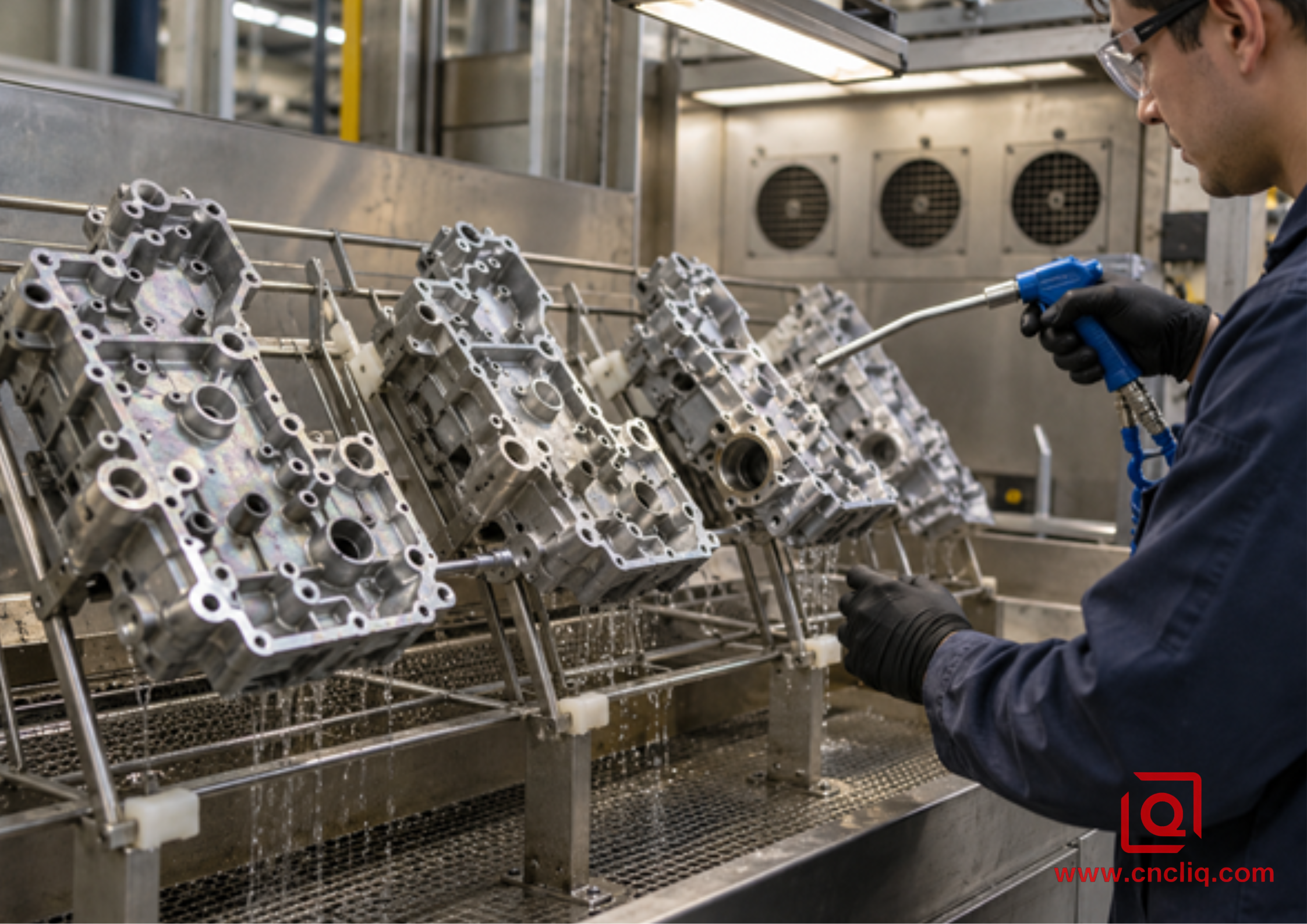
A flat coupon empties at once. A ribbed housing follows different rules. Carried-over cleaner changes the next bath. Acid trapped in a pocket returns later. Perhaps a pale trace. Perhaps a powder ring, blister, or corrosion mark.
PRC-5005 puts the rinse before film drying. Its purpose here is removal of process acids and salts. The rack now matters. Every cavity must exchange water and empty. Watch water quality and the cascade. Check spacing, spray access, and drain time. An undrainable pocket belongs in DFM. More dryer heat only bakes in the evidence.
8、Run the Qualified Method
An immersion tank is not a brush repair. Spray and applicator work differ again. Run the method that was qualified. Follow its controls. Bath analysis. Time. Working temperature. Record pH where it applies. Load. Agitation. Replenishment. Contamination.
Dark does not automatically mean strong. Light does not automatically mean failed. Put paint bases, Class 3 zones, mask edges, rack points, and allowed touch-up on the drawing. Inspect the requirement, not a remembered shade.
9、Drain and Dry Without Trapping Trouble
Give hidden water a route out. Then dry inside the approved temperature and airflow window. Heat cannot repair a poor rinse.
Handle the fresh film with clean gloves. Keep it on dedicated trays and separators. Control storage and the delay before primer or adhesive. NASA PRC-5005 uses less than 48 hours inside its program. The customer's governing requirement still belongs on the traveler.
Three Meanings of “Pore Sealing”
The phrase sounds precise. Three jobs hide behind it.
1、Sealing Anodic Oxide
After anodizing, the oxide is porous. A specified hydrothermal or chemical step may seal it. Conversion coating belongs to another family. Dye or wear duty? A thicker oxide? Compare them in our surface-treatment guide for CNC-milled aluminum.
2、Keeping Process Liquid Out
Good cleaning, controlled deoxidizing, useful rack angles, strong rinsing, and gentle drying reduce liquid held in open texture. Internal channels remain open. The work controls trapped process liquid; it does not repair the casting.
3、When Vacuum Impregnation Belongs
A tiny void may meet another and reach the far side of a wall. A qualified route draws air from those voids. Sealant enters. Exterior residue comes off. The material then cures inside the path. Pressure-tight porous castings fall within SAE AMS03_1A, for ferrous and non-ferrous materials.
A pinhole seen by eye does not, by itself, justify impregnation. Define the failure first. Leak? Cure blister? Surface texture? Then qualify the resin and the sequence. Check cleaning, cure, and later conversion treatment. Release the part by its leak test. “Impregnated” names an operation, not a pass result.
|
Requirement |
Practical starting route |
Boundary to remember |
|
Corrosion support with little dimensional change |
Qualified conversion coating |
It treats a surface; it does not fill connected pores |
|
Low-resistance contact |
Specified Class 3 strategy |
Contact geometry and test method still matter |
|
Tight pressure housing |
Casting control, machining, leak test, then impregnation if justified |
Color cannot prove tightness |
|
Outdoor color |
Conversion pretreatment plus a qualified paint system |
The complete system carries weather and appearance duty |
|
Abrasion resistance |
Anodizing or another wear finish |
Chem film is not a hard wear layer |
|
Smoother cosmetics |
Better casting and mechanical preparation, perhaps an approved topcoat |
Conversion film will not level pits |
Inspection Must Match the Job
Color helps spot a process shift. Proof requires more. Chemistry and class need records. Use the named tests for corrosion, resistance, adhesion, and tightness.
1、View appearance under agreed light. Use the limit sample. Judge cut and as-cast zones separately.
2、Measure finished threads, bores, datums, seal lands, and mask edges. Residue, rack contact, or a poor mask line can affect function.
3、Need corrosion evidence? Name the specimen and its preparation. Add duration and the pass rule. MIL-DTL-5541 lists 168 hours for corrosion exposure. ASTM B117-26 is the salt-spray chamber practice. Product exposure and acceptance still come from the product requirement. The standard also cautions against using this test as a direct forecast of outdoor life.
4、Electrical check? Define the electrodes first. Add load, current, location, conditioning, and limit. MIL-DTL-81706 qualification gives Class 3 figures of 5,000 microhms per square inch as supplied. The 168-hour salt-spray figure is 10,000. Testing there uses nominal 200 psi electrode pressure. A customer assembly may still need its own test.
5、Judge paint or powder as one system. Use an actual casting or a justified representative. Match the original pretreatment. Match its hold time. Run the real primer and topcoat through the real cure. Follow the named conditioning or scribe method.
6、Repeat leak testing after any operation able to create or reopen a path. Tie the report to serial or lot identity. Include medium, pressure, time, resolution, and acceptance value.
Liqin's surface-treatment product category shows parts moving through machining, dimensional control, and coordinated finishing. The coating step never stands alone.
Anonymous Case: A356 Imaging Bracket
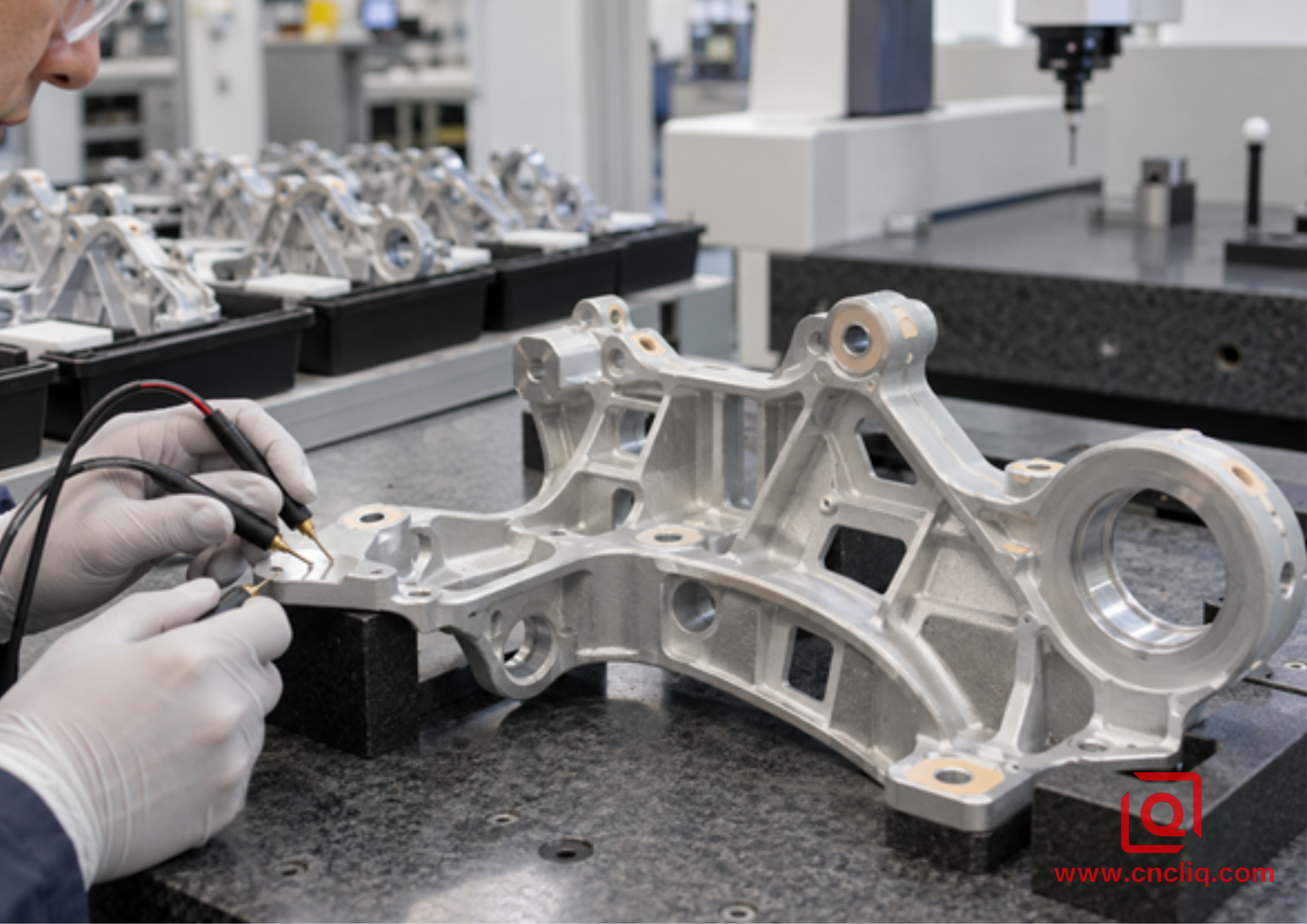
This anonymized composite fits Liqin's published capabilities. It demonstrates a route. It is not a universal process promise.
The first note was brief: “A356 bracket, clear chemical coating.” The bracket had thin ribs, cut bores, threads, a gasket land, cosmetic faces, and four bonding pads. One finish callout could not control all six jobs.
DFM began with color zones on the drawing. Exterior areas received approved conversion pretreatment below the topcoat. The four pads followed the specified low-resistance plan. Bores, threads, gasket land, masks, and rack points had separate controls.
Rough machining opened a few pores on a non-sealing rib. The open bracket held no pressure. The team did not order impregnation merely to hide texture. Isolated marks remained acceptable outside controlled faces.
The first cleaning trial told a different story. Water pulled away beside one pocket. Coolant had stayed behind after machining. A stronger conversion bath was not the answer. The shop focused the pre-clean. It refreshed the rinse and changed the rack angle. Wetting returned; the pocket drained.
First-article work began with dimensions and visual limits. Masks and coating records came next. The customer also checked paint adhesion and used a four-wire resistance test at each pad. Separators stopped finished brackets rubbing in export cartons.
The part family matches Liqin's published A356 medical X-ray board bracket casting and CNC machining capability. The lesson is simple. Chemical conversion coating on cast aluminum works as a zone-by-zone plan. “Add clear chem film at the end” does not.
What to Send With an RFQ
1、Send the controlled 2D drawing and STEP or IGES model.
2、Name alloy, condition, casting method, source status, heat treatment, and repair limits.
3、State specification revision, type, class, qualified chemistry, application method, and justified color rule.
4、Mark every working zone. Coated. Masked. Painted. Bonded. Sealed. Conductive. Cosmetic. Rack contact.
5、Identify dimensions that apply after finishing. Add thread gauges, roughness, flatness, and seal-land limits.
6、Define porosity by function. Need internal evidence? Choose CT or radiography. Need tightness? State the leak test. Add impregnation only when justified.
7、List every later material. Primer. Paint or powder. Adhesive. Give the cure schedule and maximum delay after conversion.
8、List shipment records: material and finish certificates, traceability, dimensional report, electrical results, adhesion, leak report, or salt-spray evidence as applicable.
9、Provide prototype quantity, annual demand, destination, packaging, and service environment.
Send this package through our contact page. Before quotation, Liqin can review the casting and its datums. The same review covers drainage, masks, tests, and documents. The practical aim? No part that passes the CMM but later fails paint, grounding, sealing, or assembly.
FAQ
1、Will Chem Film Stop a Leak Through Porosity?
No. The film reacts at the exposed surface. It is far too thin to close a connected channel. Rinsing and drainage only keep process liquid from open features. A leaking housing calls for casting control and a test after machining. Qualified vacuum impregnation may follow.
2、Should a casting be blasted before chem film?
Only when the approved route has a reason. Controlled media may remove scale or set texture. Dirty media can plant iron. Heavy blasting may smear metal, uncover pores, or hurt an edge. Define media and finish. Clean afterward. Deoxidize and rinse. Watch whether water forms a sheet.
3、Does a RoHS project automatically require Type II?
Type II under MIL-DTL-5541 has no hexavalent chromium. That makes it a sensible starting point when a program prohibits that chemistry. Compliance still rests on the qualified product and declarations. Drawing, contract, and destination market matter too. Type II alone does not set class, color, or every corrosion requirement.
4、What Usually Cuts Paint or Powder Blisters?
Trial the whole route on real castings. Begin with soil removal and deoxidizing. Check pocket rinsing, conversion control, handling, and hold time. Then reproduce the topcoat and actual metal temperature during cure. Liquid or gas still emerging? Review the casting and a qualified impregnation or coating change. Extra topcoat will not remove the cause.
5、What makes a conversion-coating quotation accurate?
Start with alloy, casting route, drawings, and volume. Add specification revision, type, class, and approved chemistry. Show masks and contact zones. State finished tolerances, cosmetic rules, and leak limits. Finish with later coatings, tests, records, packaging, and destination. Now the supplier can quote a route instead of guessing from “Alodine cast aluminum.”
Summary
Reliable chemical conversion coating on cast aluminum starts before the tank. Define function. Finish machining. Remove hidden soil and check wetting. Deoxidize with restraint. Rinse the actual geometry, run qualified chemistry, and empty every trap before drying. Use the film for corrosion support, later paint, and named contacts. For connected pores, begin with a leak test. Add qualified impregnation only when justified. A clear drawing and real evidence replace the vague color request.
Contact Information
Company: Ningbo Liqin Industry Co., Ltd.Daily customer maintenance & after-sales support:service@shturl. zhuwanying@cncliq.com
New inquiry, quotation & order discussion:business@shturl. zhouli@chinaliqin.com
Hotline: +86 18757148656
Disclaimer
All technical articles, material specifications, machining recommendations, and surface treatment details published on this blog are for informational and reference purposes only. Please note that general blog insights do not replace signed technical agreements. Because custom parts vary by material heat numbers, machine calibrations, and specific tolerances, binding quality specs are governed solely by your approved CAD drawings, signed contracts, and formal quality plans.
All customer case studies featured on this blog have been thoroughly anonymized and sanitized. The performance metrics, manufacturing workflows, and imagery displayed serve solely to demonstrate our custom machining capabilities and do not represent a single universal standard for all orders.
Liqin Manufacturing Team
Built on 18 years of precision engineering experience, Ningbo Liqin Industry manufactures high-tolerance metal components for demanding global markets. We operate out of a 6,500 m² production hub equipped with over 150 machines, running 4-axis and 5-axis CNC machining, mill-turn machining, cold extrusion, and pressure die casting under one roof. This setup allows us to manage projects seamlessly, taking parts from initial CAD concepts directly to finalized shipments.
We handle quality control with zero compromise. We treat tight tolerances with the engineering discipline they require. Backed by ISO 9001, ISO 13485, and IATF 16949 certifications, our QA engineers run strict IPQC, FQC, and OQC checks on every single production batch. From CMM dimensional mapping and optical profiling to hardness and salt-spray testing, we validate your critical specs upfront—so you receive drop-in ready components with zero assembly headaches or costly line stoppages. On top of manufacturing, you can rely on us for two-hour response times on new RFQs, direct support for prototype sampling, and smooth export shipping across Europe, North America, Asia, and Oceania.
Welcome your inquiries and samples. Visit our website or contact us directly for a competitive quote!