English




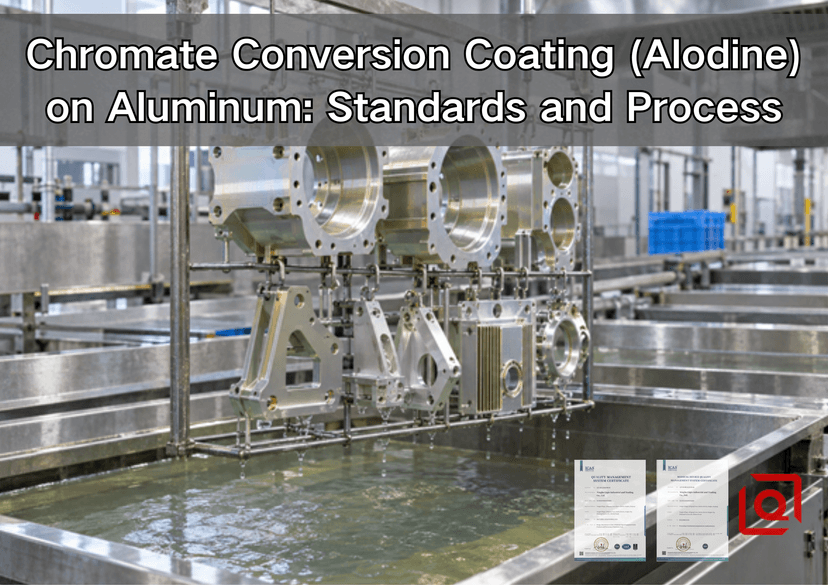
Are you still unsure whether your drawing should call out Type I Class 1A, Type II Class 3, or simply “Alodine”? On an RFQ, those few words look harmless. On the assembly bench, they can be the difference between a clean ground path and a box of parts placed on hold. What follows is the version we would want beside the drawing during a finish review: the standard, what the line operator actually controls, what QC can prove, and what purchasing should put in the RFQ.
Chem film earns its place because it is thin. Threads, sharp shoulders, and close bores usually remain workable, which is valuable on a complicated machined body. It is also easy to specify badly. “Clear chem film” does not define chemistry. “Alodine” is a trade name, not an acceptance requirement. Color alone cannot prove performance. In practice we start with the assembled job. The alloy tells us how pretreatment will behave; the interface tells us whether corrosion, paint adhesion, or current flow deserves first priority.
Start with the function. If the drawing permits hexavalent-chromium chemistry, Type I may be the controlled choice. When the composition must contain no hexavalent chromium, call out Type II. Next decide what the surface must do: Class 1A puts corrosion protection first, while Class 3 is used at lower-resistance electrical interfaces. Finish the note with the alloy, masking map, paint or adhesive system, electrical test if applicable, and required records.
What Is Chromate Conversion Coating on Aluminum?
Chromate conversion coating—also called chemical conversion coating, chem film, or chemical film—is a non-electrolytic surface reaction. That distinction matters. Anodizing grows a comparatively substantial oxide; chem film leaves a much lighter reaction layer. Look closely at a correctly prepared part and there is no paint-like skin sitting on top. The reaction has altered the immediate aluminum surface. That makes it attractive for tight bores, threads, contact areas, bonding surfaces, housings, brackets, manifolds, and aerospace or telecom hardware where dimensional change must remain small.
“Alodine” is commonly used as shorthand, but it is a Henkel trade name. Other qualified products can produce compliant coatings. A controlled drawing should cite a performance standard and required type and class, not a brand name alone. The U.S. Department of Defense’s current listing shows MIL-DTL-5541 as active, validated on February 7, 2024.
The film can slow corrosion on bare aluminum, improve adhesion beneath paint or adhesive systems, and retain a more conductive interface than anodizing. It is not a wear coating. The specification notes that abrasion resistance is relatively low, so sliding surfaces and severe erosion zones normally need another finish or a protected design.
MIL-DTL-5541 Type and Class: Do Not Mix Them Up
Type describes chemistry. Class describes intended performance. “Class 3” is incomplete when chemistry matters; “Type II” says nothing about whether corrosion protection or electrical contact is the priority.
|
Callout |
Meaning |
Typical reason |
Caution |
|
Type I |
Contains hexavalent chromium. |
Legacy aerospace/defense requirement or controlled drawing requiring traditional chemistry. |
Confirm regulatory and end-market requirements. Do not substitute Type II without authorization. |
|
Type II |
Contains no hexavalent chromium. |
Programs restricting hexavalent chromium while needing conversion coating. |
Do not read Type II as a blanket RoHS or REACH certificate. It answers one chemistry question, not every substance question for the finished assembly. |
|
Class 1A |
Maximum corrosion protection, painted or unpainted. |
Bare interiors, structures, tanks, tubing, or paint pretreatment. |
Normally less suitable than Class 3 for a low-resistance contact. |
|
Class 3 |
Corrosion protection where low electrical resistance is required. |
Grounding pads, EMI zones, telecom enclosures, and mating faces. |
Define resistance method, pressure, frequency, and limit in the PO. |
MIL-DTL-5541F gives a useful Class 3 qualification reference: under nominal electrode pressure of 200 psi, materials qualified under MIL-DTL-81706 are limited to 5,000 microhms per square inch as supplied and 10,000 microhms per square inch after 168 hours of salt spray. Those numbers are not a universal substitute for an assembly requirement. Geometry, flatness, roughness, fastener load, and test fixture affect the value, so the acquisition document must still state acceptance.
Standards on the Same Technical Map
|
Document |
Role |
Practical use |
|
MIL-DTL-5541 |
Performance requirements on aluminum. |
Defines type, class, appearance, corrosion, adhesion, inspection, and control. |
|
MIL-DTL-81706 / QPL-81706 |
Qualification of coating materials. |
Verify qualification for type, class, form, and application method. |
|
ASTM B117 |
Salt-spray practice. |
MIL-DTL-5541F uses 5% salt spray for 168 hours. |
|
ASTM D3359 / FED-STD-141 |
Paint adhesion references. |
Used for production paint systems. |
|
ASTM B449-93(2022) |
Active commercial specification. |
Its classes do not equal MIL-DTL-5541 classes. |
ASTM B449-93(2022) covers corrosion protection, organic-coating bases, and low contact impedance. It is technically equivalent to the former ISO 10546 framework, but ISO lists ISO 10546:1993 as withdrawn. If an old drawing cites ISO 10546, clarify the replacement or customer-controlled legacy requirement. Never silently “update” a customer specification.
The Shop-Floor Process, Step by Step
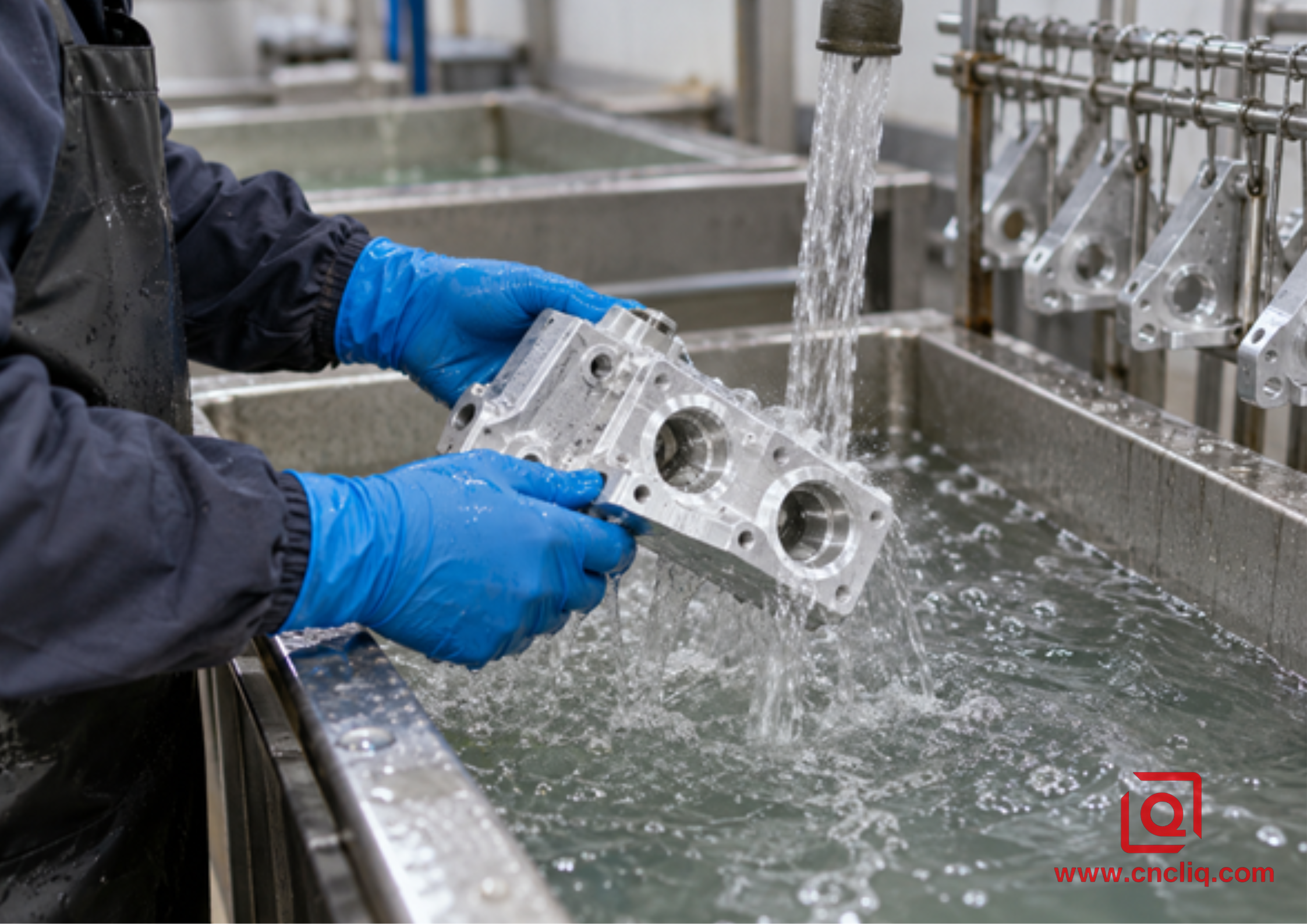
A continuous water film after rinsing is a simple but critical sign that the surface is clean enough to proceed.
1. Review the drawing before parts reach the tank
Finishing starts at quotation. Confirm alloy and temper, type, class, final color if controlled, areas to coat, masking, contact marks, touch-up permission, downstream paint or adhesive, and inspection package. Identify rack points on non-cosmetic and non-sealing surfaces. For tight datums or deep cross-holes, link finishing to machining; our guide to 5-axis CNC machining for complex aluminum housings explains why fewer re-clamps protect feature relationships.
2. Complete mechanical and heat operations first
The finish comes late in the route. MIL-DTL-5541 places it after heat treatment and after operations such as forming, drilling or perforating, machining, brazing, and welding. There is good shop logic behind that order. Cut afterward and bare aluminum appears. Weld afterward and the local heat and oxide spoil the film. Bend too hard afterward and it may be rubbed or cracked away. Deburr and clear blind holes. Steel wool, iron oxide, rouge, and steel-wire abrasives are prohibited because embedded iron can create corrosion sites.
3. Rack and mask around function
Racks must hold the part, drain solution, and limit contact marks. Mask dissimilar-metal inserts the bath could attack. Protect seals, adhesive exclusions, or bare areas only when the drawing requires it. On Class 3, do not casually mask the grounding pad. On mixed-finish parts, separate anodized cosmetic zones from chem-film contact zones.
4. Remove oil without attacking the substrate
Use cleaner compatible with the alloy and qualified supplier process. After rinsing, water should sheet across aluminum instead of pulling into islands around invisible oil. Non-etch cleaning is preferred on many wrought alloys. If alkaline etch is used, the specification warns about pitting and intergranular attack and calls for acid neutralization afterward.
5. Deoxidize and desmut
Aluminum rapidly forms native oxide. Copper-, silicon-, zinc-, or magnesium-rich constituents can leave dark smut. The deoxidizer is the reset step: it clears that barrier so the conversion bath sees active, reasonably even aluminum. Pretreatment is where alloy differences become obvious. A 2024 coupon, 6061 housing, 7075 bracket, cast body, and welded zone should not be expected to react alike. The same bath time can give different color and performance.
6. Apply qualified chemistry
Immersion, spray, or brush may be used when the order permits. Concentration, pH, temperature, dwell time, agitation, and loading must stay inside the chemical maker’s window. A reputable line records additions and analysis rather than judging by color. Henkel literature shows distinct Type I and Type II families and operating ranges; the current technical data sheet—not a generic internet recipe—must govern production.
7. Rinse, drain, and dry gently
Do not let a loaded rack hang above the bath. Moving it into a clean rinse promptly limits drag-out, streaks, and the familiar dark run marks. Rack orientation prevents solution collecting in pockets and blind holes. More heat is not better here. There is a firm temperature warning in MIL-DTL-5541F. Once an unpainted film sees 60°C or more, corrosion performance can start to fall; the heat may come from the dryer, a later operation, or actual service. The salt-fog panels are therefore not baked hard. They sit for 24 hours in a modest 16°C to 38°C range before exposure.
8. Inspect, protect, and pack
The film should be continuous and free from loose powder, voids, scratches, and defects that reduce protection or paint bonding. Clear Type II can be difficult to confirm visually, so use supplier-recommended verification. Handle with clean gloves and non-abrasive separators. Thin chem film can be damaged by metal-to-metal contact even after passing the tank.
Alloy and Geometry Change the Result
A conversion coating follows the metal; it does not hide it. Machining marks, porous cast skin, weld oxidation, embedded media, and segregation remain influential. Welds and castings may be less uniform than wrought alloys. Process-control panels make the alloy effect visible. The specification points out that higher-copper 2024-T3 is more prone to salt-fog failure than 6061-T6.
See our 6061 vs. 7075 aluminum machining guide. Finish cannot be isolated from alloy: copper-rich aerospace alloys, high-silicon castings, and welded assemblies need validated pretreatment. Gold on one alloy and gray or clear on another does not automatically indicate failure. Qualified systems can range from clear to iridescent yellow, brown, gray, or blue.
How to Choose the Right Callout
|
Need |
Starting point |
Add to drawing or PO |
|
Maximum protection or primer base |
Required Type, Class 1A |
Alloy, paint system, rack marks, adhesion and corrosion records. |
|
Grounding or EMI contact |
Required Type, Class 3 |
Contact area, resistance limit, fixture pressure, timing, masking. |
|
Hexavalent restriction |
Type II |
Compliance evidence, approved chemistry, end-market limits, class. |
|
Painted outdoor enclosure |
Often Class 1A pretreatment |
Primer/topcoat, cure, adhesion test, edge and drain details. |
|
High wear or severe marine duty |
Chem film alone may be wrong |
Evaluate anodizing, hardcoat, paint, powder, or a layered system. |
For comparison, use our OEM post-processing guide for CNC-milled aluminum. Chem film favors conductivity, paint adhesion, and minimal dimensional impact; anodizing favors wear, dielectric behavior, or thicker decorative oxide. Neither is automatically better. The assembly decides.
Common Failures and Practical Corrections
|
Symptom |
Likely direction |
Correction |
|
Patchy islands |
Oil, poor water break, trapped air |
Recheck cleaning, orientation, rinse, and loading; do not just extend time. |
|
Powdery film |
Over-treatment or chemistry drift |
Verify concentration, pH, temperature, dwell, and rinse. |
|
Dark runs |
Slow transfer and drainage |
Improve rack angle, lift speed, and immediate rinse. |
|
Pits |
Aggressive etch or alloy attack |
Use a validated milder sequence and neutralization. |
|
Paint blisters |
Dirt, excessive film, poor drying |
Control process, dry correctly, and test actual paint. |
|
High Class 3 resistance |
Heavy film, flatness, pressure, dirty contacts |
Control dwell, define measurement, stabilize fixture, inspect interface. |
Inspection and Records That Make a Certificate Meaningful
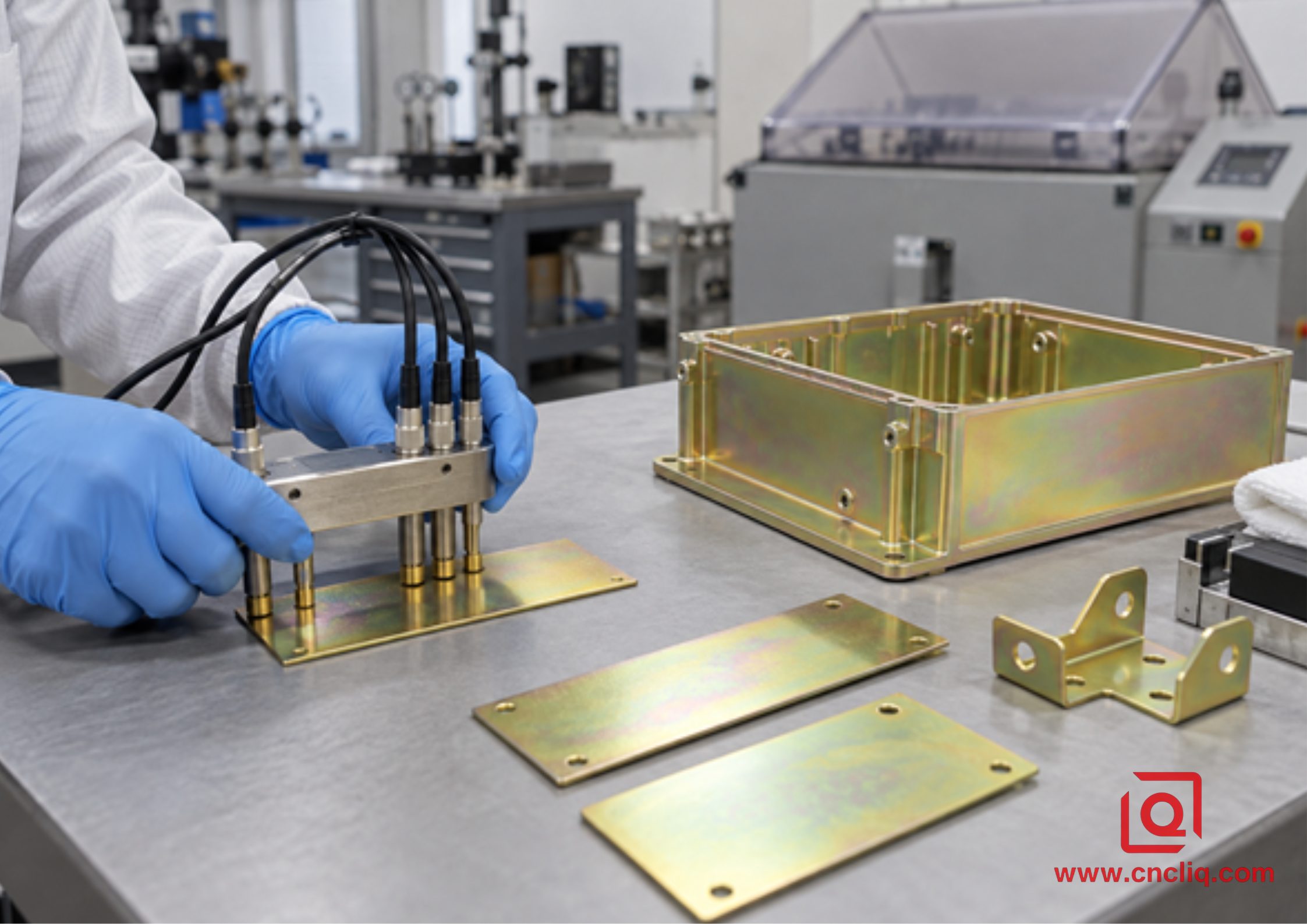
A Class 3 callout becomes useful only when the electrical test method and acceptance limit are defined.
MIL-DTL-5541 control evaluates concentration, pH, and temperature against manufacturer ranges. It sets solution analysis at least weekly and process-control tests at least monthly, with no more than 35 days between monthly tests. If compliant production stops for 35 days or more, testing is required at restart.
Corrosion verification uses five panels in 5% salt spray for 168 hours. The limit is no more than 5 isolated spots or pits per panel, none larger than 0.031 inch, and no more than 15 across all five, excluding defined edge, marking, and holding areas. For painted systems, wet-tape acceptance is 4A or better under ASTM D3359 Procedure A, with no separation at either interface.
Request material certificate, dimensional report, COC stating type and class, qualified material reference where required, control status, corrosion or adhesion evidence, Class 3 electrical results, and lot traceability. Our custom aluminum manifold machining page shows the ports, blind passages, and seals that benefit from one machining, cleaning, finishing, and inspection plan.
Anonymous Customer Case: A Conductive 6061 Telecom Component
This is an anonymized, sanitized case scenario based on Liqin’s published custom telecom-part capabilities; it is not a universal performance claim. An equipment customer needed a compact 6061-T6 electrode and mating housing for an outdoor surge-protection assembly. It required CNC-finished mating features, clean threads, corrosion protection, and a dependable conductive interface. Thick anodic film across the contact zone would work against grounding, while leaving the part bare created handling and corrosion risk.
The route was to freeze datums during cold-extrusion and CNC planning, deburr the current path without rounding contact geometry, and define a Class 3 interface with masking only where the drawing required it. The RFQ checklist included alloy, post-finish dimensions, contact-area identification, resistance conditions, corrosion evidence, and protective packaging. First-article review checked fit and electrical function together instead of approving appearance first.
This matches Liqin’s published 6061-T6 CNC-machined aluminum electrode for telecom surge protection. The broader lesson: choose coating around the interface that carries current, seals fluid, accepts adhesive, or receives paint. A finish note protects function, not merely color.
Planning a conversion-coated aluminum part? Send the 2D drawing, 3D model, alloy, annual quantity, finish callout, masked-area map, and required records through our contact page. We can review datums, rack locations, conductive zones, and acceptance before quotation.
RFQ Checklist
- Begin with the current part number and revision; attach the 2D drawing plus a STEP or IGES model.
- Alloy, temper, raw form, and material certificate.
- Standard/revision, Type I or II, and Class 1A or 3.
- Application restriction, color, chemistry, or source control.
- Areas to coat, mask, touch up, paint, bond, seal, or use as contacts.
- Whether dimensions apply before or after finishing.
- Salt-spray, adhesion, conductivity, cosmetic, and sampling criteria.
- COC, dimensional report, finish report, and declarations.
- Prototype quantity, forecast, packaging, and destination.
FAQ
1. Is Alodine the same as chromate conversion coating?
Alodine is a trade name used for several Henkel products, while chromate conversion coating or chem film is the generic family. Shop language treats them as synonyms, but a drawing should state standard, type, class, and qualified material instead of relying on “Alodine” alone.
2. What is the difference between Class 1A and Class 3?
Class 1A prioritizes maximum corrosion protection on painted or unpainted aluminum, while Class 3 provides corrosion protection where lower electrical resistance is required. Class 3 suits grounding and electronic contacts, but define the limit and method because roughness, flatness, pressure, and hardware affect results.
3. Does Type II automatically mean RoHS and REACH compliant?
No. Type II means the coating composition contains no hexavalent chromium under MIL-DTL-5541. Finished-part compliance depends on the material and process chain, current scope, exemptions, customer requirements, and evidence. State the regulation and documents in the PO.
4. Can chem film be used on tight-tolerance threads and bores?
Yes, its small dimensional effect is an advantage, but cleanliness, trapped solution, drainage, thread condition, masking, post-finish gauging, and class still matter. Put critical dimensions and gauging on the drawing and identify whether acceptance applies before or after coating.
5. What information is needed for a quote?
Provide alloy and temper, drawings and 3D model, volume, standard/revision, type, class, controlled color, masked and contact zones, downstream paint or adhesive, dimensional acceptance, tests, documentation, packaging, and destination. This lets teams plan racks, coupons, inspection, and cost before cutting.
Summary
Chromate conversion coating is practical for CNC aluminum needing corrosion protection, paint adhesion, electrical continuity, or minimal dimensional change. Choose Type I or II for chemistry and Class 1A or 3 for function, then define alloy, masking, contacts, downstream coatings, inspection, and records. Clean to a water-break-free surface, use qualified chemistry within its window, rinse and dry gently, and judge performance with corrosion, adhesion, or electrical tests—not color alone.
Contact Information
Company: Ningbo Liqin Industry Co., Ltd.
Daily customer maintenance & after-sales support:service@shturl. zhuwanying@cncliq.com
New inquiry, quotation & order discussion:business@shturl. zhouli@chinaliqin.com
Hotline: +86 18757148656
Disclaimer
All technical articles, material specifications, machining recommendations, and surface treatment details published on this blog are for informational and reference purposes only. Please note that general blog insights do not replace signed technical agreements. Because custom parts vary by material heat numbers, machine calibrations, and specific tolerances, binding quality specs are governed solely by your approved CAD drawings, signed contracts, and formal quality plans.
All customer case studies featured on this blog have been thoroughly anonymized and sanitized. The performance metrics, manufacturing workflows, and imagery displayed serve solely to demonstrate our custom machining capabilities and do not represent a single universal standard for all orders.
Liqin Manufacturing Team
Built on 18 years of precision engineering experience, Ningbo Liqin Industry manufactures high-tolerance metal components for demanding global markets. We operate out of a 6,500 m² production hub equipped with over 150 machines, running 4-axis and 5-axis CNC machining, mill-turn machining, cold extrusion, and pressure die casting under one roof. This setup allows us to manage projects seamlessly, taking parts from initial CAD concepts directly to finalized shipments.
We handle quality control with zero compromise. We treat tight tolerances with the engineering discipline they require. Backed by ISO 9001, ISO 13485, and IATF 16949 certifications, our QA engineers run strict IPQC, FQC, and OQC checks on every single production batch. From CMM dimensional mapping and optical profiling to hardness and salt-spray testing, we validate your critical specs upfront—so you receive drop-in ready components with zero assembly headaches or costly line stoppages. On top of manufacturing, you can rely on us for two-hour response times on new RFQs, direct support for prototype sampling, and smooth export shipping across Europe, North America, Asia, and Oceania.
Welcome your inquiries and samples. Visit our website or contact us directly for a competitive quote!