English




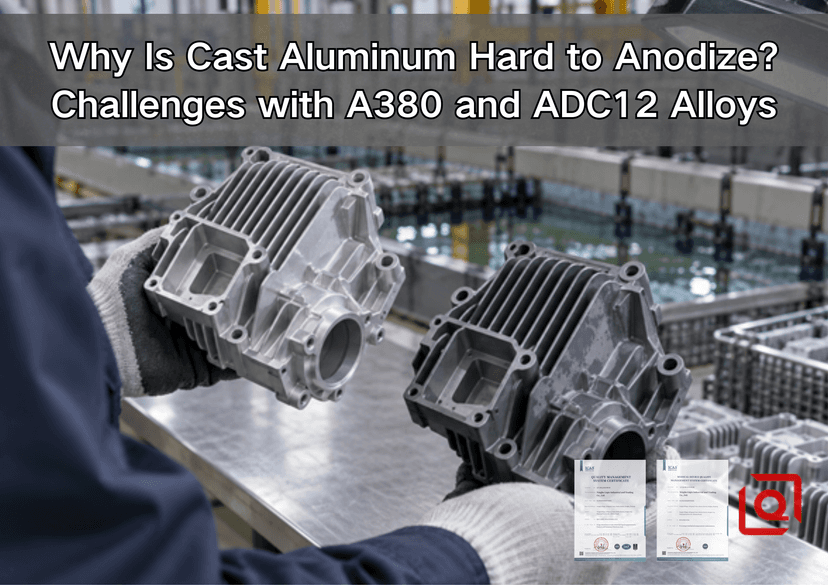
A gray housing returns from finishing. The corner looks almost black, the milled pad has gone pale, and a row of pits circles one boss. We have seen drawings call all three problems simply uneven anodizing, although each points to a different cause. The pages below trace those clues from the melt and die through machining, pretreatment, and inspection. By the end, an engineer should know which lever can actually be moved and when the honest answer is to specify another finish.
A polished section of the casting looks more like terrain than a uniform metal. Bright aluminum-rich areas run around silicon islands, intermetallic needles, an occasional gas pocket, and folds of oxide skin. Current does not cross that map evenly. Alumina grows where aluminum is available, while the neighboring phases follow their own chemistry. A raw part that looked acceptable can therefore leave the tank gray in one area, peppered in another, and weak on dye at a machined face. Two surfaces on one housing may tell different stories.
That does not mean A380 or ADC12 can never be anodized. It means the word anodize is not a complete engineering requirement. The functional target, acceptable color range, alloy standard, casting route, pretreatment, masking, sample approval, and inspection method must be agreed together.
1. What Anodizing Actually Does to Cast Aluminum
Anodizing is an electrochemical conversion process. The aluminum part is made the anode in an electrolyte, and controlled current grows an aluminum-oxide layer from the substrate. This is different from paint or powder coat, which deposits a separate film over the surface. Because the anodic layer is created from the metal itself, the starting alloy and its microstructure stay visible in the result.
For non-architectural parts, MIL-PRF-8625 identifies Type II as conventional sulfuric-acid anodizing and Type III as hard anodic coating. The specification defines coating classes and performance requirements, but it does not make a difficult casting alloy chemically identical to a wrought 6061 part. A coating callout still needs material, dimensions, sealing, masking, color expectations, and acceptance criteria.
Wrought 6061 gives the finisher a comparatively steady starting surface, so clear and dyed films are usually easier to repeat. A380 and ADC12 do not offer that luxury. Move a few millimeters across a casting and the current may meet aluminum matrix, a silicon particle, an intermetallic, then the mouth of a pore. Each responds differently. What looks microscopic during processing becomes plainly visible under an inspection lamp: a cloud here, a dark point there, sometimes a band that follows the metal flow.
The Aluminum Anodizers Council makes the same practical point in its guidance on specifying anodized aluminum: alloys that cast well can contain up to about 12 percent silicon, yet high-silicon casting alloys do not anodize well because silicon is not readily soluble in aluminum. Only the aluminum-rich areas anodize normally, while silicon-rich areas can remain as dark residue. This is a material limitation, not simply a dirty tank.
2. Why A380 and ADC12 Are Especially Difficult
Foundries choose A380.0 and ADC12 for good reasons. The melt reaches narrow ribs, reproduces busy geometry, and leaves less stock for the machining center. The catch arrives at finishing: the chemistry that helps the cavity fill does not make a friendly, uniform anodizing surface.
For A380.0 castings, the Aluminum Association gives 7.5 to 9.5 percent silicon, 3.0 to 4.0 percent copper, and an iron ceiling of 1.3 percent. Those are composition limits, not a promise that every region of a fast-cooled casting will look identical after treatment. Our detailed A380 aluminum die-casting and machining guide explains why the alloy designation and governing standard belong on the drawing. ADC12 is a JIS-based Al-Si-Cu die-casting grade widely used in Asian supply chains; Liqin's custom aluminum die-casting OEM guide records a silicon range of 9.6 to 12.0 percent for the grade. A380 and ADC12 overlap in practical use, but they are not automatically interchangeable. The heat certificate and specified standard govern.
|
Material factor |
A380 or ADC12 shop-floor benefit |
What it can do during anodizing |
Buyer-visible risk |
|
High silicon content |
Improves fluidity, thin-wall filling, and chip breaking |
Silicon-rich areas do not convert like the aluminum matrix and can remain dark |
Gray tone, black smut, mottling, weak dye uniformity |
|
Copper-bearing phases |
Supports strength and machinability |
Changes local current response and can increase coating variability |
Brownish or uneven tone, lower confidence in decorative matching |
|
Iron-rich intermetallics |
Helps control die soldering within the specified alloy balance |
Creates local electrochemical and optical differences |
Dark specks and nonuniform appearance |
|
Gas or shrinkage porosity |
Not a benefit, but a known casting risk |
Traps chemistry and interrupts a continuous surface |
Pits, staining, weeping, and local coating discontinuity |
|
Segregated die skin |
Rapid solidification helps form the casting surface |
Chemistry at the skin can differ from deeper machined metal |
As-cast and CNC-cut faces may finish in different shades |
The lesson is important for procurement. A surface can be dimensionally correct and still fail a cosmetic review. Conversely, a dark or uneven natural color does not automatically mean that every functional property has failed. Appearance, coating thickness, corrosion performance, and wear performance are separate acceptance questions. Put each one on the print if it matters.
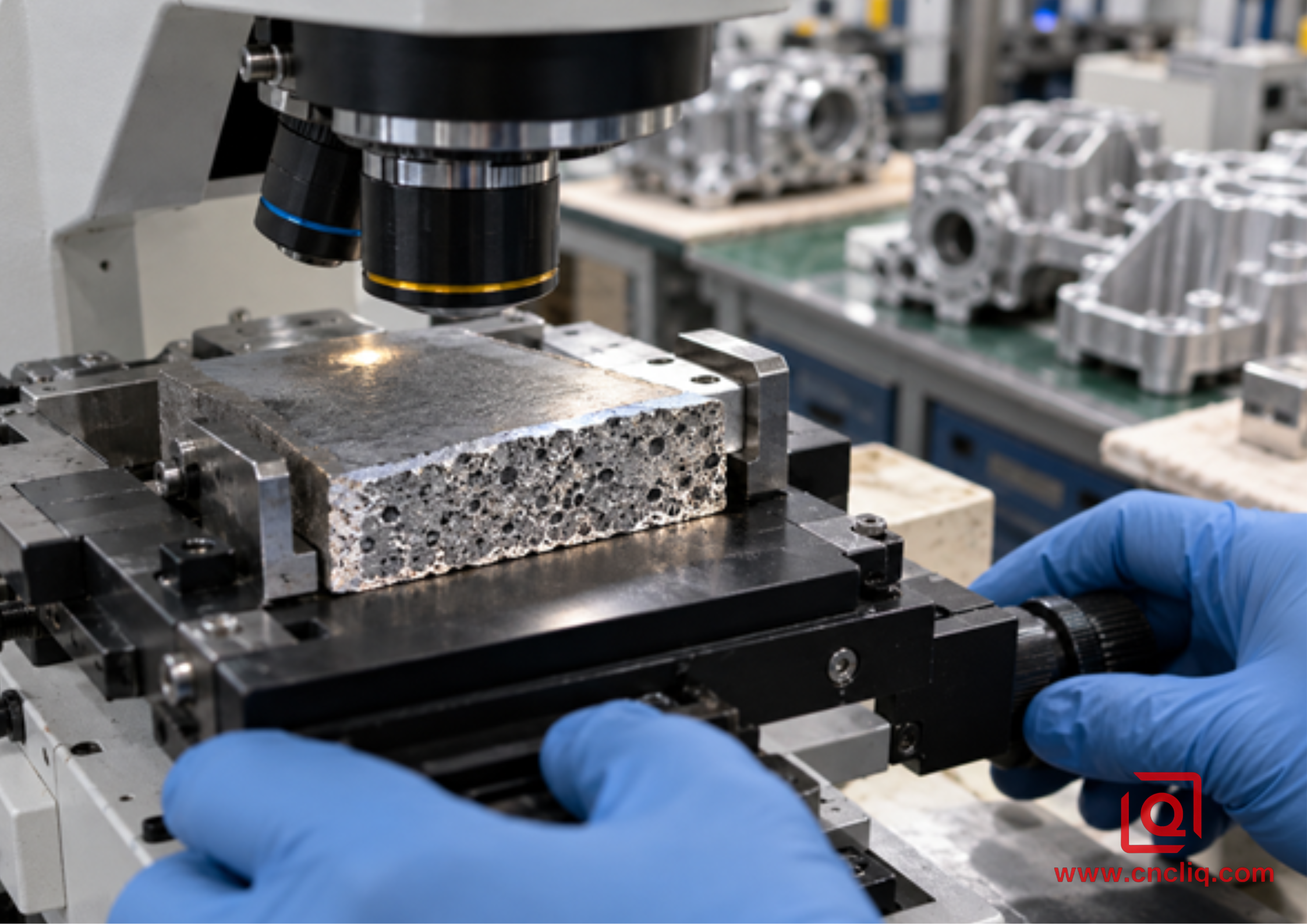
Cross-sectioned cast aluminum sample under coating inspection
3. The Microstructure Problem: One Part, Many Electrochemical Reactions
Under a microscope, a pressure die casting is a multiphase structure. Primary aluminum surrounds silicon particles and intermetallic compounds. Cooling rate changes between a thin fin, a thick boss, and the area near a gate. Material can also segregate as the shot fills and freezes. Anodizing therefore does not see one consistent electrical surface.
A peer-reviewed study, Anodizing of ADC12 Aluminum Die-casting Alloy, compared conventional cast, rapidly solidified, and composition-modified ADC12 specimens in sulfuric-acid solutions. The researchers watched the voltage response, metal ions entering solution, oxygen release, and the oxide that remained. Change the specimen preparation and the response moved. Change the alloying additions and it moved again. In other words, ADC12 was not one predictable yes-or-no result. For purchasing teams, that translates into a plain rule: the grade on the PO starts the discussion; a representative finish sample closes it.
Three surface zones deserve attention.
1. The as-cast skin can carry flow marks, die-release residue, oxides folded into the metal front, and a microstructure created by rapid cooling against tool steel. A cleaner can take off soil and residue; it cannot send the metal back through the die and make it freeze a second time.
2. A machined face cuts through the dense outer skin and may expose pores or a different phase balance. That is how one housing can show two shades even though both faces shared a tank and a clock.
3. A thick boss also cools on a different schedule from the wall beside it. After anodizing, the boundary may show up as a halo that nobody noticed on the raw casting.
Bead blasting can level the visual texture. Polishing can knock down a drag mark. Neither operation changes the alloy underneath, and neither one seals a hidden pore. There is a price for pushing harder, too: rounded edges, shifted roughness, and newly opened voids. Test pieces should come from the production die and follow the production machining path. A perfect flat coupon from another stock lot is comforting but mostly irrelevant.
4. Casting Defects That Become Louder After Anodizing
High-pressure die casting fills the cavity quickly. If air, vaporized lubricant, or oxide films are trapped, machining and anodizing can reveal what the raw surface hid.
|
Symptom after anodizing |
Likely contributors |
What to verify before changing the tank recipe |
Practical corrective direction |
|
Scattered dark pits |
Open gas pores, shrinkage voids, trapped chemistry |
Cross-section, X-ray or CT where justified, machining depth, local wall mass |
Improve venting or vacuum, stabilize shot profile, move critical surfaces, review machining stock |
|
Cloudy bands or flow-shaped color |
Segregation, cold flow, oxide films, variable die temperature |
Gate path, thermal map, fill simulation, sample location |
Rebalance gating and thermal control; approve appearance on production-intent castings |
|
Black smut after etch |
Silicon-rich residue and intermetallic response |
Alloy certificate, etch time, desmut chemistry, water breaks |
Qualify a cast-alloy pretreatment; avoid treating 6061 and A380 as the same recipe |
|
Staining around blind holes |
Retained solution or inadequate rinsing |
Hole geometry, rack orientation, drainage, rinse conductivity |
Add drainage, change orientation, mask or redesign trapped-volume features |
|
Different shade on machined pads |
Skin removal and exposed subsurface structure |
Tool path, cut depth, surface roughness, pore exposure |
Keep cosmetic faces in one surface condition or define an approved contrast range |
When pits or black residue appear, adding etch time is a tempting response. It can be the wrong one. Caustic removes aluminum faster than it removes the silicon-rich remainder, so extra time may deepen the color problem while consuming dimensions. Sort the evidence before touching the recipe. Is the mark leftover soil? A silicon-rich patch? The mouth of a pore? Or a genuine tank-control problem? Each answer sends the corrective action in a different direction.
For teams still deciding between billet and a die, our comparison of CNC machining, extrusion, and die casting for aluminum OEM parts places surface finish beside volume, geometry, and tooling cost. A flawless dyed anodize may justify 6061 billet or extrusion even when casting would reduce unit cost at scale.
5. Pretreatment Helps, but It Cannot Turn ADC12 into 6061
Pretreatment should leave a water-break-free, chemically ready surface without consuming features the drawing needs. That sounds routine until die release, native oxide, embedded dirt, and loose smut occupy the same casting. Time matters. An extra minute that cleans one region may over-etch the aluminum-rich area beside it.
A production route commonly moves from controlled cleaning and rinsing into qualified deoxidizing or etching, alloy-appropriate desmutting, another rinse, anodizing, optional dye, and the specified seal. Treat that order as a route card, not a set of bath settings. The qualified finisher owns concentration, temperature, exposure time, and current. Public charts are starting references. Only trials on the intended casting make them production evidence.
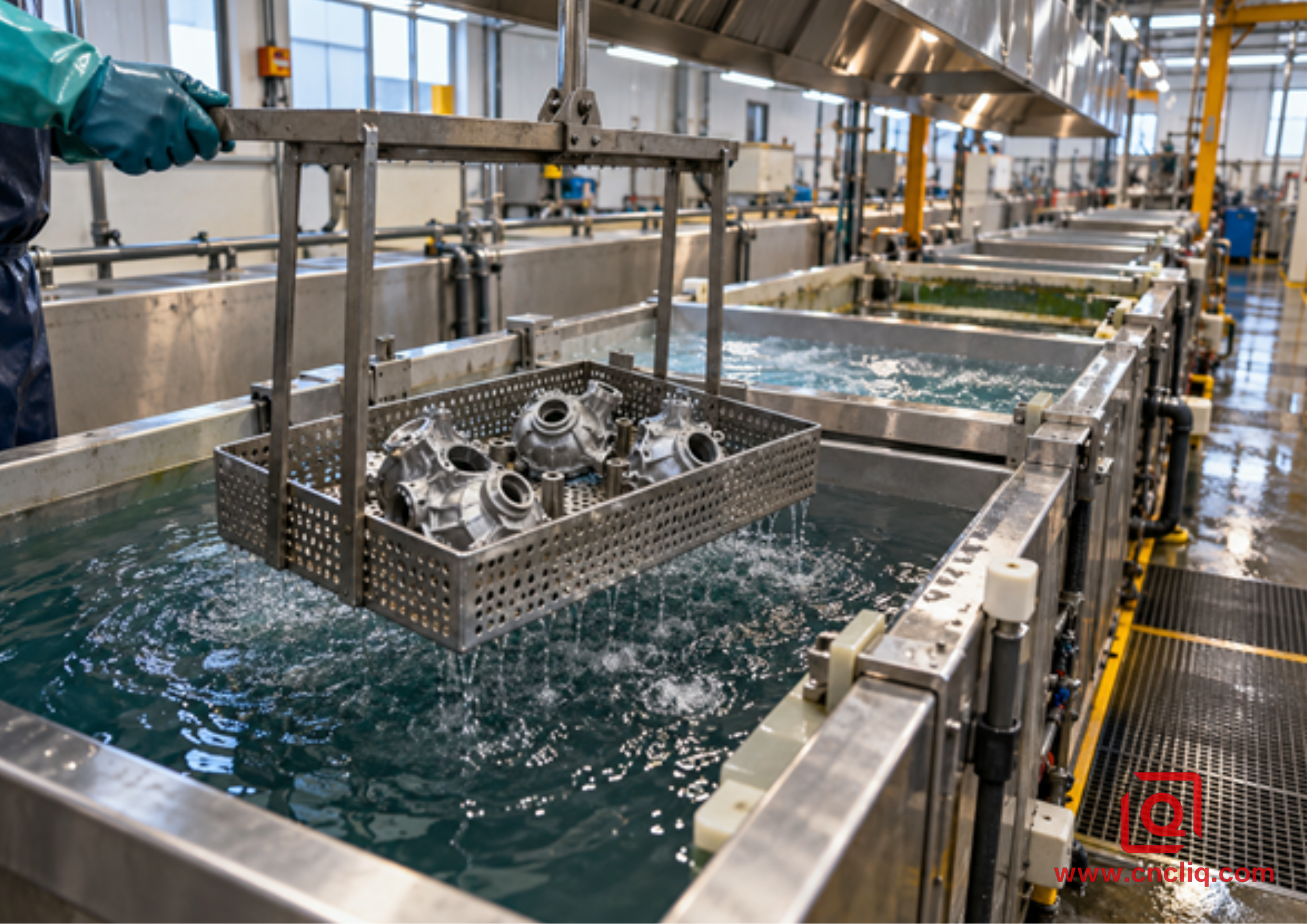
Cast aluminum parts entering a controlled pretreatment line
Before approval, run a production-intent trial with parts from the intended tool, alloy heat, machining route, deburring method, blast media, rack position, and finish line. Include both as-cast and machined surfaces. Record rack contact points and current density. Keep a signed limit sample under controlled lighting. If the visible face can be assembled in more than one orientation, inspect every orientation that the customer will see.
For dimensional features, remember that anodizing consumes some substrate and grows outward. Do not copy a universal 50 percent growth rule into a cast-part drawing without agreement. Alloy, pretreatment, coating type, and local geometry influence the result. Our Type II versus Type III anodizing guide explains coating selection, while the anodizing DFM and tolerance guide shows why threads, bores, seal lands, and electrical contacts need deliberate masking and allowance planning.
6. Type II or Type III: Start with the Function, Not the Label
If the drawing is chasing corrosion protection or color, engineers often begin with Type II. Wear faces and dielectric duty tend to push the conversation toward Type III. On an A380 or ADC12 casting, however, the Roman numeral says nothing about a guaranteed showroom-black appearance. The substrate still gets the final vote.
Type III can be especially demanding because the thicker hard coating requires tighter heat removal and electrical control. Silicon-rich phases, local porosity, and sharp current-density peaks at edges make the process less forgiving. A dark natural color may be acceptable on an internal wear surface but unacceptable on a customer-facing enclosure. In that case, the same coating can pass one engineering purpose and fail another.
Use this decision order.
1. Name the failure you are trying to prevent. A corroded wall, a worn bore, a leaking electrical barrier, and a color mismatch are four different jobs. Do not hide them behind one finish note.
2. Define the critical surface. A bearing bore, gasket land, external cover, threaded ground point, and hidden bracket do not need the same finish.
3. Define measurable acceptance. State coating type, thickness or performance target, sealing, masking, color or range sample, test method, and any permitted variation.
4. Prove the route on representative castings. Do not approve a billet coupon for a die-cast production part.
5. Lock the process change rules. Alloy heat, blasting media, pretreatment, subcontractor, or rack redesign can change the result and may require requalification.
If you send Liqin a 3D model, controlled 2D drawing, annual volume, alloy callout, visible-surface map, and required tests, our engineering team can review the handoff from pressure die casting to CNC machining and surface treatment before a quotation is frozen. Early DFM is cheaper than sorting a full batch by color.
7. When Another Finish Is the Better Engineering Choice
Anodizing is one tool, not the default answer. For many A380 and ADC12 housings, a conversion coating plus powder coat, e-coat, or a qualified liquid paint gives more controllable appearance because an opaque organic layer hides much of the substrates optical variation. Selection still comes back to service. Salt, heat, sunlight, impact, grounding points, thread fit, thermal paths, and the order of assembly can each change the winner.
|
Primary requirement |
Usually stronger candidate |
Why it may suit a casting |
Important limitation to control |
|
Uniform decorative color |
Powder coat or liquid paint over qualified pretreatment |
Opaque film masks gray and mottled substrate |
Film build affects fits, edges, threads, and heat transfer |
|
Complex cavities with corrosion protection |
E-coat with suitable pretreatment |
Immersion can reach recessed geometry |
Drainage, cure temperature, and electrical contact need planning |
|
Paint adhesion with electrical grounding areas |
Conversion coating plus selective masking |
Thin conversion layer adds little dimensional build |
Bare contact areas and corrosion tests must be defined |
|
Local wear surface |
Qualified hardcoat on a tested area, insert, or wear component |
Targets the function without demanding cosmetic uniformity everywhere |
Cast-alloy response and porosity require trials |
|
Bright, even dyed appearance |
Change to an anodizing-friendly wrought route such as 6061 when design and volume allow |
More uniform substrate supports repeatable color |
Higher machining material and cycle cost may apply |
Liqin's product catalog includes an A356 medical X-ray board bracket made by die casting, aging, CNC machining, and anodizing. It is a useful reminder that cast aluminum is not one finish category. A356 is not A380, and neither is ADC12. Chemistry, casting route, and visual limits move with the grade. Start from the certificate and the part requirement; a catalog photograph cannot approve a process.
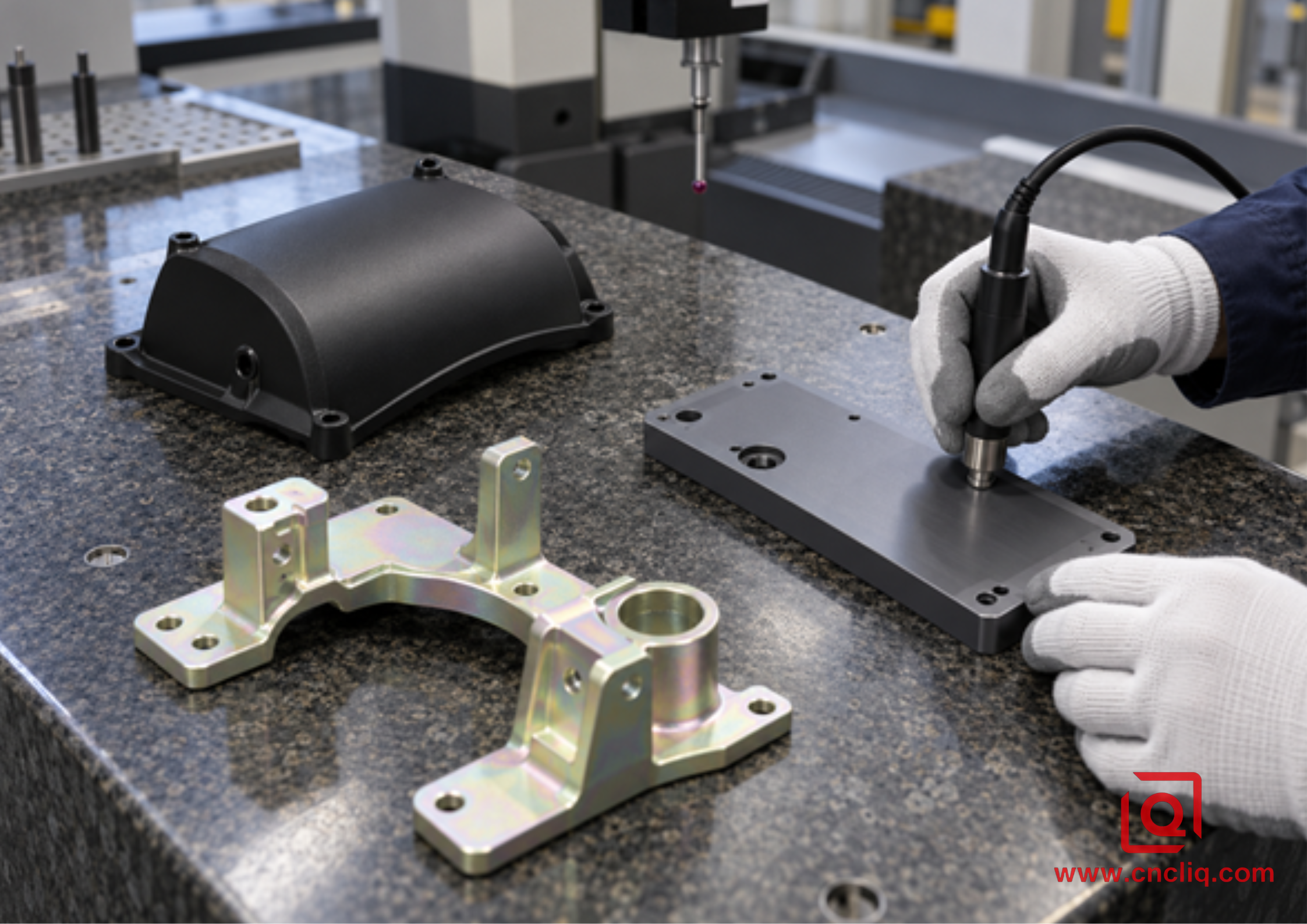
Inspection of coated and anodized components on a CMM table
8. Anonymous Customer Case: An Industrial Sensor Cover That Could Not Match 6061
A European industrial-controls buyer asked for a curved high-pressure die-cast cover with CNC-finished connector seats and a dark satin surface. The early RFQ described ADC12 with black anodizing because the mating base plate was machined from 6061 and already had a black Type II finish. The customer expected both components to look identical after assembly.
During DFM review, the risk was not the basic geometry. It was the finish comparison. The ADC12 cover contained thin walls, a heavier cable-gland boss, ejector zones, and both as-cast and machined visible faces. Those regions would not present one uniform microstructure to the anodizing bath. Matching a wrought 6061 plate by color name alone would have created a fragile acceptance standard.
The team separated the requirement into function and appearance. The cover needed outdoor corrosion protection, a stable dark finish, clean masked threads, and no visible coating buildup on a gasket land. It did not require an anodic wear surface. Three production-intent finish samples were therefore evaluated: natural dark anodizing with an agreed variation range, black powder coat over qualified pretreatment, and a dark liquid coating system. The customer reviewed samples beside the real 6061 base under the specified lighting rather than comparing website images.
For the outer cover, the buyer chose powder. Side by side with the 6061 base, it held the agreed dark appearance with less drama. Machining came first; the print then kept coating away from threads, the gasket land, and the ground point. Inspectors measured CTQs before and after finishing, probed film thickness only at nominated spots, and judged appearance against a signed sample. The decision did not prove that ADC12 was impossible to anodize. It proved that anodizing was the wrong route for that product's dominant requirement.
The customer identity and product details in this representative case are deliberately obscured. The workflow is plausible for Liqin's casting, CNC, and finishing service mix; the signed drawing and qualified control plan would still govern any live order.
9. What to Put in an RFQ for Anodized Cast Aluminum Parts
Write only A380, black anodized and every bidder must fill in the blanks. One assumes cosmetic black, another prices functional gray, and a third masks nothing. The quotes look comparable until samples arrive. Put the following facts beside the CAD model.
1. Call out the exact alloy, product form, and governing standard. List alternatives separately, with written engineering approval; never bury an A380.0-to-ADC12 swap in a supplier note.
2. 3D model and controlled 2D drawing with datums, CTQ dimensions, GD&T, machining stock, and surfaces that remain as cast.
3. Annual volume, release quantity, expected program life, and prototype or qualification quantity.
4. Finish purpose, coating specification, class, color intent, gloss or texture range, sealing requirement, and approved visual standard.
5. Color the surface map. Mark what the customer sees, what stays hidden, which pads are machined, where the rack may touch, and exactly where a shade change is acceptable.
6. Draw the masking boundaries. Threads, bores, seal lands, electrical contacts, bond points, and heat-transfer faces should never depend on a verbal instruction.
7. Name the proof. If corrosion, adhesion, wear, insulation, leakage, or another environment matters, give the test method, specimen condition, and pass line.
8. Required records, such as material certificates, first-article report, CMM report, finish certificate, control plan, capability data, and approved deviation process.
9. Do not stop the plan at final inspection. Specify separators, wrapping, dryness, and pack orientation so approved surfaces do not rub or sweat in the crate.
Need a feasibility answer before the tool is cut? Contact Liqin with your CAD files and finish target. We can compare anodizing with alternative coating routes, flag pore-sensitive machining zones, and quote a production-intent sample plan rather than offering a generic yes or no.
FAQs
1. Can A380 aluminum be anodized successfully?
It can, provided the goal is realistic. A380 includes 7.5 to 9.5 percent silicon and 3.0 to 4.0 percent copper, so a bright, even decorative color is a difficult promise. A gray or mottled natural tone is more credible. Let a production casting, processed on the intended line, set the color boundary and the functional test.
2. Can ADC12 receive black anodizing?
ADC12 can receive an anodic coating, and black dye may be attempted, but the alloy's high silicon content can produce a gray, sooty, or uneven base that prevents a clean 6061-like black. If identical color across assemblies is mandatory, evaluate an opaque coating or change the material route. Approve production-intent samples from the actual tool and alloy heat.
3. Will bead blasting make cast aluminum anodize evenly?
Blasting changes what the eye sees first: texture. It does not pull silicon or copper-bearing phases out of the metal, heal a pore, or remix a segregated region. Sometimes the blast even opens a void that was just below the skin. Control the media and pressure, protect sharp features, and qualify the result on real parts.
4. Is hardcoat anodizing better than Type II for A380 or ADC12?
No. A hardcoat may be right for a sliding face or an electrical barrier, yet extra thickness does not smooth out the alloy structure. A modest Type II film may serve a different part perfectly well. Ask what must survive, test that property on production castings, and resist choosing by thickness alone.
5. What information is needed for an accurate cast aluminum finishing quote?
Send the 3D model, controlled drawing, exact alloy and standard, yearly volume, visible-surface map, finish purpose, color tolerance, coating specification, masking zones, CTQ dimensions, required tests, documentation, and packaging needs. If appearance is critical, include a physical master sample or objective color and gloss criteria plus the inspection lighting and viewing method.
Summary
A380 and ADC12 make excellent complex castings, but their silicon-rich, multiphase structure and occasional porosity give anodizing an uneven foundation. Careful pretreatment removes contamination; it cannot make the substrate behave like wrought 6061. Begin with the failure mode, run actual production castings, and sign an honest limit sample. If powder, e-coat, paint, conversion coating, a different casting grade, or a wrought route protects the assembly more reliably, choose it before the tool locks the project in.
Contact Information
Company: Ningbo Liqin Industry Co., Ltd.Daily customer maintenance & after-sales support: service@shturl. zhuwanying@cncliq.com
New inquiry, quotation & order discussion: business@shturl. zhouli@chinaliqin.com
Hotline: +86 18757148656
Disclaimer
All technical articles, material specifications, machining recommendations, and surface treatment details published on this blog are for informational and reference purposes only. Please note that general blog insights do not replace signed technical agreements. Because custom parts vary by material heat numbers, machine calibrations, and specific tolerances, binding quality specs are governed solely by your approved CAD drawings, signed contracts, and formal quality plans.
All customer case studies featured on this blog have been thoroughly anonymized and sanitized. The performance metrics, manufacturing workflows, and imagery displayed serve solely to demonstrate our custom machining capabilities and do not represent a single universal standard for all orders.
Liqin Manufacturing Team
Built on 18 years of precision engineering experience, Ningbo Liqin Industry manufactures high-tolerance metal components for demanding global markets. We operate out of a 6,500 m² production hub equipped with over 150 machines, running 4-axis and 5-axis CNC machining, mill-turn machining, cold extrusion, and pressure die casting under one roof. This setup allows us to manage projects seamlessly, taking parts from initial CAD concepts directly to finalized shipments.
We handle quality control with zero compromise. We treat tight tolerances with the engineering discipline they require. Backed by ISO 9001, ISO 13485, and IATF 16949 certifications, our QA engineers run strict IPQC, FQC, and OQC checks on every single production batch. From CMM dimensional mapping and optical profiling to hardness and salt-spray testing, we validate your critical specs upfront, so you receive drop-in ready components with zero assembly headaches or costly line stoppages. On top of manufacturing, you can rely on us for two-hour response times on new RFQs, direct support for prototype sampling, and smooth export shipping across Europe, North America, Asia, and Oceania.
Welcome your inquiries and samples. Visit our website or contact us directly for a competitive quote!