 English




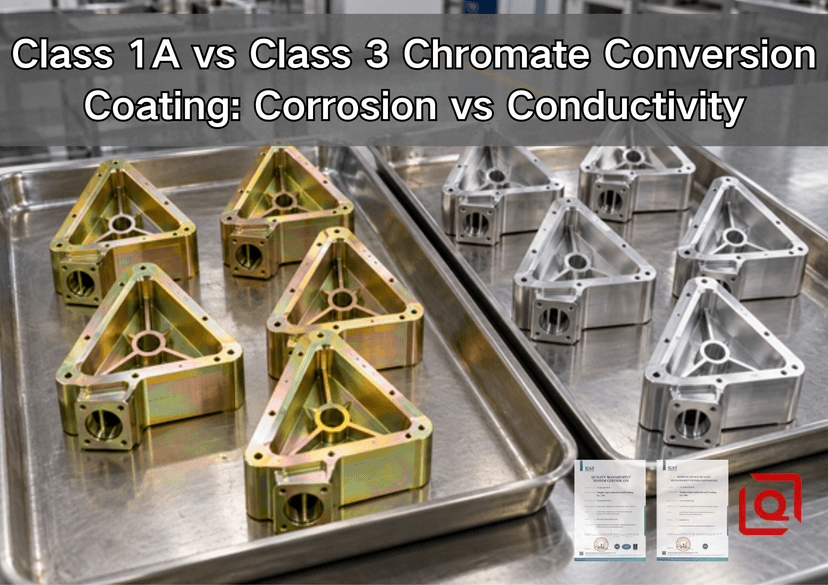
Have you ever released an aluminum housing with the note “clear chem film,” only to hear two different interpretations from the coater and the assembly team? It happens because color is being asked to do an engineering job. One person reads the note as corrosion protection. Another reads it as an electrical-ground requirement. The parts can look perfectly acceptable and still fail at the gasket, lug, or painted interface.
This guide untangles that problem from the viewpoint of people who must machine, finish, inspect, buy, and assemble the same part. The key question is not which film looks better. It is this: what must current, moisture, paint, and hardware do at that exact surface? Once that answer is clear, the Class 1A vs Class 3 chromate conversion coating decision becomes much easier to quote and verify.
Start Here: What Is the Part Supposed to Do?
Class 1A is the usual choice when maximum corrosion protection leads the requirement. The aluminum may remain unpainted, or the conversion layer may sit beneath paint or powder coating. Class 3 still protects the aluminum, but it is selected where the treated surface also needs lower electrical contact resistance. Think grounding pads, RF enclosure seams, bonded joints, and connector bodies.
That sounds almost too simple. The trouble starts when a project has both needs. Imagine a powder-coated outdoor enclosure with an internal ground pad. Class 1A may make sense beneath the paint, while a controlled Class 3 zone serves the electrical joint. One blanket callout is not always the cleanest answer. A marked surface map is.
And color? Useful for noticing a bare patch or a sudden process change, yes. Proof of class, no. Gold does not automatically mean Class 1A. Clear does not automatically mean Class 3. Qualified Type II products can be nearly colorless, and alloy, cleaning, dwell time, bath condition, and surface texture all influence what the eye sees.
What the Coating Is, and What It Is Not
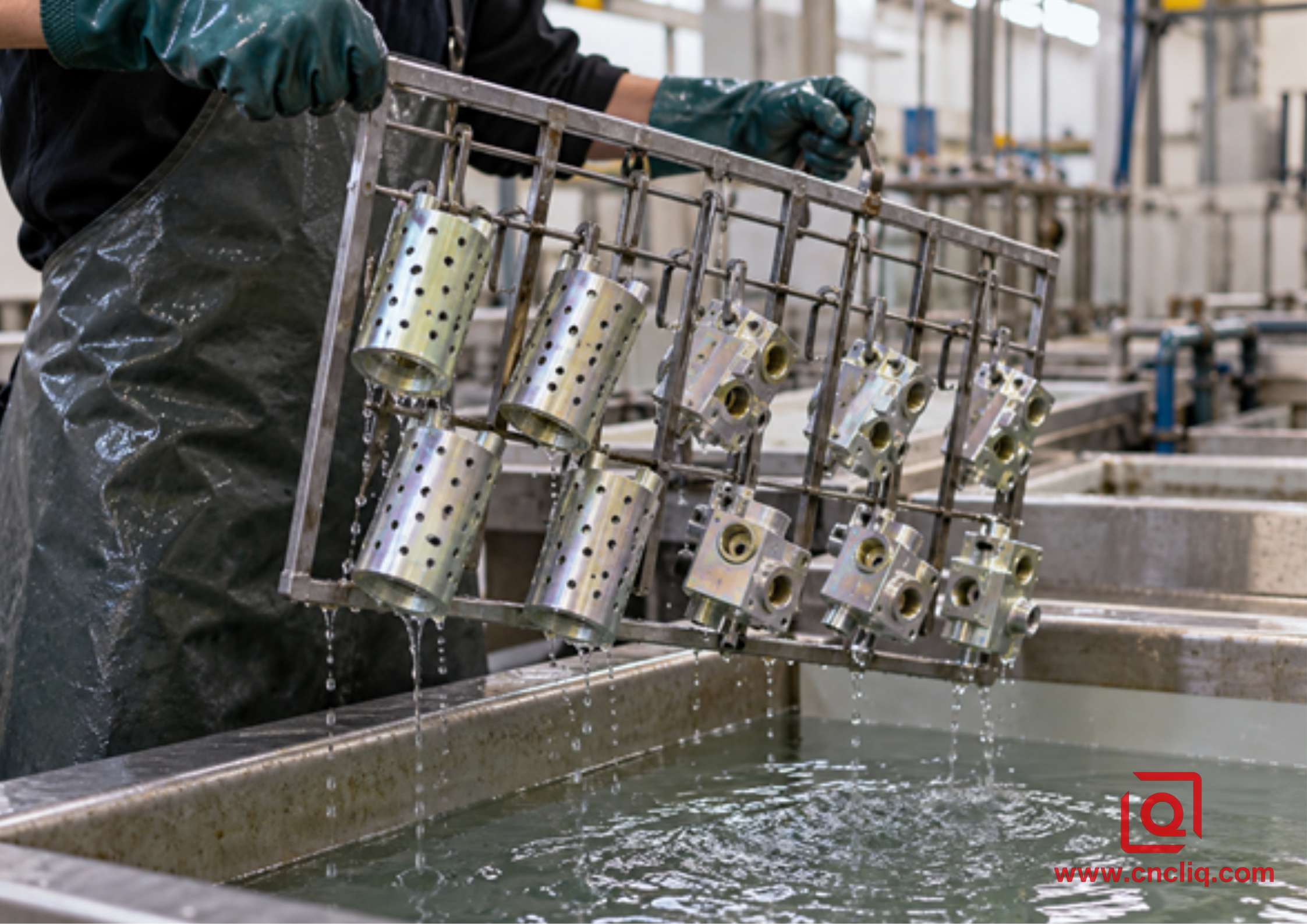
Chromate conversion coating, chem film, and chemical film all describe a reaction treatment used on aluminum. “Alodine” is a trade name that people often use for the whole process family. We avoid relying on that word alone on a controlled drawing; too many possible chemistries and performance classes can hide behind it. Our broader chromate conversion coating guide covers the standard and the full production route.
Unlike anodizing, chem film does not grow a thick, hard aluminum-oxide layer. The prepared metal reacts with conversion chemistry and develops a very thin protective film. This is why the process suits threaded features, close bores, connector shells, waveguide flanges, and precision chassis. There is little dimensional build to upset a carefully machined fit.
The chemistry type and the performance class answer different questions. Under MIL-DTL-5541, Type I contains hexavalent chromium. Type II contains no hexavalent chromium. Class 1A and Class 3 describe the work the finished coating must perform. “Type 3” is therefore not another way to say Class 3. Type II Class 3 is a normal, valid callout.
Class 1A vs Class 3 at a Glance
When an RFQ first lands on the desk, this is the comparison we want beside the drawing. It keeps appearance and supplier habit from taking over a functional decision.
|
Decision point |
Class 1A |
Class 3 |
|
Main job |
Maximum corrosion protection and paint pretreatment |
Corrosion protection with lower electrical contact resistance |
|
Common parts |
Unpainted brackets, painted housings, adhesive or coating pretreatment |
RF covers, ground paths, connector bodies, bonding faces |
|
Electrical acceptance |
No Class 3 resistance requirement |
Buyer defines the limit and the test arrangement |
|
Relative film |
Usually the heavier protective class |
Usually controlled thinner to retain lower resistance |
|
Possible appearance |
Clear, iridescent, yellow, tan, or brown |
Often clear or lightly iridescent |
|
Paint use |
Strong option beneath an approved paint system |
Useful where a conductive zone meets painted construction |
|
Question to ask |
What corrosion and adhesion evidence follows the lot? |
What limit, fixture, pressure, aging condition, and sample plan apply? |
Keep the last row in mind. “Class 3” on a certificate does not, by itself, guarantee that the assembled product will meet an electrical limit. A flat coupon and a machined housing are different measurement problems. Contact area, oxide contamination, waviness, roughness, clamping force, and fastener preload all have a vote.
The Numbers People Copy, and the Context They Miss
NASA’s PRC-5005 process specification gives the practical distinction plainly: Class 1A is for maximum corrosion protection on painted or unpainted surfaces; Class 3 is for corrosion protection where lower electrical resistance is required. That is also a good reason to put the governing specification, type, and class on the drawing instead of writing only “clear chromate.”
One set of numbers deserves a careful reading. The published MIL-DTL-5541F text discusses Class 3 material qualification under MIL-DTL-81706. With nominal electrode pressure of 200 psi, the limit is 5,000 micro-ohms per square inch as supplied and 10,000 micro-ohms per square inch after 168 hours of salt-spray exposure. Those figures belong to material qualification. They do not quietly define every production-part test, every fixture, or every assembly stack.
We often see the 5,000 figure pasted into a drawing with no contact area and no force. What should an inspector do with it? Press two probes by hand? Clamp the actual lid? Test a witness panel? If two laboratories use different contact geometry, both may work carefully and still report different values. A useful purchase requirement names the production limit, test method, contact arrangement, pressure or fastener torque, sample rate, and aging condition.
The same caution applies to 168 hours of salt fog. ASTM B117 creates a controlled corrosive environment for comparative information. It does not convert chamber hours into years at sea, beside a highway, or inside a warm cabinet. Use salt fog with defined specimens, exposure, cleaning, and acceptance criteria. Do not sell it as a service-life clock.
The Coating Tank Cannot Rescue Weak Preparation
There is a shop-floor truth that drawings rarely show: most coating trouble has already started before the part reaches the conversion bath. A greasy fingerprint can leave a quiet bare island. Rinse water trapped in a blind pocket may draw a dark line as the part dries. An aggressive deoxidizer can soften an edge that the machinist held carefully.
The route below looks ordinary. That is exactly why it deserves attention.
1、Review the drawing before cutting metal. Confirm alloy and temper, Type I or II, Class 1A or 3, finish zones, paint or adhesive steps, critical faces, rack marks, touch-up permission, and the records the buyer expects.
2、Finish heat treatment, forming, welding, drilling, deburring, and CNC work first. Machining after coating exposes bare aluminum. A steel-loaded brush or contaminated abrasive can also seed a local corrosion problem.
3、Clean until rinse water forms a continuous sheet. Beading around a pocket or seal land is a warning that oil, silicone, or another soil still interrupts the surface.
4、Choose deoxidizing and desmutting for the actual alloy. Copper-rich 2024, zinc-rich 7075, 6061, 5052, and high-silicon castings do not behave as one material. The goal is to remove oxide and residue without over-etching a sealing face or a small feature.
5、Run qualified chemistry inside its approved window. Concentration, pH, temperature, dwell, agitation, loading, and rinse quality matter together. A long dip does not automatically create “better Class 1A.” A short one does not prove Class 3.
6、Rinse, drain, and dry without bullying the new film. MIL-DTL-5541 warns that an unpainted coating exposed to 60 degrees Celsius or above may lose corrosion performance. Blind holes deserve a deliberate drain path, not hope.
7、Pack the surface as though it still has a job to do, because it does. Clean gloves, soft separators, and dry packaging prevent fingerprints, rubbing, and face-to-face damage before assembly.
When We Lean Toward Class 1A
Picture an internal chassis wall that remains unpainted. Now picture an outdoor bracket that will receive an approved paint system. The final appearances may be completely different, yet both jobs put corrosion protection first. Class 1A is the natural place to begin the engineering review.
It is also useful beneath an organic coating. A scratch, pinhole, or thin paint area can expose aluminum; the conversion layer supplies another line of defense and a better bonding surface than untreated metal. That does not make it a wear coating. A sliding land, bearing seat, or abrasive contact still needs its own material and finish decision.
Nor does Class 1A solve every outdoor problem. Continuous immersion, strong cleaners, high service temperature, or salt-heavy marine exposure may call for a complete paint system, anodizing, sealing, or another validated finish. The comparison in our aluminum OEM surface-finishing guide is useful before a designer freezes tolerances around the wrong process.
When Class 3 Earns Its Place
Class 3 belongs where current has to cross the treated interface. We see that requirement around RF and EMI seams, grounding lugs, connector bodies, lightning-protection hardware, and bonded joints. The film still protects the substrate; the balance simply moves toward lower contact resistance.
There is a geometric benefit too. Because chem film has very little build, it suits intricate machined aluminum parts without the stronger dimensional and insulating effect associated with anodic oxide. Liqin’s published 6061-T6 CNC-machined aluminum electrode for 5G lightning protection is a good example of the part family: mating geometry, finish note, and electrical job have to agree.
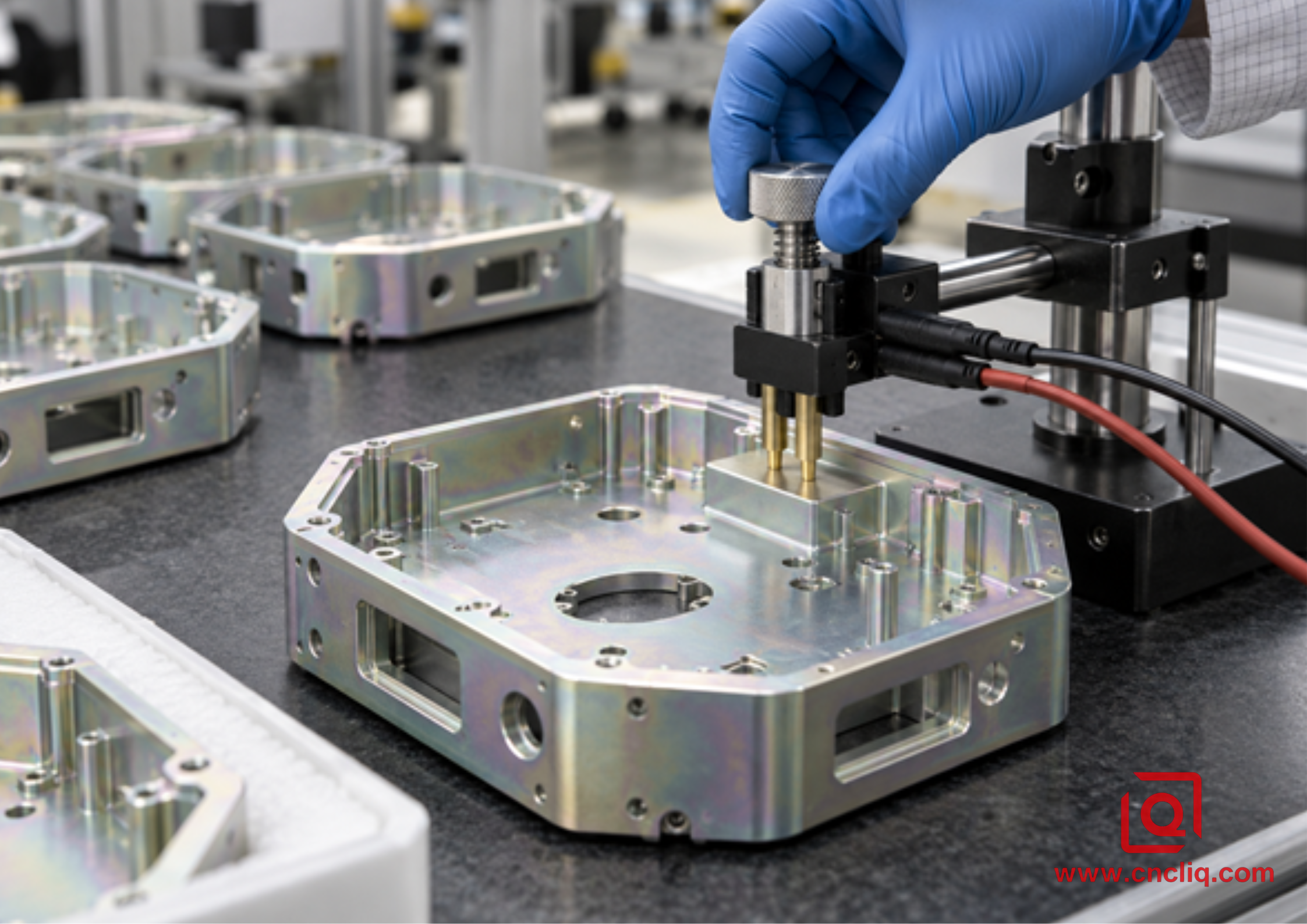
“Conductive finish” is not enough information for inspection. Where are the readings taken? Before or after salt fog? With which electrode area? At 200 psi, at a named fastener torque, or in the final assembly? A four-wire Kelvin setup can remove lead resistance from the result, but it cannot correct a vague contact arrangement. Put the arrangement on the drawing or in the linked quality plan.
Write an RFQ the Factory Can Actually Price
A good finish note starts with the governing document and revision required by the contract. A common example is “Chemical conversion coat per MIL-DTL-5541, Type II, Class 1A.” For a conductive zone, substitute Class 3 and add the project-specific electrical acceptance requirement. If a customer or agency process specification governs instead, name it. Mixing fragments from several standards without a precedence rule invites an argument later.
Then remove the questions that change the route and the price.
· Mark coated, masked, bare, painted, bonded, and conductive zones on a controlled view.
· Say whether critical dimensions apply before or after finishing, and identify post-finish gauges.
· If appearance matters, provide an approved range sample or a measurable criterion. Do not use color as a shortcut for class.
· List the evidence that must ship with the lot: certificate of conformance, qualified-material evidence when applicable, adhesion or salt-fog records, resistance data, material certificate, dimensional report, and traceability.
· Include prototype quantity, annual volume, alloy and temper, raw form, destination market, packaging, and the next assembly process.
For a mixed-finish enclosure, add a section view. Class 1A under exterior paint and Class 3 at an internal pad may be sensible. So may anodizing on wear surfaces and Class 3 at selected electrical contacts. Our overview of aluminum CNC surface finishes helps teams compare those combinations before a quotation turns into a production constraint.
Anonymous Case: A Telecom Housing With Two Surface Jobs
The following is an anonymized composite case. It is realistic, but it is not a promise that one route fits every product.
A communications-equipment buyer requested a compact 6061-T6 housing and mating electrode for an outdoor surge-protection module. The housing included threaded ports, a sealing shoulder, and a flat current-transfer pad. The RFQ said “clear chromate.” The assembly drawing, meanwhile, expected both corrosion protection and dependable grounding. Nobody had stated which surface carried which duty.
During DFM review, the drawing was treated like an interface map. The outer housing was a protective surface. The electrode seat and a defined pad formed the electrical path. The revised package named Type II chemistry, class by zone, datum faces, an unpainted boundary where required by the design, post-finish gauging, and the buyer’s own resistance test on the assembled joint. It also fixed the fastener condition and the sampling rule.
Machining held the pad and locating features in one setup. Deburring removed the raised edge without rolling the contact face. Representative production parts—not a convenient coupon in another alloy—went through cleaning and deoxidizing trials. After coating, the first-article package joined dimensional results, visual inspection, process records, and electrical readings. Soft separators protected the mating faces in export packing.
What changed the outcome? Not a new shade of chem film. The functions were separated early enough for machining, finishing, assembly, and quality to use the same language. That is the practical value of a clear Class 1A vs Class 3 chromate conversion coating plan.
Incoming Inspection: Look Beyond the Certificate
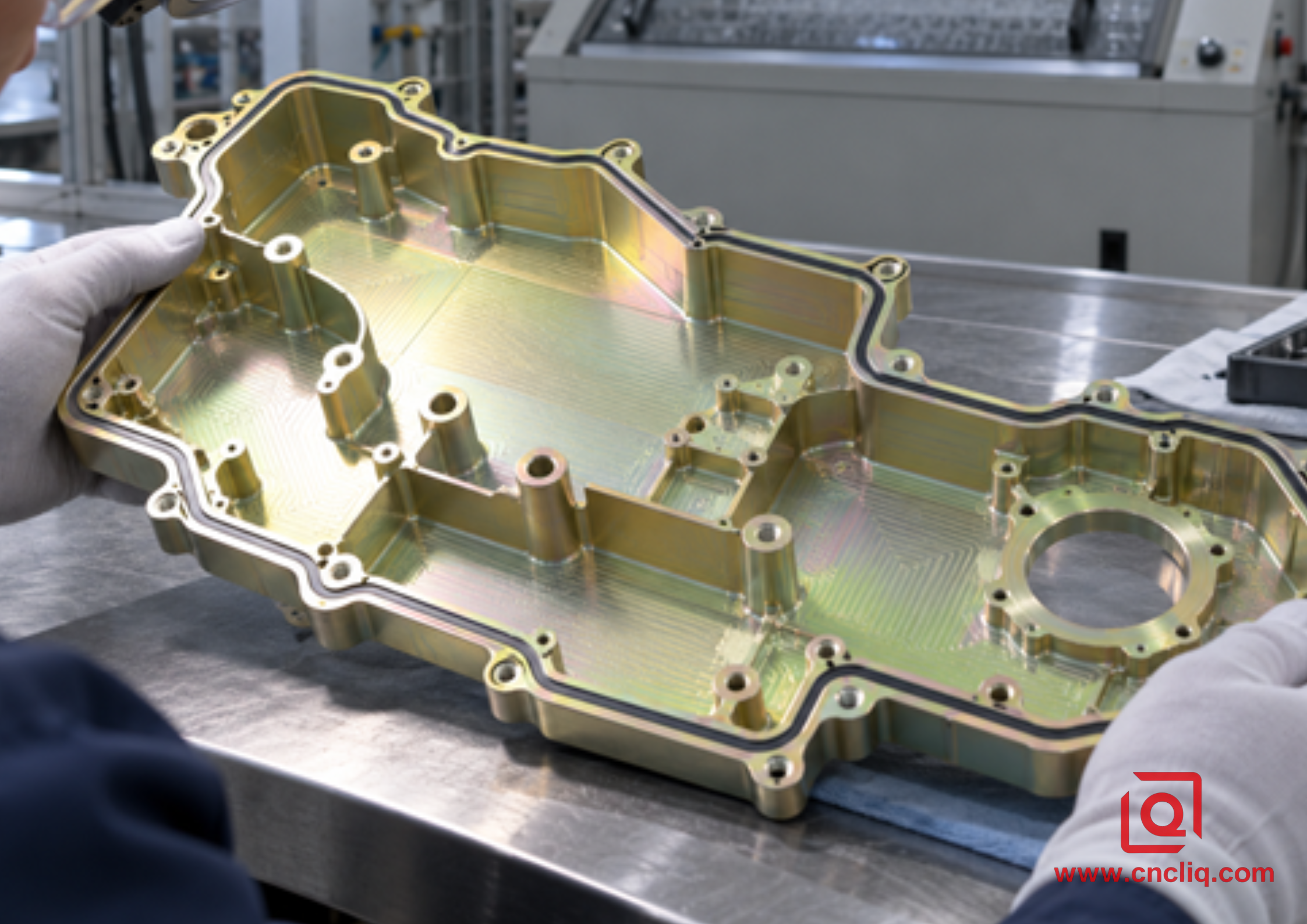
A certificate that repeats the purchase-order callout is useful. It is not the entire acceptance plan. We want evidence that ties the coating batch to the parts on the bench.
1、Match part number, drawing revision, alloy lot, coating lot, type, class, and approved process source.
2、View coverage under consistent light. Look for bare areas, powdery residue, scratches, stains, trapped-solution marks, and damage on functional faces. Record color as an observation, not a class verdict.
3、Check critical dimensions and threads after finishing. Chem film adds very little thickness, but etching, residue, handling damage, or a shifted mask can still stop assembly.
4、Read the evidence required by the order. A Class 1A lot may need corrosion and paint-adhesion controls. A Class 3 lot may add the defined contact-resistance record.
5、Protect accepted surfaces until assembly. Ink, aggressive tape, bare fingers, and abrasive dividers do not belong on a contact pad.
Mistakes That Keep Reappearing
· “Alodine” is written with no specification, chemistry type, class, or qualified-material requirement.
· Clear is treated as Class 3 and yellow as Class 1A, even though color does not certify performance.
· The 5,000 micro-ohm value is copied with no fixture, contact area, pressure, or production sampling.
· A painted assembly is expected to conduct, but nobody marks the current path.
· The process is approved on a flat 6061 coupon while the real part is 7075, welded, cast, or deeply pocketed.
· ASTM B117 hours are presented as a direct forecast of field life.
· A later adhesive cure or paint bake heats an unpainted chem-film area beyond conditions validated for the finish.
Turn the Surface Note Into a Useful Quotation
If you are comparing Class 1A vs Class 3 chromate conversion coating for a new custom aluminum part, send the 2D drawing, STEP model, alloy and temper, volumes, finish-zone map, assembly stack, acceptance limits, and document list with the RFQ. We can review datums, masks, rack locations, mixed-finish feasibility, post-finish inspection, and packing before the route is frozen.
Uncertain which class belongs at a flange or ground pad? Mark the question on the drawing. A short DFM exchange is cheaper than reworking coated hardware. Contact our engineering team for a manufacturing review and a quotation tied to measurable requirements.
FAQ
1、Is Class 1A always more corrosion-resistant than Class 3?
Class 1A is intended for maximum corrosion protection, while Class 3 balances corrosion performance with lower electrical contact resistance. That does not let class alone predict years in service. Alloy, pretreatment, chemistry, coverage, handling, geometry, and any later paint or seal system still shape the result on an actual part.
2、Does Class 3 automatically meet 5,000 micro-ohms per square inch?
No. The 5,000 micro-ohm-per-square-inch value at nominal 200 psi is part of the material-qualification context referenced by MIL-DTL-5541F. It is not a complete production-part acceptance plan. The buyer still needs to define the limit, contact area, fixture, pressure or torque, locations, sample rate, surface condition, and environmental state.
3、Can Type II Class 3 be used for a RoHS-focused project?
Type II is the MIL-DTL-5541 category for compositions containing no hexavalent chromium, and Class 3 names the lower-resistance performance purpose. It is a logical starting point, but final RoHS or REACH evidence depends on the whole material and process chain, current legal scope, customer restrictions, and the documents required on the purchase order.
4、Should a grounding pad be masked to bare aluminum?
Not automatically. Bare aluminum develops native oxide and can be contaminated or damaged during handling. A specified Class 3 film often gives a more controlled protected interface while retaining useful conductivity. If the design genuinely requires bare metal, define the boundary, hardware, preparation, storage, and verification instead of leaving the decision to the finishing supplier.
5、What should I send for an accurate chem-film quotation?
Send the controlled drawing and 3D model, alloy and temper, quantity and forecast, governing standard and revision, Type I or II, class by zone, appearance limits, critical dimensions, masks, rack-mark restrictions, downstream paint or adhesive, electrical and corrosion tests, sampling, certificates, destination, and packing requirements. That lets a supplier price the real route rather than pricing a guess.
Summary
Class 1A puts maximum corrosion protection and paint preparation first; Class 3 protects aluminum while preserving a lower-resistance electrical interface. Choose from the job of each surface, not from color, then define chemistry type, zones, test method, evidence, and handling. A precise drawing turns a vague finish request into a coating plan that can be quoted, produced, and inspected without guesswork.
Contact Information
Company: Ningbo Liqin Industry Co., Ltd.Daily customer maintenance & after-sales support:service@shturl. zhuwanying@cncliq.com
New inquiry, quotation & order discussion:business@shturl. zhouli@chinaliqin.com
Hotline: +86 18757148656
Disclaimer
All technical articles, material specifications, machining recommendations, and surface treatment details published on this blog are for informational and reference purposes only. Please note that general blog insights do not replace signed technical agreements. Because custom parts vary by material heat numbers, machine calibrations, and specific tolerances, binding quality specs are governed solely by your approved CAD drawings, signed contracts, and formal quality plans.
All customer case studies featured on this blog have been thoroughly anonymized and sanitized. The performance metrics, manufacturing workflows, and imagery displayed serve solely to demonstrate our custom machining capabilities and do not represent a single universal standard for all orders.
Liqin Manufacturing Team
Built on 18 years of precision engineering experience, Ningbo Liqin Industry manufactures high-tolerance metal components for demanding global markets. We operate out of a 6,500 m² production hub equipped with over 150 machines, running 4-axis and 5-axis CNC machining, mill-turn machining, cold extrusion, and pressure die casting under one roof. This setup allows us to manage projects seamlessly, taking parts from initial CAD concepts directly to finalized shipments.
We handle quality control with zero compromise. We treat tight tolerances with the engineering discipline they require. Backed by ISO 9001, ISO 13485, and IATF 16949 certifications, our QA engineers run strict IPQC, FQC, and OQC checks on every single production batch. From CMM dimensional mapping and optical profiling to hardness and salt-spray testing, we validate your critical specs upfront—so you receive drop-in ready components with zero assembly headaches or costly line stoppages. On top of manufacturing, you can rely on us for two-hour response times on new RFQs, direct support for prototype sampling, and smooth export shipping across Europe, North America, Asia, and Oceania.
Welcome your inquiries and samples. Visit our website or contact us directly for a competitive quote!