English




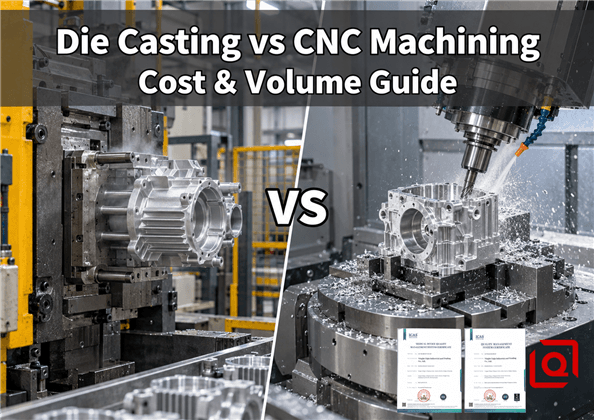
A purchasing team can make an expensive mistake with one innocent question: “Which process has the lower piece price?” That question arrives too early. The real decision is which route creates the lowest approved, delivered cost over the life of the program without locking the design too soon.
CNC machining usually starts quickly. There is no production die to fund, design changes are manageable, and billet gives engineers broad alloy choices plus predictable, dense material. The trade-off is repeated machine time and material removal on every part. High-pressure die casting (HPDC) reverses that cost structure. A production die takes capital and time up front, but the cell can repeat a complex near-net shape quickly once the process is stable. The trade-off is less design freedom after tooling release, casting-specific alloys, porosity risk and frequent secondary machining on functional features.
So there is no honest universal answer such as “switch at 1,000 pieces.” The crossover moves with geometry, alloy, cycle time, cavity count, die life, machining stock, scrap, inspection, engineering changes and the length of the program. This guide gives OEM engineers and sourcing teams a practical way to calculate that crossover, then challenge it before a purchase order is issued.
Quick Answer: Which Process Fits Your Program?
|
Program condition |
Usually stronger starting point |
Why |
|
Prototype, validation build or unstable design |
CNC machining |
Low fixed commitment and fast engineering changes. |
|
Low volume with tight datums, sealing faces or high material-strength requirements |
CNC machining |
Wrought stock and direct control of precision features reduce process uncertainty. |
|
Stable design, complex thin-wall shape and sustained high annual demand |
Die casting |
Tooling can be amortized while near-net forming reduces repeated cutting and material waste. |
|
High-volume body with a bearing bore, gasket face, thread or locating feature |
Die casting + secondary CNC |
Cast the economical envelope; machine only the features that truly need precision. |
|
Demand is uncertain or may stop after one release |
CNC first, reassess later |
A cheap theoretical casting unit price does not recover unused tooling. |
Shop-floor rule: do not compare a finished CNC part with an unfinished casting. Compare two parts at the same acceptance point: deburred, treated, inspected, packed and ready for assembly.
How the Two Processes Create Cost
CNC machining: low fixed cost, repeated variable cost
CNC machining cuts the geometry from bar, plate, extrusion, forging or another blank. The supplier prepares CAM programs, tools, soft jaws or fixtures and inspection methods. Those setup costs are real, but they are normally modest beside a hardened production die. Each additional part then consumes stock, spindle time, tools, handling, coolant, inspection capacity and some share of scrap risk.
A pocketed aluminum housing illustrates the pattern. Buying a large block is only the beginning. The machine must rough away the cavity, semi-finish stable datums, finish critical faces, drill and tap holes, and possibly flip the part several times. Chips may have recycling value, but they do not recover the purchased stock value or the machine hours used to create them. Deep pockets, thin floors, small internal radii and blanket tight tolerances stretch the cycle further. For practical ways to remove those drivers, see Liqin’s seven DFM principles for cutting aluminum CNC cost.
Die casting: high fixed cost, lower repeat cost
HPDC injects molten alloy into a steel die under pressure. The die may include cavity blocks, cores, sliders, ejectors, runners, overflows, vents and temperature-control channels. Tool design, simulation, steel, machining, heat treatment, tryout and correction all arrive before stable production. Once approved, however, one shot can form walls, ribs, bosses and an outer surface that would otherwise demand significant machining.
The casting price is still not just metal plus seconds of machine time. It also includes melt loss, trimming, shot blasting or deburring, process scrap, tool maintenance, inspection and any secondary operations. The NADCA 2024 Product Specification Standards cover tooling, alloy properties, standard and precision tolerances, GD&T, design and quality provisions—exactly the areas a serious casting RFQ must define. Liqin’s custom aluminum die casting OEM playbook adds practical guidance on draft, walls and post-machining.
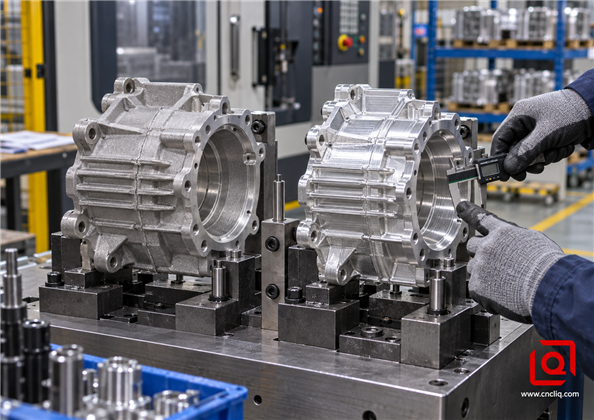
As-cast geometry and CNC-machined geometry should be compared at the same functional acceptance level.
The Break-Even Formula You Can Use in an RFQ
Start with two total-cost equations. Keep the inputs in the same currency and over the same program period.
CNC total cost = CNC setup/NRE + (CNC landed cost per accepted part × quantity)
Die-cast total cost = tooling and qualification cost + (finished cast landed cost per accepted part × quantity) + expected tool maintenance
If the CNC unit cost is higher than the finished casting unit cost, the first-pass crossover is:
Break-even quantity = (die-cast fixed cost − CNC fixed cost) ÷ (CNC unit cost − finished die-cast unit cost)
This is a screening calculation, not a purchase decision. “Finished die-cast unit cost” must include trim, deburring, secondary CNC, surface treatment, leak test or CMM work where specified, packaging and freight. Use accepted parts in the denominator. If the foundry quotes gross shots while your team pays for good parts, the math hides yield loss.
A transparent worked example—not a Liqin quotation
Suppose an engineer receives the following comparison for a stable aluminum housing. These are deliberately labeled sample assumptions, not a claim about a real order: CNC NRE is $600 and its landed accepted-part cost is $46. A casting route requires $24,000 for tool and qualification, then $14 per accepted finished part including secondary machining. Ignoring maintenance for the first screen, the crossover is ($24,000 − $600) ÷ ($46 − $14) = about 731 accepted parts.
That result does not mean the team should automatically release a die at part 732. If forecast confidence is only 60%, a design revision is likely, or the tool needs paid maintenance during the program, the risk-adjusted crossover moves right. If a multi-cavity die produces several parts per shot with a stable long run, it may move left. Ask suppliers to return their assumptions in a common cost sheet rather than hiding them inside a single piece price.
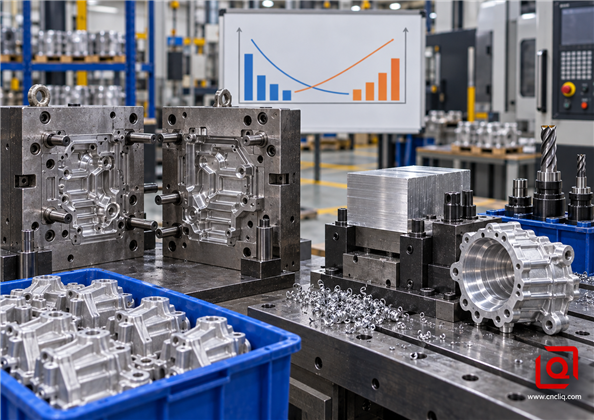
Tooling, stock removal, cycle time and output volume move the crossover; volume alone does not set it.
Cost Drivers Buyers Commonly Miss
|
Cost driver |
CNC impact |
Die-casting impact |
RFQ question |
|
Design revisions |
Usually a CAM or fixture update; severity depends on the change. |
May require insert rework, welding, new slides or a new die. |
Which features can change without cutting new steel? |
|
Material utilization |
Low buy-to-fly ratio can make stock and cycle cost dominant. |
Near-net forming reduces cutting, but runners, overflows and melt losses remain. |
Is scrap credit included, and who owns it? |
|
Precision |
Extra setups, finishing passes and inspection raise cost. |
Critical features may need machining after casting. |
Which callouts are functional and which can remain as-cast? |
|
Quality risk |
Residual stress, tool wear and setup error can cause rejection. |
Porosity, cold shuts, flash and dimensional drift can cause rejection. |
Is price based on gross pieces or accepted pieces? |
|
Capacity and schedule |
Long cycles consume spindle hours; parallel machines may be needed. |
Fast repeat cycles follow a longer tooling and launch phase. |
What is the validated weekly capacity after inspection? |
|
Tool ownership and maintenance |
Fixtures and programs still need ownership terms. |
Die storage, preventive maintenance and end-of-life inserts matter. |
Who owns the tool, and what shot/maintenance records are supplied? |
Tolerance deserves special attention because it can distort both quotes. A sourcing drawing that applies ±0.01 mm everywhere may force slow CNC finishing and broad CMM coverage. The same drawing sent to a foundry may come back with major secondary machining or an unrealistic promise. Separate general geometry from the actual interfaces: bearing bores, dowel locations, sealing tracks, threaded ports and assembly datums. Liqin’s guide to CNC tolerance versus cost explains why small tolerance changes can trigger a different process plan.
Energy is another hidden line. A U.S. Department of Energy study, Energy Consumption of Die Casting Operations, found that melting and holding, alloy, casting yield, scrap, cycle time, machine size, shifts and downstream machining all influence a die-casting facility’s energy use. That supports a practical purchasing point: a process label is not an energy or cost number. Ask for the supplier’s actual route and yield.
Volume Bands: A Better Way to Think Than a Single Threshold
1–50 parts: CNC is normally the practical route for prototypes and engineering verification. The goal is learning. A production die would commit cash before interfaces, thermal behavior and assembly details are stable.
50–500 parts: CNC often remains attractive, especially for complex revisions, regulated validation, replacement parts or uncertain demand. Review fixtures and stock form because repeatability is now important. A simplified bridge process may be considered, but do not call it production economics without a full comparison.
500–5,000 parts: this is the negotiation zone, not an automatic answer. A simple part with short CNC cycle time may stay machined. A deep, heavily pocketed housing with stable geometry may justify casting earlier. Annual quantity, lifetime quantity and release size must all be stated. A promise of 20,000 lifetime units does not help cash flow if only 400 are firmly ordered.
5,000+ parts: a stable, castable geometry increasingly rewards HPDC, particularly where ribs and bosses replace extensive stock removal. Still check mechanical-property needs, cosmetic finishing, leak paths, tool life and the machining allowance on critical zones. Liqin’s CNC machining vs high-pressure die casting decision matrix provides another view of geometry, tolerance and annual scale.
Forecast discipline: calculate at confirmed quantity, most-likely lifetime quantity and upside quantity. If a process wins only in the upside case, it is not yet the low-risk choice.
Geometry, Materials and Surface Finish Can Override Volume
Geometry
Die casting likes reasonably uniform walls, draft, generous transitions and a clear parting strategy. It can form complex outer shapes, ribs and bosses efficiently, but undercuts may require slides and add tool cost. Heavy isolated sections invite shrinkage risk. CNC likes accessible tools, standard corner radii and fewer orientations. Deep narrow pockets, hidden cross-holes and thin unsupported walls add time or distortion risk.
Material
CNC machining can start from wrought 6061, 7075 and many other metals when the drawing and supply route support them. HPDC uses alloys selected for fill, solidification and die behavior, such as common aluminum casting families. Do not swap a wrought alloy for a casting alloy by name alone; review strength, elongation, thermal behavior, corrosion, joining and applicable standards with engineering.
Finish
Machined wrought aluminum is often the cleaner route when decorative anodizing is central. High-silicon die-cast alloys can respond differently, so powder coating, conversion coating, painting or another qualified finish may be more appropriate. Specify appearance zones, masking, coating thickness and whether dimensions apply before or after finish. A vague “black anodize” note can create a quote that looks comparable while describing two different outcomes.
Why the Hybrid Route Often Wins
For many OEM housings, the best answer is not die casting or CNC. It is die casting plus disciplined secondary CNC. The die forms the ribs, exterior walls, bosses and general envelope. CNC then finishes the bearing bore, gasket track, mounting plane, threads and datums. This preserves the casting’s repeat economics without pretending an as-cast surface can satisfy every functional callout.
The handoff has to be designed from the start. Add stable locating pads. Keep critical datum targets in a sensible relationship to the die’s parting arrangement. Leave controlled machining stock, but not so much that the cutter breaks through the dense surface region without need. Define how the fixture handles normal casting variation. Then tie inspection to function instead of measuring every surface with the same intensity. NADCA’s current specification manual explicitly includes datum-location considerations, GD&T and standard versus precision tolerances, making it a useful neutral reference during this handoff.
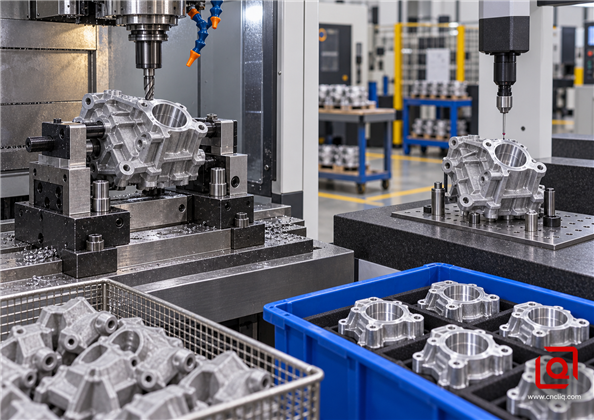
A robust hybrid route casts the envelope, machines critical interfaces and verifies them from defined datums.
Verified Product-Based Case Analysis
Case A: die-cast motor end cap with precision interfaces
Liqin’s published precision motor flange/front end cap is described as a pre-coated black aluminum die-casting with CNC control focused on the bearing bore and locating spigot, including concentricity and perpendicularity. That makes it a useful, verifiable example of the hybrid logic. The general housing geometry benefits from casting, while the rotating assembly interfaces justify targeted machining and inspection. The product page does not publish an order volume or savings percentage, so none is claimed here.
Case B: CNC-machined hydraulic manifold
Liqin’s published custom hydraulic manifold is described as a custom CNC-machined part with multi-directional ports, stepped and blind holes, cross-channels, locating surfaces and an anodized finish. Those internal paths and sealing relationships explain why direct machining can remain valuable: the process offers flexible routing and direct control of ports and datums without committing to a dedicated production die. Again, this is a process-fit analysis of verified product information, not a claim about an unnamed customer’s commercial results.
Together, the two products show why part function beats slogan-level rules. A housing envelope and a fluid manifold may both be aluminum, yet their geometry, interfaces and revision risk can point to different routes.
Anonymous Buyer Scenario: A Decision Without Invented Results
An anonymized industrial equipment buyer asked its supply team to compare routes for an aluminum drive housing. To protect confidentiality, no order values, dimensions, customer identity or performance results are presented. The useful part is the decision method. Engineering separated the drawing into three groups: castable envelope features, CNC-critical interfaces and nonfunctional cosmetic surfaces. Purchasing requested three quotes at confirmed, expected and upside volumes. Each supplier had to disclose tooling, qualification, finished accepted-part cost, machining operations, yield basis, maintenance responsibility and lead time. The team kept CNC for validation builds, froze the interfaces after assembly testing, and treated a cast-plus-CNC route as a later production option rather than assuming the prototype process had to remain forever. This staged approach reduces tooling-regret risk while keeping a clear path to scale; exact savings must be calculated from the buyer’s real quotes.
How to Build an Apples-to-Apples RFQ
1. Send both 3D and controlled 2D data. The model defines shape; the drawing defines critical dimensions, datums, finish and acceptance.
2. State quantity three ways. Include first release, annual demand and expected program life. Mark what is firm and what is forecast.
3. Identify frozen and changeable features. This lets a die designer consider replaceable inserts and prevents an early steel commitment around unstable geometry.
4. Separate as-cast and machined requirements. Mark surfaces, stock allowance, datums, threads, bores and sealing tracks.
5. Define alloy and condition precisely. Ask for any proposed substitution in writing, with the standard and mechanical-property basis.
6. Request a cost stack. Tool, NRE, raw material, casting or machine cycle, secondary operations, finish, inspection, packaging and freight should be visible.
7. Define quality evidence. State sampling, CMM report, material certificate, coating report, capability study, leak test or other project-specific records.
8. Clarify tool terms. Ownership, storage, preventive maintenance, expected life, repair approval and transfer conditions belong in the commercial package.
9. Ask for a DFM call before final quote. Ten minutes on wall transitions, parting line, tool access and blanket tolerances can remove more cost than weeks of price negotiation.
If you want Liqin’s engineers to compare the two routes, send a STEP model, 2D drawing, target alloy, surface finish, first order quantity, annual forecast and the features that cannot move. Ask for separate CNC, die-cast and hybrid assumptions where all three are feasible. That gives your team a decision record—not just a low number in a spreadsheet. Request a manufacturability review and quotation.
Click Here For Your Inquiry 👆
FAQs
1. Is die casting always cheaper than CNC machining at high volume?
No. High volume improves tool amortization, but geometry, alloy, yield, secondary machining, surface treatment, inspection, maintenance and forecast certainty still control the result. Compare finished accepted parts over the full program and calculate the crossover with supplier-specific inputs.
2. What production volume should trigger a switch from CNC to die casting?
There is no fixed threshold. Prototype and uncertain programs usually favor CNC, while stable sustained demand makes die casting more attractive. Run the arithmetic with your own quotes. Check it once against firm releases, again against the working forecast, and once more against the upside case. A borrowed 1,000-piece cutoff is not a sourcing strategy.
3. Where should a casting stop and precision machining begin?
Not across every feature as-cast. HPDC can form repeatable near-net geometry, but bearing bores, gasket tracks, precision datums and close-fit holes often need secondary CNC machining. Put tight controls only where the assembly needs them and define the inspection datum scheme.
4. Which process is better for design changes?
CNC machining is normally more forgiving because many changes affect CAM programs, tools or fixtures rather than hardened production steel. A die can sometimes use replaceable inserts, but major wall, gate, slide or parting changes may require costly rework or replacement.
5. What information is needed for an accurate die casting vs CNC quote?
Provide the 3D model, controlled drawing, alloy, finish, critical-to-function features, inspection plan, first release, annual and lifetime quantities, program timing, packaging and delivery location. Make every bidder show what sits behind the price: tooling, launch charges, expected yield, follow-on operations and the cost of one accepted part at your dock.
Summary
Start with CNC when the drawing is still moving, the batch is small or the precision work dominates. Let die casting take over only after the geometry settles and the expected run can genuinely pay the tool back. Many housings land in the middle: cast the broad shape, cut the few faces and bores that matter, then inspect from practical datums. Price both routes to the same delivered, assembly-ready condition before you choose.
Contact Information
Company: Ningbo Liqin Industry Co., Ltd.
Daily customer maintenance & after-sales support:service@shturl. zhuwanying@cncliq.com
New inquiry, quotation & order discussion:business@shturl. zhouli@chinaliqin.com
Hotline: +86 18757148656
Disclaimer
All technical articles, material specifications, machining recommendations, and surface treatment details published on this blog are for informational and reference purposes only. Please note that general blog insights do not replace signed technical agreements. Because custom parts vary by material heat numbers, machine calibrations, and specific tolerances, binding quality specs are governed solely by your approved CAD drawings, signed contracts, and formal quality plans.
All customer case studies featured on this blog have been thoroughly anonymized and sanitized. The performance metrics, manufacturing workflows, and imagery displayed serve solely to demonstrate our custom machining capabilities and do not represent a single universal standard for all orders.
Liqin Manufacturing Team
Built on 18 years of precision engineering experience, Ningbo Liqin Industry manufactures high-tolerance metal components for demanding global markets. We operate out of a 6,500 m² production hub equipped with over 150 machines, running 4-axis and 5-axis CNC machining, mill-turn machining, cold extrusion, and pressure die casting under one roof. This setup allows us to manage projects seamlessly, taking parts from initial CAD concepts directly to finalized shipments.
We handle quality control with zero compromise. We treat tight tolerances with the engineering discipline they require. Backed by ISO 9001, ISO 13485, and IATF 16949 certifications, our QA engineers run strict IPQC, FQC, and OQC checks on every single production batch. From CMM dimensional mapping and optical profiling to hardness and salt-spray testing, we validate your critical specs upfront—so you receive drop-in ready components with zero assembly headaches or costly line stoppages. On top of manufacturing, you can rely on us for two-hour response times on new RFQs, direct support for prototype sampling, and smooth export shipping across Europe, North America, Asia, and Oceania.
Welcome your inquiries and samples. Visit our website or contact us directly for a competitive quote!