English




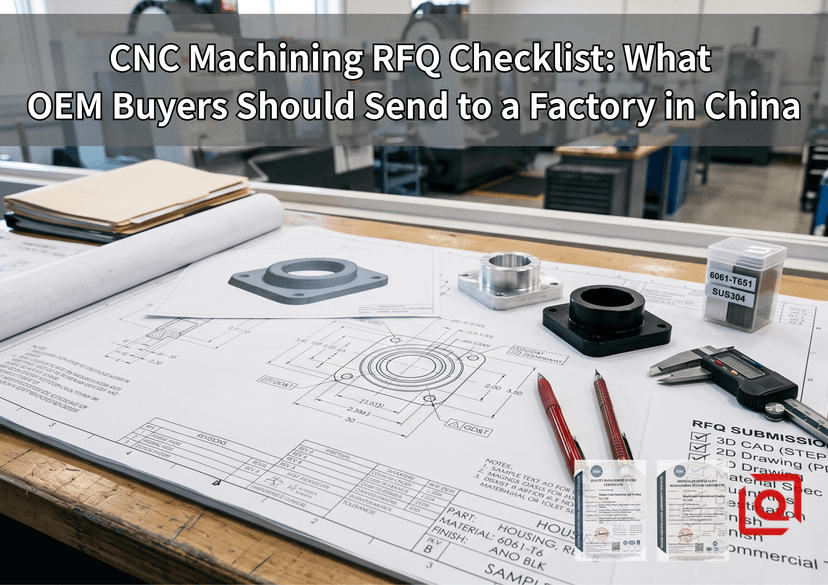
Short answer: Treat the RFQ as a small version of the build contract. Name the part and revision; call out the exact material condition; flag the dimensions that truly matter; state finish, inspection evidence, quantities, destination, and commercial terms. Attach native 3D CAD together with the controlled 2D drawing, and say which file wins if they disagree. Suppliers can then price the same job instead of filling the blanks with different assumptions.
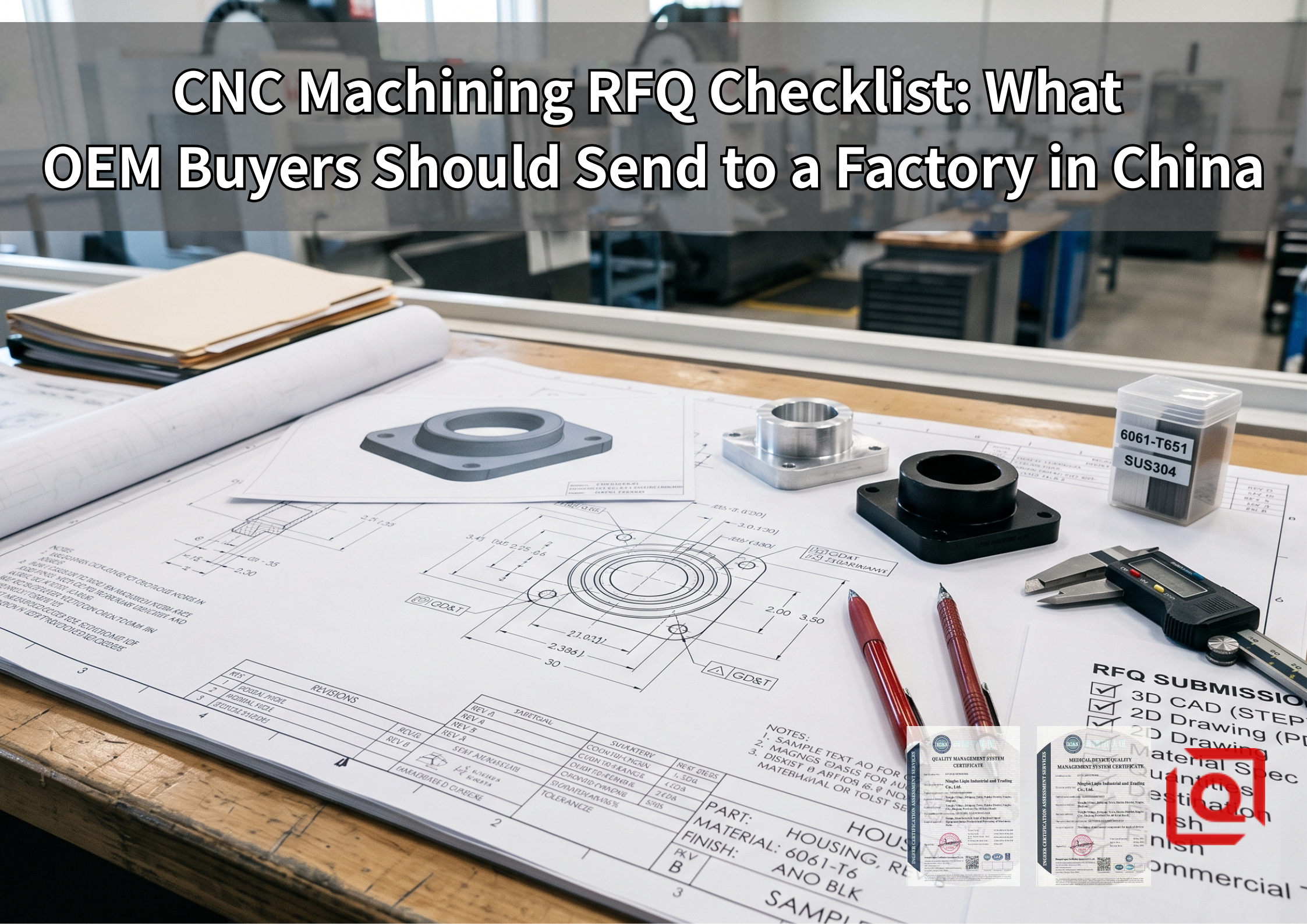
An RFQ is more than a request for a number; it is where design intent first crosses from the buyer's desk to the manufacturing team. Leave a gap and each supplier will close it in a different way. One might price ordinary commercial tolerances. A second budgets a complete dimensional report. A third leaves out anodizing, individual wrapping, or freight. Nobody has to be acting badly for the totals to be miles apart—the jobs in their spreadsheets simply are not the same.
This RFQ checklist is a working note for OEM engineers, sourcing managers, and supply-chain teams. It covers the files worth sending, the awkward questions worth asking, and the details that often hide outside a quoted unit price. It also shows where DFM belongs and how an early prototype enquiry can grow into a controlled production release. No single template fits every part. The useful habit is simpler: make each requirement intentional, traceable, and possible to compare.
The minimum RFQ package at a glance
In a rush? Use the table as a first-pass packing list. A factory can begin a feasibility discussion while a few commercial points are still open; production release is a different matter and needs one consistent data set. Write “to be confirmed” beside an unknown. A visible question is safer than a silent guess.
| RFQ element | What to send | Why it changes the quote | Common failure |
|---|---|---|---|
| Part identity | Part number, name, revision, assembly reference | Prevents obsolete geometry from being priced | CAD and drawing show different revisions |
| Geometry | STEP or other agreed 3D format plus PDF/DXF drawing | Drives stock size, process, tools, setups, and cycle time | Screenshot or STL used as the sole authority |
| Material | Alloy/grade, temper or condition, approved specification | Changes price, machinability, distortion risk, and availability | “Aluminum” or “stainless” without grade |
| Requirements | Critical dimensions, GD&T, threads, roughness, edges, cleanliness | Determines tooling, fixturing, inspection, and risk allowance | Every dimension treated as equally critical |
| Finish | Process, color, texture, coating thickness or governing standard, masking | Adds outside processing, handling, and dimensional effects | “Black anodize” with no functional criteria |
| Quality evidence | FAI, material certificate, CMM report, sampling plan, special-process certificate | Defines inspection labor and documentation | Requesting “full report” without defining scope |
| Demand | Prototype quantity, production breaks, annual demand,release pattern | Spreads setup cost and changes tooling strategy | Asking for one unit price with no volume |
| Delivery and terms | Need date, destination, Incoterm, packaging, currency, payment expectations | Separates manufacturing cost from logistics and finance | Comparing EXW with delivered pricing |
1. Establish one controlled definition of the part
Use a part number and revision that appear in every file
Begin with a simple identity block: customer name or project code, part number, part description, revision, and RFQ date. Put the same information in the email, the file names, and the drawing title block. If a zip package contains several parts, include a bill of materials or RFQ index that maps each part number to its files and requested quantities. This small discipline prevents a common sourcing failure: the commercial team quotes revision B while the engineer expects revision C.
State which source governs when the model and drawing disagree. A typical arrangement is that the 3D model controls untoleranced geometry while the 2D drawing controls GD&T, threads, surface finish, material, notes, and special characteristics. Your actual rule may differ. Write it down. If model-based definition is used, identify the native model or annotated derivative that contains the authoritative product definition.
Do not send multiple uncontrolled files named “final,” “final2,” and “latest.” A supplier cannot price configuration risk with confidence.If alternatives are intentional, label them Option A and Option B and request separate quotations. If a legacy drawing has known errors, issue a marked clarification sheet rather than relying on a phone conversation that may never reach the programmer or inspector.
Choose useful geometry formats
STEP is widely useful for neutral solid geometry because it carries accurate surfaces and can be read by many CAD/CAM systems. Parasolid and supported native formats can also work well. A 2D PDF remains important because it communicates requirements that geometry alone does not express. DXF may help for profiles, but it should not silently replace a controlled drawing. STL is a tessellated mesh; it can be helpful for visualization or some prototype workflows, but it is usually a weak sole authority for precision machined geometry.
Before sending, open the exported file in a neutral viewer. Confirm units, body count, missing features, suppressed components, hole geometry, and the overall bounding size. A millimeter/inch mistake is obvious after machining and often invisible in a rushed RFQ. For assemblies, send the assembly view for context and individual manufacturing files for each quoted item. Identify purchased inserts, bearings, seals, pins, and fasteners so the supplier knows whether to procure, install, or exclude them.
2. Define material beyond the family name
“Aluminum,” “steel,” and “plastic” are family names, not buying specifications. A usable callout includes the alloy or grade, temper or heat-treated condition, the relevant product form, and the specification your organization accepts.Why the fuss? Two materials with similar everyday names may differ in availability, strength, residual stress, corrosion response, chip behavior, tool wear, downstream treatment, and paperwork. Those differences reach both price and risk.
With aluminum, T6 and T651 are not labels to swap casually; keep the condition required by the design and stock form. Nor should a buyer assume that naming conventions travel perfectly between regions, or that the nearest available grade is automatically acceptable. ASTM B07.03 currently lists ASTM B211/B211M-23 for rolled or cold-finished bar, rod, and wire, while ASTM B221-21 covers extruded products. Match the purchase specification to the product form on this job. Copying a standard from an old drawing is not material control.
A permitted substitute still needs guardrails. One workable note is: “The supplier may propose an alternative with its mill certificate, a property comparison, a corrosion review, and written buyer approval before production.” That gives purchasing room to solve a shortage without handing over design authority. When no substitute is allowed, put that in plain words. Also be specific about proof: perhaps a certificate of conformance is enough, or perhaps the job needs the original mill certificate, heat or lot linkage, positive material identification, or another traceability record.
Material-specific sourcing pages can help buyers organize questions without turning this RFQ into a general alloy guide. For projects that may involve an aluminum cnc machining factory china, the RFQ should state alloy, temper, finish, and dimensional features affected by coating. A buyer evaluating a 6061 aluminum parts factory china should add the applicable stock-form specification and certificate requirement. For higher-strength designs, a request to a 7075 aluminum machining factory china should also define the approved temper and the service conditions the supplier must consider.
Do the same for other metals. An inquiry to a stainless steel machining factory china should specify grade, condition, passivation or other finish, and any contamination-control expectation. For a brass cnc machining factory china, identify the exact brass designation and any lead-content or regulatory restrictions. A copper cnc machining factory china inquiry may need conductivity, plating, contact-surface, burr, or cleanliness requirements in addition to dimensional controls.
3. Communicate tolerances as functional requirements
Do not apply the tightest tolerance everywhere
Tighter tolerances can change the entire process plan.They may require a more stable stock condition, roughing and stress relief, additional setups, custom workholding, slower finishing cuts, temperature control, in-process probing, grinding, or more extensive inspection. If only two features control fit, identify those features. A blanket title-block tolerance that is unnecessarily tight on every nonfunctional surface increases cost without improving the assembly.
Choose bilateral, unilateral, limit, or geometric tolerances for the function they control. Datums should follow how the part seats and locates in the assembly, not whichever face makes the drawing easy to arrange. ASME lists Y14.5-2018 (R2024) as its reference for the language and interpretation of GD&T in drawings and digital definitions. For an RFQ, the practical point is consistency. Name the edition, then check that the proposed datum scheme and controls can actually be measured.
Also define surface roughness only where it serves sealing, sliding, fatigue, optical, cosmetic, or coating functions. Specify the parameter and units. A bare “Ra 0.8” can be misread when units are not explicit. If lay direction or measurement cutoff matters, state it. For edge requirements, distinguish “remove sharp edges” from a controlled edge break or radius. The first is a workmanship note; the second is a measurable feature that may need dedicated tooling and inspection.
Ask the factory to identify capability assumptions
A quotation ought to keep drawing requirements on one side and supplier assumptions on the other. Request the general tolerance used for untoleranced features, the proposed inspection method for critical characteristics, and a note against anything the shop cannot verify internally. When evaluating a precision cnc machining factory china, a machine's published positioning figure is only one clue. The finished part is also influenced by its geometry and material, the setup, tool condition, shop environment, measurement method, and batch size.
Invite a blunt answer about any feature that cannot be reached, clamped, deburred, coated, cleaned, or checked as drawn. That single request turns a price exercise into an early technical review, and it leaves a paper trail before the purchase order. A custom gauge deserves its own short agreement: designer, owner, approval method, storage, and whether calibration and upkeep sit inside or outside the quoted amount.
4. Select a likely process without prescribing an impossible route
Define the function and the hard limits, then leave room for the manufacturer to suggest a sensible route. A note that simply says “CNC mill” can shut out turning, mill-turn work, extrusion plus machining, casting plus machining, or a multi-axis plan for no good reason. The opposite mistake is just as costly: approving a cheaper process before anyone has reconciled material, porosity, datums, cosmetic faces, traceability, and validation.
For a prismatic part, the conversation with a cnc milling factory china should get concrete: can the tool reach the floor, how deep is the pocket, what radius is realistic, where will a thin wall move, and which faces can touch the fixture? With a cnc turning factory china, shift the discussion to runout, concentricity, thread standards, seals, cutoff faces, flats, and cross holes. A mill turn machining factory china may remove a handoff, but its quotation still needs a believable workholding and inspection story.
Freeform surfaces and close positional relationships across several faces may point toward a 5 axis cnc machining factory china. Find out whether the plan uses 3+2 positioning or true simultaneous five-axis motion when the answer affects reach, finish, inspection, or price. Fewer setups may reduce errors transferred from one datum to the next. Still, “five-axis” is not a magic promise of tighter dimensions or a lower bill.
For early builds, a cnc prototyping factory china should distinguish prototype intent from production intent. Is the part proving geometry, material performance, appearance, assembly, or manufacturing process? A finish-look prototype may not validate a production machining sequence. A functional prototype may need the production alloy and critical tolerances but can relax nonfunctional cosmetics. Write the test purpose so the factory knows where not to compromise.
For repeat orders, a production cnc machining factory china quotation should discuss fixture strategy, tool-life control, lot traceability, change control, capacity reservation, and replenishment. A low volume cnc machining factory china may use flexible fixtures and combine operations differently because setup cost is spread across fewer pieces. Ask for quantity breaks rather than assuming the one-piece prototype price scales linearly.
5. Specify surface treatment as part of dimensional design
Finish requirements need more than a process name and color. State the base material, pretreatment, finish system, appearance class, color reference or approved sample, texture, gloss if relevant, coating thickness or applicable standard, masking areas, rack-mark allowance, electrical contact areas, corrosion or wear requirement, and post-finish inspection. Identify dimensions that apply before coating and those that apply after coating.
When the project uses a china machining factory surface finishing workflow, ask the quoting team to say which operations are in-house and which are performed by approved partners. Outside processing can be entirely appropriate, but it changes transport, handling, queue time, traceability, rework responsibility, and lot control. The quote should identify the party responsible for final acceptance.
Anodizing is especially easy to underspecify. A request framed around china cnc factory anodizing tolerances should identify coating type, thickness range or governing specification, masking, plug-gauge strategy, and whether fit dimensions are verified before or after finishing. The RFQ should not assume a universal dimensional change. Growth depends on the specified process and acceptance method, while stripping and re-anodizing may affect dimensions and appearance.
For wear surfaces, a buyer looking for hard anodized aluminum parts factory china should define functional contact areas, coating thickness, sealing, color acceptance, roughness, masking, and any post-treatment grinding or lapping. Threads, bearing bores, electrical grounds, and press fits deserve explicit notes. If the assembly uses a mating sample, state whether the factory will receive it and how acceptance will be recorded.
6. Give quantities that represent the purchasing plan
Quantity is not one box on a form. Show the path if you know it: samples, first production lot, normal release size, likely annual demand, ordering rhythm, and expected program life. A shop looking at five parts makes different choices from one preparing for five thousand. The numbers influence soft jaws versus dedicated fixtures, standard versus custom cutters, bar feeding, probing, automated inspection, and even how raw stock is purchased.
Price breaks should match choices somebody might actually make. Five, 25, 100, 500, and 1,000 pieces is a sensible ladder for some programs and meaningless for others. Use your likely release sizes.Where practical, keep setup and one-time engineering on separate lines; repeat-order economics are much easier to read when nonrecurring work has not been buried in a convenient unit price.
Expecting staggered releases? Show how orders will work in practice—scheduled releases under one PO, a blanket order, vendor-managed stock, call-offs, or separate orders. Decide in advance whether the supplier can purchase a year's material and who takes unused stock if demand falls away. That choice changes cash exposure, storage, obsolescence, traceability, and price.
Do not ask for an artificially low MOQ without explaining the program. A factory may quote a low-volume pilot competitively when it can see a credible transition plan, compatible future parts, or repeat releases. Equally, do not present an optimistic annual forecast as a guaranteed order. Label forecasts, committed quantities, and optional volumes separately.
7. Define inspection evidence before comparing price
“100% inspection” is incomplete. It may mean a visual check, a few hand-tool measurements, every drawing dimension, or every critical characteristic. Define what is measured, how often, by which method, and what record accompanies the shipment. Separate process-control measurements from customer-reporting requirements.
A practical plan might require a first article report for the first production run and after defined changes, 100% verification of a short list of critical dimensions, and lot sampling for other characteristics. The appropriate plan depends on risk, process capability, regulatory obligations, and the cost of failure.ISO’s official page for ISO 2859-1:2026 describes AQL-indexed single, double, and multiple sampling schemes for lot-by-lot inspection by attributes. A buyer should not paste an AQL number into an RFQ without defining defect classes, lot formation, inspection level, switching rules, and the relationship to critical characteristics.
Ask for measurement traceability that fits the project. NIST explains that metrological traceability is a property of a measurement result linked through a documented, unbroken calibration chain, with each link contributing to measurement uncertainty. The NIST metrological traceability guidance also warns that merely having an instrument calibrated is not, by itself, enough to make every result traceable. For a CNC RFQ, request current calibration status, identified equipment, method, environmental conditions where material, and measurement uncertainty where it can affect conformity decisions.
Use the supplier’s quality assurance page as a starting point, then ask project-specific questions. Equipment photographs are useful context, but they do not prove that the selected instrument, program, fixture, probe strategy, and uncertainty are appropriate for your feature.If coating, heat treatment, plating, or testing goes outside, decide what must come back with the parts: a processor certificate, test result, accreditation detail, buyer approval, or some combination of them.
8. Make the quotation easy to compare
A useful china cnc machining factory quotation should make the scope visible. It does not need to reveal confidential hourly rates or every internal margin. It should let the buyer determine what is included, what is excluded, which assumptions drive the price, and what changes at different quantities.
| Cost block | Buyer question | Why it matters |
|---|---|---|
| Material | Which grade, condition, stock form, allowance, and certificate are included? | Exposes substitution and yield assumptions |
| Engineering | Are programming, DFM, documentation, and first-article work recurring or one-time? | Clarifies repeat-order price |
| Tooling and fixtures | Record the payer, owner, storage location, and upkeep rule. | Avoids an ownership argument on the next order |
| Machining | Which process route and number of setups are assumed? | Helps evaluate capability and risk |
| Outside processing | Which finish, heat treatment, test, and certificates are included? | Prevents missing process costs |
| Inspection | What inspection frequency and report format are included? | Separates verification levels |
| Packaging and logistics | What packaging, destination, Incoterm, duty, tax, and freight basis apply? | Makes landed comparisons fair |
When comparing a cnc machining factory china with another source, normalize the quotation before ranking it. Put every offer into the same matrix: exact revision, material, finish, inspection, packaging, quantity, currency, Incoterm, tool ownership, lead-time definition, and validity period. A lower unit price that excludes first article, coating, or freight may be the higher landed cost.
Also ask what triggers a requote. Common triggers include revision changes, annual volume changes, raw-material movements, exchange rates, urgent delivery, special certificate requirements, or a changed inspection plan. A supplier should not be punished for identifying legitimate uncertainty. The buyer’s goal is to make uncertainty explicit and manageable.
9. Treat DFM as a controlled proposal
A useful cnc machining factory china dfm review cannot stop at “increase radius” or “relax tolerance.” It should point to the feature, show the manufacturing problem, and offer a specific change. What might that change do to price, timing, risk, or quality? The buyer needs enough information to decide. Until the design owner signs off, a DFM comment remains a proposal—not a new drawing requirement.
Ask the supplier to classify comments. One useful scheme is: quotation assumption, manufacturability blocker, cost-reduction opportunity, inspection concern, finishing concern, and production-risk item. For every blocker, request the smallest viable design change or an alternative process. For every cost opportunity, request a separate price so the engineer can judge value rather than approve a change blindly.
Typical DFM topics include tool access, internal corner radius, deep pockets, long slender bores, thin walls, interrupted turning, thread depth, undercuts, datum accessibility, clamping surfaces, burr access, cosmetic faces, coating growth, rack marks, distortion, and inspection access. The correct decision depends on function. A deep pocket may be expensive but necessary. A tight profile tolerance may protect an assembly interface. DFM should illuminate the tradeoff, not override the drawing.
Control the accepted outcome with a revised drawing or documented deviation. Do not approve a permanent design change only in a chat thread. Record the part number, revision, affected requirement, disposition, approver, date, quantity or lot limit, and whether the change is temporary or permanent.This record becomes essential when a prototype succeeds and the project moves to production.
Request a DFM Review and CNC Quote
10. Plan the prototype-to-production release
The prototype order and the production order should not share an undefined acceptance standard. Before the prototype, state what the build is intended to learn. After the build, record the inspection result, assembly result, test result, finish approval, open deviations, and required drawing changes. Then issue a controlled production release.
For repeat production, ask how the supplier controls the approved program, fixture, cutting tools, inspection program, outside processors, and material source. Define notification requirements for changes. Some changes are harmless, some require a new first article, and some require customer validation. Your purchase order and quality agreement should reflect the project’s actual risk and regulatory context.
Look past the sales claims and ask for evidence. In its overview, ISO presents ISO 9001 as agreed requirements for a quality-management system; it is not a universal factory playbook. Treat the certificate as context. Read the holder, issuer, dates, scope, site address, and revision, then match that scope to the work being quoted.
Do not wait for a problem before drawing the escalation route. Put a name or role beside technical questions, deviations, threatened deliveries, and corrective action.The clock difference is manageable; a question with no owner is not. Be cautious when a spectacular lead time comes without a clear route for approvals. A modest schedule with named responsibilities may be the safer plan.
11. Know when casting should be quoted as an alternative
CNC machining is often appropriate for prototypes, lower volumes, changing designs, and parts that benefit from wrought stock. At higher or sustained volumes, a casting route followed by machining may reduce material removal and cycle time. That does not make casting automatically better. Put the tradeoffs on one page: tooling investment, porosity, draft, walls, parting lines, ejector marks, alloy and heat treatment, dimensional capability, leak criteria, and the cost of a late engineering change.
When contacting an aluminum die casting factory china, send the volume outlook and program life first. Add the machined interfaces that matter, pressure or leak criteria, cosmetic zones, relevant x-ray or test needs, and the planned validation stages. Then pin down the handoff: is the offer for raw castings, or for completed parts after machining, finishing, and inspection?
When reviewing die casting factory china tooling cost, pull the tool price away from the piece price. The tool line should name the owner, cavity count, material, assumed shot life, maintenance and repair rules, storage, sampling, modifications, and transfer terms. Then check the smaller items—trim tools, fixtures, gauges, spare inserts.They are easy to miss and expensive to discover later. Compare the program, not one unit price tied to one forecast.
If the design is not frozen, price both routes. A machined version can support functional validation while casting DFM and tool design proceed. Define whether the machined prototype is expected to reproduce cast material behavior; usually it does not. The buyer should keep geometry validation, material/process validation, and production-rate validation as separate questions.
12. Protect files and control communication
Before transmitting controlled files, determine whether an NDA, data-processing agreement, export-control review, or customer authorization is required. Use the approved secure channel. Label confidential packages, limit distribution, and remove unrelated assemblies or proprietary information from the RFQ. A supplier needs enough context to manufacture correctly, but it does not need your entire product archive.
Ask how the factory controls access, backups, employee permissions, subcontractor transmission, and retention. If outside processors require drawings, define which information may be shared and how the supplier remains responsible for confidentiality. For regulated or defense-related work, obtain legal and compliance guidance appropriate to the destination, technical data, nationality restrictions, and contract. A general NDA does not replace those obligations.
Commercial and technical records must move together. If engineering accepts a DFM change, purchasing and the supplier's production team need the same controlled note.If quantity or delivery terms move, the quotation revision should move too.Keep one accountable RFQ log; decisions scattered among email, chat, and meeting notes are almost designed to be missed.
13. A hypothetical RFQ comparison example
Consider a hypothetical machined aluminum housing used only to illustrate RFQ logic. The initial package contains a STEP model, a drawing labeled revision A, “6061 aluminum,” black anodize, and a request for 100 pieces. Supplier One assumes 6061-T6 extruded stock, general tolerances for untoleranced dimensions, Type II black anodizing, visual inspection, EXW shipping, and no formal dimensional report. Supplier Two assumes 6061-T651 plate, masks two bores, measures all drawing dimensions, provides a first-article report, individually protects cosmetic faces, and quotes delivered freight.
The prices cannot be compared because the scopes are different. The buyer revises the RFQ to specify 6061-T651 plate under the approved material standard, identifies four critical dimensions, defines the post-anodize acceptance condition for two bores, states the anodizing requirement, requests one first-article report plus 100% verification of the four critical dimensions, defines packaging, and asks for EXW and freight as separate lines. Both suppliers then quote the same revision and scope.
This example deliberately avoids a claimed saving, universal lead time, or “typical” price. Those figures move with geometry, location, machine route, finish, batch size, evidence requirements, and the market. What matters here is the method: remove hidden assumptions first.A remaining price gap is then worth investigating.It may come from process, capacity, service, or margin; at least the team is investigating a real difference rather than guessing.
14.Questions worth putting to the supplier
- Which revision and files did you use for the quotation?
- What material grade, condition, stock form, and certificate are included?
- What stays inside your plant, and what work goes to an outside processor?
- What process route, machines, setup count, and fixture strategy are assumed?
- Which drawing requirements drive the greatest cost or risk?
- What DFM changes are blockers, and which are optional savings?
- How will the critical characteristics be measured and reported?
- Which finishing standard, thickness, masking, color, and acceptance method are included?
- What tooling, programming, fixture, gauge, or first-article charges are nonrecurring?
- Who owns and maintains dedicated tooling and gauges?
- How does the price change at realistic release quantities?
- When does quoted lead time start: purchase order, deposit, final drawing approval, or material receipt?
- What is excluded from the unit price and the stated Incoterm?
- What changes require buyer notification or a new first article?
- How are nonconforming parts contained, investigated, and replaced?
These questions are more useful than asking whether a factory is “good.” A capable supplier should be able to explain boundaries, assumptions, and evidence without turning the discussion into a list of machine brands. The answers also help the buyer decide whether the relationship fits a prototype, a low-volume bridge, or a long-running production program.
15.A copy-ready CNC RFQ checklist
Project and files
- Buyer company and project code
- Part number, description, and revision
- 3D CAD format and controlling-model statement
- 2D drawing with units, scale, projection, and governing standard
- Assembly drawing, BOM, mating-part or functional context where needed
- Conflict rule between model, drawing, specification, and purchase order
Material and process
- Exact material grade, temper/condition, stock form, and approved specification
- Substitution permission and approval path
- Required heat/lot traceability and certificates
- Preferred process, if mandatory, or permission to propose alternatives
- Insert installation, welding, heat treatment, or special-process requirements
Technical acceptance
- Critical dimensions and special characteristics
- GD&T standard and revision
- Threads, inserts, sealing surfaces, and gauges
- Surface roughness parameter, units, and measurement conditions
- Edge breaks, burr limits, cleanliness, and cosmetic zones
- Finish process, color, texture, thickness/standard, masking, and rack marks
- Pre-finish versus post-finish dimensional requirements
Quality and evidence
- First article requirement and trigger for repetition
- Inspection frequency for critical and noncritical characteristics
- Report template, ballooned drawing, CMM output,and language
- Material and special-process certificates
- Sampling plan, defect classes, and lot definition where used
- Gauge ownership, calibration, and measurement-traceability requirements
- Nonconformance, deviation, corrective-action, and change-notification rules
Commercial and delivery
- Prototype, pilot, release, and annual quantities
- Price breaks and separation of nonrecurring charges
- Currency, payment terms, quotation validity, and tax treatment
- Need date, destination, shipping mode, and Incoterm
- Packaging, labeling, preservation, and documentation
- Requested production lead time and its starting event
- Contact for technical questions and approval turnaround
FAQ for OEM buyers requesting CNC quotations
Can I request a quote without a finished drawing?
Yes, for an early budget or feasibility discussion. Send the most accurate 3D model available, explain the part’s function, identify known material and finish needs, provide approximate quantities, and list the decisions still open. Ask the supplier to label the result as a budgetary estimate with assumptions. A firm production quotation normally requires a controlled definition of tolerances, notes, acceptance, and commercial scope.
Should I send a STEP file or a 2D drawing?
Send both when possible. The 3D model communicates geometry efficiently.The 2D drawing communicates requirements that may not exist in the model, including GD&T, critical dimensions, threads, surface roughness, finish, material condition, inspection notes, and revision control. State which file controls each type of information.
How many quantity breaks should I request?
Use quantities that correspond to real buying decisions: samples, likely releases, and annual demand. An attractive grid is useless if nobody will order those volumes. Put nonrecurring engineering, fixtures, gauges, and tooling on their own lines where possible.That way the repeat-order price remains visible instead of being blended with launch cost.
What information most often changes CNC price?
Part size and material volume, alloy and condition, setup count, tool access, pocket depth, wall rigidity, tolerance and GD&T, surface finish, threads, deburring, outside processing, inspection documentation, order quantity, and delivery urgency are frequent drivers. The dominant driver is part-specific, so request a DFM explanation rather than relying on a generic ranking.
How do I compare two factory quotes fairly?
Normalize revision, material, finish, inspection, quantity, packaging, currency, Incoterm, freight, tooling ownership, and delivery definition. Record every exclusion and assumption. Compare landed cost and risk, not only unit price. If scopes differ, issue one clarification and ask each supplier to requote the same controlled package.
What should I ask about factory identity and subcontracting?
Match the legal entity on the quotation to the one that will invoice you.Record the manufacturing address, work done there, approved outside processes, and the party responsible for final inspection. Check that relevant certificates are current and cover the right site. There is nothing inherently wrong with a qualified outside processor; hiding one is the problem.
What does an ISO 9001 certificate actually tell a buyer?
It tells you that a quality-management system has been assessed within a stated scope; it does not inspect your part. Capability, process control, measurement, and validation still have to fit the job in front of you.Read the certificate, confirm the covered site and activities, then ask how the supplier will control this drawing, this revision, and these critical features.
When should I request a CMM report?
Request it when the selected measurement method is appropriate for the feature and the report supports a real acceptance decision. Define the ballooned characteristics, reporting format, sampling frequency, alignment/datum strategy, and any uncertainty concern. A long automatic report is not automatically better than a short plan focused on critical characteristics.
How should anodizing be described?
Define base alloy, anodizing type, thickness or governing standard, sealing, color or approved sample, texture, masking, rack-mark allowance, electrical contact zones, and whether dimensions apply before or after coating. Call out threads, bores, press fits, sealing faces, and other interfaces affected by the finish.
Can a factory propose die casting instead of machining?
Yes, as a separately evaluated alternative.Request tool cost and ownership, production-volume assumptions, alloy, porosity and leak criteria, draft and wall recommendations, machining after casting, surface finish, inspection, validation, and change risk. Keep the original machined quote until the alternative is technically approved.
How does prototype work differ from repeat production?
The sign over the door matters less than the operating system behind it. Prototype work prizes speed, flexibility, and quick engineering decisions.Repeat orders add another layer: stable fixtures, controlled programs, tool-life planning, reserved capacity, lot linkage, formal change control, and repeatable inspection. Have the supplier walk through what changes when the order moves from five pieces to five hundred.
Why do some CNC quotations take longer than others?
File quality is usually the first reason. Geometry, part count, material availability, finish, reporting requirements, and unresolved DFM questions add review time as well. A same-day number built on silent assumptions may be less useful than a slower quote that shows its open points. Send the RFQ checklist in this article and name somebody who can answer technical questions without a long relay.
Prepare the package, then ask for one comparable response
The best RFQ makes design intent easy to find and commercial scope difficult to misunderstand. Give the factory controlled files, exact material, functional tolerances, finish acceptance, inspection evidence, realistic quantities, and delivery terms. Ask for assumptions and exclusions in writing. Invite DFM proposals, but approve them through revision control.That process shortens clarification, improves supplier comparison, and creates a stronger foundation for prototypes and production.
CNCliq’s CNC machining services page outlines its manufacturing service scope, while the quality assurance page provides context for inspection capabilities. To request a review, send the 3D model, 2D drawing, material, quantity breaks, critical dimensions, finish, inspection requirements, delivery destination, and target date. The engineering team can then identify open questions and prepare a quotation based on the stated scope.
Authoritative references
- Dimensioning reference — ASME Y14.5-2018 (R2024) Dimensioning and Tolerancing.
- Quality-system overview — ISO's ISO 9001 explained. Confirm the applicable revision and certificate scope for the supplier being reviewed.
- ISO, ISO 2859-1:2026 Sampling procedures for inspection by attributes.
- NIST, Bruce, Possolo, and Watters, Metrological Traceability: Frequently Asked Questions and NIST Policy, Technical Note 2156.
- ASTM International Committee B07, Subcommittee B07.03 on Aluminum Alloy Wrought Products, including the current standards list for relevant product forms.