 English




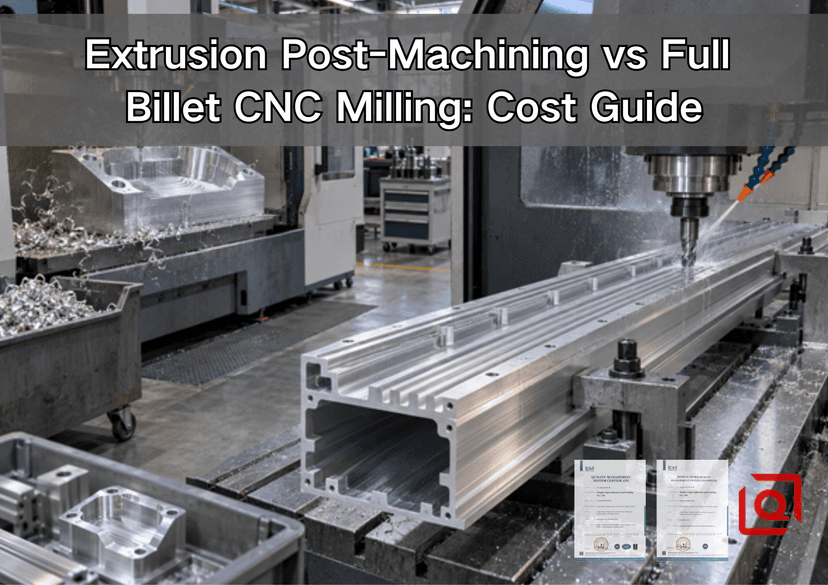
You have the drawing open, two quotes beside it, and no obvious winner. One supplier wants to open an extrusion die. The other plans to start with a solid block and fill a chip cart. Both routes can be right. I have also seen both look cheap on the first line of a quote and turn expensive once the drawing, batch plan, and inspection notes are read properly.
My rough screen is simple, though I never let it decide the job. When the section stays put and the interfaces are frozen, I price a profile. A prototype with uncertain hole locations usually belongs on a mill. So does a compact part whose shape changes in every direction. Most live jobs are not so tidy. They need arithmetic, not a claim about saving chips.
1. Start with the Geometry, Not the Annual Quantity
When the model opens, I usually roll it until the long axis points at me. I am looking for a section that still makes sense at the far end. Lose that section almost immediately and I lean toward billet. Keep it for most of the length and a profile remains worth pricing.
Machine rails are the easy picture. So are long sensor frames, enclosure members, and heat-sink bases. Their section keeps repeating down the length; the drill pattern, end cut, thread, window, or seal land usually does not. We let the press handle that repeating backbone and leave the scattered features to the machining center. The cutter then has less metal to chase and, quite often, a shorter day in the CNC cell.
A manifold is different. Passages intersect, bosses sit where the valves need them, and pockets change from face to face. For that kind of part, a custom profile may bring little to the table. Liqin's precision aluminum manifold product shows the sort of multi-face geometry that makes sense as a fully machined component.
Only then do I look at annual quantity. A bad profile candidate is still a bad candidate at 10,000 pieces. Our earlier aluminum machining versus extrusion DFM guide covers that process boundary in more detail. For the present decision, keep the following shop-side comparison handy.
|
Decision signal |
Extrusion post-machining tendency |
Full billet CNC milling tendency |
|
Main geometry |
Constant cross-section with local machined features |
Fully 3D form, isolated bosses, deep pockets, changing wall layout |
|
Design maturity |
Released or close to released |
Prototype or still changing |
|
Volume pattern |
Repeat batches and stable annual demand |
One-off, pilot, bridge, or irregular demand |
|
Upfront cost |
Extrusion die, profile trial, machining fixture, first article |
CAM programming, cut stock, soft jaws or fixture, first article |
|
Recurring cost |
Profile, sawing, secondary CNC, deburring, finish, inspection |
Billet or plate, longer CNC cycle, chips, deburring, finish, inspection |
|
Main quality risk |
Bow, twist, profile variation, weak workholding, datum transfer |
Residual stress, heavy material removal, thermal drift, long cycle |
|
Change flexibility |
Lower after the die is approved |
High; CAM and fixtures can often be revised faster |
2. What Extrusion Post-Machining Actually Includes
The phrase “extrusion plus CNC” fits neatly into a spreadsheet cell. The route sheet is not so neat. No chips yet: section review, die cutting, a trial push, measurement. Perhaps a correction. Straighten the bars, cut them, and check what turned up. Now the CNC operator can load the nest and work on the local details. Edges are broken afterward. Cleaning, finish, final checks, packing: each is another handoff, and every handoff can mark a visible face. Quite a long trip for one spreadsheet cell.
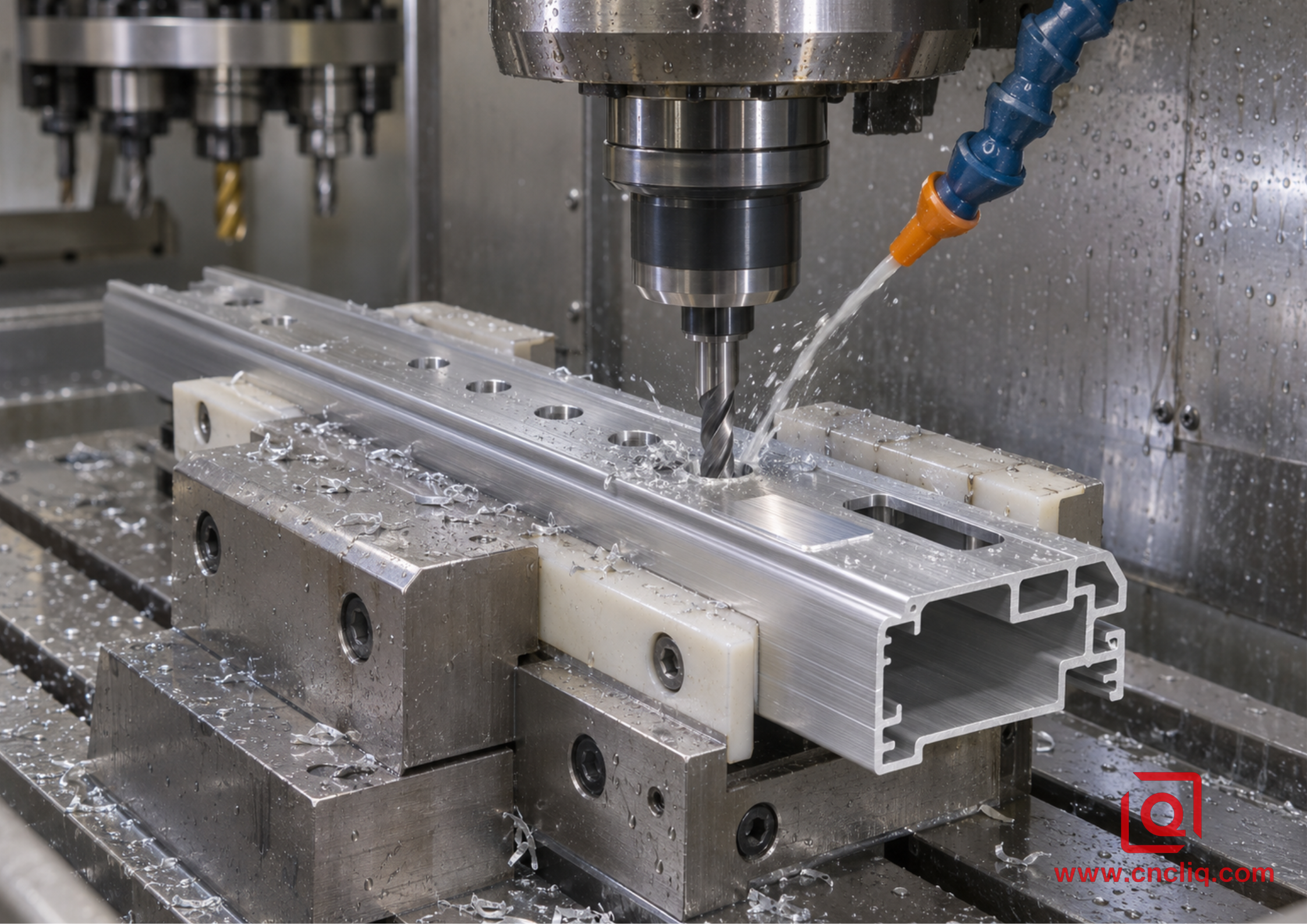
Near-net is often misread. Some faces may arrive ready to use; others clearly will not. Flow through the die, cooling, straightening, and handling all leave their fingerprints. The Aluminum Association's extrusion tolerance guidance is helpful here because it does not lump everything into one vague “profile tolerance.” Twist, bow, flatness, and the metal or space dimensions of a section are separate checks.
On a drawing, I like to see three clear zones. Raw profile surfaces get a sensible extrusion tolerance. Bearing seats, sealing lands, mounting datums, and threaded patterns get machined requirements. Visible faces get appearance notes, with anodizing and rack locations called out where they matter. Put one tight blanket tolerance over all three zones and the quote grows quickly. Worse, nobody is quite sure what the designer intended.
Liqin's 4G lightning arrester housing follows a related near-net idea: cold extrusion first, precision machining afterward. The forming method differs from a long profile press. The planning habit does not. Put the bulk in place early; save the spindle for dimensions that matter at assembly.
3. What Full Billet CNC Milling Actually Includes
Billet is the straightforward route. Saw a piece of plate or bar large enough to contain the model, leave working allowance, and start cutting. For a pilot build, that simplicity is worth money. There is no profile die waiting on approval, and a late hole move may mean a CAM edit and a jaw touch-up rather than a die correction.
The invoice arrives through the spindle instead. Every cavity and outside relief has to be opened with a cutter. More minutes mean more edge wear, coolant, chip volume, and occupied machine time. Cut one side heavily and the stock may move as its internal stress balances again. Before debating cycle details, I run one blunt calculation:
For yield, divide finished mass by purchased blank mass and express the result as a percentage.
Low yield is not the same thing as landfill. Clean aluminum swarf can be sold back. Follow one kilogram through the shop, though. We bought it, booked it in, held it, cut it, drained it, and paid somebody to move it. The scrap cheque does not give those spindle minutes back.
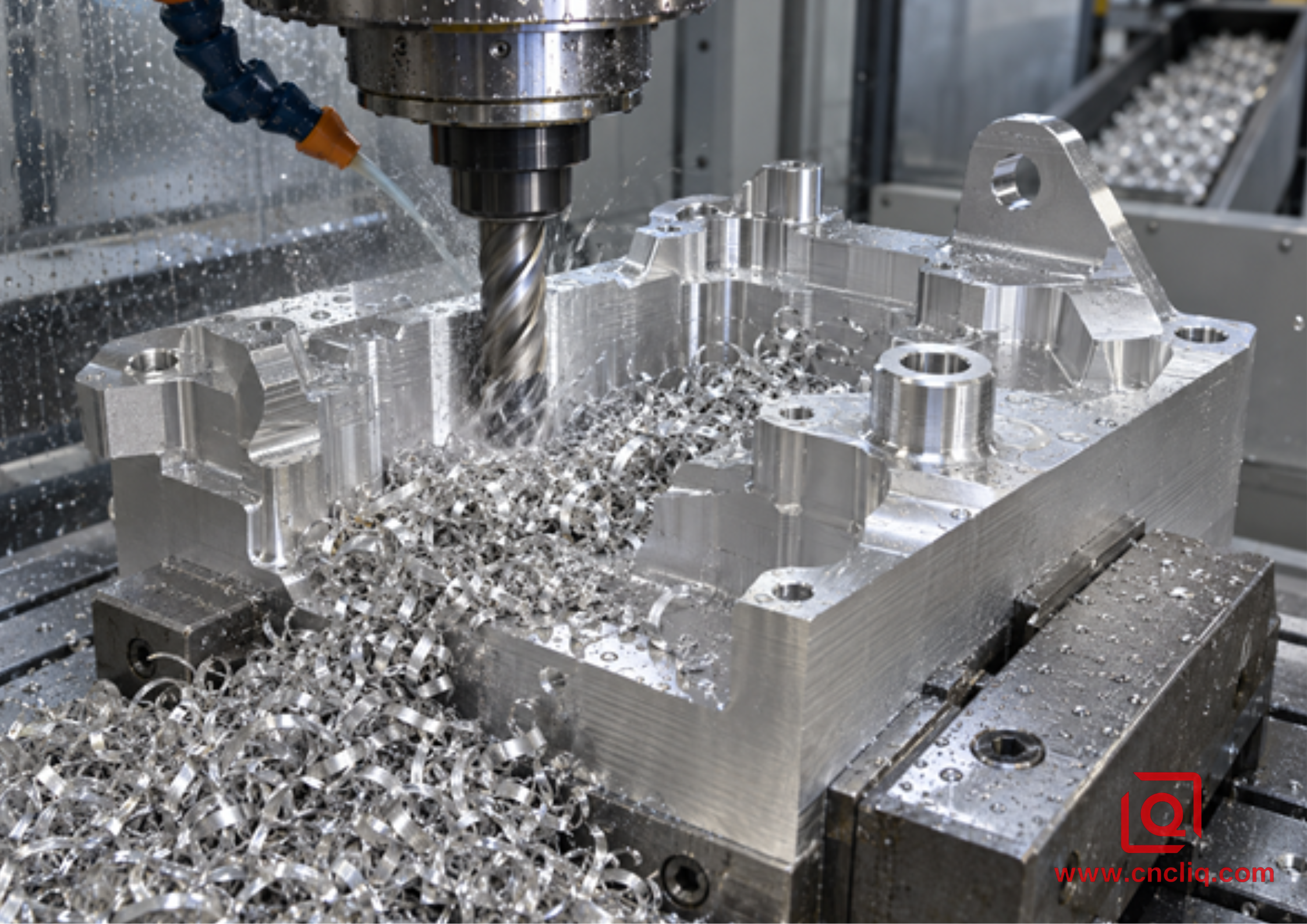
There is a less visible bill too. Down in a deep pocket, chips bounce around, coolant has a harder job, and a long cutter starts acting like a spring. Those problems are manageable; our deep-pocket chip evacuation guide and 6061 speeds and feeds guide cover the usual fixes. Billet may still win. Just price the process the machine will see, not the clean CAD model.
4. Compare Total Accepted-Part Cost
Many comparisons go wrong right here. One column stops at a cut length. The other carries anodizing, a CMM report, and export packing. Of course the first figure looks better; it is not yet the same product.
Pick a common finish line. I use one conforming component after wash, finish, inspection, and packing, ready for the buyer's incoming bench. Then the ordinary cost relationship below has some meaning.
Total order cost = fixed route cost + quantity × recurring cost per accepted part.
On the profile side, fixed money may sit in the die, trials, corrections, CNC program, fixture, gauge, and first article. Billet avoids that die, but programming and workholding do not disappear. Setup and inspection do not either. Recurring cost is the unglamorous column. Stock and spindle time are obvious; worn tools and operator touches are not. Neither are edge breaking, washing, finish, scrap allowance, inspection, packing, or freight. Add the lot before calling one route cheaper.
Notice the words accepted part. We may saw 105 blanks and ship only 100. Those five rejects did not vanish from the ledger. Cost therefore gets divided by the hundred pieces in the tray, not by the blanks that entered the cell. A low machine rate can look attractive until another setup, sorting, and a second inspection appear on the route card.
|
Cost pool |
Questions for an extrusion plus CNC quote |
Questions for a billet CNC quote |
|
Raw material |
Profile alloy, temper, cut length, minimum run, remnant policy |
Plate or bar alloy, temper, blank size, drop allowance |
|
Tooling |
Die ownership, life, storage, correction allowance |
Soft jaws, tombstone, vacuum fixture, fixture ownership |
|
Machining |
Features left for CNC, setup count, cycle time, datum plan |
Removal volume, setup count, cycle time, tool access |
|
Quality |
Profile checks on receipt, first piece, sampling, gauges |
First piece, process checks, CMM plan, distortion watch |
|
Finish |
Masking before finish, visual faces, coated sizes |
Burr limits, masking, coating build, coated sizes |
|
Commercial |
Minimum press run, repeat call-offs, spare stock |
Stock lead, prototype premium, batch window |
One dated but useful reference point comes from the Aluminum Extruders Council: its 2019 paper, Should You Consider the Use of Custom Aluminum Extrusions?. For many 7- to 10-inch circle-size dies, the examples sit in the low thousands of US dollars. Minimum orders get a warning as well. That is background only. A 2026 offer must come from the actual die type, alloy, press, trial plan, and supply region.
5. Do the Break-Even Math Yourself
The arithmetic is the short part. Judgment takes longer. With both quotes ending at the same delivered condition, use:
Break-even pieces = extra fixed money for the profile route ÷ saving on each accepted piece.
Here F means fixed route money. V is the repeat cost of one good part. Check the lower half of the fraction first. When billet V minus extrusion V is zero or below zero, the model never pays the die back. A positive N gives only a paper crossing point; forecast confidence, cash, storage, and the minimum press run still get a vote.
Now take a sanitized 420 mm automation rail, the sort of part that makes this exercise worthwhile. The hollow spine is continuous. Later operations add eight holes, one connector window, two finished ends, and clear anodizing. These dollars are working inputs for the example, not a price list for the next drawing.
|
Example input |
Profile plus CNC |
Block-to-part CNC |
|
One-time route spend |
USD 7,200 |
USD 950 |
|
Input mass for one part |
0.93 kg cut profile |
3.10 kg sawn block |
|
Shipped mass |
0.78 kg |
0.78 kg |
|
Input-to-part yield |
83.9 percent |
25.2 percent |
|
Repeat accepted piece |
USD 24.80 |
USD 58.60 |
|
Assumed CNC cycle |
8.5 minutes |
26 minutes |
The crossover comes out near 185 accepted parts: 7,200 minus 950, divided by 58.60 minus 24.80. Would I open the die for a 40-piece validation lot? No. The drawing is still likely to move, and billet buys room to learn. At a believable 1,800-piece production demand, the profile has space to earn back its fixed cost. Even then, purchasing needs to ask about the minimum press run and the pile of stock it may create.
A blanket “saves 50 percent” claim is poor RFQ advice. Change the rail length, wall, finish, or one datum and the answer moves. Run pilot, expected annual, and conservative demand through the same sheet; the cautious case often tells you most.
6. An Anonymized Customer Case: Automation Controller Rail
An automation-equipment buyer asked for a cost comparison on a long aluminum controller rail. The initial CAD model had a repeated hollow spine, two external mounting flanges, local cable windows, M5 threads, and precision end datums. The forecast was uncertain: 60 units for validation, followed by 1,500 to 3,000 units per year if field testing passed. The case details and numbers are anonymized and sanitized for illustration.
The first route used full billet CNC milling. It supported the validation build without a die, and the engineering team could move windows and mounting holes after assembly feedback. The main cost driver was not the finishing pass. It was roughing the long internal cavity and outside reliefs, then managing chips and part movement over several setups.
For production, the DFM review converted the stable spine and flanges into an extruded profile. Machining stock remained only on the two end datums and the local sealing shelf. A contoured fixture supported the hollow section near each clamping point. The CNC program then sawed and faced the ends, opened the cable windows, drilled and tapped the mounting pattern, and probed the functional datums before unloading.
The key decision was staged, not ideological. Billet was retained for validation because flexibility had value. Extrusion post-machining was released only after interface locations, annual demand, and cosmetic requirements were frozen. That approach avoided opening a die against an immature drawing while preserving a credible path to lower recurring cost.
The quality plan changed too. Incoming checks covered cut length, bow, twist, and fixture supports. The final CMM program measured machined datums, holes, threads, and sealing shelf, not non-functional raw walls. Inspection stayed with function.
7. DFM Rules That Protect the Extrusion Savings
1. Keep the extrusion responsible for the repeated section. Do not force isolated three-dimensional bosses, blind pockets, or closed local features into the die concept when CNC can add them more predictably.
2. Use balanced walls and gradual transitions where the profile allows. Large thickness jumps and isolated heavy masses complicate metal flow, cooling, straightness, and die correction. Final limits must come from the selected extruder and alloy.
3. Add machining stock selectively. Put allowance on functional datums, sealing lands, bearing seats, and other interfaces that require a clean cut. Extra stock on every surface increases profile weight and defeats near-net economics.
4. Design the fixture at the same time as the profile. A thin hollow can dent in a normal vise or bounce back when the jaws open. Give it shaped soft jaws, support where the cutter pushes, a sensible clamp load, and one datum plan the operator can repeat. The fixture belongs in the process review from day one.
5. Group local details by tool direction. If the drill and end mill can reach most of the work from one or two orientations, fewer hands touch the part. When details wrap around several faces, price 3-axis fixtures against indexed machining with the complete setup model in our 3-axis versus 5-axis cost guide.
6. Settle the finish route while the dimensions are still being reviewed. An anodizer needs rack points; powder coat may need masking; either process can change a fit or a visible face. The drawing must say which limits apply before treatment and which apply after it. Our post-processing guide for CNC-milled aluminum goes deeper into that handoff.
8. Quality Control at the Points That Matter
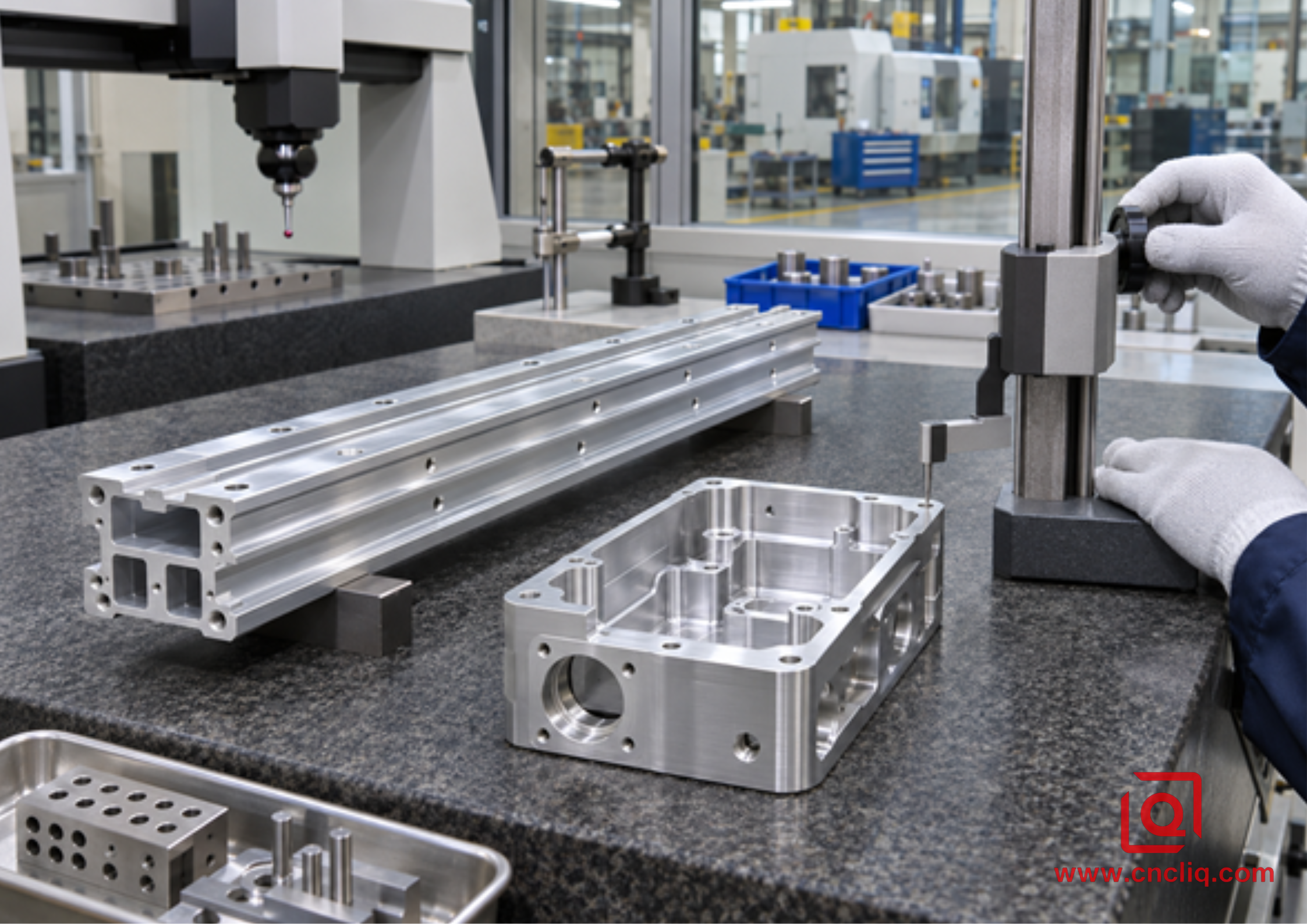
Start with the material identity and the approved profile revision. Match alloy and temper to the purchase specification and its documents. On an extruded job, I want bow, twist, straightness, cut length, and the chosen raw reference faces checked before the first fixture is loaded. If a bar rocks on its supports, that problem belongs at receiving, not beside the final CMM.
During machining, probe or verify the primary datums before cutting a pattern of related features. Control clamping so an accepted dimension does not spring out after release. A first-off inspection should include the critical datum relationships, not merely individual sizes. If anodizing or another finish follows, confirm which dimensions are accepted before and after treatment.
For billet, monitor the semi-finished part after heavy removal. A long housing may look flat while clamped and relax when the vise opens. Balanced roughing, suitable stock condition, intermediate checks, and a controlled finishing allowance are often more valuable than chasing a faster roughing cycle.
The final report should follow the drawing's critical-to-quality features. CMM mapping suits true position, profile, and related datums; a calibrated gauge may be quicker for a repeated bore or thread. More measured points do not automatically mean better control. What matters is seeing the process move while there is still time to stop the batch.
9. When Full Billet CNC Milling Is the Better Buy
Pick billet when the drawing is still earning its red marks. That covers the one-off prototype, validation lot, bridge order, shaky forecast, and product that may change after a bench test. Billet also deserves the first quote when the shape refuses to repeat, thick bosses break up the section, or the required alloy, temper, or property direction does not suit the proposed profile.
Do not treat billet as the “expensive” route by default. Standard plate or bar can shorten procurement lead time, eliminate die ownership questions, and avoid storing a minimum extrusion run. A two-setup billet process can be remarkably efficient for a compact part with open access. The correct decision is the lowest risk-adjusted accepted-part cost for the present stage of the program.
10. When Extrusion Post-Machining Is the Better Buy
Choose extrusion post-machining when the repeated section contains a meaningful share of the final volume, local machined features are limited, the design is stable, and recurring demand can absorb tooling and minimum-order constraints. It becomes especially attractive when billet machining would spend most of its cycle opening a long cavity, leaving thin rails, or converting purchased metal into chips.
There is a capacity argument as well. A near-net profile can calm the chip problem and release hours on a busy spindle, making the week's machine plan less fragile. It is not a free pass. Ask to see how the part will be supported, where the datum comes from, when straightness is checked, and how finish and inspection fit the route.
If your drawing is close to release, ask Liqin's custom CNC machining team to compare both routes using the same finish, inspection, packaging, and delivery boundary. Send the STEP file, controlled 2D drawing, pilot quantity, annual forecast, target alloy and temper, critical features, cosmetic surfaces, and required documentation. A useful response should explain not only which route is cheaper, but why.
11. RFQ Checklist for a Comparable Quote
1. Send the current STEP model together with the released 2D drawing and its revision.
2. State the alloy, temper, acceptable stock forms, and any traceability requirement. “Aluminum” alone is not enough.
3. Separate prototype quantity, first production batch, annual forecast, and expected repeat schedule.
4. Mark the datums, fits, seals, and threads that drive assembly; say plainly which faces may remain raw profile.
5. Show the faces a customer will see, the finish and color target, every mask, and places where a rack mark is acceptable.
6. Define inspection documents, sampling level, first-article format, material certificates, and any capability evidence required.
7. Put die and fixture ownership in writing. Include storage time and the rule for an engineering change.
8. Request the minimum extrusion order, expected profile yield, remnant handling, and safety-stock proposal.
9. Make both quotes end at the same point: edges broken, part cleaned and finished, inspection complete, and packing plus freight assumptions stated.
10. Ask for a DFM review before freezing the profile so machining allowance and fixture support are designed into the part.
FAQ
1. At what quantity does extrusion post-machining become cheaper than billet CNC milling?
There is no universal quantity. Calculate the crossover from the additional extrusion fixed cost divided by the recurring unit-cost difference, then test that result against the extruder's minimum run, forecast confidence, inventory cost, and design-change risk. A small, simple profile can cross early, while a large hollow die, complex fixture, or uncertain program may require a much larger committed volume.
2. Can raw extrusion match a completely machined part for tolerance?
Not on every surface by default. Raw extrusion has its own tolerances for section dimensions, straightness, flatness, and twist, while CNC machining can refine selected datums and functional features. The economical drawing leaves non-critical surfaces under appropriate profile tolerances and assigns tight requirements only to machined interfaces such as bores, sealing faces, mounting datums, and precision hole patterns.
3. Is extrusion always more material-efficient?
Often, yes, because a repeating section starts much closer to the finished shape. But count the metal lost while the press settles, saw kerf and end cuts, leftover lengths, CNC allowance, rejected bars, and surplus caused by the minimum run. The useful comparison is purchased mass against good parts for this order, not a stock utilization claim from another job.
4. Should we prototype with extrusion or billet?
Billet is usually the lower-risk prototype route when interfaces, windows, hole patterns, or wall geometry may change. It avoids committing to a profile die too early. Once the design passes fit and function testing, the team can redesign the stable repeated section for extrusion and preserve the validated local features as secondary CNC operations.
5. What files and information are needed for an extrusion versus billet quote?
Send a 3D CAD model, controlled drawing, alloy and temper, prototype and annual quantities, critical-to-quality dimensions, datum scheme, finish and cosmetic requirements, inspection documentation, packaging needs, and delivery location. Also flag expected engineering changes and forecast uncertainty; those commercial risks can shift the best route even when the pure unit-cost calculation favors extrusion.
Summary
Extrusion post-machining is strongest for stable, repeated cross-sections and repeat demand; full billet CNC milling is strongest for prototypes, changing designs, low volumes, and fully three-dimensional parts. Compare both at the accepted finished-part level, include fixed tooling and recurring quality costs, calculate a transparent break-even, and confirm that minimum orders, datum control, finishing, and forecast risk support the answer before releasing production.
Contact Information
Company: Ningbo Liqin Industry Co., Ltd.
Daily customer maintenance & after-sales support:service@shturl. zhuwanying@cncliq.com
New inquiry, quotation & order discussion:business@shturl. zhouli@chinaliqin.com
Hotline: +86 18757148656
Disclaimer
All technical articles, material specifications, machining recommendations, and surface treatment details published on this blog are for informational and reference purposes only. Please note that general blog insights do not replace signed technical agreements. Because custom parts vary by material heat numbers, machine calibrations, and specific tolerances, binding quality specs are governed solely by your approved CAD drawings, signed contracts, and formal quality plans.
All customer case studies featured on this blog have been thoroughly anonymized and sanitized. The performance metrics, manufacturing workflows, and imagery displayed serve solely to demonstrate our custom machining capabilities and do not represent a single universal standard for all orders.
Liqin Manufacturing Team
Built on 18 years of precision engineering experience, Ningbo Liqin Industry manufactures high-tolerance metal components for demanding global markets. We operate out of a 6,500 m² production hub equipped with over 150 machines, running 4-axis and 5-axis CNC machining, mill-turn machining, cold extrusion, and pressure die casting under one roof. This setup allows us to manage projects seamlessly, taking parts from initial CAD concepts directly to finalized shipments.
We handle quality control with zero compromise. We treat tight tolerances with the engineering discipline they require. Backed by ISO 9001, ISO 13485, and IATF 16949 certifications, our QA engineers run strict IPQC, FQC, and OQC checks on every single production batch. From CMM dimensional mapping and optical profiling to hardness and salt-spray testing, we validate your critical specs upfront—so you receive drop-in ready components with zero assembly headaches or costly line stoppages. On top of manufacturing, you can rely on us for two-hour response times on new RFQs, direct support for prototype sampling, and smooth export shipping across Europe, North America, Asia, and Oceania.
Welcome your inquiries and samples. Visit our website or contact us directly for a competitive quote!