 English




Are you dealing with outdoor anodized aluminum parts that looked right at approval, then turned bronze, gray, or lighter after a season outside? Follow the part back through the factory before cutting the next batch. The answer may sit in the alloy rack, blast cabinet, color bath, or the way rainwater collects after installation. This guide turns those clues into a drawing and RFQ that make “UV resistant” testable.
There isn’t one “fading defect” or one cure. Sunlight can alter an organic dye. An incomplete seal can admit grime and cleaner residue. Two alloy lots may differ from the start, although the mismatch is noticed only after assembly. Heat, salt, trapped rinse water, or an aggressive wash make diagnosis harder. Prevention begins before machining and ends with a named test and pass limit.
Preparing an RFQ for an outdoor enclosure, sensor mount, light bracket, telecom component, marine fitting, or vehicle trim? Send Liqin the 2D drawing and matching 3D model, then add the expected exposure, color target, annual quantity, and the features that cannot move. Our engineers can mark alloy risk, masks, coating growth, rack contact, checks, and packing on one route before the quotation is fixed.
1. Why Outdoor Anodized Aluminum Changes Color
Anodizing converts the metal’s own surface into aluminum oxide. Before a decorative Type II film is sealed, its pores can take up dye or receive another coloring treatment. Sealing makes those pores far less receptive. The color therefore isn’t a loose skin of paint, yet that alone doesn’t make every shade permanently lightfast.
Outdoor appearance can move for five different reasons.
1. UV energy can break down colorants. Organic dyes vary widely in lightfastness. A color that performs well on indoor instruments may not be suitable for continuous direct sun.
2. Heat accelerates change. A dark enclosure in full sun can become much hotter than the surrounding air. That is why a light test and a combined UV-and-heat comparison do not answer exactly the same question.
3. Poor or inconsistent sealing leaves the oxide more able to take up stains, cleaning residue, and moisture. The part may pass a quick visual check after production and still drift later.
4. The substrate can create a false fading diagnosis. Alloy chemistry, material lot, extrusion flow lines, cast porosity, machining direction, etching, and blasting all influence how the finish reflects light. Liqin’s comparison of 6061 and 7075 anodizing behavior explains why two correctly processed alloys can carry different undertones.
5. Service contamination changes appearance. Salt, alkaline wash chemicals, acid cleaners, sunscreen, fuel, lubricants, road film, and trapped water may stain or haze a surface even when the dye itself has not photochemically faded.
Those differences save time at the receiving bench. Brown only on the sunny side of a black cover? Check lightfastness. A pale trail below a screw suggests moisture or cleaning chemistry. When a whole lot looks warmer, check the alloy certificate and retained coupon before blaming the dye tank. Liqin’s black anodized aluminum UV guide covers that finish in detail; this method also applies to other outdoor colors.
2. Start with the Outdoor Duty, Not the Color Name
“Outdoor” hides more than it reveals. A camera tucked under an eave, a telecom box on a roof, and a marine bracket washed in salt spray are all outdoor parts. Their UV dose, metal temperature, wet time, cleaning, and abrasion are nothing alike. Give the finisher a short week-in-the-life description before choosing the color route.
|
Service question |
What the supplier needs to know |
Why it changes the finish decision |
|
Sun exposure |
Direct, intermittent, shaded, or behind glass |
Changes the required lightfastness evidence |
|
Thermal load |
Expected ambient and approximate surface temperature |
Dark parts and enclosed electronics can run hotter |
|
Moisture and salt |
Dry inland, humid, coastal, splash, or condensation |
Drives corrosion, drainage, and seal requirements |
|
Chemical contact |
Cleaner, fuel, oil, disinfectant, or process fluid |
Some agents stain the seal or attack aluminum oxide |
|
Appearance role |
Hidden, functional, customer-facing, or color-matched assembly |
Determines whether visual limits and retained samples are needed |
|
Mechanical duty |
Handling only, sliding, impact, or abrasive dust |
May shift the choice from decorative Type II to hardcoat or another finish |
Now describe the failure that would make you reject the part. “No obvious fading” leaves two inspectors free to disagree. Name the exposure, the reference panel, the instrument, the allowed shift, and any separate corrosion or fit rule. CIE Lab* readings and a ΔE formula can turn color change into a number, but no single ΔE limit works for every product. Freeze the formula, instrument geometry, illuminant, observer, measurement spots, surface texture, and limit before anybody starts the clock.
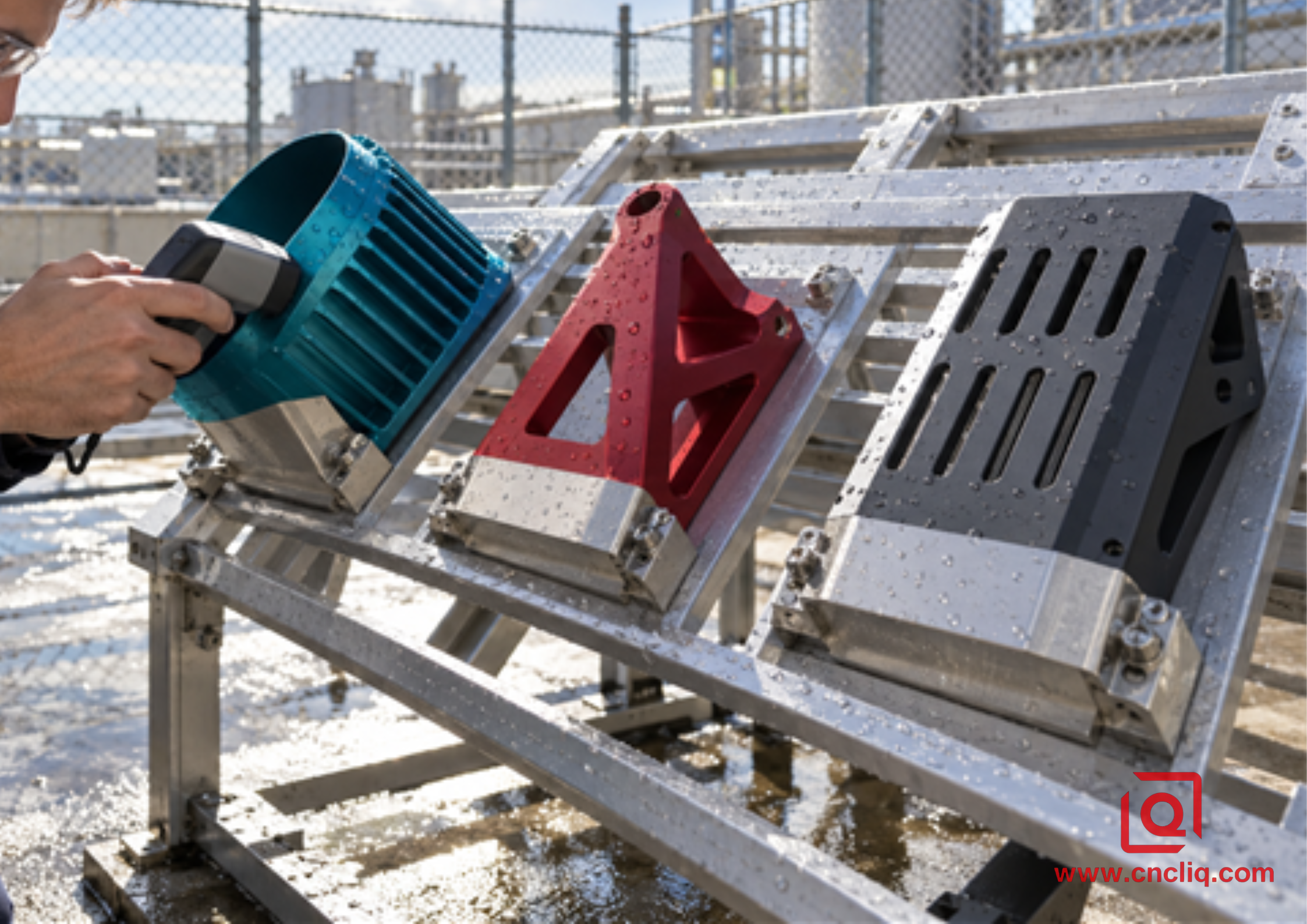
Outdoor exposure rack with anodized components and color measurement
Figure 1. Meaningful color evaluation compares production-intent material and finish under a defined exposure, not two phone photographs taken under different light.
3. Choose a Coloring System That Matches the Exposure
On a purchase order, “anodized” is only the family name. The visible shade might come from an organic dye, an inorganic treatment, metal deposited electrolytically, an interference process, or simply the natural oxide and alloy underneath. These routes don’t share one color range or one response to sunlight.
The Aluminum Anodizers Council describes two-step electrolytic coloring with metallic salts as a route to exterior bronze-through-black shades. It also warns that some organic-dyed finishes can change markedly outside. The Council’s guide to specifying anodized aluminum ties lightfastness to coating thickness and the amount of color held in the oxide. That isn’t a ban on every organic dye. It is a reason to ask for data on the exact dye system and proof that resembles the intended climate.
Use this practical selection logic.
1. The part will live in full sun and bronze, charcoal, or black is acceptable. Start the trial list with an exterior-qualified electrolytic color.
2. The brand color has to be bright. Ask for the dye maker’s lightfastness data, the anodizer’s process window, seal evidence, and a trial on the ordered alloy. A rendering on a monitor is not an approval sample.
3. Clear or natural anodizing removes the dye from the equation, not every appearance risk. Alloy, etch, film build, stains, and corrosion can still move what the eye sees. Use the clear anodize versus bare aluminum guide to keep protection and appearance separate.
4. Repeated wear changes the decision. Type III hardcoat may earn its place, although its natural shade varies and sealing changes the wear conversation. Check Liqin’s Type II versus Type III anodizing guide before treating hardcoat like a decorative color card.
5. An exact opaque color, frequent impacts, or field touch-up may point away from anodizing. Compare the real duty with an exterior coating in the powder coating versus anodizing guide.
At RFQ stage, “black anodize” or “blue anodize” isn’t enough. Add the governing document and revision, type and class where they apply, color route or performance, film range, seal, appearance standard, test, and pass rule. The official US defense record for MIL-PRF-8625F covers six coating types and two classes for non-architectural work; Type II is conventional sulfuric anodizing and Class 2 is dyed. The specification name opens the discussion. It doesn’t finish the print.
4. Control the Base Aluminum Before It Reaches the Tank
No tank can make every aluminum surface identical. Wrought 6xxx alloys such as 6061 are a comfortable starting point for uniform decorative work. Move to a more heavily alloyed 7xxx grade and the base tone can run darker or warmer. A high-silicon casting may show flow, mottling, and an obvious break between cut and as-cast faces. Liqin’s guide to anodizing A380 and ADC12 cast aluminum shows why a clean result on 6061 plate cannot simply be copied to a die-cast cover.
Color-critical work starts at receiving. Record alloy, temper, product form, and lot. When parts sit side by side, try to cut the visible family from one lot, give the faces the same texture, and send them through one finishing load. We like three modest references: a light limit, a dark limit, and a coupon from the accepted run. They beat an RGB or Pantone value on a monitor because the translucent oxide keeps showing the metal below it.
Finish the surface decision on the drawing too. Polish, fine milling, and bead blasting can enter the same dye bath and leave with three different looks. Cutter sweeps, welds, hand blending, scratches, and coolant stains do not disappear under anodize. Often they become easier to see. The anodizing defect prevention guide is the right companion when the defect began before any oxide was grown.
5. Treat Sealing as a Controlled Operation
Sealing comes late in the line, yet it belongs near the top of an early-fading investigation. In a qualified hot-water seal, hydration moves the pore walls toward boehmite and reduces the open volume. Mid-temperature chemical systems get there by another route. Which one belongs on the job depends on the oxide, color, governing document, and service. A borrowed internet recipe is no substitute for the finisher’s qualified process.
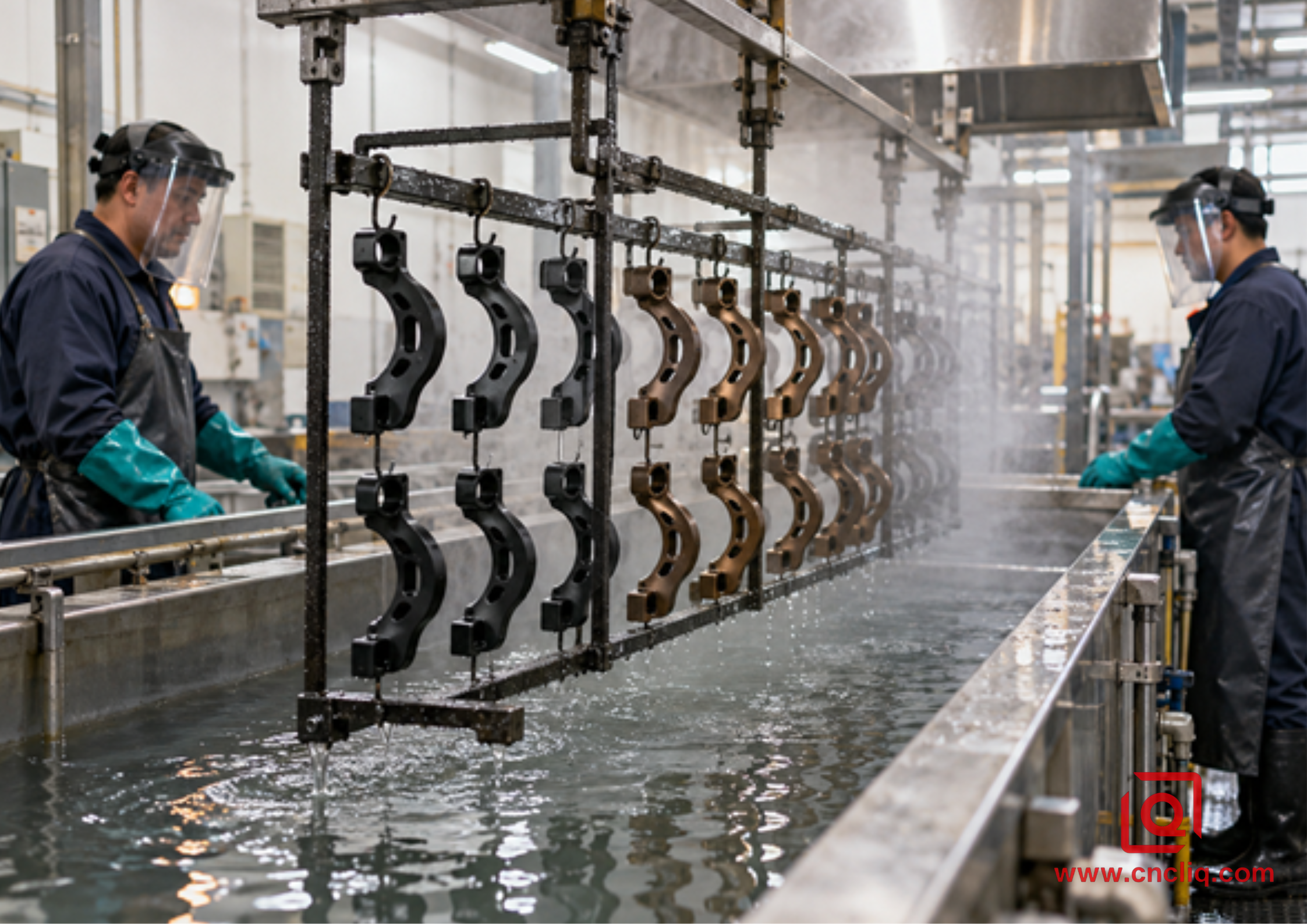
Anodized aluminum parts entering a controlled sealing stage
Figure 2. Color stability depends on a controlled finishing route from pretreatment through coloring, rinsing, sealing, and handling.
The traveler should answer plain questions: which seal, what bath condition, how long, at what temperature and load, with which rinse, and how often is it checked? Fresh color can look excellent over a weak seal. ASTM B136 uses dye staining after an acid treatment to challenge whether the sealed coating remains adsorptive. Useful evidence, yes. A promise of outdoor life or a corrosion result, no.
MIL-PRF-8625F colored work is sealed after dyeing. Hardcoat deserves its own decision because a seal can change abrasion behavior. Put a colored shell and a sliding bore on one component and you may end up with masks, selective processing, or separate rules for each feature. Liqin’s custom CNC-machined anodized hydraulic manifold makes the problem tangible: ports, seal faces, internal passages, outside protection, cleaning, and final dimensions all meet in one part. Buying those operations as unrelated lines invites trouble.
6. Design the Component So the Finish Can Survive Outside
Even a qualified color system can fail early when the part traps water or creates uncontrolled contact points. Good DFM reduces those risks before machining begins.
1. Add drainage and avoid blind pockets that retain cleaner, saltwater, or rinse solution. State the orientation in service when it is not obvious from the model.
2. Break sharp edges where the design permits. Current density and film growth are harder to control on fragile knife edges, and handling damage exposes the substrate.
3. Mark rack-contact zones on hidden, noncritical surfaces. The anodizing line needs reliable electrical contact, and that contact leaves a local mark.
4. Mark the bores, threads, bearing seats, O-ring lands, adhesive patches, grounds, and thermal interfaces. For each one, write COAT, MASK, PLUG, or FINISH LATER. Liqin’s guide to masking precision holes and ground surfaces shows how that shop conversation becomes a usable drawing.
5. Put film growth into the tolerance stack. Some aluminum is consumed and some oxide grows beyond the old surface. The familiar 50/50 sketch is fine at concept stage; a close fit needs measured data from the chosen alloy, shape, and finishing source.
6. Review every dissimilar-metal joint and fastener crevice. Rain can turn that joint into a galvanic cell. Anodic oxide insulates, but scratches, masks, and clamping pressure alter the real current path.
7. Make the pack and assembly tools part of the finish plan. Two parts rubbing in a carton produce bright edges that somebody will call fading, even though the real culprit is abrasion.
When casting, CNC work, and finishing share a drawing, let the dominant failure mode choose the route. Liqin’s precision aluminum light housing is the sort of outdoor geometry where fins, seal faces, threaded ports, surface protection, and inspection cannot be separated. Its best finish still depends on the alloy, color target, heat, weather, and proof the buyer expects.
7. Test Color Stability Without Pretending Chamber Hours Equal Years
A chamber is useful, but it doesn’t own a time machine. ISO 2135:2024 covers artificial-light testing of colored anodic coatings and positions the accelerated method as quality control after outdoor exposure has established the lightfastness number. ISO 6581:2018 compares resistance to UV light and heat. Neither document says that a given chamber run equals a fixed number of years on every roof.
The Aluminum Anodizers Council’s outdoor method places production-color panels facing south on an unshaded rack at 45 degrees. The point is to weather the job’s own stock and complete finishing route. One climate cannot represent every destination, so a global product may need more than one exposure location.
A shop-ready control plan has four separate pages, even if the final report combines them.
1. Incoming and process record: certificate, heat or lot, starting texture, bath lot, rack direction, and route revision.
2. Coating record: film readings at named spots, seal result, and appearance under the agreed lamp.
3. Color record: retained control, instrument setup, measurement map, starting Lab* data, ΔE formula, exposure, and limit.
4. Function record: final sizes, thread gauges, continuity at bare pads, gasket fit, corrosion result, and any cleaner trial.
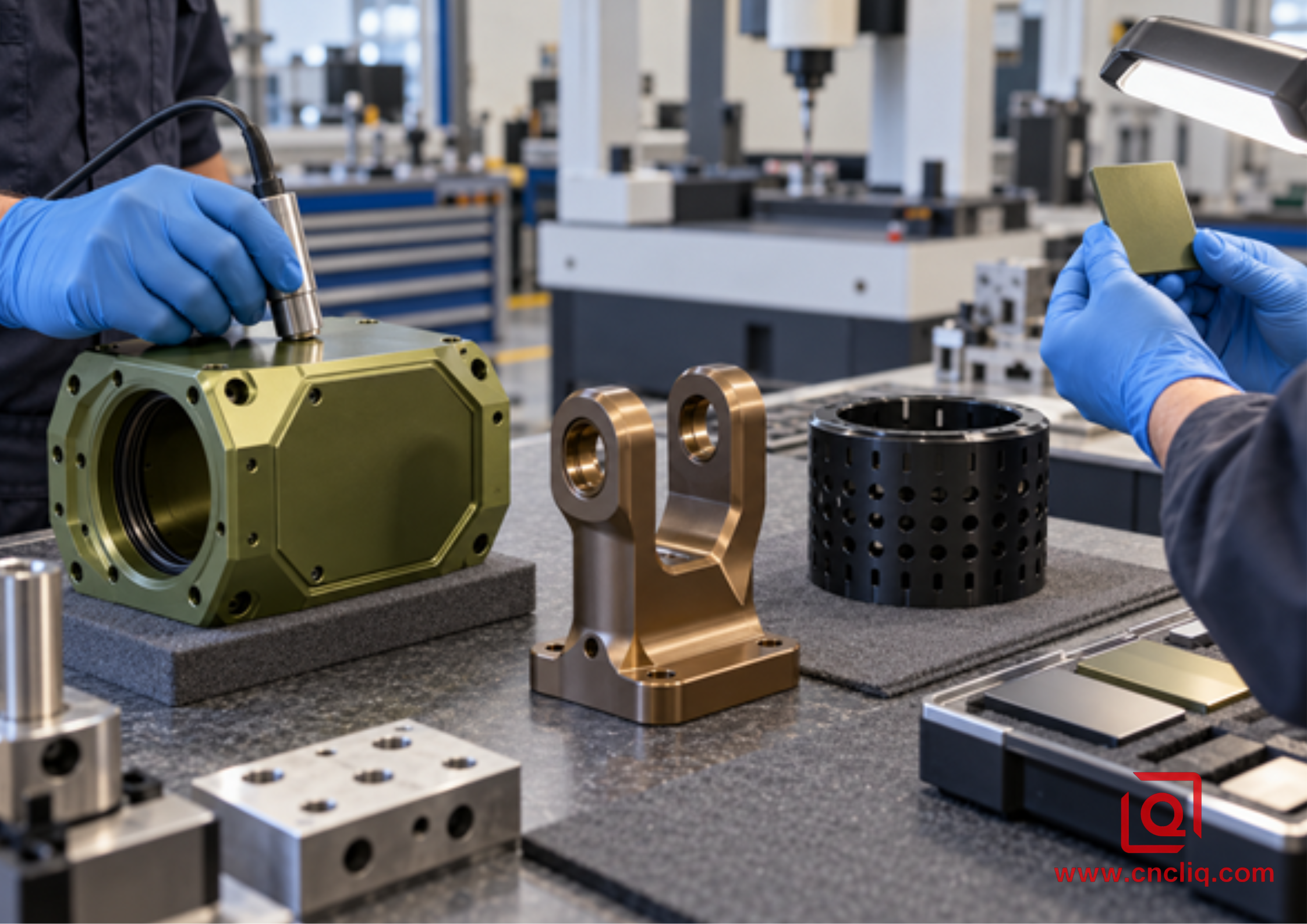
Coating thickness and retained-coupon color inspection
Figure 3. Film readings mean more when the seal check, color readings, and final dimensions can all be traced to the very same lot.
ASTM B117 salt fog may belong in the corrosion plan; it does not measure UV colorfastness. A panel can keep its shade while damaged edges corrode. Another can satisfy a corrosion rule while its dye shifts. Keep color, seal, corrosion, adhesion where relevant, and dimensions on separate acceptance lines. It makes a failure far easier to read.
8. Anonymous Customer Case: Rooftop Optical Sensor Housings
This is an anonymized composite built around Liqin’s published CNC and finishing capabilities. It shows how a control plan can work; it is not a performance promise for every part.
A European monitoring-equipment buyer was sourcing 6061-T651 rooftop sensor housings with curved mounting yokes. Direct sun hit one side. Summer heat built inside the box; rain and a weekly neutral-detergent wash followed. Coastal salt arrived now and then on the wind. The prototype supplier had used a deep organic black. After the comparison exposure, its sunny faces went past the customer’s limit and leaned brown, while the sheltered faces stayed dark.
Film readings revealed no obvious thin patch. The paperwork was the bigger clue: no named lightfastness test, ΔE method, seal check, material-lot rule, or retained panel. A cable cover also held wash water against the housing. Writing “bad anodizing” on the complaint would solve none of it.
The second build began with one 6061-T651 lot for the visible family. A drain appeared below the cable cover. The drawing picked out threads, an O-ring land, an optical datum, and a grounding pad for masking; a rear boss took the rack mark. After viewing real panels, the customer traded absolute jet black for a dark electrolytic bronze. Exterior stability mattered more than matching a black patch on a monitor.
Production-intent coupons went through the line with the parts. The customer fixed the instrument setup and accepted no more than ΔE00 2.0 after the chosen comparison; seal quality and finished dimensions remained separate checks. Trial one returned 3.7, so it stopped before assembly. The next route returned 1.4, passed its seal check, and left the masked bore and gasket geometry inside the print. Those figures belong to this illustrative case alone. They do not predict another alloy, color, or climate.
A small trial costs less than sorting an export shipment. Send Liqin the model, drawing, service note, color target, quantities, and report list together. Machining allowances and finish qualification can then share one quotation. The contact form accepts an RFQ package for engineering review.
9. What to Put on the Drawing and RFQ
Before release, read the print once as the machinist, once as the finisher, and once as the inspector. These twelve lines should survive all three readings.
1. Write the alloy, temper, and product form. Add a same-lot rule when neighboring cosmetic parts must read as one family.
2. Name the anodizing document and revision, then the type, class, film range, and color route or required performance.
3. Tell the weekly service story: when sunlight hits, how hot the metal gets, how long it stays wet, what salt or cleaner arrives, and where rubbing occurs.
4. Approve a physical range made from production-intent material. Record the lamp and viewing conditions.
5. Lock the color method, instrument settings, ΔE formula, measurement map, exposure, and pass limit.
6. State the required seal performance and name the seal check plus its sampling frequency.
7. Flag every critical finished dimension and use qualified growth data for its allowance.
8. Map masks across threads, fits, grounds, gasket lands, optical faces, adhesive zones, and fluid passages.
9. Give the rack somewhere to touch. Show drainage direction and the true cosmetic faces.
10. List only the evidence the risk earns: material certificate, first article, film readings, seal result, color report, coupon, dimensions, corrosion data, and pack approval as applicable.
11. Add prototype quantity, normal lot, annual demand, delivery target, and change-control rule.
12. Pass cleaning and maintenance limits all the way to the end user.
With those answers, a quotation can cover the route that will actually run, from controlled stock and cutting through masking, finishing, inspection, paperwork, and packing. A one-line color note cannot do that. For a review before chips are cut, send Liqin the current STEP file and controlled 2D print. Circle what the customer sees and what the assembly cannot afford to lose.
FAQ
1. Does all colored anodized aluminum fade outdoors?
No. Begin with how this part gets its shade and how the open oxide is closed. Then bring the base alloy and the real exposure into the same review. An exterior project may favor an electrolytic bronze or black, while an organic dye has to earn approval with relevant evidence. A supplier who says “never” without naming a test has skipped the useful part of the conversation. Put real samples through a trial.
2. How should I choose a color for a component that lives in full sun?
Do not rank finishes by the word printed on the color card. A black part may use organic dye, a two-stage electrolytic route, the natural tone of hardcoat, or a shop-specific process. Some organic blacks hold up well; others shift when light and heat work together. For harsh exterior duty, dark electrolytic routes often make the shortlist. The finishing source should explain the coloring route, the seal, and the evidence offered for this application.
3. Can a clear topcoat stop anodized color from fading?
It can help a qualified system in a severe environment, but the added film brings its own questions. Check adhesion and film build first; then look at gloss, aging, and the repair plan for field damage. It cannot turn an unsuitable dye or incomplete seal into a sound base process. Run the proposed stack on ordered material and judge the finished size, appearance, chemical contact, and weathering as one system.
4. What cleaning routine is safest for outdoor anodized parts?
Use the written method agreed by the product owner and finishing source. A typical starting point is gentle neutral cleaning, a thorough water rinse, and soft wiping, but the actual job still governs. Try strong alkalis, acids, chloride-bearing products, and abrasive pads on coupons before they touch production hardware. Record dilution and dwell time, then rinse crevices before residue dries.
5. What information gives us the fastest reliable anodizing quotation?
Send the controlled 2D print with its matching 3D model. Add alloy, temper, visible-face map, color reference, exposure, anodizing document, film range, masks, final CTQs, tests, reports, sample count, annual volume, and delivery target. Leave no blank pretending to be a decision; label it for joint review. That gives machining and finishing room to propose a test instead of quietly pricing a guess.
Summary
The service environment comes first. From there, select a coloring route that has credible exterior evidence, keep the material lot and surface preparation steady, watch the oxide and seal, drain trapped water, and protect every fit that assembly still needs. Apply ISO 2135 or ISO 6581 only to the comparison it describes, then use production-intent exposure when the question is outdoor behavior. Retain a reference and measure against it. Color, seal, corrosion, and dimensions deserve separate decisions. A complete drawing and RFQ give the CNC shop and anodizer one shared problem to solve before volume production.
Contact Information
Company: Ningbo Liqin Industry Co., Ltd.Daily customer maintenance & after-sales support:service@shturl. zhuwanying@cncliq.com
New inquiry, quotation & order discussion:business@shturl. zhouli@chinaliqin.com
Hotline: +86 18757148656
Disclaimer
All technical articles, material specifications, machining recommendations, and surface treatment details published on this blog are for informational and reference purposes only. Please note that general blog insights do not replace signed technical agreements. Because custom parts vary by material heat numbers, machine calibrations, and specific tolerances, binding quality specs are governed solely by your approved CAD drawings, signed contracts, and formal quality plans.
All customer case studies featured on this blog have been thoroughly anonymized and sanitized. The performance metrics, manufacturing workflows, and imagery displayed serve solely to demonstrate our custom machining capabilities and do not represent a single universal standard for all orders.
Liqin Manufacturing Team
Built on 18 years of precision engineering experience, Ningbo Liqin Industry manufactures high-tolerance metal components for demanding global markets. We operate out of a 6,500 m² production hub equipped with over 150 machines, running 4-axis and 5-axis CNC machining, mill-turn machining, cold extrusion, and pressure die casting under one roof. This setup allows us to manage projects seamlessly, taking parts from initial CAD concepts directly to finalized shipments.
We handle quality control with zero compromise. We treat tight tolerances with the engineering discipline they require. Backed by ISO 9001, ISO 13485, and IATF 16949 certifications, our QA engineers run strict IPQC, FQC, and OQC checks on every single production batch. From CMM dimensional mapping and optical profiling to hardness and salt-spray testing, we validate your critical specs upfront—so you receive drop-in ready components with zero assembly headaches or costly line stoppages. On top of manufacturing, you can rely on us for two-hour response times on new RFQs, direct support for prototype sampling, and smooth export shipping across Europe, North America, Asia, and Oceania.
Welcome your inquiries and samples. Visit our website or contact us directly for a competitive quote!