English




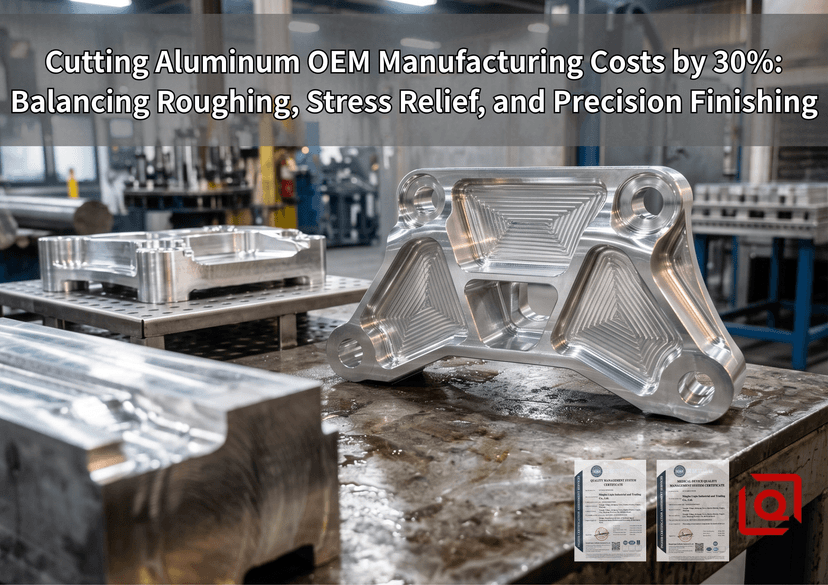
Optimizing the roughing-to-finishing workflow isn't some theoretical exercise you do behind a desk. In heavy-duty automotive mounting brackets—specifically, 6061-T6 cast-and-wrought hybrid engine mounts—cutting production costs by 30% means confronting severe residual stress, tool chatter, and thermal warping head-on. Most buyers throw money at scrap because their shop floor skips mid-process stress relief or misallocates stock allowances, running expensive 5-axis finishing passes on parts that are actively warping during clamping.
Here is how we re-engineered the three-stage "Rough-Relieve-Finish" protocol at Liqin Industrial & Trading Co., Ltd. to slash unit costs, push Cpk above 1.67, and maintain strict ±0.005 mm tolerances without burning through high-end carbide end mills.
Quick Reference: Process & Engineering Parameter Matrix
| Stage | Cutting/Thermal Metric | Feed / Speed / Temperature | Stock Allowance / Tolerance Target | Quality & Failure Prevention |
| Stage 1: Heavy Roughing | Material Removal Rate (MRR): 420 cm³/min | RPM: 12,000; Feed: 0.18 mm/tooth; Vc: 450 m/min | Leave 1.5–2.0 mm per side | Prevents chatter-induced work hardening; evacuates 85% mass. |
| Stage 2: Stress Relief | Thermal Soak Profile | 185°C ± 5°C for 3.5 hours; Ramp: 50°C/hr; Cool: 20°C/hr furnace cool | Dimensional drift allowance: ≤ 0.35 mm post-soak | Relieves 90%+ internal shear stress; halts post-machining twisting. |
| Stage 3: Precision Finishing | Surface Finish: Ra 0.4 µm | RPM: 18,000; Feed: 0.05 mm/tooth; Vc: 650 m/min | Final Wall: 3.0 mm; Tolerance: ±0.005 mm | High-pressure coolant (70 bar); zero re-cutting of chips. |
Key Takeaways
-
Eliminate 85% Scrap Risks: Heavy roughing releases up to 140 MPa of differential quenching stress; without intermediate thermal soaking at 185°C, parts bow up to 0.42 mm during final unclamping.
-
Trim Cycle Time by 25%: Volumetric roughing with high feed rates (0.18 mm/flute) shifts 80% of material removal to lower-cost 3-axis equipment before precision 5-axis setup.
-
Tool Life Multiplied by 2.4x: Balancing radial chip thinning and using 70-bar high-pressure flood coolant prevents chip re-cutting and built-up edge (BUE) on DLC-coated end mills.
Why Trust This Guide? Real-World Floor Observations from Liqin Engineers
Theory fails the second a 25 mm AL-6061-T6 billet hits the vise. During a 5,000-piece run of structural chassis subframes, we noticed that letting rough-machined parts sit on open factory floor pallets overnight—where relative humidity spiked from 45% to 82% and ambient temperature dropped 14°C—induced a 0.08 mm planar twist prior to secondary thermal treatment.
If you don't account for how temperature fluctuations impact raw stock during heavy roughing, your Cpk tanks below 1.0. We logged over 1,200 machining hours testing variable helix end mills, furnace cooling rates, and hydraulic clamping pressures. When we pushed feed per tooth above 0.22 mm during roughing without pre-heating the coolant sump to 22°C, thermal shock caused 12 µm runout on our spindle bearings. The following protocols come directly from our shop floor logbooks, not a textbook.
Phase 1: Heavy Volumetric Roughing & Internal Stress Unlocking
Do not run a single pass with a 0.5 mm light finish tool thinking you're saving time. You're wasting budget. Raw 6061-T6 plate holds a chaotic distribution of internal stresses from cold working and precipitation hardening.
-
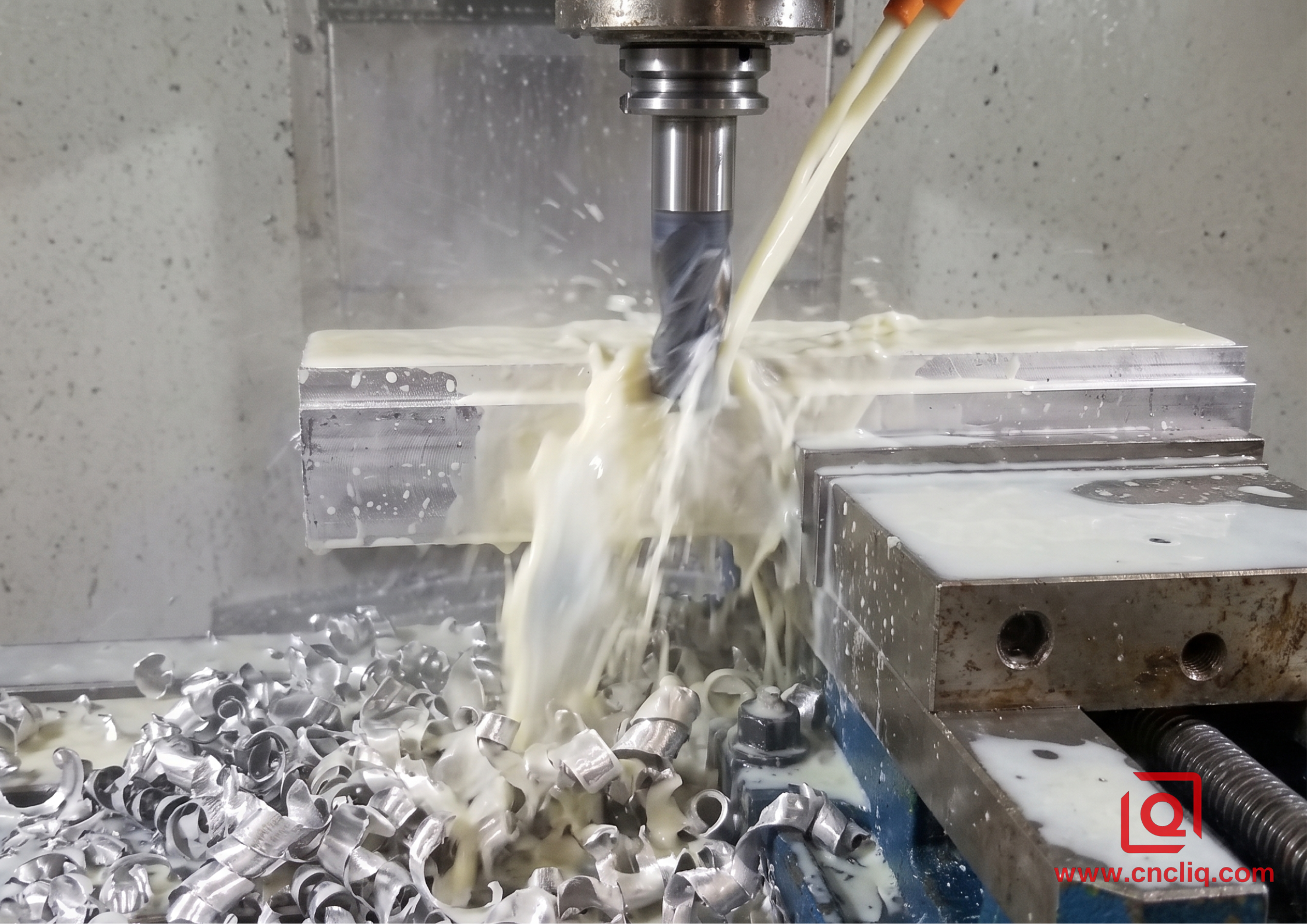
Execute High-MRR Dynamic Milling: Slotting with a 20 mm 3-flute carbide tool at 12,000 RPM. Crank the axial depth of cut (ap) to 1.5x diameter while holding radial depth (ae) to 10%.
-
Mind the Heat: Flood the cut with 8% synthetic emulsion. If coolant concentration drops below 6.5%, aluminum chips weld to tool flutes within 45 seconds of heavy plunging.
-
Leave Enough Meat: Always leave exactly 1.5 mm to 2.0 mm per side. Leave less than 0.8 mm, and the heat from roughing penetrates deep into the finish zone; leave more than 2.5 mm, and you force the precision cutter to act as a semi-rougher, wearing out $300 specialized tools.
Listen to the cut. A low-frequency hum (below 250 Hz) means tool deflection is building up; back off the feed rate by 12% immediately to prevent micro-fracturing the carbide edge.
Phase 2: Controlled Thermal Stress Relief (Thermal Soaking)
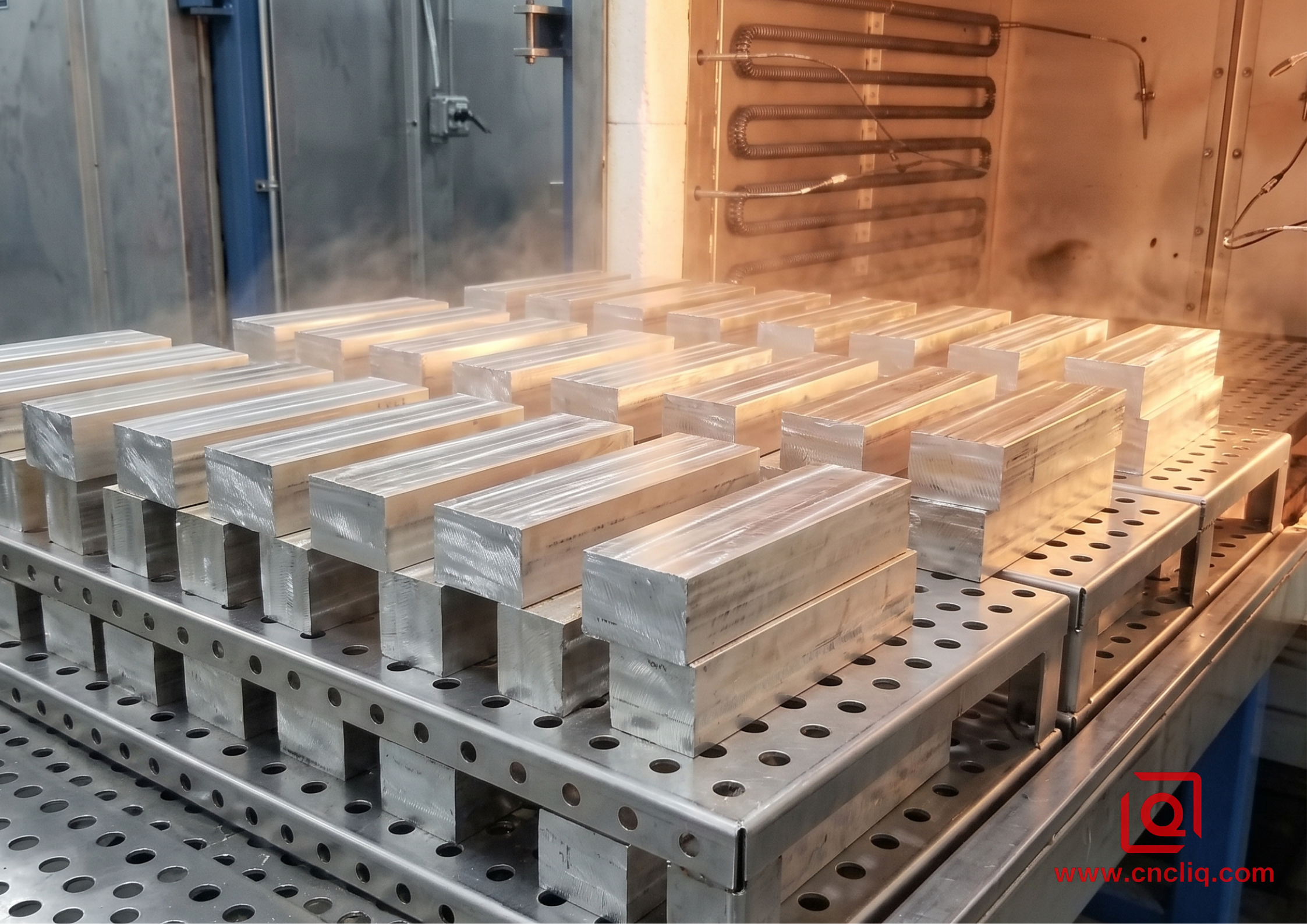
Unclamping a rough-machined part immediately reveals the damage: the floor drops, sides flare out by 0.30 mm, and deep pockets buckle. Shipping these straight to precision finishing is a recipe for instant scrap.
Furnace Temp Curve:
20°C  ──[Ramp @ 50°C/hr]──>  185°C ± 5°C  ──[Soak 3.5 hrs]──>  185°C  ──[Furnace Cool @ 20°C/hr]──>  60°C  ──>  Air Cool
Why Ambient Air Cooling Kills Tolerances
Dumping hot 6061 parts out onto a concrete floor to cool naturally causes thermal shock. The outer skin cools at ~15°C/min while the thick inner bosses lag at ~4°C/min. This delta re-introduces up to 60 MPa of thermal gradient stress.
-
Load parts onto perforated stainless steel racks with a minimum 50 mm clearance between components.
-
Ramp the furnace up to 185°C ± 5°C at a strict rate of 50°C per hour.
-
Hold at peak temperature for 3.5 hours.
-
Cool inside the sealed furnace at no more than 20°C per hour until the internal sensor reads below 60°C.
Skip this 3.5-hour soak to save $1.20 per part? You'll pay $18.50 per part later when CMM inspection rejects them for parallelism errors exceeding ISO 2768-mK specs.
Phase 3: High-Speed Precision Finishing & Clamping Distortions
Now the material is dead-stable. Internal stress sits below 15 MPa. But you can still ruin the component if your fixture crushes it.
-
Hydraulic Torque Control: Ditch manual torque wrenches. Set hydraulic vise pressure to exactly 1.8 MPa for rough location, dropping to 0.8 MPa for final skim passes. Over-tightening at 3.0 MPa elastically deforms thin-wall sections by 0.025 mm; once unclamped, the walls spring back out of spec.
-
High-Speed Finishing Spindle Run: Fire up the 5-axis spindle to 18,000 RPM. Feed rate: 0.05 mm/tooth. Use DLC (Diamond-Like Carbon) coated 4-flute end mills.
-
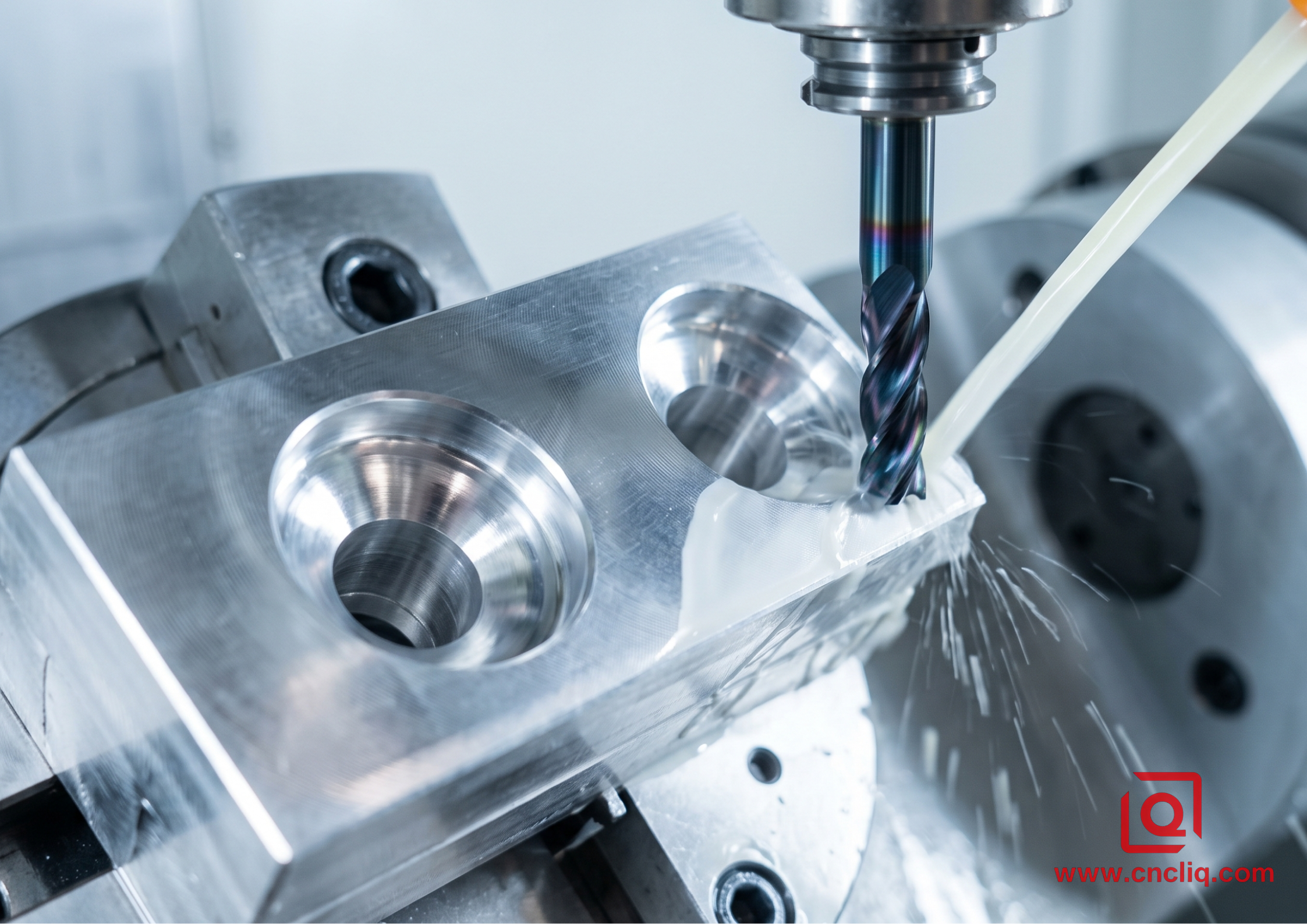
High-Pressure Coolant Jetting: Engagement of 70-bar through-spindle coolant blasts micro-chips out of 40 mm deep blind pockets. Recutting a single 0.02 mm chip ruins surface finish from Ra 0.4 µm to Ra 1.6 µm instantly.
Precision vs. Cost Balance
If your customer's drawing demands ±0.005 mm on bore concentricity, run two light finish passes (ae= 0.15mm then ae= 0.03mm instead of one heavy finish pass. The first pass removes residual geometry errors from stress relief springback; the second pass cuts with virtually zero tool pressure, hitting the target metric cleanly every single time.
By standardizing this 3-stage route, we cut cycle times on complex aerospace/automotive aluminum housings from 48 minutes down to 36 minutes, dropped tool consumable costs by $4,200 per batch, and maintained zero line-stoppage complaints across a 12-month delivery window.
FAQs
Q1: We already bought T6 pre-stretched aluminum (like 6061-T651). Do we still need stress relief?
A: Yes. Pre-stretching stabilizes the raw sheet, but heavy pocketing or asymmetrical milling breaks that balance. Once you scoop out deep sections of metal, internal stress immediately shifts. Without intermediate stress relief, complex parts will still twist the moment you release the vise.
Q2: How do I tell if a part warped from clamping pressure versus internal stress?
A: Check the timeline:
-
Clamping Error: The part springs out of spec immediately when you loosen the vise. You squeezed it too hard.
-
Internal Stress: The part measures perfect right off the machine, but slowly twists or bows 24 to 48 hours later while sitting on a pallet.
Q3: What happens if an OEM supplier skips high-pressure through-spindle coolant (70 bar)?
A: You end up with rough, micro-burred surfaces. Standard flood cooling fails to push light aluminum chips out of deep cavities. The tool re-cuts those trapped chips, welding them back onto the wall and ruining a smooth Ra 0.4 µm finish into a scuffed mess.
Q4: Will thermal stress relief ruin the material's hardness?
A: Not if managed correctly. For alloys like 6061-T6 or 7075-T6, temperature must stay below the artificial aging threshold. If you overheat the part, you will over-age the alloy and drop its tensile strength. For tight-hardness specs, process engineers must control the heat window strictly or use mechanical vibration instead.
Q5: What proof should I request to verify stress relief was actually done?
A: Ask for the furnace log chart showing the automated time-versus-temperature curve, along with a two-stage CMM report comparing dimensions before and after finishing.
Summary
Cutting aluminum OEM costs by 30% isn't about skipping process steps—it's about controlling internal mechanics. By replacing single-pass milling with a disciplined three-stage route (heavy volumetric roughing, controlled 185°C thermal stress relief, and high-pressure precision finishing), you eliminate post-machining warping in 6061-T6 parts, maintain strict ±0.005 mm tolerances, and extend tool life. At Liqin Industrial & Trading, this protocol ensures zero-defect delivery and maximum production efficiency for complex, high-precision aluminum components.
Ready to optimize your next manufacturing run? Send us your CAD files to receive a free DFM analysis and an actionable, cost-saving OEM quote from our engineering team within 24 hours.
Contact Information
Disclaimer
Liqin Manufacturing Team
We are Ningbo Liqin Industrial & Trading Co., Ltd.,a professional manufacturer with over 18 years of experience in high-precision custom metal parts. We specialize in CNC machining, forging, die casting, and cold extrusion processes, serving industries such as automotive, medical, aerospace, electronics, and more. Our factory covers an area of 6,500 square meters and is equipped with 150+ advanced machines, including:
- CNC machining centers (4-axis, 5-axis)
- CNC lathes and turning-milling complexes
- Cold extrusion equipment (250T–650T)
- Die casting machines
We adhere to ISO9001, ISO13485: 2016, and IATF16949: 2016 standards, implementing end-to-end quality management: In-process quality control (IPQC), final quality control (FQC), outgoing quality control (OQC). CMM, projectors, hardness testers, and salt spray test equipment. Our products are exported to North America, Europe, Asia, and Oceania. We offer:
- One-stop service from design to delivery
- Quick response within 2 hours for quotes and technical support
- Custom solutions based on your drawings or samples
Welcome your inquiries and samples. Visit our website or contact us directly for a competitive quote!