 English



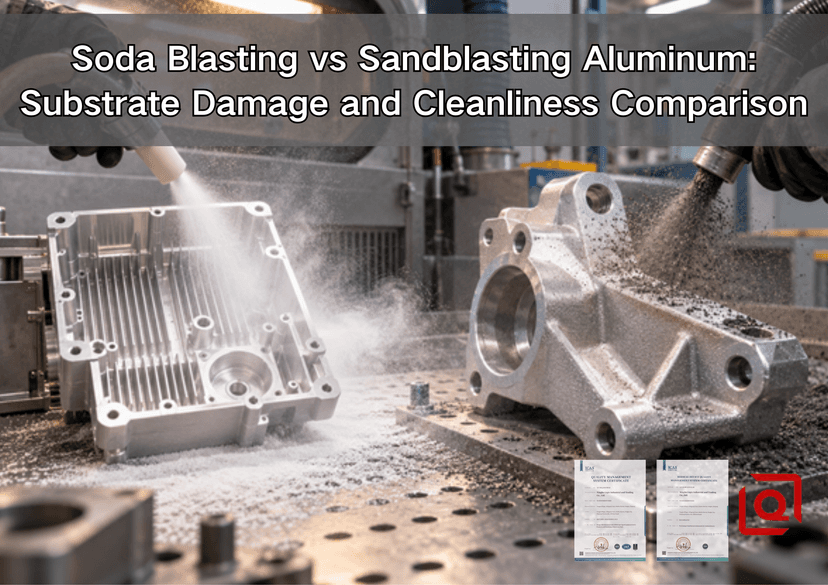
Will cleaning the aluminum quietly spoil a seal face, thin wall, or thread? That concern is reasonable. A part may look excellent after blasting and still fail later. Grit can remain in a blind hole. A sharp edge can lose metal. Paint can lift because the surface was never truly clean.
Our viewpoint here is the workbench, not the media brochure. Damage comes first. Residue, later finishes, checks, cost, and RFQ wording follow. The RFQ should come out with fewer blanks.
Why trial soda blasting aluminum first? Usually, to preserve what is underneath. Heavy removal or specified profile shifts that trial toward harder media. Clean-looking? That is only one check.
Quick Workshop Choice
|
Question |
Soda |
Hard abrasive |
|
Action |
Crystal fracture |
Cutting or peening |
|
Metal change |
Low after proof |
Watch edges, holes, and thin walls |
|
New profile |
Usually very little |
A useful coating profile can be created |
|
Often suited to |
Delicate stripping |
Rigid parts or heavy oxide |
|
Hidden issue |
Soda in dead ends |
Grit or steel carryover |
|
Before approval |
Prove residue removal |
Prove profile and dimensions |
One note belongs at the top. A drawing that says only “sandblast” is incomplete. Bead is round; oxide is angular. Garnet and plastic media widen the field. Fresh particles also differ from worn material. Liqin’s comparison of glass bead and aluminum oxide on aluminum explains those differences in practical terms.
1. Start With the Part, Not the Media Bag
A short RFQ note often asks for two jobs at once. “Remove old paint and prepare for powder” is a good example. Paint removal is stripping. Powder preparation may also need cleaning, profile, conversion treatment, and a time limit before coating.
The jobs overlap. They are not identical.
Soda may remove the old film and leave little tooth below it. Angular abrasive may create plenty of tooth and soften a needed edge. Bead can leave a pleasant satin face and still struggle with stubborn oxide. One photograph settles none of that.
Mark four items before choosing media. First, name what must come off. Second, mark what must not change. Third, state the next finish. Fourth, define the pass check.
Think in zones. A threaded boss is not a broad cosmetic wall. An O-ring groove certainly is not. Dowel bores and contacts may need their own treatment. The same goes for datums, seal lands, and engraving. A color map on the drawing is cheap protection.
2. What Soda Does to Aluminum
Here, the medium is sodium bicarbonate. The familiar Mohs value is about 2.5. A hit breaks the crystal apart. Energy goes into the coating or soil, with less deep cutting below.
That breakaway action gives soda blasting aluminum its value. Old paint may lift while cutter marks remain readable. Typical targets include carbon and soot. Grease and light shop soil belong on the list too. Delicate geometry gets a fairer start.
Soft media still needs control. A close nozzle raises local force. A steep angle changes the impact. Long dwell marks one area while the rest remains untouched. High flow and dirty media add more variation.
Start at the vulnerable features. Look at thread crests and knife edges. Check raised letters. Support thin ribs. Cover seal grooves and press-fit bores. Treat masking as process control.
Soda normally adds little anchor profile. This helps when the machined face should remain visible. It can be a problem before paint or bonding. In the U.S. Bureau of Reclamation coating guide, sodium bicarbonate is mainly a stripper. Need a deeper profile? The guide turns to conventional abrasive cleaning.
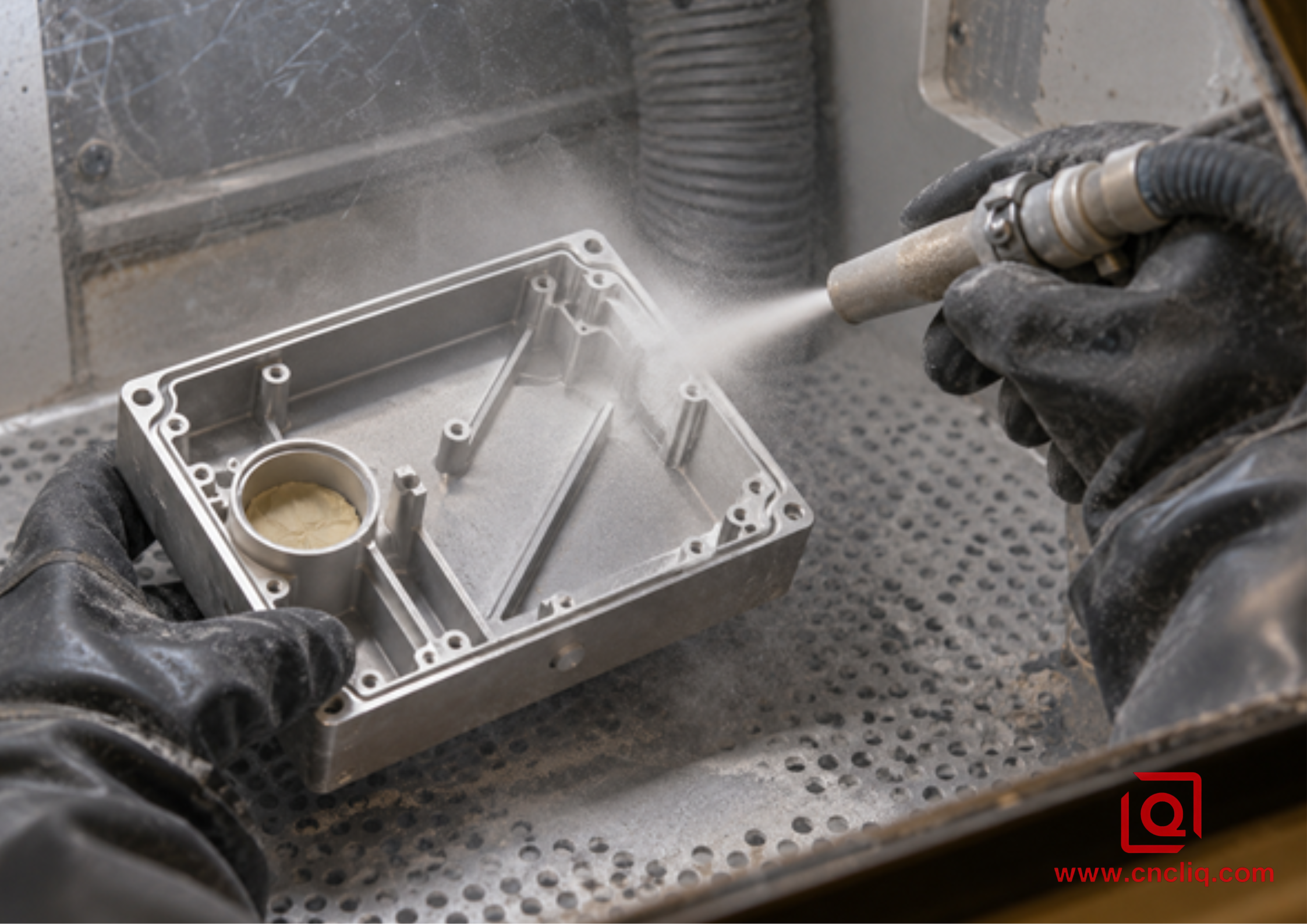
Inline image 1: soda blasting a thin-wall aluminum enclosure
Figure 1 shows masks at threads, bores, seal tracks, and weak ribs, even with mild media.
3. Sandblasting Is a Family Name
“Sandblasting” hides the actual operation. Angular oxide has a cutting edge. Round bead mainly peens and blends. Garnet brings another cutting shape. Plastic media may suit selective stripping.
Media also changes during use. Beads break. Sharp particles lose edges. Dust joins the working mix. So the finish can drift while the gauge sits still.
Cabinet history matters too. Aluminum may pick up stray steel grit from shared equipment. The mark can wait before it appears. Only after finishing might rust-colored specks arrive.
Three cautions appear in the ASM Handbook article Surface Engineering of Aluminum and Aluminum Alloys. One is warped thin work. Another is wear-through from coarse media. The third is staining from steel grit left in aluminum.
For a cosmetic matte face, name the media and size range. Keep an approved sample beside the line. Liqin’s bead-blast grit and roughness guide covers mesh, pressure, particle breakdown, nozzle travel, and incoming tool marks. Grit number alone cannot promise one Ra value or one shade.
4. Where Substrate Damage Begins
Start at the threaded hole. Ignore the broad face for a moment. That face is easy to clean and easy to photograph. The small feature tells a better story.
Set four parts on the bench: a 6061-T6 housing, 5052 cover, A356 casting, and 7075 bracket. Each reacts in its own way. Often, geometry outranks the alloy label.
|
Failure |
Likely cause |
Features at risk |
Shop control |
|
Metal loss |
Hard angular media cuts the alloy |
Fits, datum pads, small holes, and narrow lands |
Trial the real alloy and measure after the full finish |
|
Rounded detail |
Edge hits repeated |
Thread, chamfer, lettering |
Mask; redirect; use the sample |
|
Distortion |
Support missing |
Cover, fin, rib |
Fixture; shorten; check flatness |
|
Media left behind |
No exit path |
Pore, pocket, blind hole |
Vacuum; wash; view the inside |
|
Foreign material |
Dirty or steel media |
Visible or corrosion face |
Separate equipment and handling |
|
Lost function |
No protected-zone note |
Seats, contacts, seal grooves |
Mark exclusions on drawing and traveler |
A heavy casting may stay flat. A 0.8 mm cover may not. Fixture the cover before a trial. Inspect flatness after every later finish too.
Soda lowers several risks. It does not cancel measurement. Use the least aggressive qualified route. The named soil still has to come off. Every protected feature still has to pass.
5. Clean Looking Does Not Mean Coating Ready
Bright metal is persuasive. An even gray face is persuasive too. Oil can remain. Soluble salt, alkaline dust, and grit can remain too.
After soda, inspect threads and seams for bicarbonate. Pores and blind holes hold it well. Only a wetted surface gets that dissolving action. An air gun merely relocates loose dust.
The traveler should name the cleaning sequence. State the wash chemistry. State the rinse-water requirement. Show the drainage position. Write down the dry and the hold time. Primer and adhesive depend on that detail. Anodizing, conversion coating, and powder do as well.
Hard media changes the concern. A pocket may hide loose particles. Soft metal may retain a hard grain. Shared steel equipment brings ferrous material into the picture.
Begin with clean gloves and fixtures. Filter the air. Vacuum controlled areas. Match chemical pretreatment to the later finish. The cabinet lamp cannot approve chemistry.
ASTM F22-21 is the reference used here for a water-break check. A continuous film is the desired observation. Beading or a broken film raises the flag. The check is fast and does not harm the part. No numeric result comes from it. Ionic residue needs different evidence.
If ionic cleanliness matters, agree on an extract or conductivity method. Do that before the first batch. Do not invent the acceptance limit after a failure.
6. Match the Blast Route to the Next Finish
Paint and Powder
Begin with the coating supplier’s profile requirement. Soda alone seldom fills that line on the specification. It may do selective stripping first. Wash and rinse next. A light profiling pass can follow where approved.
Angular abrasive can clean and profile a robust part. One pass may do both jobs. The coater should name the media, profile range, pretreatment, and film system.
More roughness is not free insurance. Tall peaks hold soil and consume coating. Film may run thin over the tips. Lightweight detail may also lose metal.
For this topic, the relevant AMPP reference is SSPC-SP 16-2020. Its scope reaches nonferrous metal, including aluminum alloy. First check that its end condition fits the job. The drawing must still carry protected areas and the coating maker’s needs.
Anodizing and Chemical Conversion Coating
The chemical line receives the surface left by blasting. It cannot restore a lost edge. It cannot hide every opened pit.
Fine bead blasting may lower glare and blend light tool-mark contrast. Aggressive media may expose casting flaws or soften details. Soda better preserves the incoming machined texture. All bicarbonate and soil must leave before the chemical line.
Liqin’s OEM post-processing guide for CNC-milled aluminum connects blasting with masking, film growth, and dimensional planning. Porous castings need extra thought. For pores, see the guide to chemical conversion coating on cast aluminum. It follows cleaning and drying through cast geometry.
Bonding Work
No single knob controls a bond. Chemistry and oxide condition come first. Then include roughness and primer. Contamination and time before assembly finish the picture.
Put the proposed route in front of the adhesive supplier. Make coupons that represent the part. Use the real primer and adhesive. Finish with the project’s mechanical test.
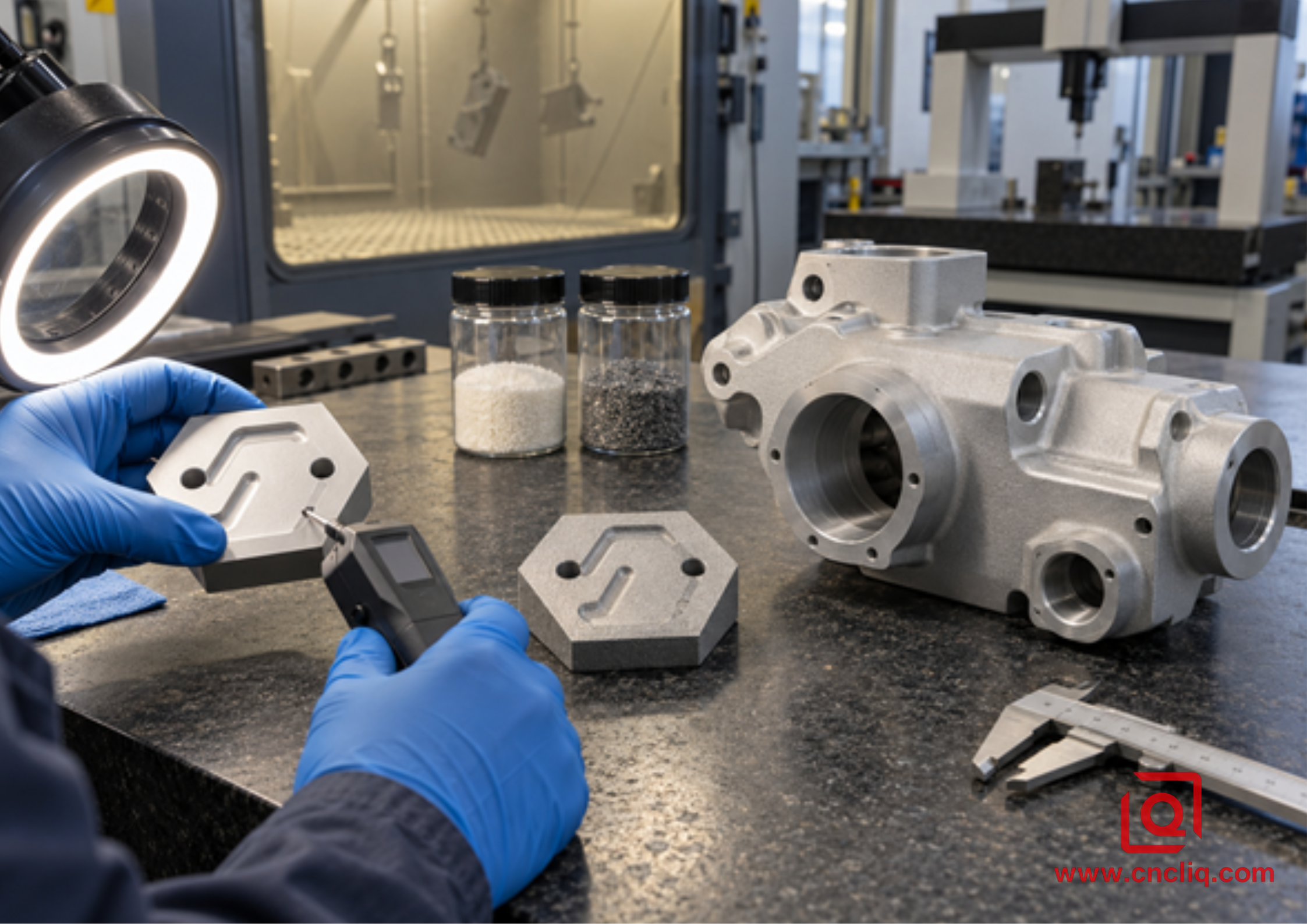
Inline image 2: inspection of soda-blasted and abrasive-blasted aluminum coupons
Figure 2 separates four checks: appearance, roughness, edge condition, and dimensions.
7. Selection Matrix for Common OEM Aluminum Parts
|
Part and goal |
Better first trial |
Reason |
Hold point |
|
Painted 5052 cover |
Soda trial |
Gentle on shape and edge |
Flatness, holes, soda removal |
|
Threaded 6061 enclosure |
Soda or fine bead by zone |
Mixed cosmetic and functional faces |
Mask map, gauges, trapped media |
|
Scaled A356 casting |
Qualified angular media |
Rigid section, faster removal |
Pores, grit, coating fit |
|
7075 paint bracket |
Controlled fine angular media |
Profile may be needed |
Edges, critical zones, coupon |
|
Carbon-soiled pump part |
Soda, then validated wash |
Low base-metal attack |
Passages and final clean check |
|
CNC face before matte anodize |
Fine bead trial |
Blending rather than sharp cutting |
Sample, alloy lot, fits, color |
A custom precision aluminum light housing shows why zones matter. It combines seal faces, gasket tracks, threads, and broad outer walls. One blanket blast note would be poor DFM. The exterior may follow an approved cosmetic route. Precision interfaces should remain protected.
8. A Qualification Plan That a Buyer Can Audit
1. Name the soil and the next finish. Do not write only “dirty.” Paint, carbon, grease, oxide, and casting residue can send the job in different directions.
2. Mark every treatment zone. Include bores, threads, datums, contacts, seal lands, marks, and appearance faces.
3. Record the media. Add shape, size range, condition, delivery method, and cabinet segregation.
4. Trial production material. Flat coupons help, but the first article must include real ribs, pockets, edges, and holes.
5. Begin gently. Log the pressure and nozzle. Add stand-off, angle, travel, flow, dwell, and fixture support.
6. Validate cleanup. The record begins with vacuum, then wash and rinse. Add drain position, dry method, hold time, and the named clean check.
7. Inspect after the full route. Check dimensions, flatness, gauges, edges, appearance, profile, and trapped media.
8. Qualify the real finish. Run the primer or paint that will ship. Powder, anodize, conversion, and adhesive follow exactly the same logic.
9. Freeze the approved route. Keep the coupon, traveler, media record, test method, photographs, packaging, and revalidation triggers.
The first article is not paperwork for its own sake. Bad assumptions are cheapest here. Ten samples may reveal a weak mask or poor drainage; a thousand repeated parts reveal it too late.
9. Anonymous Customer Case: Sensor Mounts With Two Surface Needs
This anonymized composite case reflects a normal custom-machining problem. It is not a universal guarantee.
A European automation buyer requested 6061-T6 sensor mounts. Each mount had three thin lattice ribs. It also carried a precision dowel bore, several M3 threads, and a broad painted face. The RFQ said only “sandblast clean.”
That note exposed every feature to one process. The part needed two results instead.
The review began with zones. The dowel bore stayed masked. So did the gasket land, threads, and identification area. Soda was trialed on the broad ribs. Its job was coating removal with little new profile.
Cleanup came next. The route used a compatible wash and several rinses. Parts drained in a controlled position. Clean air finished the dry. Blind holes received a separate check.
The paint supplier then reviewed profile. Soda had not created the required tooth. A light second step was tested on approved outer areas. It did not touch the precision zones.
The first article carried several records. CMM results covered dimensions before and after finishing. Thread gauges checked the M3 holes. Flatness caught movement at the lattice. Photographs recorded each mask line. A water-break check addressed hydrophobic soil. Coupons went through the real primer and topcoat.
Production waited for sample approval. That pause avoided an uncontrolled repair loop. The buyer received one documented route instead of separate stripping and painting surprises.
For a useful review, send the drawing and alloy. Add the existing coating. Mark critical zones. Name the next finish. Liqin can then propose trial media, masking, and inspection before production pricing.
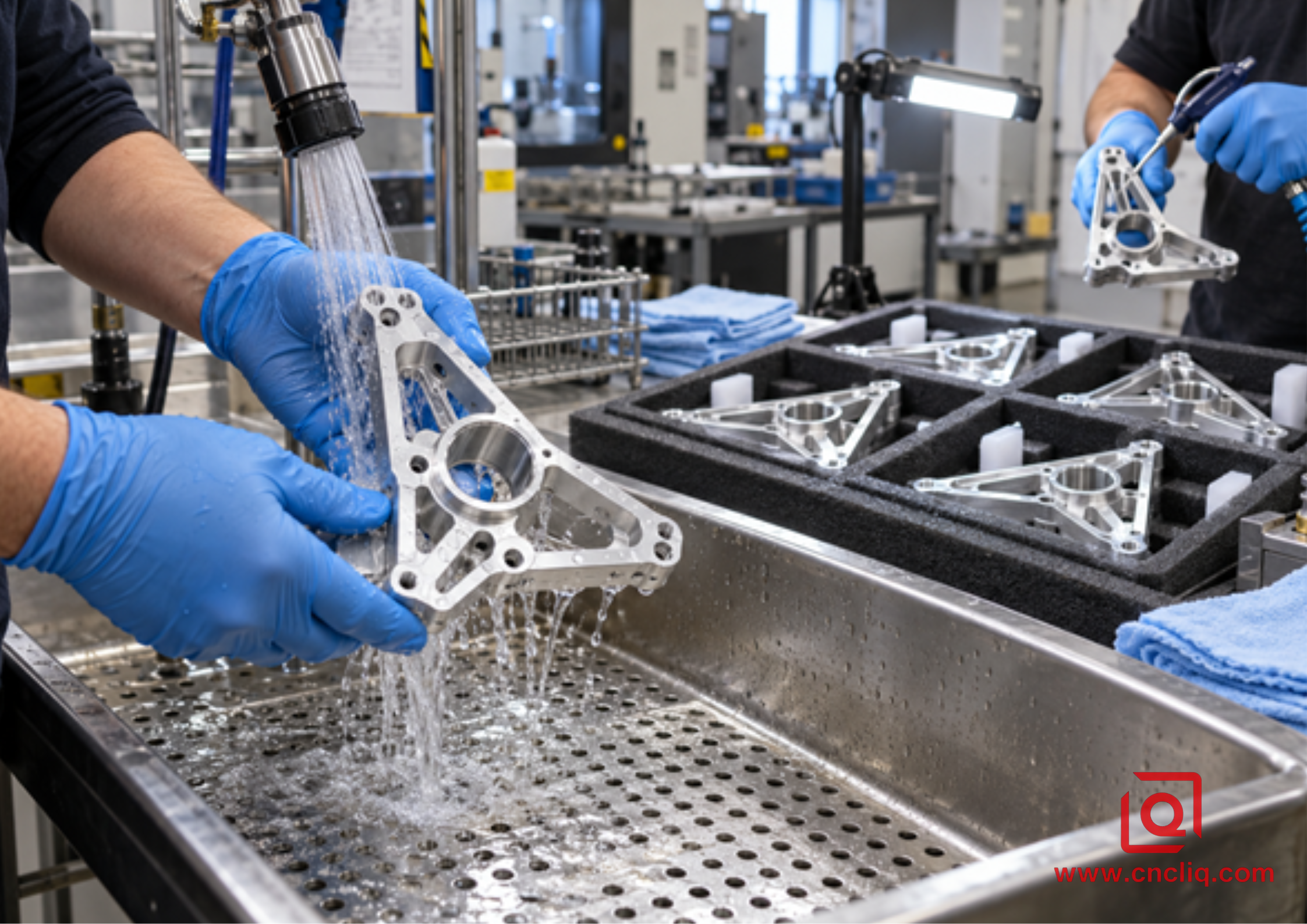
Inline image 3: final rinsing and packing of machined aluminum sensor mounts
Figure 3 places rinse, drain position, blind-hole inspection, and separated packing within one route.
10. Cost on the Production Route
Soda may work slowly on thick coatings and heavy oxide. Price the whole route. Count media and extraction. Washing, rinsing, drying, and checking come next. The payoff can be a delicate part that needs neither straightening nor another machining setup.
Hard media normally removes stubborn material sooner. Reuse is possible with certain media. A short cycle can still produce a long bill. Price in masks, cabinet separation, media condition, nozzle wear, cleanup, checks, and scrap risk.
Compare qualified routes. Do not compare media price per kilogram.
Every blasting process creates exposure concerns. OSHA’s fact sheet Protecting Workers from the Hazards of Abrasive Blasting Materials notes high dust and noise. Hazards may come from the media and from the removed coating or substrate.
Crystalline silica sand needs special attention. Silicosis is one possible outcome of exposure. Lung cancer and other breathing problems are also listed hazards. Ordinary silica sand should never be a casual default. Enclose the work, extract dust, select proper PPE, control waste, and follow local rules.
11. The RFQ Package
1. Put the controlled 2D drawing first. Supply a 3D model beside it. STEP and IGES are common choices.
2. List alloy and temper. Follow with raw condition, manufacturing route, and revision.
3. Identify the existing coating or soil. Flag any known hazardous constituent.
4. Mark surfaces to clean, strip, profile, preserve, or mask. Show the visual boundary.
5. State dimensions and tolerances after blasting and all later finishes.
6. Say what comes next. That might be primer or paint. It might instead be powder, anodize, conversion, plating, or bonding.
7. Add the profile and roughness. Attach an appearance sample. Then state cleaning proof, adhesion test, and limits.
8. Give the quantity and first-article need. Include reports, packing, destination, and schedule.
9. State whether media substitution, cabinet sharing, repair, and rework are allowed.
For thin walls, tight bores, and cosmetic faces, send the drawing before freezing the blast note. Soda blasting aluminum may be the right first trial. A zone review should confirm that choice. It can also settle masks, gauges, and later treatment.
FAQs
1. Can Soda Mark the Aluminum?
Compared with hard mineral media, soda cuts less. That is why delicate parts often see it first. It can still leave damage. Watch long dwell, close stand-off, dirty media, and unsupported walls. Trial the production alloy and real geometry. Check dimensions and protected features after cleanup.
2. Can Paint Follow Soda Immediately?
Do not assume so. Soda blasting aluminum can remove an old film yet add little profile. Bicarbonate left behind may interfere with adhesion. Show that washing and rinsing worked. Then follow the coating supplier’s needs for cleaning, profile, and conversion. Apply the real primer and topcoat to a coupon.
3. Is One Medium Always the Safest?
No. Soda cuts lightly. Fine bead often suits a satin appearance trial. Angular oxide can prepare a sturdy part for coating, with more risk at edges and fits. Review alloy and temper beside wall thickness, soil, profile, and the later finish.
4. Which Checks Support a Cleanliness Decision?
Begin with appearance, then look inside cavities. Gauge the critical features. For hydrophobic soil, use the agreed water-break check. When ions matter, add the customer’s extract or conductivity method. Let the later coating, anodizing, conversion, or bond route set final acceptance.
5. How Detailed Should the Blast Callout Be?
Name the media and size or grade. Mark treated and masked surfaces. State appearance or profile, post-finish dimensions, cleanup method, next coating, and inspection rule. Add an approved sample when color or texture matters. State whether substitution and shared cabinets are allowed.
Summary
When shape and original texture matter most, start the soda trial there. Heavy removal or a measured profile points toward controlled hard media. A sound route joins the media to alloy, geometry, masks, cleanup, checks, and later finish. Put those details beside the drawing. Sign off on a real sample before production. The result should work, not merely look clean.
Contact Information
Company: Ningbo Liqin Industry Co., Ltd.Daily customer maintenance & after-sales support:service@shturl. zhuwanying@cncliq.com
New inquiry, quotation & order discussion:business@shturl. zhouli@chinaliqin.com
Hotline: +86 18757148656
Disclaimer
All technical articles, material specifications, machining recommendations, and surface treatment details published on this blog are for informational and reference purposes only. Please note that general blog insights do not replace signed technical agreements. Because custom parts vary by material heat numbers, machine calibrations, and specific tolerances, binding quality specs are governed solely by your approved CAD drawings, signed contracts, and formal quality plans.
All customer case studies featured on this blog have been thoroughly anonymized and sanitized. The performance metrics, manufacturing workflows, and imagery displayed serve solely to demonstrate our custom machining capabilities and do not represent a single universal standard for all orders.
Liqin Manufacturing Team
Built on 18 years of precision engineering experience, Ningbo Liqin Industry manufactures high-tolerance metal components for demanding global markets. We operate out of a 6,500 m² production hub equipped with over 150 machines, running 4-axis and 5-axis CNC machining, mill-turn machining, cold extrusion, and pressure die casting under one roof. This setup allows us to manage projects seamlessly, taking parts from initial CAD concepts directly to finalized shipments.
We handle quality control with zero compromise. We treat tight tolerances with the engineering discipline they require. Backed by ISO 9001, ISO 13485, and IATF 16949 certifications, our QA engineers run strict IPQC, FQC, and OQC checks on every single production batch. From CMM dimensional mapping and optical profiling to hardness and salt-spray testing, we validate your critical specs upfront—so you receive drop-in ready components with zero assembly headaches or costly line stoppages. On top of manufacturing, you can rely on us for two-hour response times on new RFQs, direct support for prototype sampling, and smooth export shipping across Europe, North America, Asia, and Oceania.
Welcome your inquiries and samples. Visit our website or contact us directly for a competitive quote!