English




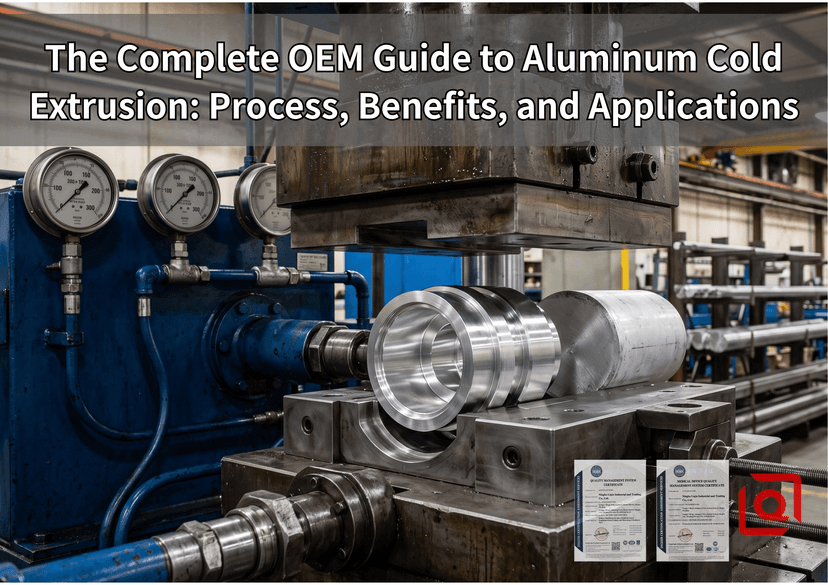
Machining a deep internal cavity out of a solid aluminum bar on a multi-axis CNC mill feels comfortable on paper until you watch your scrap bins fill up with chips representing over half of the raw billet you paid for. Subtractive machining makes total sense for five rapid prototypes or twenty validation samples. But the moment your purchasing forecast scales into tens of thousands of units each year, paying machine spindle time to turn expensive raw metal into scrap will slowly drain your product margin.
If you design or source hollow, cup-shaped, symmetrical, or stepped aluminum components, cold extrusion offers an exceptionally efficient route. On our shop floor, hydraulic presses run continuously, shearing round slugs, tumbling them smooth, coating them with specialized dry lubricants, and displacing metal past its yield point at room temperature.
Here is a practical look at aluminum cold extrusion from the factory floor—how the metal flows under pressure, how continuous grain structure eliminates pressure leaks, and how engineering teams can cut piece-part costs without compromising structural integrity.
       FORWARD EXTRUSION                       BACKWARD EXTRUSION
   [ Punch Moves Downward ]                [ Punch Moves Downward ]
   +-----------------------+              +-----------------------+
   |       | Punch |       |              |       | Punch |       |
   |       +-------+       |              |       +-------+       |
   |   [ Billet / Slug ]   |              |  ^   [ Billet ]   ^   |
   |-------+       +-------|              |  |   Flows Up     |   |
   | Die   | Extr. |  Die  |              |  |   Around Punch |   |
   |       | Rod   |       |              |                       |
   +-------+       +-------+              +-----------------------+
     (Material flows same                   (Material flows opposite
      direction as punch)                    direction to punch)
What Actually Happens Inside the Tooling Die?
Cold extrusion does not rely on preheating or molten metal. Instead, high-tonnage mechanical or hydraulic presses drive cold aluminum slugs past their elastic threshold into the plastic deformation range entirely through raw mechanical force.
Before a piece of metal ever sees a press, raw round bar gets sheared into cylindrical blanks called slugs. Every single slug is weighed automatically to verify mass consistency, tumbled in vibratory bowls to deburr sharp edges that might nick tooling, and submerged into a specialized surface conversion bath.
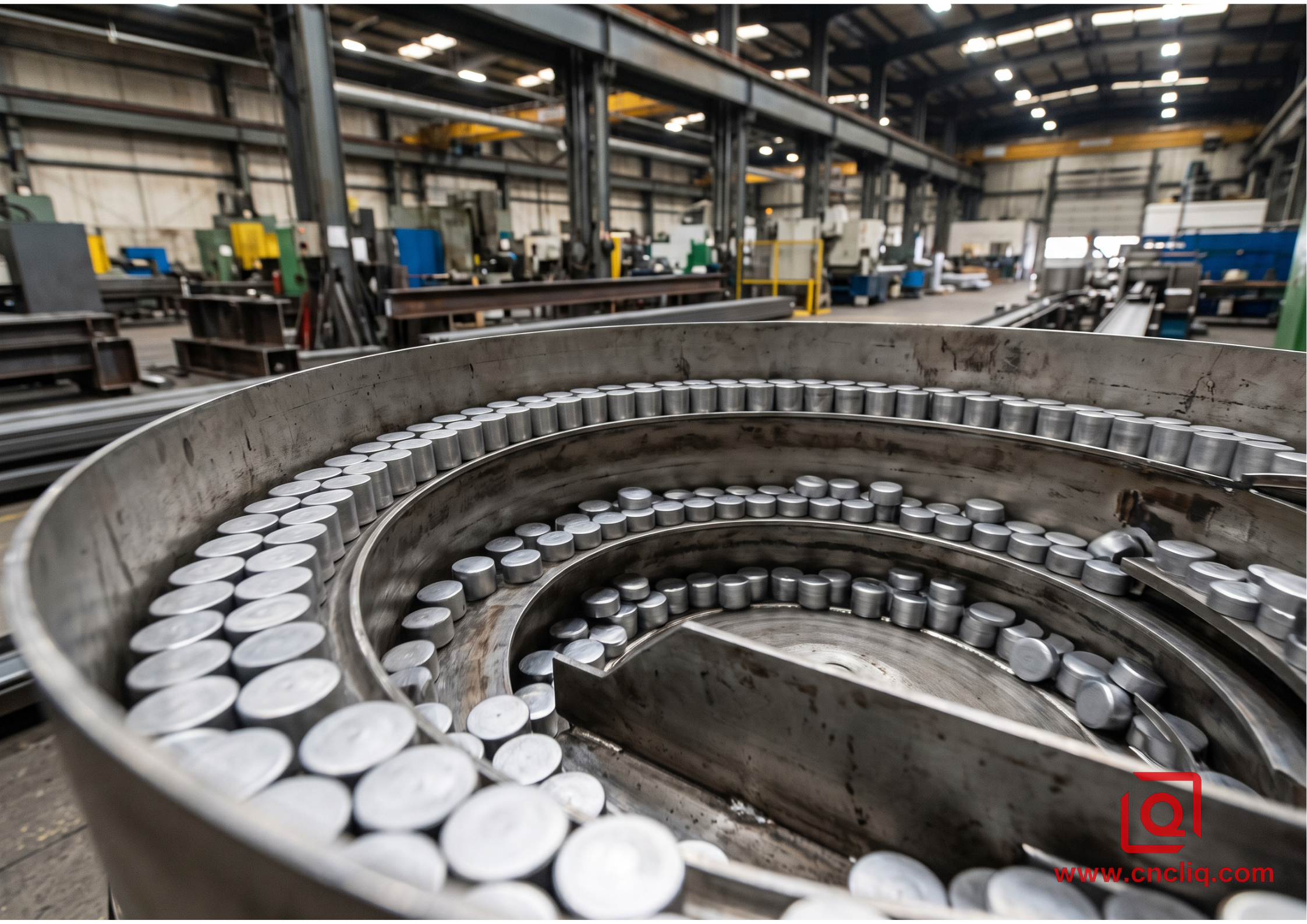
This chemical coating—typically a micro-crystalline zinc phosphate layer topped with a reactive soap film—creates an indispensable high-pressure barrier. Without this thin chemical film, the aluminum would grab onto the polished carbide die walls almost immediately under heavy friction, causing galling, damaging the tooling, and throwing off the press stroke.
After lubrication, the slug drops into a precision-ground tungsten carbide die. As the hardened steel punch comes down with hundreds of tons of direct force, the confined aluminum acts much like dense wax at room temperature. It follows the easiest route available, pushing into the open spaces designed between the punch and the die cavity.
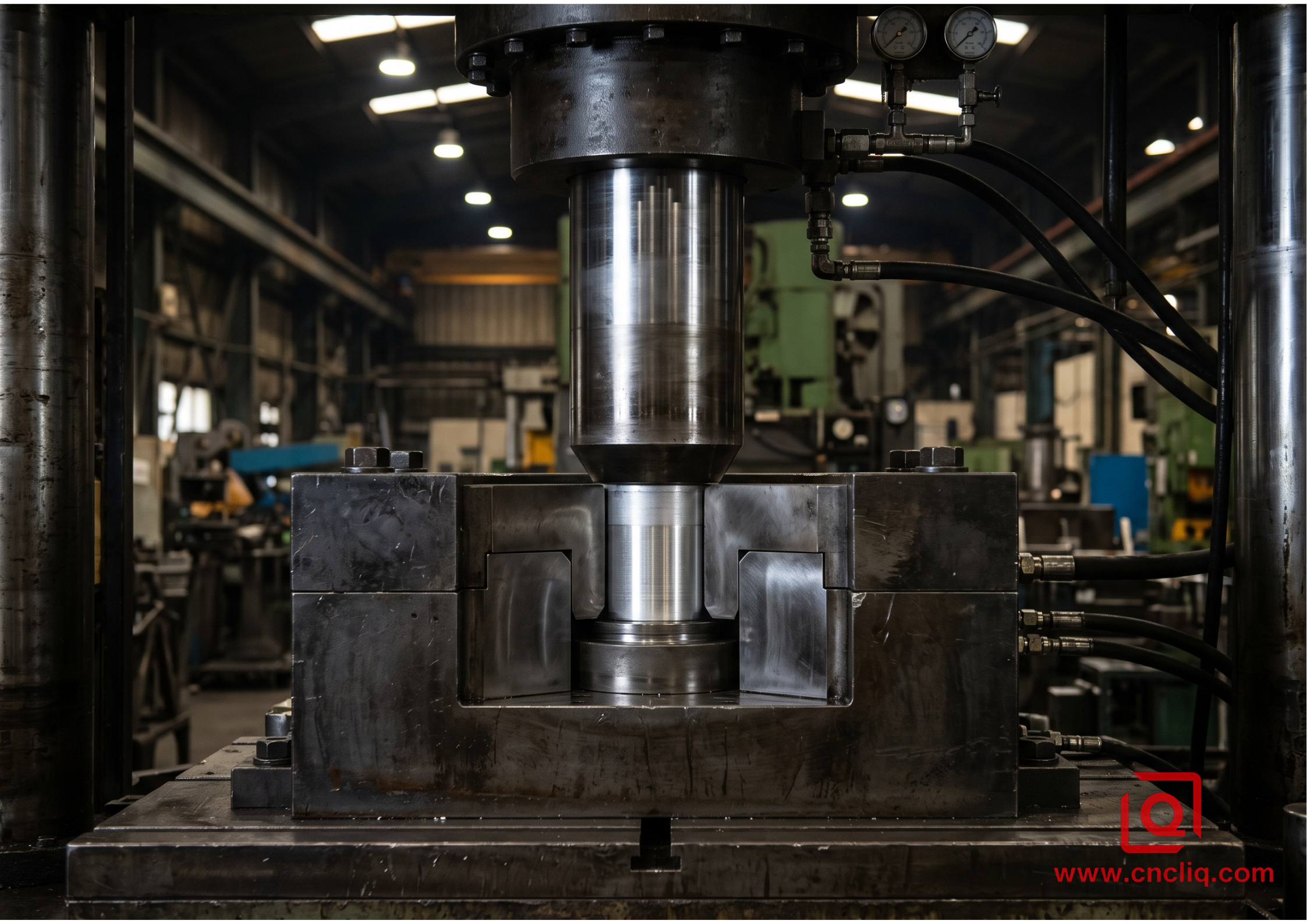
Depending on the geometry of your target component, toolmakers deploy three foundational metal flow strategies:
-
Forward Extrusion: The descending punch forces the slug forward through a necked-down restriction in the die cavity. The displaced material moves in the identical direction of the ram stroke. We rely heavily on this configuration when manufacturing stepped motor shafts, multi-diameter connector pins, solid valve spools, and structural standoffs.
-
Backward (Reverse) Extrusion: The slug sits seated against a solid die base with nowhere to travel downward. As the punch pushes firmly into the center of the slug, the displaced aluminum flows upward into the annular clearance surrounding the punch body. This setup is the absolute workhorse for deep-draw cans, high-pressure sensor bodies, electronic capacitor enclosures, and hollow cylinders.
-
Combined (Compound) Extrusion: A single press stroke displaces aluminum both downward through a bottom throat and upward around the descending punch simultaneously. This allows us to produce a complete fluid connector or valve body—featuring a solid stepped stem on one end and a deep hollow cavity on the other—in a single continuous cycle without secondary welding or multi-piece assemblies.
         COMBINED (COMPOUND) EXTRUSION
          [ Punch Descends ]
       +-----------------------+
       |       | Punch |       |
       |       +-------+       |
       |   ^   [ Billet ]   ^  |  <- Material flows UP
       |   |                |  |     around the punch
       |---+                +--|
       |Die|               |Die|
       |   | [Shank Stem]   |  |  <- Material flows DOWN
       +---+                +--+     through die throat
Material Behavior: Balancing Ductility and High Strength
Push aluminum alloys hard enough in compression, and they don't all behave the same way—their composition and grain structure decide that. Picking one over the other comes down to a trade-off: how easily it flows in the die versus the yield strength you actually need at the end.
| Alloy Grade | Initial State | Final Post-Form Temper | Typical Yield Strength | Primary OEM Component Uses | Tool Wear Profile |
| 1070 / 1050 | O Annealed | H14 / H18 Work Hardened | 95 to 135 MPa | High-efficiency thermal heat sinks, EV battery vent caps, capacitor cans | Minimal |
| 6061 | O Soft Anneal | T4 / T6 Post Heat-Treated | 240 to 275 MPa | Automotive brake pistons, high-pressure hydraulic manifolds, sensor bodies | Moderate |
| 6082 | O Soft Anneal | T6 Post Heat-Treated | 260 to 310 MPa | Heavy-duty structural chassis links, suspension bushings, industrial cylinders | Moderate to High |
| 7075 | O Spheroidized | T6 / T73 Stress Relieved | 430 to 505 MPa | Aerospace structural fittings, defense ordnance housings, tie-rod ends | High |
High-purity alloys like 1070 and 1050 flow like soft putty under pressure. Their crystal lattice carries plenty of slip planes and few alloying obstacles, so they fill deep cavities without shear cracks or mid-process annealing. They take the top spot when thermal or electrical conductivity has to be at its peak.
When strength and thread-holding bite are the requirement, 6000-series grades such as 6061 and 6082 are the industry workhorses. One catch: don't cold extrude stock T6 temper—its as-shipped hardness shatters punches and cracks at sharp corners.
Raw 6061 slugs need a full recrystallization anneal first: hold them at 380–415°C for approximately 3 hours, then let them cool slowly inside the furnace. That leaves the metal soft and ductile.
During the violent few seconds of cold plastic deformation, the metal experiences severe strain hardening. Once formed, the near-net-shape components pass directly into a dedicated solution heat-treatment and artificial aging furnace at 175 degrees Celsius for 8 hours to achieve full T6 temper mechanical properties.
Process Benchmarks: Cold Extrusion, CNC Machining, and Die Casting
Every manufacturing process involves distinct technical trade-offs between tooling investment, material utilization, cycle time, and structural durability.
Grain Fiber Lines Comparison:

CNC Machining (Cut Fibers):
=================== (Cutting tool slices across native grain lines)
------------------- (Exposes microscopic leak paths and stress risers)

Cold Extrusion (Continuous Unbroken Fibers):
~~~~~~~~~~~~~~~~~~~ (Grain flow curves smoothly around structural contours)
~~~~~~~~~~~~~~~~~~~ (Maximizes burst resistance and cyclic fatigue life)
| Manufacturing Parameter | Aluminum Cold Extrusion | Multi-Axis CNC Machining | High-Pressure Die Casting (HPDC) |
| Material Scrap Rate | 5% to 8% (Minor crop ends) | 55% to 75% (Substantial chip loss) | 15% to 25% (Gates, runners, and flash) |
| Grain Structure & Fatigue | Superior (Continuous grain flow) | Moderate (Grains cut by tooling) | Low to Moderate (Prone to porosity) |
| As-Formed Dimensional Tolerance | Plus/minus 0.030 to 0.060 mm | Plus/minus 0.008 to 0.015 mm | Plus/minus 0.100 to 0.250 mm |
| Surface Roughness | Ra 0.2 to 0.8 micrometers | Ra 0.8 to 3.2 micrometers | Ra 1.6 to 6.3 micrometers |
| Production Cycle Time | 1.5 to 4.0 seconds per piece | 120 to 480 seconds per piece | 25 to 60 seconds per shot |
| Economical Production Scale | 5,000 units and above | 1 to 500 units | 10,000 units and above |
CNC machining gives generous dimensional freedom and very tight tolerances. That makes it a good fit for low-volume runs and complex non-symmetrical profiles. The flip side: cutting tools slice across the natural grain of rolled bar stock, leaving microscopic stress risers and possible leak routes through thin walls.
High-pressure die casting turns out intricate shapes fast. But turbulent molten-metal injection can trap tiny gas pockets and shrinkage voids. Under steady hydraulic pressure or repeated high-fatigue loading, those hidden pores can grow into serious leak paths.
Cold extrusion reshapes the metal while it stays fully solid. The aluminum's continuous grain lines bend around internal fillets and follow the wall contours, so extruded parts get higher burst strength, good fatigue life, and a smooth, burnished finish straight off the press.
Practical DFM Guidelines for Design Engineers
Designing a part for cold extrusion requires thinking about how solid metal flows under hydrostatic pressure. Features that look effortless to cut with an end mill can generate catastrophic stress spikes in hard tooling.
        PRONE TO TOOL WEAR                       RECOMMENDED DFM PROFILE
    |                          |           |                             |
    |   Sharp Corner (R = 0)   |           |    Smooth Fillet (R >= 1.5) |
    +-------+          +-------+           \          /--------\         /
            |          |                    \        /          \       /
            |          |                     |      |            |     |
     (Severe tool stress concentration)   (Balanced flow, extended punch lifespan)
-
Bottom-to-Wall Thickness Proportions: In backward-extruded cylindrical parts, aim to keep the base thickness roughly 1.0 to 1.5 times the sidewall thickness. If the bottom floor is engineered too thin relative to the vertical walls, the punch face will punch straight through the slug before continuous backward flow can establish itself.
-
Transition Fillets and Internal Radii: Avoid sharp, 90-degree internal transition shoulders with zero radius. Always specify generous transitional fillets of at least 1.5 mm, or ideally 2.5 mm when using 6000-series alloys. Sharp internal steps block uniform metal displacement, trap air pockets, and create severe bending fatigue on the punch shoulder.
-
Symmetrical Wall Distribution: Asymmetrical wall designs create uneven lateral forces across the punch face during the press stroke. When one side wall is substantially thicker than the opposite wall, the descending punch inevitably deflects toward the path of least resistance. This punch wandering causes severe wall-thickness runout and can fracture the surrounding tungsten carbide die insert.
-
Gentle Draft Angles: Although cold extrusion can produce straight vertical walls with zero draft, adding a subtle draft angle between 0.25 and 0.5 degrees along non-critical internal surfaces significantly lowers extraction friction during the return stroke. This small detail can easily double your working tooling lifespan.
Quality Control and Inspection Standards
In high-speed cold extrusion operations where presses stroke up to 45 times every minute, rigorous process control is essential to ensure thousands of consecutive parts stay precisely on dimension.
-
Dimensional Precision (DIN ISO 2768-m): Outer diameters direct-formed against polished carbide die inserts regularly hold ISO IT8 to IT9 tolerance standards. Smooth internal bores created over ground punch mandrels achieve ISO IT7 consistency without boring passes.
-
Continuous Slug Mass Verification: Every sheared raw billet passes across high-speed check-weighers. In a closed-die tooling configuration, excess material volume cannot escape; an overweight slug causes extreme hydrostatic pressure spikes that can permanently deform heavy press bolster plates.
-
Surface Integrity and Non-Destructive Testing (ASTM E1417): Cold deformation introduces intense hoop stress along external part skins. Automated eddy-current inspection and regular fluorescent penetrant testing verify that formed surfaces remain completely free of longitudinal micro-fissures or friction tearing.
-
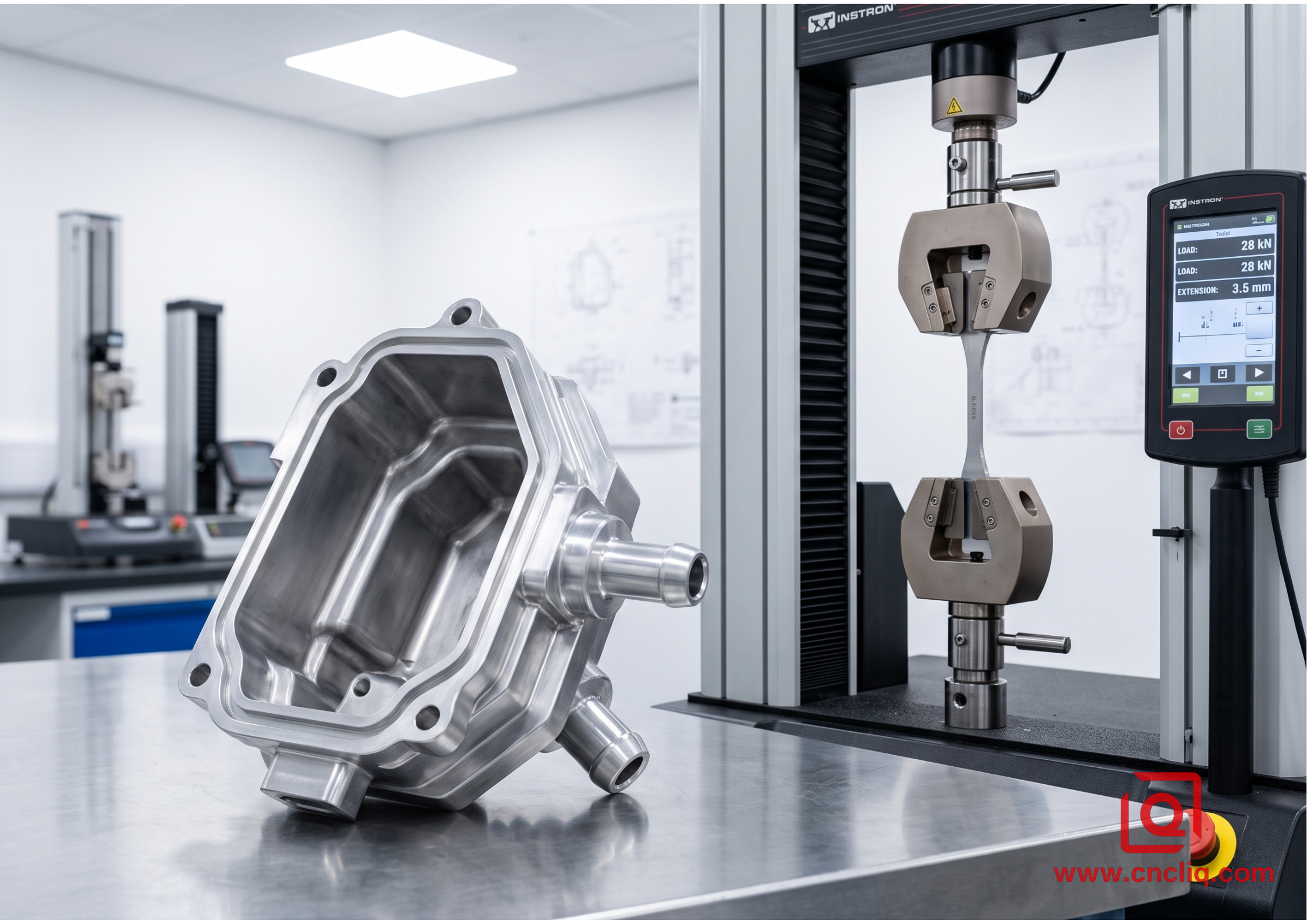
Hardness and Mechanical Proof Testing (ASTM E10 and ISO 6506-1): Parts emerging from post-forming T6 heat-treatment furnaces undergo systematic Brinell and Vickers hardness testing, paired with periodic destructive tensile pulls to guarantee complete yield strength compliance across every production lot.
Real-World OEM Application Breakdown
+-------------------------------------------------------------------------+
|                  CASE STUDY: AUTOMOTIVE PRESSURE HOUSING                |
+-------------------------------------------------------------------------+
| Target Application:                                                     |
| - High-pressure fuel rail sensor enclosure                             |
| - Annual Production Volume: 120,000 units                               |
| - Material Specification: 6061-T6 Aluminum                              |
| - Performance Target: Zero leakage at 35 MPa proof pressure             |
|                                                                         |
| Prior Manufacturing Hurdles:                                            |
| - Machined from solid 45 mm diameter 6061-T6 bar stock on CNC lathes    |
| - Machine cycle time: 210 seconds per finished unit                     |
| - Material loss: 68% of raw aluminum converted into waste chips         |
| - Minor porosity along cut grain lines caused occasional micro-leaks   |
|                                                                         |
| Implemented Cold Forming Process:                                       |
| 1. Backward cold extrude hollow cup near-net shape in 2.2 seconds       |
| 2. Perform solution and artificial aging heat treatment to T6 temper   |
| 3. Quick 18-second secondary CNC pass for M18x1.5 thread and O-ring seal |
|                                                                         |
| Quantified Production Gains:                                            |
| - Raw material starting mass dropped from 385 grams to 132 grams        |
| - Overall piece-part manufacturing cost decreased by 41.8%              |
| - 100% burst test pass rate across 120,000 parts delivered             |
+-------------------------------------------------------------------------+
An international automotive Tier-1 supplier approached our team with a challenging high-pressure fuel rail sensor housing. Their existing manufacturing partner had been turning the entire component from solid 45 mm diameter 6061-T6 extruded bar stock.
Each part tied up a high-precision multi-axis lathe for 210 seconds, cutting away 68% of the initial raw material into scrap chips. More critically, machining straight into the solid bar cut across the longitudinal grain boundaries, which occasionally resulted in microscopic fluid seepage through the thin sensing diaphragm wall during high-pressure validation testing at 35 MPa.
Our engineering team transitioned the component to a high-efficiency two-stage manufacturing route:
[Sheared 6061 Billet]
       |
       v
[Anneal Below 45 HBW Hardness]
       |
       v
[Apply Dry Phosphate Lubricant]
       |
       v
[Reverse Cold Extrude Near-Net Cup (2.2 Seconds)]
       |
       v
[Unbroken Grain Alignment Along Internal Cavity]
       |
       v
[Solution & Aging Heat Treatment to T6]
       |
       v
[High-Speed CNC Finish: Threads & Seal Groove (18 Seconds)]
We sheared soft-annealed 6061 slugs, applied an advanced chemical conversion lubricant, and backward-extruded the deep hollow body on a 400-ton press in just 2.2 seconds. This plastic displacement forced the natural aluminum grain structure to flow continuously around the internal base transitions and up the sidewalls.
Following a standard T6 heat treatment cycle to restore maximum mechanical strength, a secondary CNC lathe spent just 18 seconds cutting the external M18x1.5 mounting threads and seating an elastomeric seal groove.
The results were immediate and measurable. Raw starting material dropped from 385 grams down to 132 grams per piece—a 65.7% reduction in raw metal purchase weight. Total part cost fell by 41.8% including tooling amortization, while the dense, continuous grain alignment completely resolved pressure testing failures across all 120,000 production units delivered.
Conclusion: Evaluating Your Next OEM Project
Aluminum cold extrusion offers a reliable manufacturing bridge between the material economy of casting and the surface precision of multi-axis machining.
When your parts require cylindrical symmetry, deep blind cavities, or robust pressure resistance under cyclic loading, cold forming reduces cycle times from several minutes down to mere seconds while dramatically curbing material scrap.
Send over your STEP or IGES component files along with your projected annual delivery requirements. Our engineering group will conduct a thorough DFM review, calculate press tonnages, evaluate grain flow paths, and outline an optimized volume production strategy tailored to your exact technical specifications.
Contact Information
Disclaimer
All technical articles, material specifications, machining recommendations, and surface treatment details published on this blog are for informational and reference purposes only. Please note that general blog insights do not replace signed technical agreements. Because custom parts vary by material heat numbers, machine calibrations, and specific tolerances, binding quality specs are governed solely by your approved CAD drawings, signed contracts, and formal quality plans.
All customer case studies featured on this blog have been thoroughly anonymized and sanitized. The performance metrics, manufacturing workflows, and imagery displayed serve solely to demonstrate our custom machining capabilities and do not represent a single universal standard for all orders.
Liqin Manufacturing Team
Built on 18 years of precision engineering experience, Ningbo Liqin Industry manufactures high-tolerance metal components for demanding global markets. We operate out of a 6,500 m² production hub equipped with over 150 machines, running 4-axis and 5-axis CNC machining, mill-turn machining, cold extrusion, and pressure die casting under one roof. This setup allows us to manage projects seamlessly, taking parts from initial CAD concepts directly to finalized shipments.
We handle quality control with zero compromise. We treat tight tolerances with the engineering discipline they require. Backed by ISO 9001, ISO 13485, and IATF 16949 certifications, our QA engineers run strict IPQC, FQC, and OQC checks on every single production batch. From CMM dimensional mapping and optical profiling to hardness and salt-spray testing, we validate your critical specs upfront—so you receive drop-in ready components with zero assembly headaches or costly line stoppages.On top of manufacturing, you can rely on us for two-hour response times on new RFQs, direct support for prototype sampling, and smooth export shipping across Europe, North America, Asia, and Oceania.
Welcome your inquiries and samples. Visit our website or contact us directly for a competitive quote!