 English




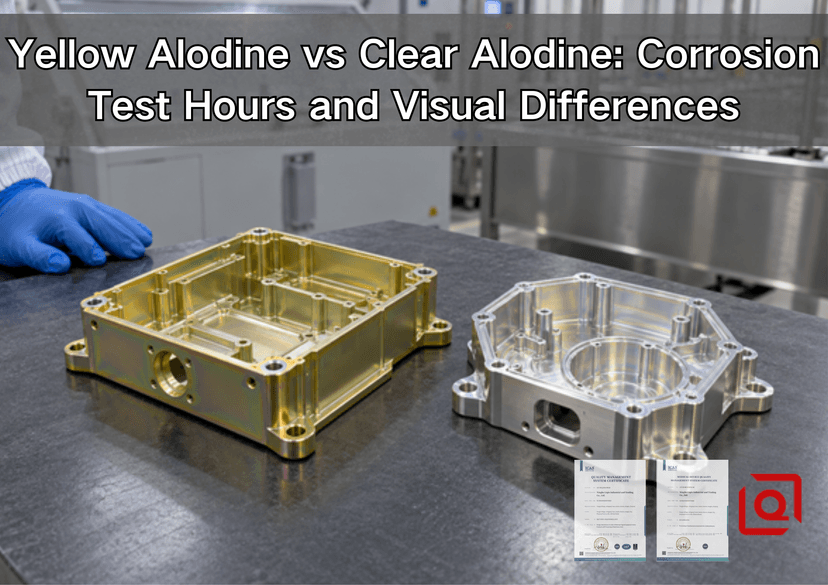
Are you still deciding between yellow Alodine and clear Alodine, while the drawing says only “chem film” and the supplier keeps asking what you really need? That small color decision can affect compliance, inspection, grounding, paint preparation, and the appearance of every production lot. This guide explains yellow Alodine vs clear Alodine from a shop-floor engineering point of view, including what the colors usually indicate, how the 168-hour corrosion requirement is used, why color cannot prove performance, and what to put on an RFQ so a finisher can quote the correct process.
The short answer is simple. Yellow or gold Alodine is commonly associated with traditional hexavalent-chromium Type I chemistry. Clear or faintly blue conversion coating is commonly associated with non-hexavalent Type II chemistry, although qualified products and alloy reactions can produce other shades. Under MIL-DTL-5541, chemistry is defined by Type I or Type II, while function is defined by Class 1A or Class 3. “Yellow,” “clear,” and “Alodine” alone are not complete acceptance criteria.
Yellow Alodine vs Clear Alodine at a Glance
|
Engineering question |
Yellow or gold appearance |
Clear or faintly iridescent appearance |
What the buyer should specify |
|
Usual chemistry association |
Often Type I, containing hexavalent chromium |
Often Type II, containing no hexavalent chromium |
State Type I or Type II, not color alone |
|
Typical visual character |
Pale straw, gold, yellow-green, bronze, or iridescent |
Colorless, silver, faint blue, gray, or light iridescence |
Approve a physical limit sample if appearance matters |
|
Corrosion priority |
Can be Class 1A or Class 3 |
Can be Class 1A or Class 3 |
State the required class and test evidence |
|
Electrical grounding |
Possible when qualified as Class 3 |
Common choice for Class 3 contact zones |
Define contact area, resistance method, and masking |
|
Paint or adhesive base |
Common Class 1A use |
Also available in qualified Class 1A systems |
Name the downstream primer, paint, or adhesive |
|
Dimensional effect |
Very small compared with anodizing |
Very small compared with anodizing |
Still define post-finish gauging on critical fits |
|
Regulatory concern |
Hexavalent chromium needs program-specific review |
Often selected when hexavalent chromium is prohibited |
Request the exact compliance documents needed |
|
Salt-spray reference |
MIL-DTL-5541 production control commonly uses 168 hours |
The same performance framework can apply when qualified |
Do not convert test hours into field-life years |
The most important purchasing lesson is that two parts may look different and still meet the same class, while two parts that look similar may have very different chemistry or process control. The finish note must control the standard, revision, type, class, alloy, areas to coat, visual limit, and records.
1. What “Alodine” Means on an Aluminum Drawing
Alodine is a familiar trade name, not the generic process name. The broader process is chemical conversion coating, also called chem film or chemical film. Anodizing grows a comparatively substantial oxide; chem film does not. Here the reaction stays right at the surface. The finished layer is barely there dimensionally, still carries current, and gives the aluminum useful corrosion protection.
That almost negligible build is valuable on threads and fitted bores. It also suits grounding faces, radio-frequency enclosures, machined brackets, fluid manifolds, bond areas, and aluminum that will be painted. Fits normally move much less than they would after Type II or Type III anodizing. There is a trade-off, though: chem film is a poor answer for a rubbing surface, heavy abrasion, or an exact cosmetic shade that has no approved limit sample.
For a deeper explanation of cleaning, deoxidizing, coating, rinsing, drying, and inspection, see Liqin’s chromate conversion coating process guide. That article also explains why a performance specification and a qualified material are safer than a brand name by itself.
2. Type, Class, and Color Are Three Different Decisions
As of this writing, the U.S. Department of Defense quick-search record lists MIL-DTL-5541 as active. On a drawing, do not read “type” and “class” as if they were interchangeable. Type answers, “Which chemistry?” Class answers, “What must this coating do?”
1. Type I means the conversion material contains hexavalent chromium. Traditional yellow or gold films are frequently made with this chemistry. Legacy aerospace and defense drawings may require it, but any substitution must be approved by the drawing owner.
2. Type II means the conversion material contains no hexavalent chromium. Many clear, blue-gray, or lightly iridescent films fall into this group. Type II does not automatically certify the complete part as RoHS- or REACH-compliant; it answers only the hexavalent-chromium question within this coating specification.
3. Class 1A prioritizes maximum corrosion protection on painted or unpainted aluminum and is a common starting point for paint or adhesive preparation.
4. Class 3 provides corrosion protection where lower electrical contact resistance is required. Typical locations include a grounding land, the joint in an EMI or RFI enclosure, a connector body, or a conductive flange.
Color is another observation, not a shortcut around type and class. A dark yellow part has not proved that it is Class 1A, and a colorless part has not proved that it is Class 3. There are qualified clear Class 1A systems. The visible shade is the trail left by the whole line: alloy first, then cleaning, deoxidizing, film weight, bath condition, time in solution, rinse quality, and the way the part was dried.
3. What 168 Hours in Salt Spray Does—and Does Not—Tell You
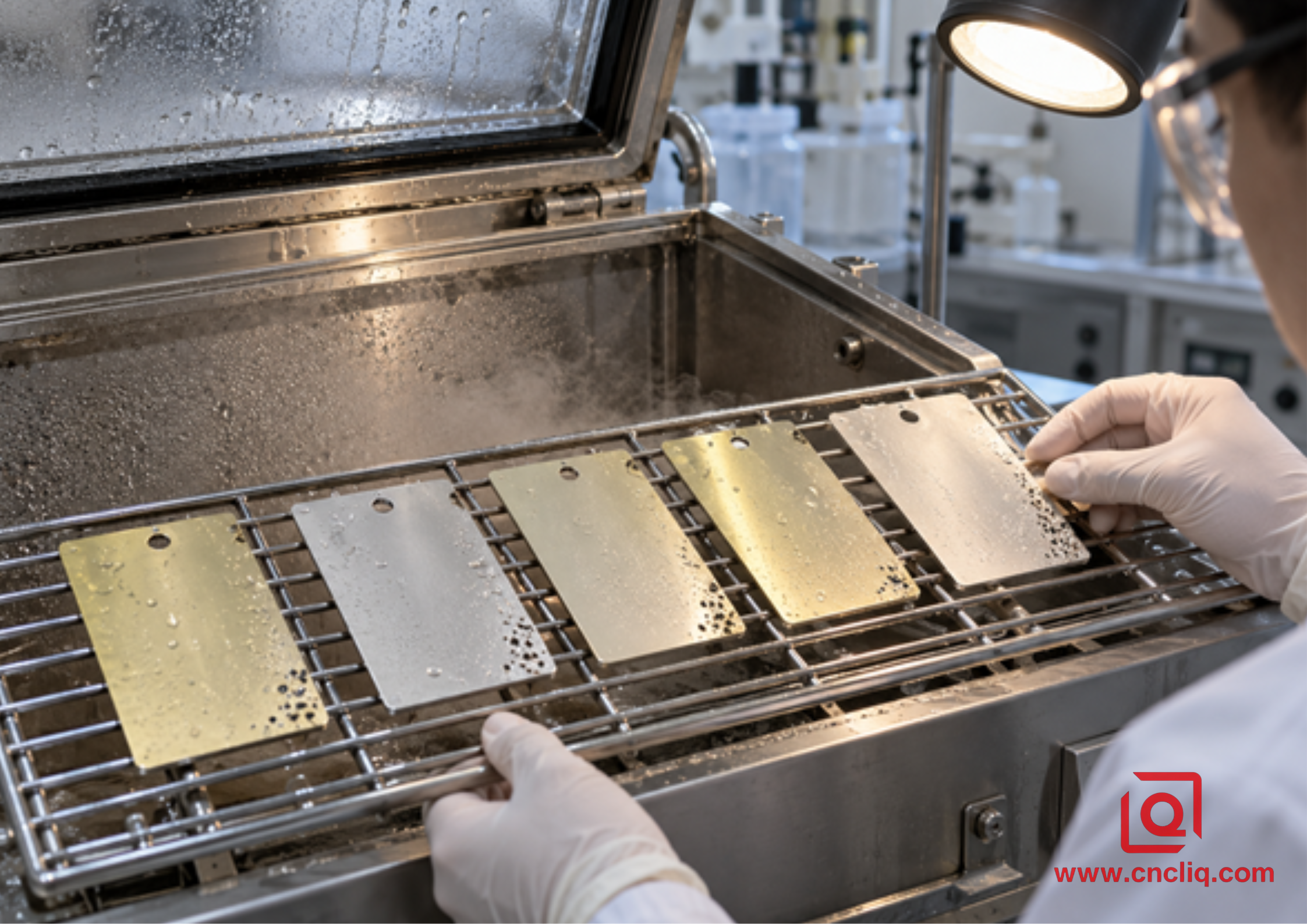
Salt-spray witness coupons after neutral salt fog exposure
For process control under MIL-DTL-5541, the familiar checkpoint is 168 hours in a 5 percent salt-spray environment. ASTM B117 governs how that environment is run. Inspectors examine witness panels and apply the specification’s exclusions for edges, identification marks, and holding points. They count relevant corrosion; they do not grade the coupon by how deep its yellow color appears.
The related material specification, MIL-DTL-81706, does not use one schedule for everything. In qualification testing, Class 1A calls for 336 hours on 2024-T3 and 7075-T6 panels, whereas the Class 3 schedule calls for 168 hours on 6061-T6. The listed conformance schedules use 168 hours for both Class 1A and Class 3 panels. Keep those numbers attached to their context: the named specification, alloy, conversion material, specimen, and acceptance method. They are not evidence that any yellow part will necessarily outlast any clear part.
The difference between a chamber number and real service life matters. The current ASTM B117 standard describes a controlled corrosive environment for relative comparison. ASTM also warns that stand-alone salt fog data does not reliably predict natural exposure. In plain shop language, 168 hours is a qualification or process-control milestone. It does not equal a fixed number of outdoor years, marine seasons, or washdown cycles.
A NASA evaluation of non-hexavalent conversion coatings paired a 168-hour ASTM B117 exposure with contact-resistance measurements, then set out additional environmental work. That is the useful part of the test plan: corrosion and conductivity get their own measurements instead of being guessed from color. The details are in NASA’s report on chromium-free conversion coatings for electronics.
4. Will Yellow Alodine Always Beat Clear Alodine in Corrosion Testing?
No—not without knowing the rest of the process. Many experienced finishers learned to associate a darker yellow chromate with more coating weight and better protection on bare aluminum. That history is real, but it is a poor purchasing rule today. A qualified Type II clear system may meet the specified class. A yellow coating may still fail after weak cleaning, bath drift, excessive etching, a contaminated rinse, or an overly hot dry.
The correct yellow Alodine vs clear Alodine comparison starts with six controlled variables.
1. Alloy and temper. Put a rack of 6061-T6 beside one of 2024 or 7075 and the 6061 will usually be easier to keep visually consistent. Copper affects 2024; zinc and copper affect 7075. Cast A380 and ADC12 bring their own complication. Silicon-rich regions respond differently from the rest of the casting, which is why an otherwise sound finish may look gray, dark, or mottled.
2. Qualified chemistry. Confirm that the conversion material is qualified for the required type, class, form, and application method under the applicable purchasing documents.
3. Pretreatment. Oil, polishing compound, embedded steel, heavy smut, aggressive alkaline etch, or a weak deoxidizing step can decide the result before the conversion bath is reached.
4. Process window. Record what the bath was actually doing: concentration, pH, temperature, immersion time, agitation, workload, and bath age. Leaving parts in longer simply to chase a darker shade can produce a coating that wipes, powders, or damages easily.
5. Drying and later heat. Watch the thermometer. An aggressive dry can dehydrate the new conversion layer, and heat may return later during a bake, adhesive cure, or paint cycle. All of those steps belong on the route sheet.
6. Test definition. State whether the purchase requires witness-panel salt fog, paint adhesion, coating identification, contact electrical resistance, cosmetic inspection, or a combination.
If an RFQ simply asks for “clear Alodine, 168 hours,” the finisher still lacks the class, alloy, acceptance limit, sampling plan, and evidence package. A better note is discussed below.
5. Why One Coating Can Look Different from Lot to Lot
The final shade reflects several things at once: bath chemistry, deposited film, the way light crosses that film, and the aluminum below it. A clear Type II coating on a clean 6061 housing may disappear at first glance, then show a soft blue or rainbow cast when the part is tilted. Traditional Type I work can move from pale straw through gold and into olive. With 2024 and 7075, local chemistry is less uniform, so the deoxidizer and conversion bath do not meet the same surface everywhere. Welds, original cast skin, cutter tracks, and hand-blended repairs add still more variation.
That means the visual inspection plan should not say only “yellow” or “clear.” For customer-facing parts, agree on an upper and lower color limit using production-alloy samples processed by the approved route. View both pieces under the same broad work light. A hard, narrow beam can make a mild rainbow cast look severe. Decide appearance separately from corrosion, paint adhesion, and conductivity. If alloy-driven variation is a concern, Liqin’s 6061 vs 7075 anodizing appearance guide explains why a surface treatment follows the metal rather than hiding it.
6. Shop-Floor Process Controls That Protect Both Appearances
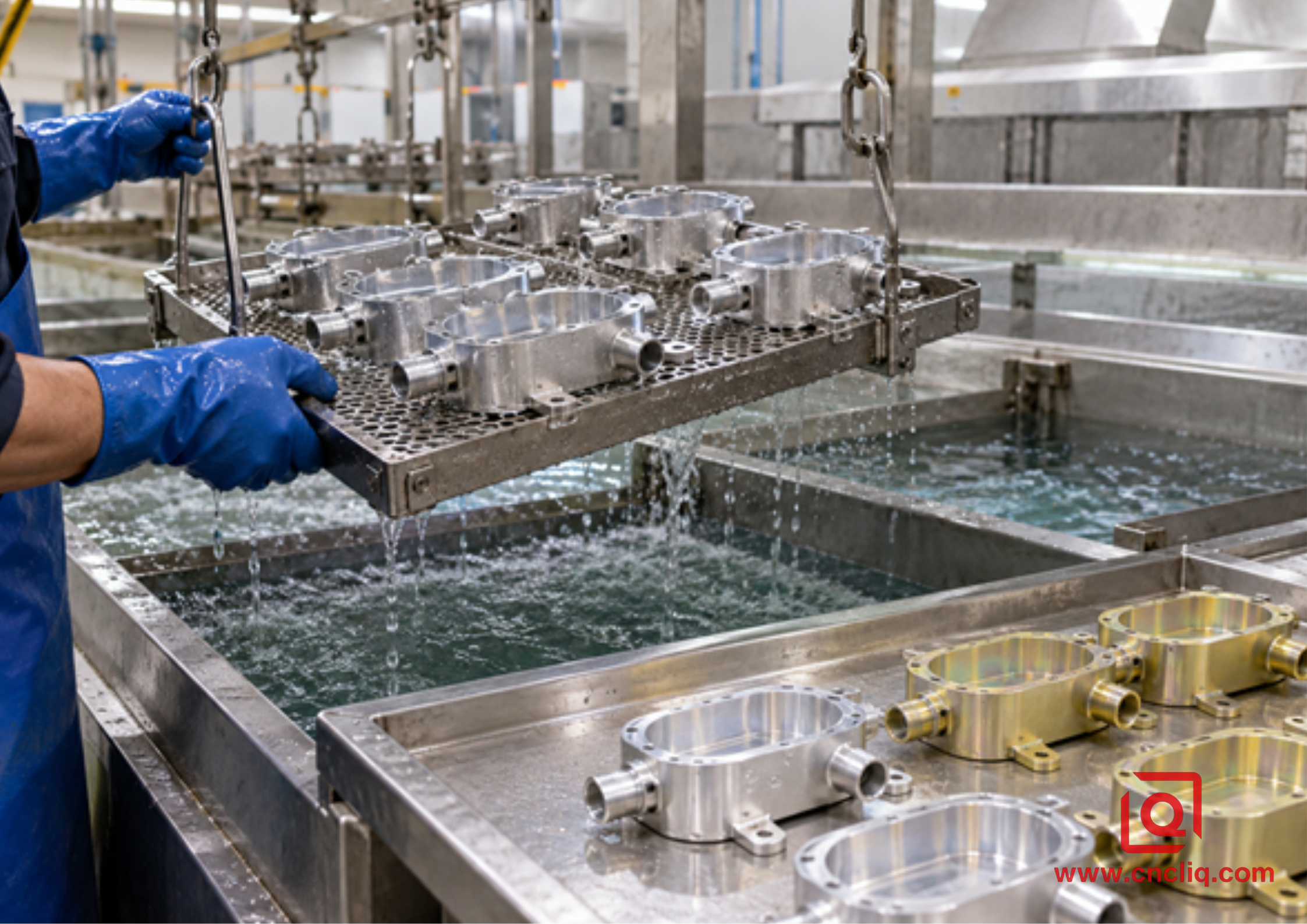
CNC aluminum telecom housings moving through a conversion-coating rinse line
A reliable result begins before the wet line. Machining, deburring, welding, and heat treatment should be complete. A late cut exposes bare aluminum; a late weld destroys the local film. Racks must support the part, drain trapped liquid, and keep contact marks away from sealing faces, cosmetic surfaces, and grounding zones.
The operator then needs a clean, water-break-free surface. After degreasing and rinsing, water should sheet across the aluminum instead of gathering around invisible oil islands. The deoxidizer must remove the native oxide and alloy smut without attacking sharp edges or opening critical dimensions. For copper-rich alloys, this step is especially sensitive.
Application may be by immersion, spray, or an approved touch-up method, depending on the order and qualified material. Once the reaction is complete, the part needs a clean rinse without delay and a mild dry. That small piece of discipline reduces streaking, loose powder, water spotting, and lost corrosion performance. Packaging matters too. A thin conversion film can be scratched by metal-to-metal contact even when the salt-fog coupon passed.
Our aluminum OEM surface-finishing guide compares chem film with anodizing and other finishing routes. It is useful when corrosion, conductivity, wear, color, and dimensional growth compete on the same drawing.
7. Anonymous Customer Case: Telecom Grounding Enclosure
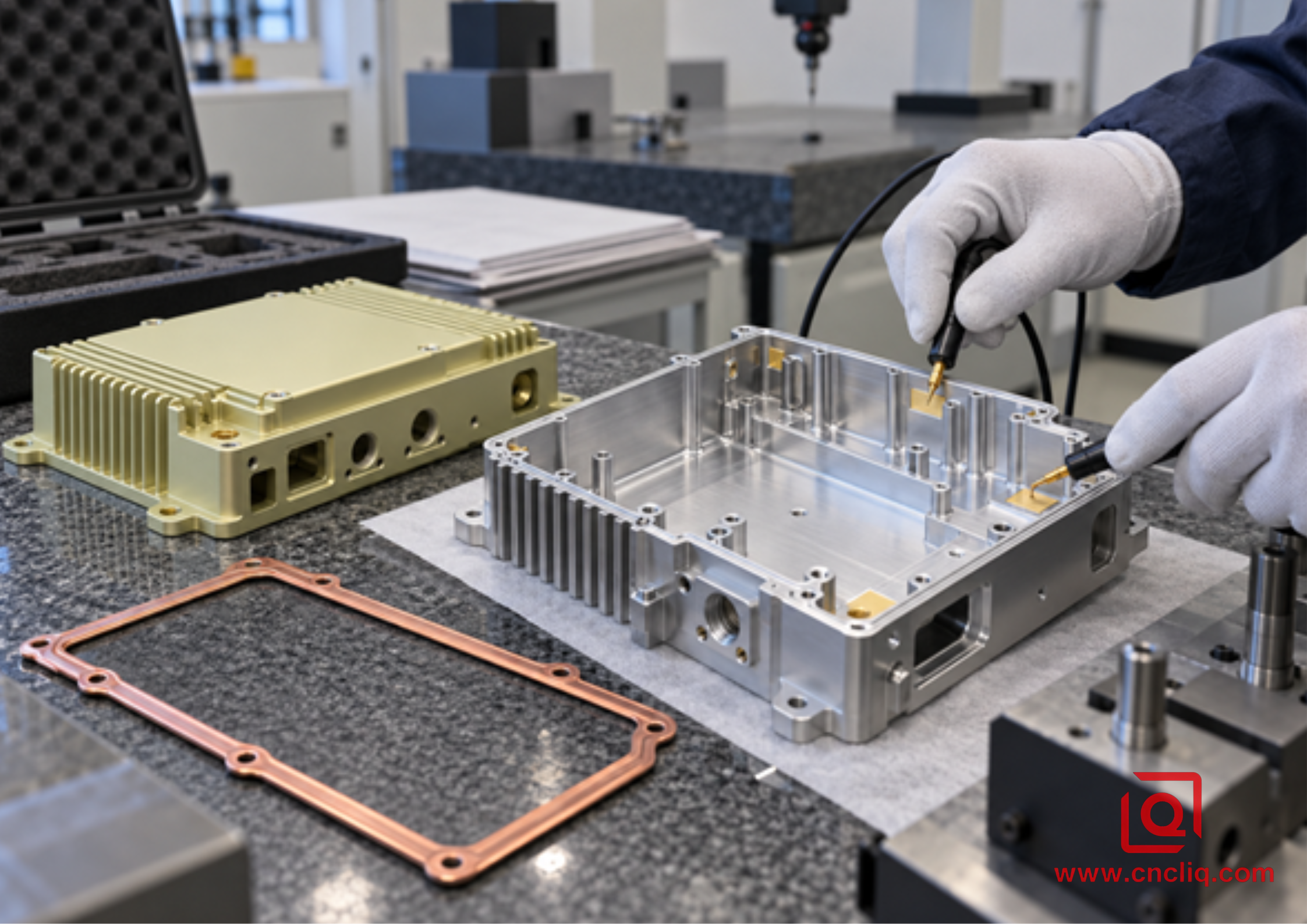
Electrical contact-resistance inspection on a custom aluminum RF enclosure
An anonymized telecom-equipment customer asked for a compact 6061-T6 surge-protection enclosure with milled sealing faces, tapped connector ports, and two grounding pads. The first RFQ said “clear Alodine, outdoor use.” That wording created three risks: it did not define chemistry, it did not state whether corrosion or contact resistance had priority, and it did not identify which faces would later receive a gasket and conductive hardware.
During DFM review, the part was divided by function. The enclosure body needed a non-hexavalent conversion coating. The grounding pads needed a Class 3 interface and no insulating paint. The external assembly still required environmental protection from the final enclosure system, because chem film alone was not treated as a substitute for a sealed outdoor barrier. Threads were gauged after finishing, and rack points were moved to hidden bosses.
The manufacturing route used stress-relieved stock, two CNC setups, full deburring, ultrasonic cleaning, controlled conversion coating, post-finish visual inspection, CMM verification of sealing geometry, thread gauges, and contact-resistance checks on agreed areas. Witness coupons carried the coating process through corrosion testing. A physical appearance sample prevented the customer from rejecting acceptable faint iridescence as discoloration.
This case matches the functional logic of Liqin’s published 6061 aluminum electrode for 5G lightning-protection equipment: precision features, surface passivation, electrical function, outdoor equipment, and ready-to-assemble inspection all have to be planned together. Clear was not “better” in the abstract. It was appropriate only after the drawing separated four questions: chemistry, class, visible finish, and exposure of the assembled product.
8. How to Choose Yellow or Clear Alodine
Choose from the finished assembly backward.
1. Look at the governing approval first. A program that bans hexavalent chromium needs Type II plus the requested compliance evidence. Conversely, a controlled legacy print calling for Type I cannot be changed just because someone prefers a cleaner-looking part.
2. Define the function. When the main job is bare-metal corrosion protection or preparation for paint, examine the Class 1A route first. When the joint must carry current with low contact resistance, Class 3 is the relevant route.
3. Separate appearance from performance. State “clear,” “yellow,” or an approved visual range only when appearance matters, then attach a limit sample or written visual criteria.
4. Check the alloy and geometry. Do not stop at “aluminum.” A quote for 6061-T6 is not automatically valid for 2024, 7075, A356, A380, ADC12, or even a different temper, so write the actual material on the RFQ. Mark the features a wet-line operator needs to notice, such as cast skin, welds, pockets that hold liquid, blind or threaded holes, sharp edges, and inserted metals.
5. Define the complete finish system. Tell the supplier what happens after chem film. Primer, liquid paint, powder, adhesive, sealant, and a joint against copper or stainless steel can each change the correct route. Include the cure temperature rather than leaving it for the finisher to guess.
6. Set proof requirements. Request the relevant certificate of conformance, qualified material identification, bath or process records where required, witness-panel salt fog, paint adhesion, contact resistance, visual limits, and dimensional report.
9. A Better Drawing Note and RFQ Package
A practical starting note is: “Chemical conversion coat per MIL-DTL-5541, current drawing-approved revision, Type II, Class 3; clear appearance; process material qualified to MIL-DTL-81706; coat all surfaces except masked zones shown; electrical contact areas and acceptance method per quality plan.” The contract and customer specification must decide the final wording.
Send enough information for the machine shop and finisher to own the same requirement.
1. Identify the part and drawing revision, then attach the 2D print and a STEP or IGES model.
2. State the alloy, temper, and stock form. Say whether the quotation must include a material certificate.
3. Give the governing finish standard and revision. Select the type and class, and name any customer-approved-source restriction.
4. Required appearance, visual limits, golden sample, cosmetic zones, and permitted rack marks.
5. Use the drawing to point out coating coverage and masks. Mark any touch-up zone, paint or bond area, sealing land, and live electrical contact.
6. Circle the dimensions that remain critical after coating, and state when the inspector must accept them.
7. Be specific about proof. Give the salt-fog time and failure limit, the resistance setup, the adhesion method, the lot-sampling rule, and the report format that purchasing expects.
8. Quantity, prototype plan, annual volume, packaging, destination, and final operating environment.
For custom CNC aluminum parts, send these items with the inquiry. Liqin’s engineering team can review finish compatibility, masking, rack points, tolerance risk, inspection evidence, and packaging before the route and quotation are fixed.
FAQ
1. Is yellow Alodine always Type I and clear Alodine always Type II?
No. Yellow or gold is strongly associated with traditional Type I hexavalent-chromium chemistry, while clear or faint blue is common for Type II non-hexavalent systems, but appearance alone cannot identify a compliant type. Alloy, coating weight, qualified product, pretreatment, and lighting all influence color. The certificate, process material, and drawing callout must establish chemistry.
2. Do yellow and clear Alodine both pass 168 hours of salt spray?
They can when the selected qualified system, substrate, class, preparation, and process control meet the specified requirement. MIL-DTL-5541 uses 168-hour 5 percent salt spray for process control, while MIL-DTL-81706 includes different qualification and conformance schedules. Ask for the exact standard, alloy, coupon plan, acceptance limits, and report instead of treating color as evidence.
3. Which finish is better for grounding and EMI shielding?
Class 3 is the key requirement because it targets corrosion protection where low electrical resistance is needed. Clear Type II Class 3 is common on modern electronics hardware, but yellow Type I Class 3 may also be specified on controlled programs. Define the contact zone, surface condition, electrode pressure, resistance limit, measurement timing, and whether readings are required after corrosion exposure.
4. Will Alodine change CNC dimensions or thread fit?
Chemical conversion coating is very thin and normally has far less dimensional effect than anodizing, which makes it useful for threads, bores, and close-fitting features. Even so, cleaning or etching can affect edges and surface condition, trapped solution can stain blind features, and damaged threads can fail gauging. Identify critical post-finish dimensions and require final thread checks where assembly risk is high.
5. How can I prevent assumptions and delays during quotation?
Send the current drawing and model first. On the same request, identify the material condition and quantity, then spell out the finish revision, type, class, allowed shade, masks, live contact faces, later paint or adhesive, and dimensions inspected after coating. Purchasing should also name the test records, packing method, and destination country. If the finish note is still open, describe the duty of the assembled part; that gives engineering enough context to expose assumptions before they become price or lead-time changes.
Summary
Yellow Alodine vs clear Alodine is not simply a color contest: yellow commonly points to Type I hexavalent chemistry and clear commonly points to Type II non-hexavalent chemistry, while Class 1A and Class 3 define the functional target. Use the 168-hour salt-spray requirement as a controlled qualification or process-control result, not a direct forecast of field life. For reliable CNC aluminum parts, specify the standard, type, class, alloy, visual limit, masking, downstream system, inspection method, and records, then validate the finished assembly rather than approving the coating by shade alone.
Contact Information
Company: Ningbo Liqin Industry Co., Ltd.Daily customer maintenance & after-sales support:service@shturl. zhuwanying@cncliq.com
New inquiry, quotation & order discussion:business@shturl. zhouli@chinaliqin.com
Hotline: +86 18757148656
Disclaimer
All technical articles, material specifications, machining recommendations, and surface treatment details published on this blog are for informational and reference purposes only. Please note that general blog insights do not replace signed technical agreements. Because custom parts vary by material heat numbers, machine calibrations, and specific tolerances, binding quality specs are governed solely by your approved CAD drawings, signed contracts, and formal quality plans.
All customer case studies featured on this blog have been thoroughly anonymized and sanitized. The performance metrics, manufacturing workflows, and imagery displayed serve solely to demonstrate our custom machining capabilities and do not represent a single universal standard for all orders.
Liqin Manufacturing Team
Built on 18 years of precision engineering experience, Ningbo Liqin Industry manufactures high-tolerance metal components for demanding global markets. We operate out of a 6,500 m² production hub equipped with over 150 machines, running 4-axis and 5-axis CNC machining, mill-turn machining, cold extrusion, and pressure die casting under one roof. This setup allows us to manage projects seamlessly, taking parts from initial CAD concepts directly to finalized shipments.
We handle quality control with zero compromise. We treat tight tolerances with the engineering discipline they require. Backed by ISO 9001, ISO 13485, and IATF 16949 certifications, our QA engineers run strict IPQC, FQC, and OQC checks on every single production batch. From CMM dimensional mapping and optical profiling to hardness and salt-spray testing, we validate your critical specs upfront—so you receive drop-in ready components with zero assembly headaches or costly line stoppages. On top of manufacturing, you can rely on us for two-hour response times on new RFQs, direct support for prototype sampling, and smooth export shipping across Europe, North America, Asia, and Oceania.
Welcome your inquiries and samples. Visit our website or contact us directly for a competitive quote!