English




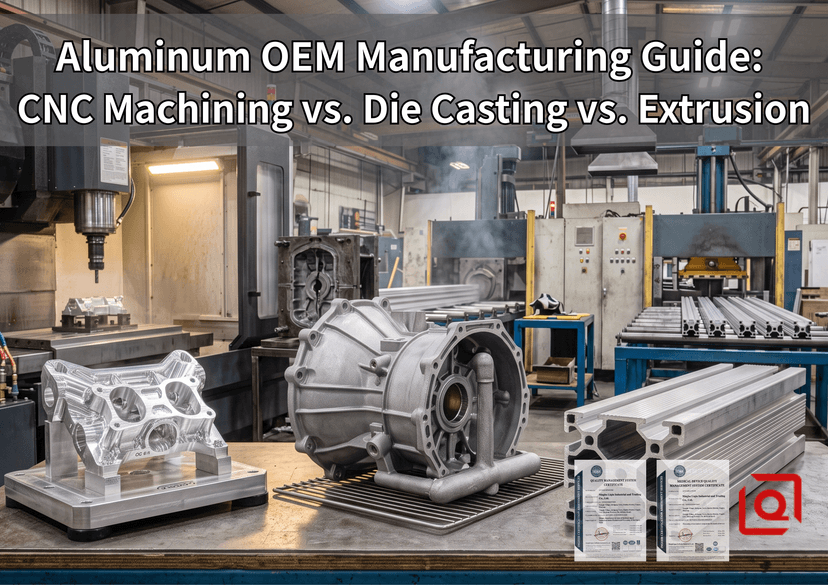
Quick-Reference Technical Matrix: Process & Parameter Benchmarks
| Evaluation Dimension | 5-Axis / 3+2 CNC Machining | High-Pressure Die Casting (HPDC) | Precision Aluminum Extrusion |
| Primary Alloys | AL 6061-T6, 7075-T7351, 2024-T3 | ADC12, A380, A356.0-T6 | AL 6063-T5, 6005A-T6, 6082-T6 |
| Dimensional Tolerance | ISO 2768-mK / ±0.008 mm (critical features) | ISO 8062 CT4 – CT6; ±0.08 mm/100 mm | GB/T 14846 High Precision / ±0.15 mm |
| As-Cast / Machined Ra | Ra 0.8 µm – 1.6 µm (milled); Ra 0.4 µm (polished) | Ra 3.2 µm – 6.3 µm (skin layer intact) | Ra 1.6 µm – 3.2 µm (longitudinal) |
| Min. Wall Thickness | 0.8 mm (requires damped fixture) | 1.2 mm (local); 2.0 mm (structural average) | 1.0 mm (dependent on tongue ratio) |
| NRE / Tooling Cost | $0 (Zero NRE, soft modular clamping $300–$800) | $12,000 – $65,000 (H13 hardened steel, 48–52 HRC) | $1,500 – $6,000 (H13 die stack, gas nitrided) |
| Secondary Machining Burden | 0%–10% (deburring & internal thread tapping) | 30%–50% (gating removal, sealing faces, bores) | 40%–70% (cross-drilling, CNC milling cutouts) |
| Economic Break-Even | 1 to 500 pcs/run | 3,000+ pcs/year (tool amortization threshold) | 500+ meters / 1,000 pcs per profile cross-section |
Key Engineering Takeaways
-
Gating Velocity & Porosity: HPDC runner design at 42 m/s gate velocity inevitably traps air, yielding 1.2–2.5% gas porosity. If T6 solution heat treatment (535°C for 4 hours) is mandated without high-vacuum assistance (<50 mbar), surface blistering WILL destroy part geometry.
-
Resistant Material Behavior: Milling AL 7075-T7351 off a 45 kg solid billet generates severe residual stress relief. Without a two-stage stress-relief anneal (190°C for 3 hours between roughing and finish passes), planarity on thin-walled (<2.5 mm) mounting flanges will drift beyond ±0.03 mm TIR.
-
Die Wall Shear in Extrusion: Pushing 6063 billet through an H13 nitrogen-nitrided die at 520°C ram temperature causes severe die pickup if ram speed exceeds 18 m/min. Maintain dead-cycle time under 14 seconds to stop transverse weld seam blistering.
Why Trust This Guide? Floor-Level Notes from Liqin Engineering
Listen, textbook formulas like ISO 8062 CT grades won't save your assembly line when a batch of ADC12 gear housings leaks under a 0.3 MPa helium decay test. We learned this the hard way on a 12,000-piece automotive pump run:
We ran ADC12 in a 650-ton cold-chamber HPDC machine. Melt held at 660°C. Nitrogen degassing dropped hydrogen levels to 0.11 mL/100g Al, yet x-ray inspection showed micro-shrinkage clusters right around the M8x1.25 tapped boss. Why? The gate velocity hit 48 m/s, freezing off the intensification pressure before the 35 MPa hydraulic squeeze could compact the solidification front. We re-engineered the runner area from 120 mm² to 165 mm², dropped biscuit thickness to 22 mm, and added a local squeeze pin over the boss. Scrap rate plummeted from 14.2% to 0.4% overnight.
If your OEM supplier isn't logging melt hydrogen levels, thermal imaging die maps every 50 shots, or checking dynamic spindle torque during 5-axis trochoidal milling—find another supplier.
Deep Dive: Deciding Between Milling, Casting, and Pushing Profiles
1. 5-Axis CNC Machining: When Geometric Absolute Control Trumps Tooling Amortization
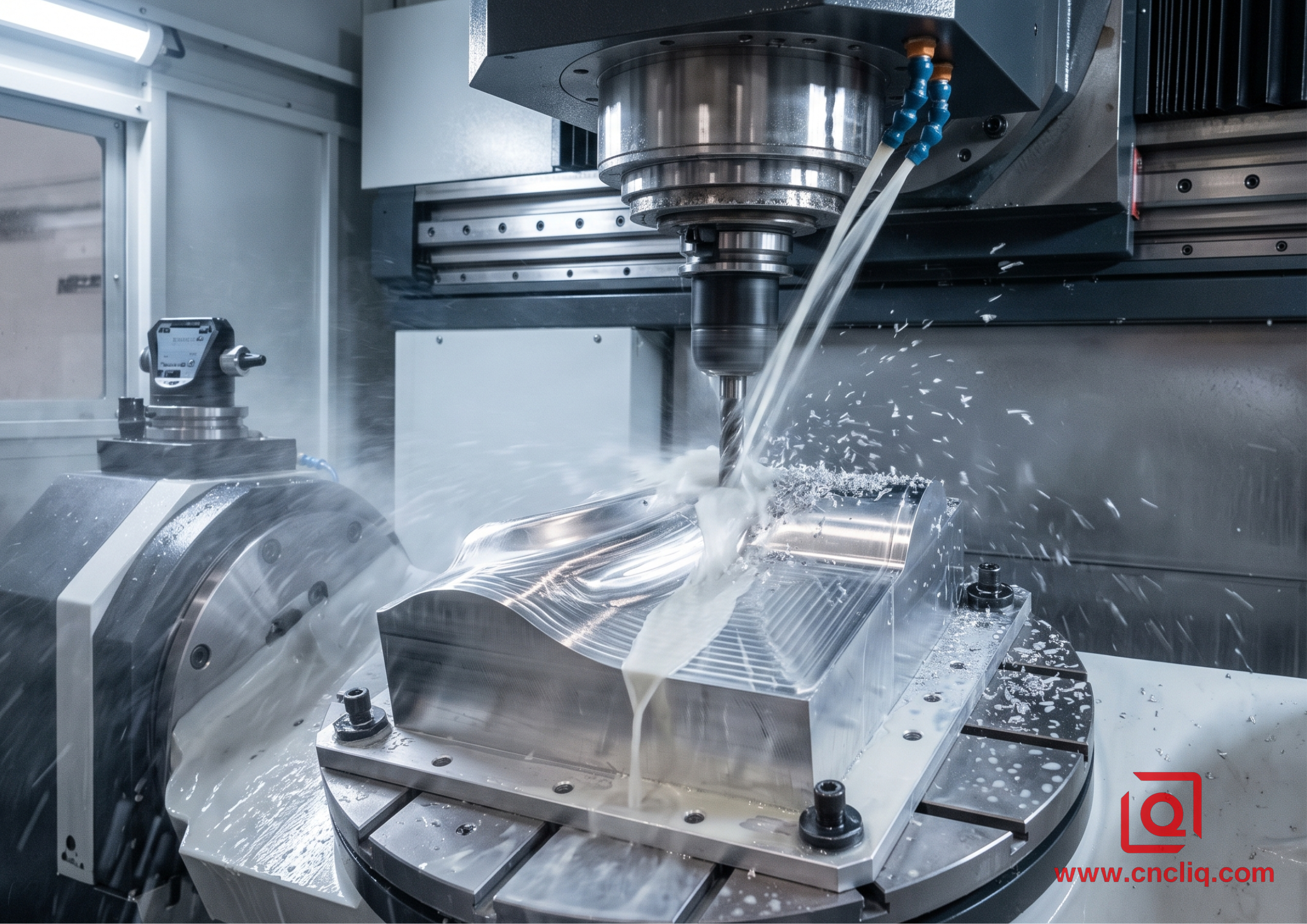
Take a complex marine sensor enclosure machined from wrought 6061-T6 block stock. You need true 3D contouring, deep internal cavities with 0.015 mm bore alignment, and zero porosity for deep-sea pressure seals.
[Solid Billet 6061-T6] ➔ [Rough Trochoidal Milling (AP 15mm, AE 10%)]
                        ➔ [Stress Relief: 190°C x 3 hrs] ➔ [Finish Pass Ra 0.8]
                        ➔ [CMM Inspection & Type II Anodize]
-
Tooling & Setup Strategy: Don't use standard vise clamping on thin-walled AL 7075 shells. Hydraulic pressure deforms wall sections. Use custom vacuum fixtures or polyurethaned soft jaws.
-
Cutting Parameters: For high-speed milling (HSM), spin 3-flute carbide endmills with balanced G2.5 spec at 18,000 RPM. Feed rate: 0.12 mm/tooth. Keep flood coolant at a strict 8% concentration—anything lower causes chip welding and tool buildup (BUE), tearing up surface finish to Ra >3.2 µm.
-
When to Avoid: Do not CNC mill if your material removal rate (MRR) exceeds 85% of total block weight on volumes over 1,000 units. Turning 80 kg of aluminum into 6 kg of chips while running $120/hr 5-axis machines is financially irresponsible.
2. High-Pressure Die Casting (HPDC): Scaling Complex Thin-Wall Enclosures Past 3,000 Units
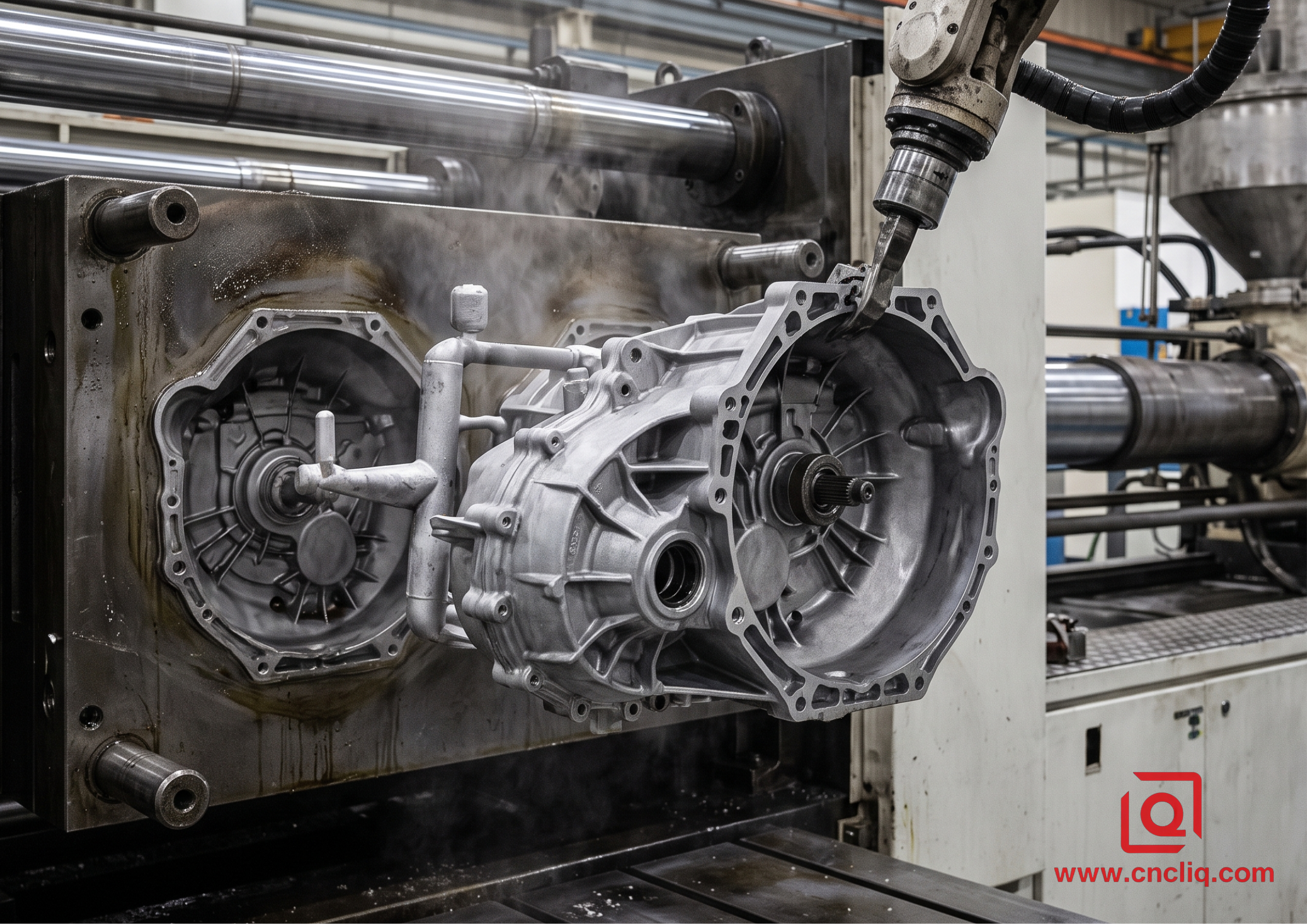
When annual volumes clear 3,000–5,000 pieces, CNC unit costs flatline. HPDC takes over. You pour molten A380 or ADC12 into H13 tool steel dies under 400 to 1,000 tons of clamping force.
-
Managing Wall Thickness: Never design abrupt wall steps. Transitioning from 1.5 mm to 6.0 mm causes thermal mass traps. Solidification shrinkage forms internal voiding. Keep wall transitions within a 1:1.5 ratio or apply core-outs.
-
Secondary CNC Machining Reality: Casting gives you near-net shape, but sealing grooves, bearing bores (H7 tolerance), and mating faces need CNC secondary passes. Allow 1.0–1.5 mm machining stock—no more. Machining off more than 2.0 mm cuts through the dense, fast-cooled skin layer (0.5–1.0 mm thick) right into porous, coarse-grained subsurface metal.
3. Precision Aluminum Extrusion: Unbeatable Cost Efficiency for Constant Cross-Sections
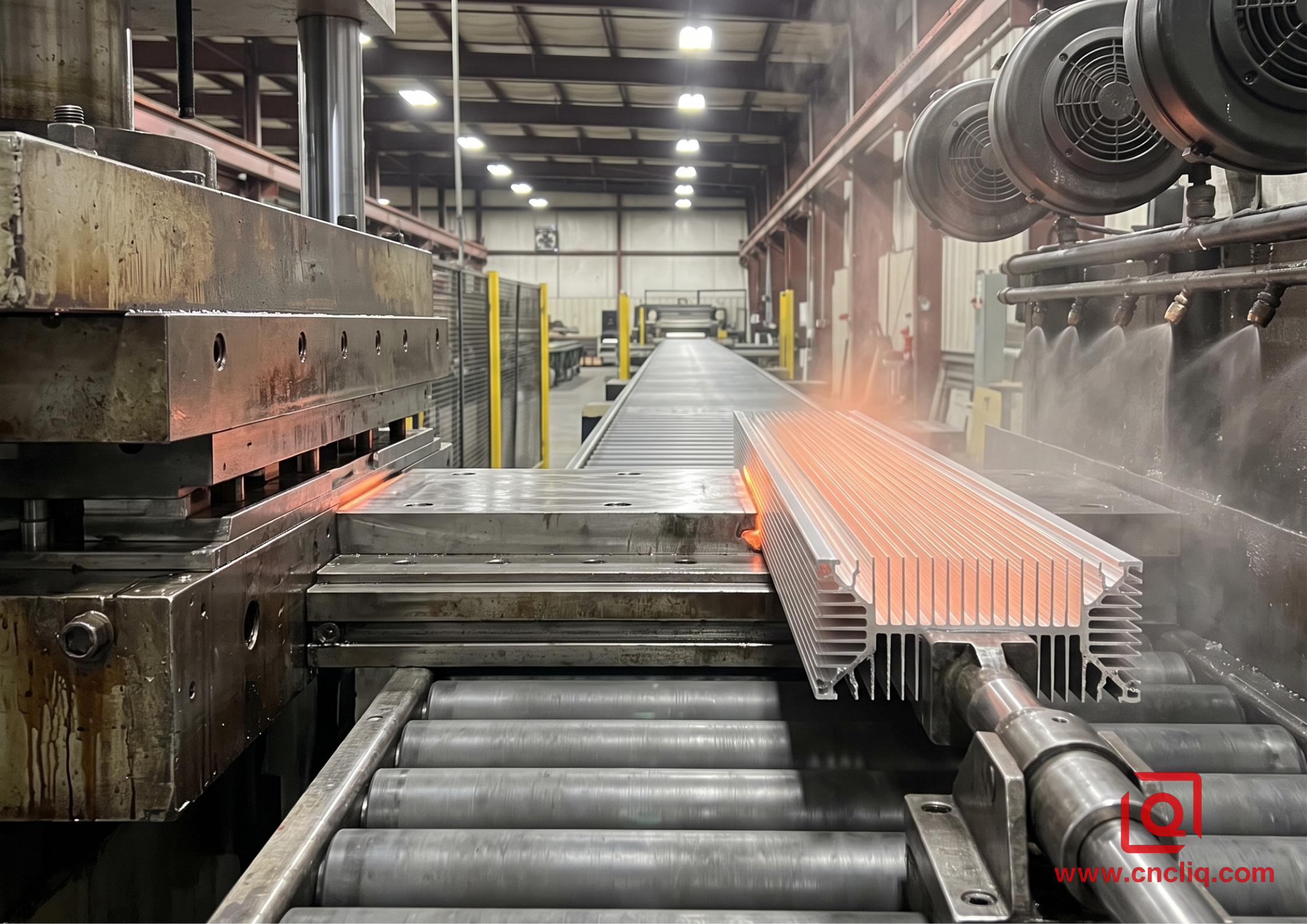
If your design features a constant cross-section—like structural frames, heatsinks, or enclosure rails—extrusion is vastly superior to both CNC and HPDC.
-
The Extrusion Die Dynamics: Billets of AL 6063 are preheated in a gas furnace to 480°C–520°C and forced through a nitrided H13 steel die under hydraulic pressure (1,500–3,500 tons).
-
Tolerances & Secondary CNC Setup: Standard commercial extrusion follows ISO 2768-m, but critical features need post-extrusion CNC operations. Profile bow and twist must be controlled during the air-quench/water-spray inline cooling stage (aim for a quench rate >200°C/min to lock in T6 age hardening readiness).
-
Cross-Section Design Rule: Avoid extreme tongue ratios (width-to-height ratio of die slots exceeding 3:1). High tongue ratios cause die tooth deflection, leading to wall thickness variation across profile runs.
Floor-Level Troubleshooting: 3 Common OEM Defects & Root Cause Actions
Problem A: Subsurface Gas Bubbles Appearing After Type III Hard Anodizing (ADC12 Casting)
-
Root Cause: Hydrogen absorption during melting combined with high turbulent injection speed.
-
Corrective Action: Implement online rotary degassing using Argon gas (flow rate 15 L/min for 12 minutes). Maintain melt hydrogen level below 0.12 mL/100g Al using a Reduced Pressure Test (RPT) density index check (<2.0%). Reduce shot sleeve filling ratio speed transition point to avoid air entrapment before shot intensification phase.
Problem B: Dimensional Drift on 6061-T6 Machined Mounting Arms (Length 450 mm, Tolerance ±0.015 mm)
-
Root Cause: Cutting heat buildup combined with severe internal stress release from cold-rolled plate stock.
-
Corrective Action: Switch from standard T6 to T7351 (stress-relieved by stretching). Implement roughing pass (leave 0.5 mm stock), unclamping to relieve internal stress, and then execute final finish pass under temperature-controlled (20°C ± 1°C) flood coolant conditions.
Problem C: Transverse Surface Streaks & Tear Marks on Extruded 6082-T6 Profiles
-
Root Cause: Die bearing land wear and aluminum pick-up due to excessive billet temperature (540°C) and ram speed (>22 m/min).
-
Corrective Action: Lower billet preheat temperature to 490°C. Perform gas nitriding on the H13 die stack after every 15 metric tons of extrusion run to maintain a surface hardness of 900–1100 HV. Reduce ram velocity to 14 m/min.
Procurement Decision Matrix: Making the Final Factory Choice
    [Is Cross-Section Constant?]
          ├── YES ──> [Aluminum Extrusion] ──> Post-CNC Cross-Drilling & Anodize
          └── NO
               │
               ├── [Volume < 500 pcs/yr OR Tolerance < ±0.02mm] ──> [5-Axis CNC Machining]
               │
               └── [Volume > 3,000 pcs/yr AND Wall Thickness > 1.2mm] ──> [High-Pressure Die Casting]
Choosing an aluminum OEM route is never about picking the "best" process—it is about matching geometry, mechanical yield strength, tolerance budgets, and amortization schedules. Before signing off on tooling P.O.s, require your supplier to submit:
-
DFM & Moldflow Solidification Simulation (MagmaSoft or ProCAST) for die casting.
-
CMM First Article Inspection (FAI) reports with 32-point dimensional mapping.
-
Raw material mill heat certificates (MTR) showing chemical spectrum analysis and mechanical tensile test data.
FAQs
Q1: What happens if you machine too deep into a high-pressure aluminum die casting during secondary CNC milling?
A: You will bite right through the dense, rapidly chilled outer skin layer and hit the soft, porous sponge-like metal underneath. Pressure-cast aluminum forms a tight, fine-grained protective shell against the cold mold walls during rapid solidification. If your milling path strips away more than a paper-thin margin, you expose internal micro-voids and gas pockets. The immediate consequence? Your sealing flanges and bearing seats will fail leak tests under pressure, weeping fluid directly through what should have been a solid metal wall.
Q2: Why do long, thin-walled AL 7075 parts warp like a banana after heavy 5-axis roughing, and how do we freeze their geometry?
A: Raw aluminum billets store immense internal stress from the mill rolling and quenching process. When your tool plunges in and rips away massive amounts of material, those locked-in internal forces suddenly unleash, causing the part to twist and bow as it seeks equilibrium. To keep the component flat:
-
Opt for stress-relieved temper stock that has been mechanically stretched at the mill.
-
Never finish a part in one brutal pass. Rough out the bulk material, then unclamp the workpiece completely. Let the metal "breathe" and relax its internal tension. Apply a thermal stress-relief bake in the oven before re-clamping with delicate vacuum pressure for the final, light finishing cuts under a heavy deluge of temperature-stabilized coolant.
Q3: Can you put high-pressure die cast parts through high-temperature heat treatment or hard anodizing?
A: Standard die castings and high-temperature ovens are natural enemies. As molten aluminum rushes into the die cavity, it traps tiny pockets of air. If you later bake that casting at high temperatures for heat treatment, those trapped gas bubbles expand violently, causing the surface to erupt in ugly blisters that warp the entire structure. For parts destined for severe environment hard-anodizing, the molten metal must undergo rigorous gas purging before injection, and the mold cavity must be pulled under a strong vacuum to suck out every trace of air before the metal solidifies.
Q4: What causes custom extruded aluminum profiles to twist and come out with uneven wall thickness?
A: That is the classic symptom of uneven friction and metal flow velocity inside the extrusion die. When forcing a red-hot aluminum billet through a steel die under thousands of tons of hydraulic pressure, complex or lopsided profile cross-sections create severe uneven drag. The metal rushing through wider gaps flows fast, while metal squeezed into narrow slots gets choked. This differential shear force flexes the steel die core out of alignment, causing the extruded profile to snake, twist, and vary in thickness down the line. You must re-balance the die land lengths to equalize flow resistance across the entire cross-section.
Q5: Before paying the final balance on mass-production tooling, what shop-floor evidence should an OEM buyer demand?
A: Never sign off on tooling based on a clean-looking sample alone. Demand clear proof of process stability from the shop floor:
-
A full computer solidification map proving the metal stream fills the cavity smoothly without trapping air pockets in critical mounting points.
-
A comprehensive multi-point CMM inspection map showing that the mold repeatedly produces identical dimensions without physical drift over consecutive production runs.
-
Official material certification proving the raw alloy chemical makeup is clean, fully degassed, and free of structural impurities.
Summary
Selecting the right aluminum OEM process—whether 5-Axis CNC Machining, High-Pressure Die Casting (HPDC), or Precision Extrusion—comes down to balancing geometric complexity, mechanical yield strength, and tooling amortization. CNC milling provides unmatched precision and zero porosity for low-volume runs, HPDC dramatically lowers unit costs for complex thin-walled parts exceeding 3,000 pieces, and extrusion offers unbeatable efficiency for constant cross-sections. By identifying floor-level failure modes like residual stress warping, gas porosity, and die deflection early, OEM buyers can streamline secondary machining, maintain tight tolerance budgets, and secure long-term supply chain reliability.
Ready to optimize your next manufacturing run? Send us your CAD files to receive a free DFM analysis and an actionable, cost-saving OEM quote from our engineering team within 24 hours.
Contact Information
Disclaimer
Liqin Manufacturing Team
We are Ningbo Liqin Industrial & Trading Co., Ltd.,a professional manufacturer with over 18 years of experience in high-precision custom metal parts. We specialize in CNC machining, forging, die casting, and cold extrusion processes, serving industries such as automotive, medical, aerospace, electronics, and more. Our factory covers an area of 6,500 square meters and is equipped with 150+ advanced machines, including:
- CNC machining centers (4-axis, 5-axis)
- CNC lathes and turning-milling complexes
- Cold extrusion equipment (250T–650T)
- Die casting machines
We adhere to ISO9001, ISO13485: 2016, and IATF16949: 2016 standards, implementing end-to-end quality management: In-process quality control (IPQC), final quality control (FQC), outgoing quality control (OQC). CMM, projectors, hardness testers, and salt spray test equipment. Our products are exported to North America, Europe, Asia, and Oceania. We offer:
- One-stop service from design to delivery
- Quick response within 2 hours for quotes and technical support
- Custom solutions based on your drawings or samples
Welcome your inquiries and samples. Visit our website or contact us directly for a competitive quote!