English




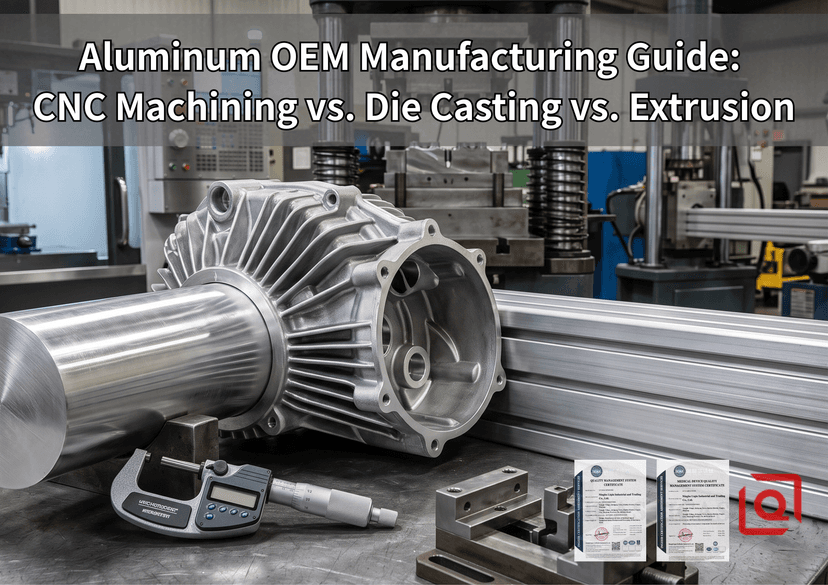
Tossing a 3D CAD model to an OEM supplier locks in your piece-part cost, delivery schedule, and mechanical properties well before anyone fires up a spindle or taps a furnace.
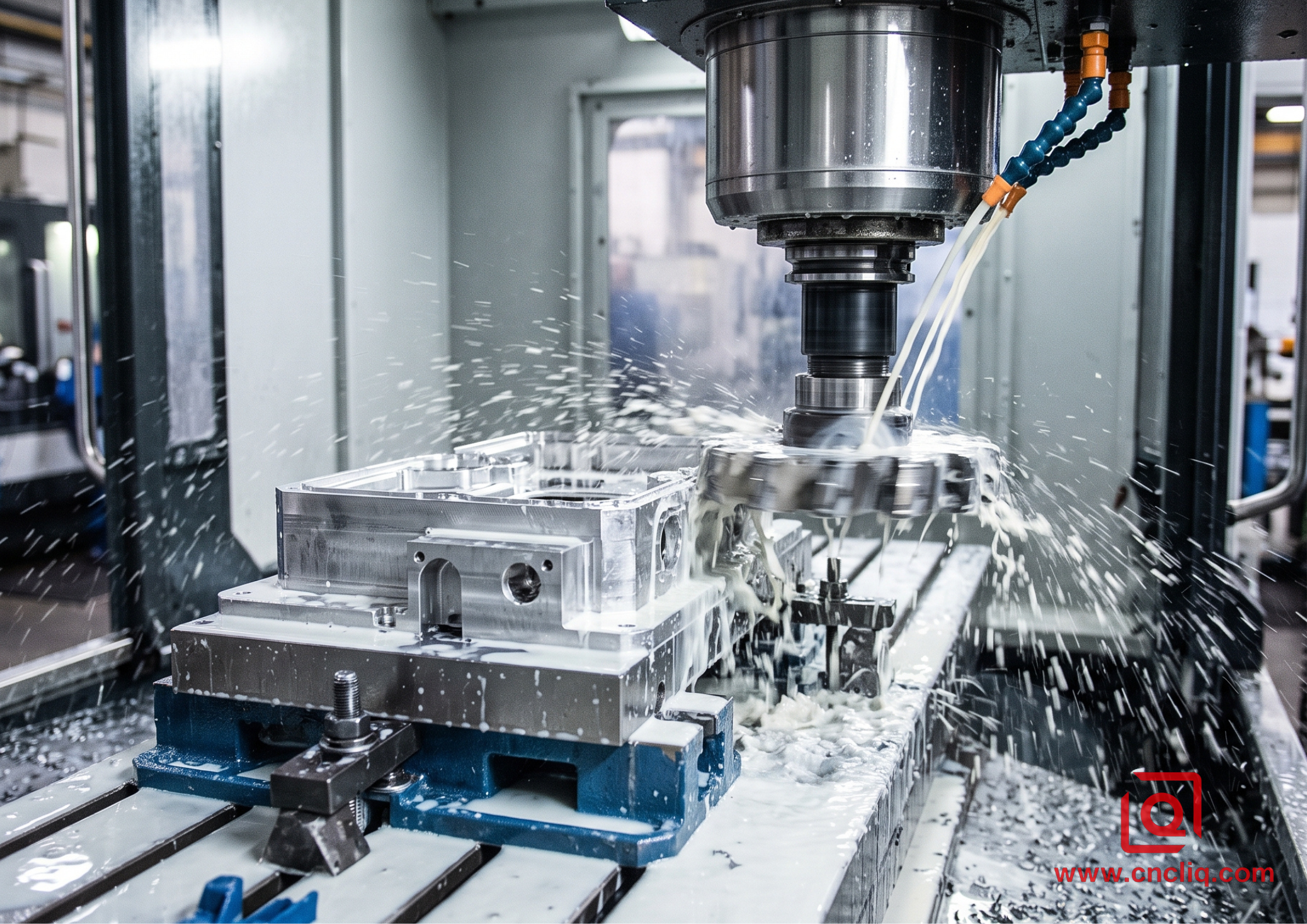
We run into this headache on the shop floor every week: an R&D engineer calls out a multi-cavity electronics housing hogged out entirely from solid billet for a 500-to-5000 piece run. Sure, the box looks razor-sharp straight out of the fixture, but it eats up 50 minutes of VMC spindle time on every single cycle. At the same time, the chip auger is spitting out bins of scrap metal, leaving the piece price uncomfortably steep. Then again, cutting expensive tool steel for an HPDC die before your product rev is frozen will corner your mechanical design before you are ready.
Weighing CNC milling, high-pressure die casting, and profile extrusion (paired with post-machining) comes down to balancing raw strength, part envelope, run volume, and surface finish targets.
Let's look at how these 3 routes actually stack up under real production conditions.
Process Overview & Technical Comparison
To ground the decision in clear shop-floor metrics, the table below highlights how raw material formats, tolerances, tooling commitments, and surface treatments differ across each method.
Aluminum OEM Process Decision Matrix
| Parameter / Metric | CNC Precision Machining | High-Pressure Die Casting (HPDC) | Aluminum Extrusion + Secondary CNC |
| Primary Feedstock | Wrought Bar / Billet / Plate (e.g., 6061-T6, 7075-T651) | Ingot / Molten Foundry Alloy (e.g., A380, ADC12) | Extrusion Billet (e.g., 6063-T6, 6061-T6) |
| Standard Tolerances | ISO 2768-f / ISO 2768-m (Linear: +/- 0.02 mm to +/- 0.05 mm) | NADCA Standard (+/- 0.15 mm to +/- 0.25 mm as-cast) | ASTM B221 Profile (+/- 0.25 mm to +/- 0.50 mm raw profile) |
| Surface Finish (As-formed) | Ra 0.8 um - 1.6 um (Down to Ra 0.4 um with wiper inserts) | Ra 1.6 um - 3.2 um (Requires deburring / shot blasting) | Ra 1.6 um - 3.2 um (Visible longitudinal die lines) |
| Wall Thickness Capability | 0.8 mm minimum to prevent chatter; solid with no upper limit | 1.5 mm - 4.0 mm optimal; heavy sections cause shrink porosity | 1.0 mm - 15.0 mm depending on profile envelope |
| Tooling Cost (NRE) | Minimal to Low ($0 - $1200 for soft jaws & custom fixtures) | High ($15000 - $45000+ for H13 hardened tool steel dies) | Moderate ($1800 - $4500 for custom extrusion dies) |
| Tooling Lead Time | 2 to 5 days for fixturing and CAM toolpath programming | 6 to 9 weeks for die build, T1 sampling, and CMM inspection | 3 to 4 weeks for die wire EDM, trial run, and profile sign-off |
| Economic Break-Even Run | 1 to 500 pcs (Maximum flexibility, zero upfront tooling) | 3000 to 50000+ pcs/year (Amortizes initial tooling expense) | 500 to 5000+ pcs/run (Ideal for continuous linear shapes) |
| Anodizing Response | Outstanding (MIL-A-8625 Type II cosmetic / Type III hardcoat) | Poor for clear/color (Silicon creates dark streaks; use powder coat) | Exceptional (6063 produces rich, streak-free satin finishes) |
1. CNC Precision Machining: Extreme Accuracy, Zero Tooling Lock-In
CNC milling and turning cut parts directly from solid wrought billet. Because the stock has already been rolled or extruded under intense pressure, its internal structure is dense, homogeneous, and free of subsurface voids.
[Solid Billet Stock] ──> [Rough Pocket Hogging] ──> [Semi-Finish] ──> [Stress Relieve] ──> [Finish Contouring] ──> [Deburr & Wash]
When to Run It on CNC
-
Precision Mating Features: Go-to route for bearing fits holding 0.01 mm location tolerances, rotating shafts dialed in for near-zero runout, or O-ring lands requiring sub-micron seal flatness.
-
Heavy Cyclic Stress & Dynamic Shock: Wrought 6061-T6 delivers yield numbers that cast melt runs simply fail to match under load. When components take a beating from persistent vibration, rough assembly handling, or fatigue spikes, hogging solid billet removes any worry over sub-surface porosity.
-
Fluid Part Revisions: If field-testing means tweaking a bolt circle or shaving a wall down the line, a programmer can re-post the toolpath in 2 hours. You avoid the massive lead times and sunk costs of modifying hard tooling.
Realities on the Shop Floor
The biggest challenge with CNC machining is internal stress relief. When you hog out massive pockets from a solid block of aluminum, the material relaxes and wants to twist or bow on the table.
On our shop floor, we tackle this by hogging out the rough geometry, unbolting the workpiece to allow the metal to breathe and spring into its natural shape, and then re-clamping it with lighter torque before making high-speed finishing passes.
For visual parts, billet parts go right into sulfuric acid anodizing baths (MIL-A-8625 Type II) to yield a clean, consistent satin or colored finish without blotchiness.
2. High-Pressure Die Casting: Net-Shape Speed for High Volume
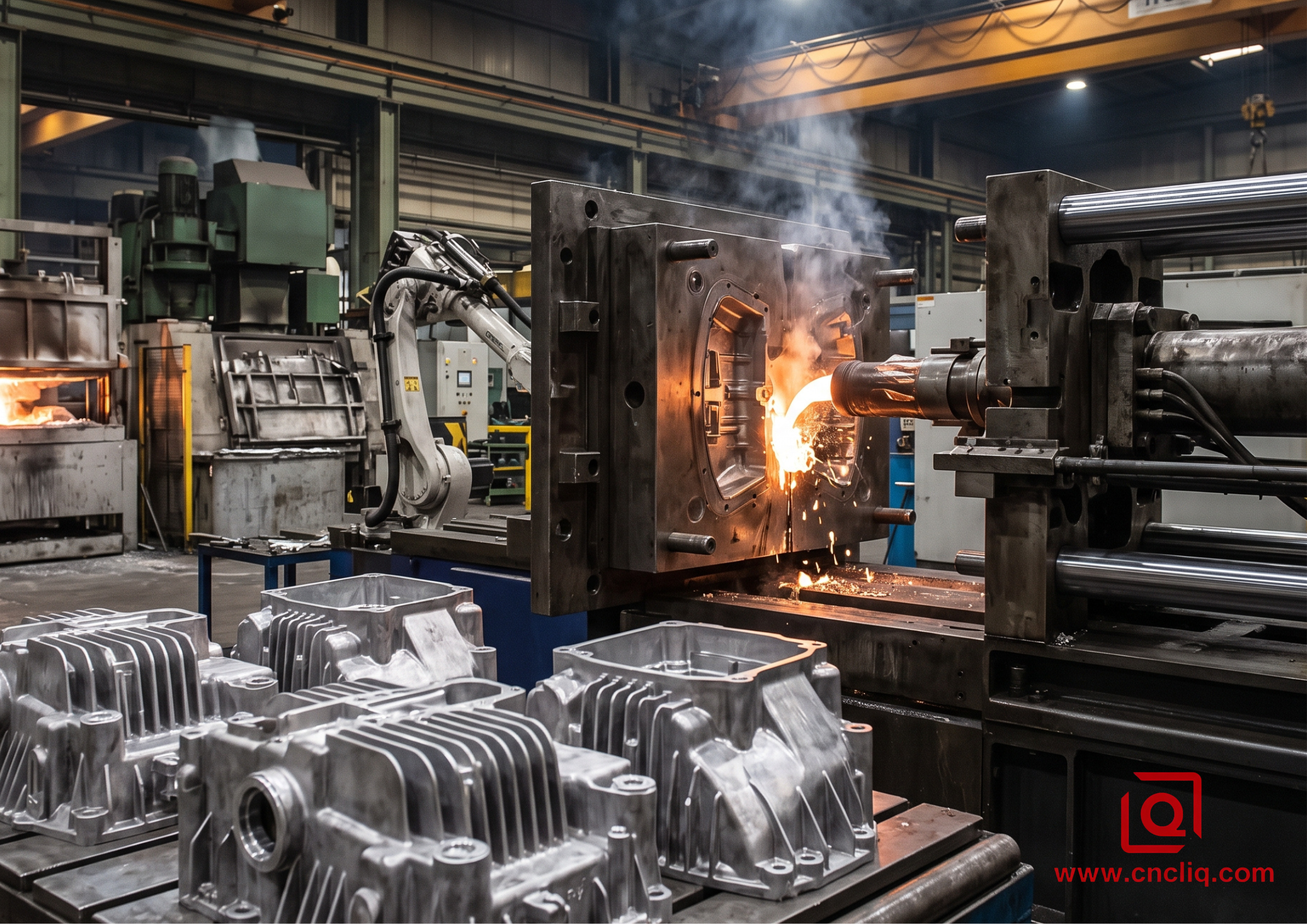
High-pressure die casting forces molten aluminum into heavy tool steel dies under intense hydraulic pressure. The metal solidifies in a split second, cutting part cycle times from tens of minutes down to well under a minute.
[Molten Alloy] ──> [High-Pressure Sleeve Injection] ──> [Rapid Solidification] ──> [Part Ejection & Trim] ──> [Secondary CNC on Mating Faces]
When to Select Die Casting
-
High Annual Production: Once your production demand climbs into the thousands, the dramatic reduction in machine run time and material scrap easily amortizes the upfront mold investment.
-
Intricate Organic Features: Complex thin-walled ribs, mounting bosses, cooling fins, and cable channels that would take multiple endmills and impossible setups to machine can be formed in a single shot.
Realities on the Shop Floor
Liquid aluminum chills fast the second it hits the cold steel cavity, readily locking trapped air pockets and shrinkage voids deep inside heavy wall sections. Because of that, running as-cast surfaces directly against high-pressure fluid seals or expecting dowel pins to press-fit properly straight off the ejector pins is simply asking for leaks.
We almost always run die casting as a two-step hybrid workflow:
-
Cast the main structural body with generous draft angles on vertical walls and keep the wall thickness thin and uniform so the metal chills quickly without shrinking away from the core.
-
Transfer the trimmed casting to a CNC fixture to skim the critical mating flanges flat, bore out bearing pockets to precision limits, and tap fine mounting threads.
Finishing Note: Cast alloys like ADC12 and A380 contain significant amounts of silicon to help the molten metal flow into thin ribs. That same silicon turns blotchy and dark grey in an anodizing tank. If your product needs a clean cosmetic finish, plan for powder coating, wet spray, or e-coating instead.
3. Aluminum Extrusion + Secondary CNC: The Linear Geometry Shortcut
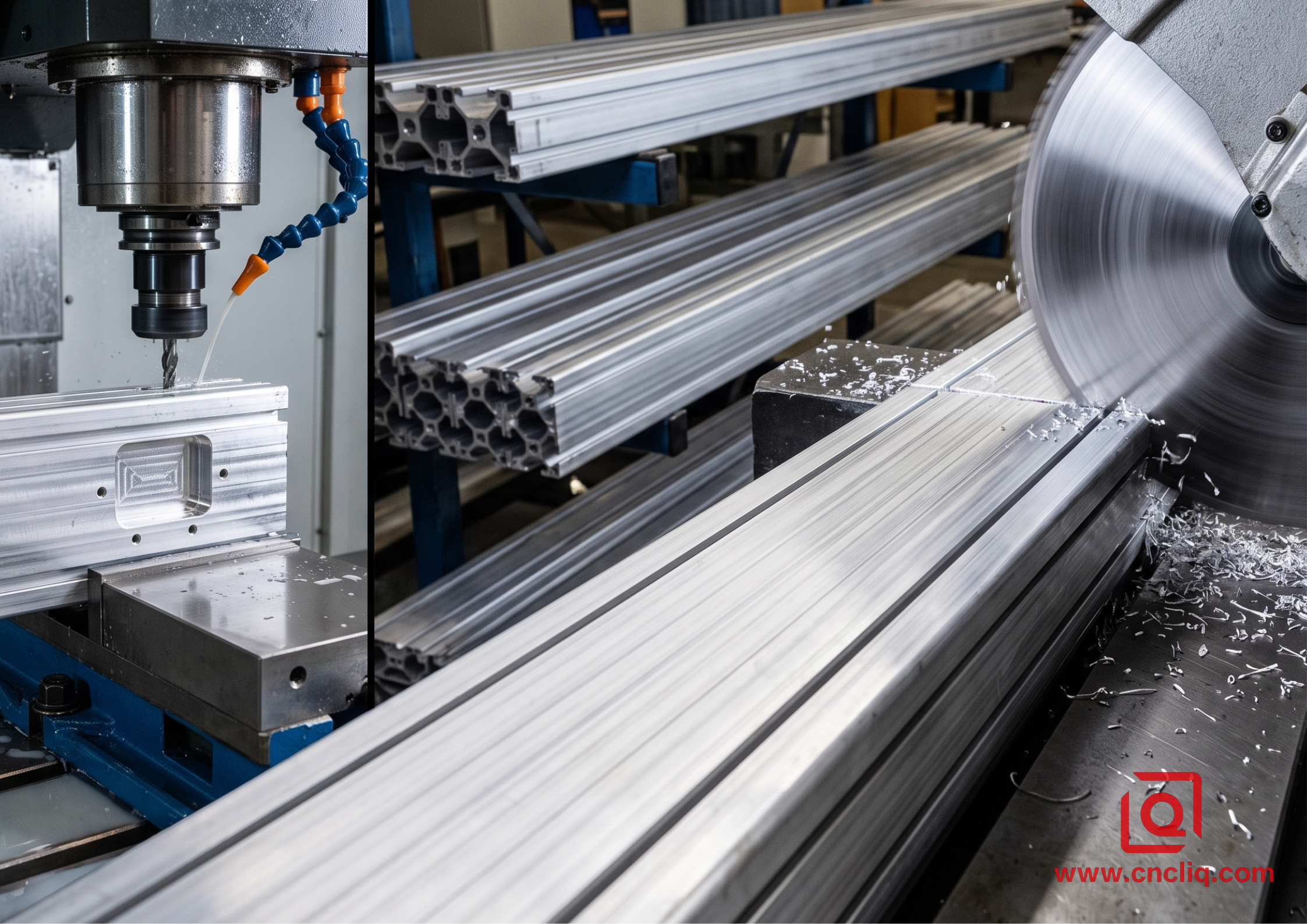
Extrusion works on the toothpaste principle: a hydraulic ram forces pre-heated billet through a custom steel die profile, spitting out continuous linear lengths of constant cross-section. Tooling stays dirt-cheap here, routinely running 10% to 20% of what you would shell out for a hardened HPDC mold.
[Heated Billet] ──> [Hydraulic Die Press] ──> [Stretching & Cooling] ──> [Precision Saw Cut] ──> [CNC Milling of Pockets & Ports]
When to Run Extrusion
-
Uniform 2D Profiles: No-brainer for thermal fin arrays, round motor enclosures, DIN rails, linear guide channels, and modular machine frames.
-
Smart Mid-Run Cost Targets: If you are producing 1000 to 10000 units and need low piece prices without choking on a 50000-dollar die-cast mold invoice, cutting an extrusion tool lands right in the economic sweet spot.
Realities on the Shop Floor
Freshly extruded lengths naturally have subtle dimensional variations across long spans, including minor twist, bow, and slight wall flex.
Never rely entirely on as-extruded profiles for precision bolt patterns or critical alignments. The common manufacturing sequence involves:
-
Cutting the long extruded profile into individual blanks on a high-speed precision saw.
-
Dropping the blanks into custom pneumatic vise jaws on a vertical machining center.
-
Milling the mounting surfaces flat, opening up connector ports, and drilling holes in a single fast setup.
Extrusion alloys like 6063 accept sulfuric acid anodizing beautifully, giving your finished product an even, premium appearance that is ready for customer-facing enclosures.
Shop-Floor Case Study: Optical Sensor Housing Optimization
An industrial instrumentation OEM approached us with an outdoor sensor enclosure. The part required IP67 water sealing along its perimeter, a precise interior bore for mounting an optical lens assembly, and external cooling fins for thermal management.
Initial Approach:
[Solid 6061-T6 Billet] ──> Full 3-Axis CNC Hogging ──> High Scrap Rate, High Machine Time, Cost: $58.50/unit @ 3000 pcs

Optimized Hybrid Approach:
[Custom Hollow 6063-T6 Extrusion] ──> Precision Saw Cut ──> Fast 4-Axis CNC Clean-up ──> Low Scrap, Cost: $27.80/unit @ 3000 pcs
The Bottleneck
The original revision was cut 100% from solid 6061-T6 plate:
The raw stock started massive, and after roughing out the main cavity, over 80% of that paid-for aluminum got dumped into the chip bin.
Cycle time dragged past 40 minutes per part across 3 separate vise setups. At 3000 parts, unit pricing was pinned hard at 58.50 dollars. The customer looked into high-pressure die casting, but the tooling quote stopped them cold. They also worried trapped gas porosity along the seal channel would cause oil weeping down the road. Besides, cast aluminum takes anodize poorly, leaving a dull, uneven dark grey finish that fails premium visual specs.
The Engineering Solution
We worked together to convert the constant profile of the housing into a custom hollow 6063-T6 extrusion:
-
Low-Cost Die: We cut an extrusion die for $2400 in about 3 weeks. The die profile directly shaped the outer heat-dissipating fins, the internal hollow chamber, and the cable conduit paths.
-
Saw Cutting: Long extrusions were sliced into individual blanks on a precision saw with minimal material loss.
-
Secondary CNC: Blanks were clamped in a dedicated multi-station fixture on a 4-axis machining center. We faced both end caps, interpolated the precision lens mounting bore, and machined the smooth O-ring sealing groove.
The Final Result
-
Machining cycle time dropped from over 40 minutes down to roughly 6.5 minutes per unit.
-
Raw material waste plummeted, keeping raw material spend to a minimum.
-
Unit price dropped from $58.50 down to $27.80, fully paying off the extrusion die within the first batch.
-
The housing easily passed IP67 pressure testing and took a deep, uniform black anodized finish across the entire outer skin.
Actionable DFM Sourcing Checklist
Before sending your drawing package out for manufacturing quotes, run through these practical checks:
-
Evaluate Your Annual Batch Volume:
- Under a few hundred pieces: Stick with solid billet CNC machining to keep tooling at zero and stay agile.
- Hundreds to a few thousand pieces: Check if the cross-section can be turned into a custom extruded profile.
- High-volume production: Look into high-pressure die casting if the walls are relatively thin and consistent.
-
Identify Critical Fits vs. Clearance Zones:
- If your print has tight bearing bores or precision sealing faces, plan on a secondary CNC milling pass regardless of whether the base shape is cast or extruded.
-
Factor In Surface Finishing Upfront:
- If the print demands rich color tones or Type 3 hardcoat, stick with wrought or extruded stock like 6061 or 6063. If complex geometry forces you into a casting, revise your drawing notes to powder coat, liquid spray, or a chromate conversion wash.
-
Keep Nominal Wall Thickness Even:
- When modeling cast parts, blend rib roots and wall transitions uniformly. It prevents heat sinks during cooling and keeps shrinkage porosity out of your structural cores.
FAQs
Q1: Can we hit tight bearing and sealing fits straight off the mold or die without running secondary CNC machining?
A: Bottom line, negative. As-cast HPDC shots under NADCA limits or mill-finish profiles to ASTM B221 generally wander between plus-or-minus 0.15 mm and plus-or-minus 0.50 mm across linear spans. That is far too loose for interference fits, locating pins, or positive O-ring squeeze. The proven shop floor route uses a foundry pour or press run to knock out the bulk profile in seconds, then parks the blank on a machining center for a light skim cut to true up seal faces and ream critical bores to plus-or-minus 0.02 mm or closer.
Q2: Why does anodize come out splotchy or dull charcoal on die-cast parts?
A: Foundry grades like A380 and ADC12 rely on 8% to 12% silicon so the melt stays fluid enough to shoot into narrow ribs before chilling against the tool walls. The catch comes at the anodizing line: that heavy silicon load will not build a clear anodic film. Instead, it leaches out as muddy smut and blotchy grey streaks. If a job calls for rich, uniform color or clean cosmetic anodize, cut your parts from wrought 6061 plate or run them through 6063 extruded stock. If the cast geometry is locked, swap your drawing notes to e-coat or durable powder paint.
Q3: Where is the real batch-size crossover point between hogging billet on CNC and cutting hard tooling for HPDC?
A: The payback crossover usually sits right in the 2500 to 5000 piece bracket per year. Under 1000 parts, sinking 15000 to 45000 dollars or more into an H13 tool steel mold inflates piece-part amortization way past billet hogging. Once annual runs push beyond 3000 parts, switching from 40-minute spindle runs to 30-second press shots—while cutting chip waste to zero—pays off that mold bill in short order.
Q4: How do raw strength numbers stack up between a billet hog-out and a die-cast housing?
A: Rolled stock like 6061-T6 packs an aligned, wrought grain flow that yields 30% to 40% higher tensile numbers and leagues better fatigue endurance over poured melt. Cast structural walls always carry trapped micro-bubbles and chill flaws under the skin, making them risky candidates for sharp cyclic shake, shock loads, or load-bearing linkages where an unseen void can pop a crack.
Q5: What are the main design restrictions when converting a machined aluminum part into a custom extrusion profile?
A: The primary rule is that the feature profile must remain consistent along one linear axis. You can incorporate external cooling fins, complex hollow chambers, and internal wire tracks into the cross-section, but any non-linear features—like cross holes, pockets, threaded holes, or stepped end faces—must be added via secondary CNC machining. Additionally, maintain relatively balanced wall thickness ratios across the die opening to avoid profile warping during the extrusion cooling stage.
summary
Locking in the right fabrication route for OEM aluminum components boils down to weighing lot sizes, print tolerances, and mechanical load targets. Hogging parts 100% on CNC gives you agile revisions and dead-on accuracy for small runs. HPDC takes over once volumes spike, churning out shots in seconds. For linear cross-sections in mid-sized batches, pushing an extrusion profile and finishing critical fits on a mill delivers the sharpest cost cut on the floor.
Contact Information
Disclaimer
All technical articles, material specifications, machining recommendations, and surface treatment details published on this blog are for informational and reference purposes only. Please note that general blog insights do not replace signed technical agreements. Because custom parts vary by material heat numbers, machine calibrations, and specific tolerances, binding quality specs are governed solely by your approved CAD drawings, signed contracts, and formal quality plans.
All customer case studies featured on this blog have been thoroughly anonymized and sanitized. The performance metrics, manufacturing workflows, and imagery displayed serve solely to demonstrate our custom machining capabilities and do not represent a single universal standard for all orders.
Liqin Manufacturing Team
Built on 18 years of precision engineering experience, Ningbo Liqin Industry manufactures high-tolerance metal components for demanding global markets. We operate out of a 6,500 m² production hub equipped with over 150 machines, running 4-axis and 5-axis CNC machining, mill-turn machining, cold extrusion, and pressure die casting under one roof. This setup allows us to manage projects seamlessly, taking parts from initial CAD concepts directly to finalized shipments.
We handle quality control with zero compromise. We treat tight tolerances with the engineering discipline they require. Backed by ISO 9001, ISO 13485, and IATF 16949 certifications, our QA engineers run strict IPQC, FQC, and OQC checks on every single production batch. From CMM dimensional mapping and optical profiling to hardness and salt-spray testing, we validate your critical specs upfront—so you receive drop-in ready components with zero assembly headaches or costly line stoppages. On top of manufacturing, you can rely on us for two-hour response times on new RFQs, direct support for prototype sampling, and smooth export shipping across Europe, North America, Asia, and Oceania.
Welcome your inquiries and samples. Visit our website or contact us directly for a competitive quote!