 English




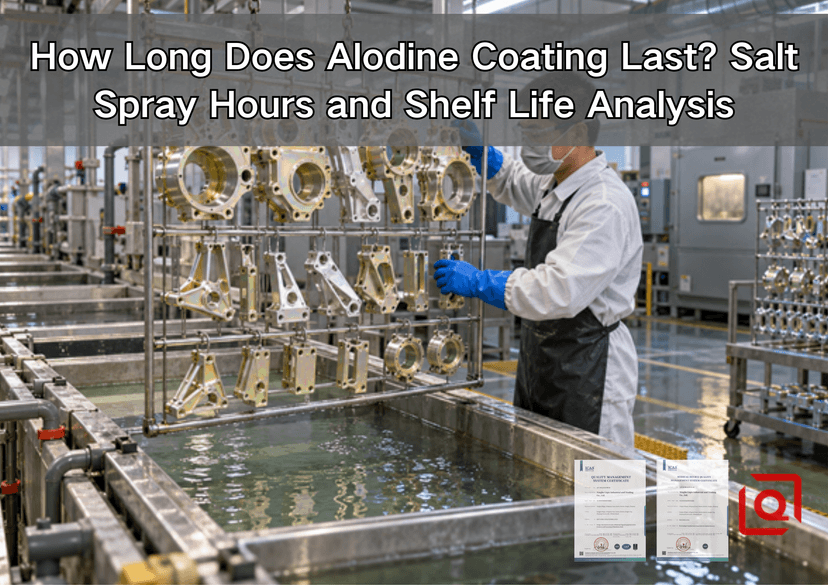
Are you still wondering whether “168 hours of salt spray” means an Alodine-coated part will survive outdoors for a certain number of years? Or whether treatment chemical, a working bath, and a finished component share one shelf life? They do not. This guide shows how a shop-floor engineer evaluates Alodine coating lifespan without turning a laboratory result into a sales promise.
Under MIL-DTL-5541, prepared control panels spend 168 hours in the corrosion test. Passing that week in the cabinet tells us the line is under control. That is a process benchmark, not a calendar-life warranty. Field durability depends on alloy, type and class, pretreatment, damage, heat, drainage, dissimilar metals, and any topcoat. Chemical shelf life is a separate value from the exact manufacturer’s data sheet and batch documents.
For buyers, the practical question is not simply “How long does Alodine last?” It is “What coating system, test evidence, handling plan, and maintenance condition will protect this particular aluminum part in its actual duty?”
Quick Answer: Four Different Meanings of “Last”
|
Question being asked |
Defensible answer |
What should control the purchase order |
|
How long must a MIL-DTL-5541 coating resist salt fog? |
168 hours in a 5% salt-spray exposure, followed by specified visual acceptance criteria |
Standard revision, type, class, panel method, acceptance limits, and test records |
|
How many years will bare Alodine last in service? |
No universal conversion exists between salt-spray hours and field years |
Actual humidity, salt, temperature, abrasion, drainage, galvanic couples, cleaning, and inspection plan |
|
How long does unused Alodine chemistry remain usable? |
Product-specific; Henkel states up to 24 months for unopened BONDERITE M-CR 1200 AERO in original packaging |
Exact product TDS, batch number, expiry date, storage conditions, and unopened/opened status |
|
How long can coated parts wait before painting or assembly? |
No single 24-hour, 72-hour, or multi-month rule applies to every system |
Customer specification, approved paint system, cleanliness, packaging, reinspection, and coating supplier instructions |
This distinction prevents two common sourcing errors: accepting an unsupported “years outdoors” claim and applying one product’s shelf life to another chemistry.
What Alodine Coating Actually Is
Alodine is a Henkel trade name often used as shorthand for chromate conversion coating or chem film. The film forms by chemical reaction with aluminum rather than electrolytic oxide growth. It is thin, barely disturbs a close fit, and helps with corrosion, paint bonding, or a deliberately conductive joint.
Check the source before copying an old drawing note. The U.S. Department of Defense currently lists MIL-DTL-5541 Revision F as active and records its latest validation on February 7, 2024. The document separates chemistry from function:
|
Callout |
Meaning |
Typical engineering reason |
|
Type I |
Composition contains hexavalent chromium |
A controlled legacy or aerospace process where the drawing permits it |
|
Type II |
Composition contains no hexavalent chromium |
Programs that prohibit hexavalent chromium while still requiring conversion coating |
|
Class 1A |
Maximum corrosion protection, painted or unpainted |
General protection and pretreatment under an organic coating |
|
Class 3 |
Corrosion protection where low electrical resistance is required |
Grounding pads, EMI contact zones, bus interfaces, and conductive housings |
Type does not establish class, and color proves neither. The drawing, qualified material, controlled process, and records matter more than appearance.
For a complete explanation of drawing callouts, cleaning, bath control, and inspection, see our MIL-DTL-5541 chromate conversion coating guide. If your team is deciding between a decorative oxide and a thin conductive conversion film, the comparison of gold anodized aluminum versus Alodine finish addresses appearance, electrical behavior, and specification differences.
What 168 Salt Spray Hours Really Mean
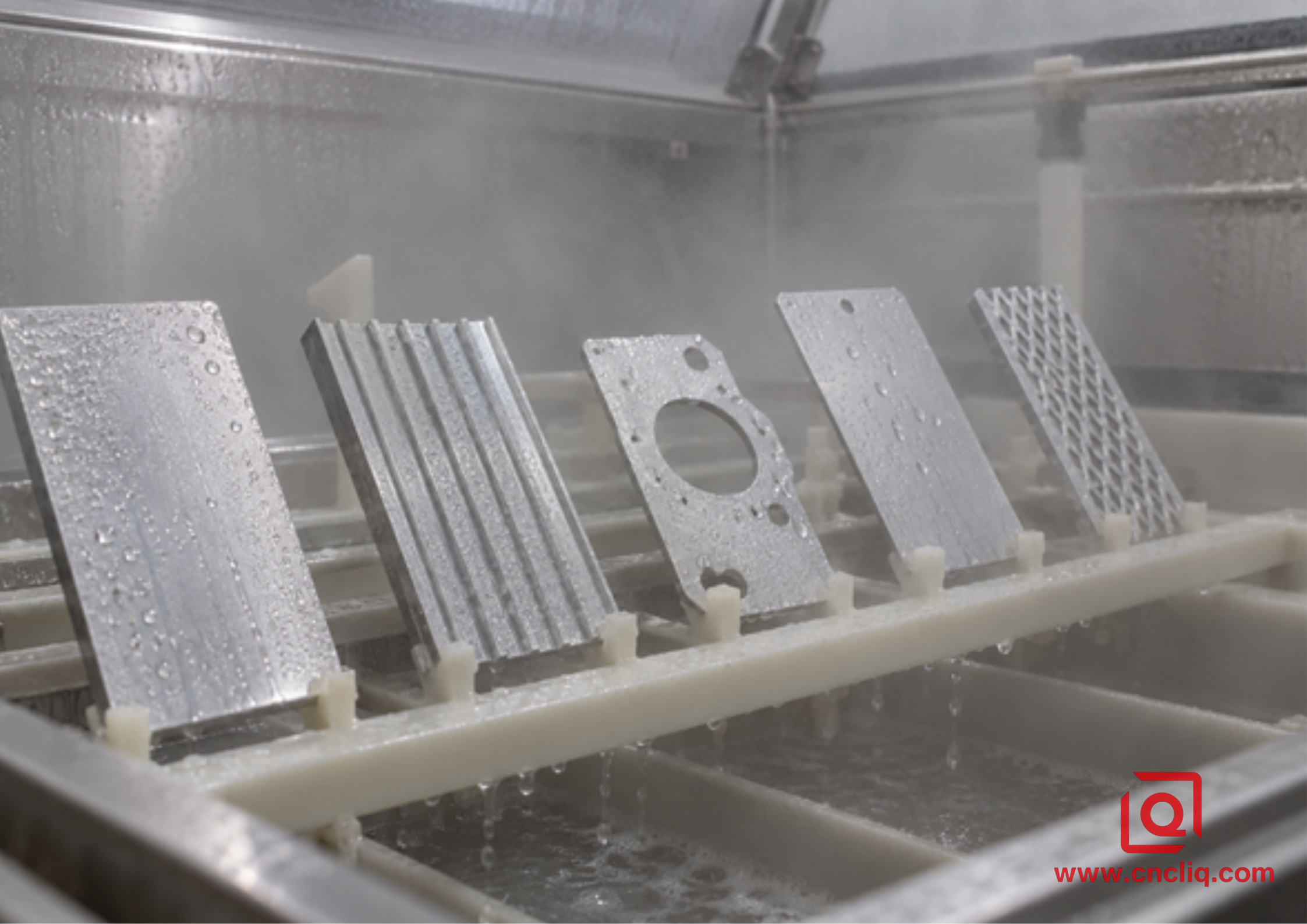
Five aluminum process-control coupons inside a neutral salt-spray chamber
Here is one trap we still see on RFQs: 336 hours is assigned to Class 1A and 168 hours to Class 3. MIL-DTL-5541F does not make that split. The corrosion clause calls for 168 hours on specimens carrying the applicable coating class. The 336-hour figure usually arrives from an anodizing requirement that has been mixed into the chem-film note.
The test is more controlled than putting a production part in a salty box and checking it a week later. Five prepared panels are conditioned after coating and then face 5% salt fog for 168 hours under ASTM B117. The military document adds its own rules for angle and post-test handling. Acceptance allows no more than five isolated spots or pits on each panel, none larger than 0.031 inch in diameter, and no more than fifteen spots or pits across the five panels. Defined edge, identification, and holding areas are excluded.
“168 hours” without the specimen, alloy, pretreatment, chamber practice, and failure criterion says little. A supplier should identify what was tested, when control panels were run, the chemistry used, and what constituted failure.
ASTM’s current B117-26a standard page is equally important. ASTM describes B117 as a controlled environment for relative corrosion-resistance information. It also states that prediction in natural environments has seldom correlated with salt-spray results when they are used alone. Think of B117 as the chamber recipe. Another specification must say how long to run it and what counts as failure; neither document gives a calendar conversion.
This is why the following equation should never appear in an engineering report:
168 salt spray hours = a fixed number of outdoor years
There is no reliable universal factor on the right side. Continuous salt fog does not reproduce every duty cycle. Compare a dry control cabinet with a shore-side bracket: the latter collects salt, sweats overnight, dries in the sun, vibrates, and holds water around fasteners. Coatings can rank differently in those two worlds. The cabinet result checks the process. Field exposure, a suitable cyclic method, or testing of the complete assembly answers the durability question.
How Long Can Bare Alodine Last in Real Service?
A responsible manufacturer should not promise one number. Bare chem film may remain useful for long periods on a clean indoor component that is rarely touched, yet deteriorate quickly on an exposed coastal part that traps salt water and rubs against hardware. The difference is not marketing; it is the exposure mechanism.
|
Service condition |
Main risks |
Practical specification approach |
|
Clean, dry indoor assembly |
Fingerprints, handling scratches, packaging abrasion |
Define class, handling, separator material, and visual acceptance; recheck before assembly |
|
Sheltered industrial enclosure |
Condensation, coolant mist, cleaning chemicals |
Confirm chemistry compatibility and require drainage, inspection, and controlled packaging |
|
Direct outdoor weather |
Wet-dry cycling, UV on any topcoat, airborne contamination |
Treat bare chem film cautiously; consider primer and topcoat or another qualified finish |
|
Coastal or marine exposure |
Chloride deposits, persistent moisture, crevices, galvanic couples |
Do not use 168 hours as a field-life promise; validate a complete coating system |
|
Electrical contact zone |
Wear, fretting, contact pressure, contamination |
Use Class 3 where specified and define the electrical test, mating hardware, and masked boundary |
|
Painted or powder-coated aluminum |
Underfilm contamination, adhesion, edge coverage, coating damage |
Control conversion pretreatment and evaluate the whole organic coating system |
Alloy and Pretreatment Change the Result
6061, 2024, 5052, cast aluminum, and a welded assembly do not present the same surface chemistry. Copper-rich phases, silicon-rich areas, smut, heat-affected zones, and embedded contamination influence film formation and corrosion initiation. Two parts can enter the same tank for the same time and leave with different risk.
Preparation must remove oil and native oxide without pits, excessive etch, or residue. A continuous rinse film is a useful indication that grease is not breaking the water into islands. Deoxidizing and desmutting must suit the alloy; no conversion bath can repair embedded steel or residual cutting fluid.
Look First at the Places Where Liquid Can Hide
Run a swab through a blind port after a poor rinse and the problem is obvious: liquid has nowhere to go. Seams and pockets do the same thing. During DFM, turn the rack in the same direction the part will drain, add an escape path where the design permits it, and make sure rinse water and air can reach the recess.
This is particularly relevant to custom aluminum manifold machining, where cross-passages, blind ports, seal faces, and dissimilar fittings meet in one body. The published product normally uses anodizing options, but the geometry illustrates why any conversion-coating proposal must define masking, drainage, cleaning, and post-finish verification around functional passages.
Abrasion and Handling Can Defeat a Passing Film
Chem film is not a hard wear coating. Clamps, bulk packing, steel benches, and connector movement can damage it. If rubbing is part of normal duty, put anodizing or a tougher qualified finish on the shortlist instead of asking chem film to behave like armor.
Our CNC-milled aluminum finishing guide compares chem film with Type II anodize, hardcoat, electroless nickel, a bead-blasted finish, and the option of leaving tool marks visible. Decide what the surface has to accomplish first. The process name comes second.
Then Trace Heat, Water, and Every Mating Material
Do not let the oven become an afterthought. Dry-off, adhesive cure, paint bake, and the final service temperature each need their own approved limit; going past it can shorten coating performance. Now follow the water. If it sits beneath a washer or gasket, the moisture can join aluminum to stainless steel, copper, or carbon fiber and start attack in a very small area. Put those meeting points on the print.
Alodine Shelf Life: Chemistry, Bath, and Finished Part Are Not the Same
“Alodine shelf life” can refer to three different inventories. Mixing them leads to weak purchasing controls.
1、Unopened Product Shelf Life
For BONDERITE M-CR 1200 AERO, Henkel states a shelf life of up to 24 months when the powdered product is stored in unopened original packaging. The same page identifies an operating temperature of 21°C to 38°C for that immersion product.
That figure belongs to one product in one packaging condition. It cannot be carried over to a different chemistry, a container whose seal has been broken, or a diluted tank. On receipt, log the product name and batch, both date fields, the required storage condition, and the TDS revision being used.
2、Opened Concentrate and Working-Bath Life
As soon as the package is opened or the tank enters service, sealed-package life is no longer the right measure. Shop reality takes over: work carries cleaner into the tank, water evaporates, metal loading rises, pH moves, and replenishment or poor rinsing changes the bath.
MIL-DTL-5541 process control calls for solution analysis at least weekly and process-control testing at least monthly, with no more than 35 days between monthly tests. If compliant production stops for 35 days or more, testing is required at restart. These controls are more meaningful than a handwritten “mixed on” date by itself.
A shop should quarantine an out-of-control bath, correct it under the chemical supplier’s instructions, and verify performance before releasing production. Adding concentrate until the color looks right is not a quality system.
3、Storage Life of Finished Parts
There is no universal rule that every conversion-coated part must be painted within 24 hours, nor a universal guarantee that an unpainted component can sit for years. The allowed hold time comes from the customer specification, approved paint or adhesive system, environmental cleanliness, packaging, and reinspection requirement.
Fresh parts should reach clean gloves rather than bare hands. Keep each piece dry and off its neighbor; shop coolant, the wrong paper or foam, and sliding contact can undo a good coating. When paint follows, inspect the bonding face for dust, oil, and condensation before it enters the next line.
Shop-Floor Controls That Extend Useful Life
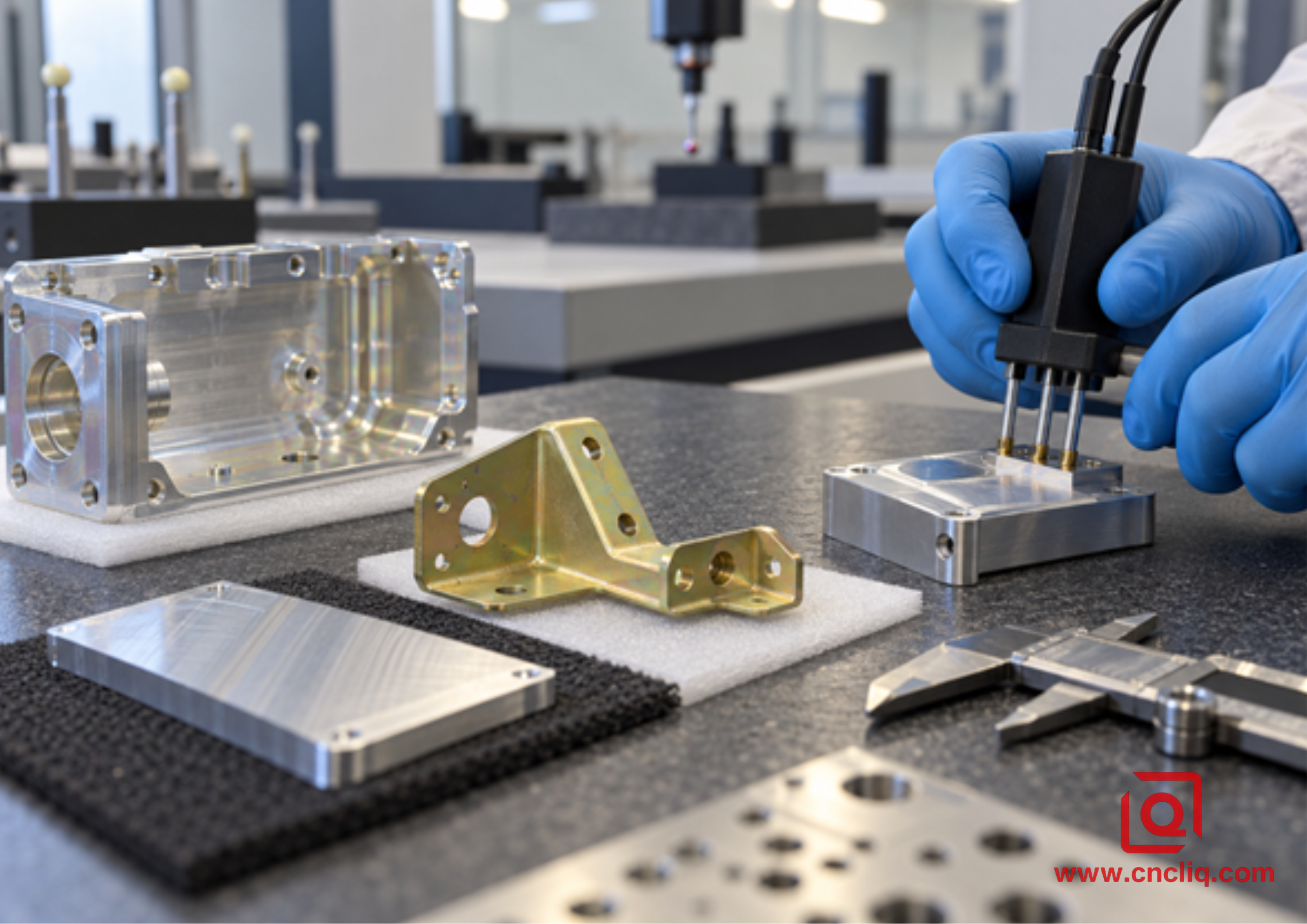
Electrical contact inspection on clear and gold conversion-coated CNC aluminum parts
An Alodine coating lifespan is mostly won or lost before shipment. The following route is practical for custom precision parts.
1、Review the Drawing Before Machining
Define alloy and temper, standard revision, type, class, controlled color, masked and contact zones, post-finish dimensions, downstream coatings, tests, and records. “Alodine clear” is not enough.
2、Finish Heat and Mechanical Operations First
Unless the approved route makes an exception, the coat tank comes after heat treatment, forming, all cutting operations, hole making, and welding. Touch the part with a tool later and raw aluminum appears. Weld later and the nearby film is gone.
3、Plan Where the Part Hangs and Drains
Ask where the operator can hang the part without marking a visible face or a seal. Rotate pockets toward an exit, shield dissimilar inserts when the specification requires it, and draw the conductive areas so masking is not left to memory.
4、Clean, Deoxidize, and Desmut for the Actual Alloy
Use controlled cleaning, avoid iron-bearing abrasives, confirm a water-break-free surface, and adjust approved pretreatment for the alloy or weld condition.
5、Run Qualified Chemistry Inside Its Window
Control concentration, pH, temperature, dwell, loading, and replenishment to the current data sheet. Use the approved product and application method.
6、Rinse and Dry Without Damaging the Film
Move racks promptly, rinse with controlled water, prevent pocketing, use the approved drying temperature, and avoid touching the active surface.
7、Verify Function, Not Only Color
Inspect continuity and defects. Review salt-spray control, wet-tape adhesion when painted, and electrical results for Class 3. The COC should state the standard, type, and class.
8、Pack for the Actual Journey
A short local delivery and an ocean shipment do not need the same pack. Use clean separators, stop movement inside the carton, keep moisture away, and consider how the customer will store and unpack the lot.
Anonymous Customer Case: Conductive Telecom Hardware With a Painted Exterior
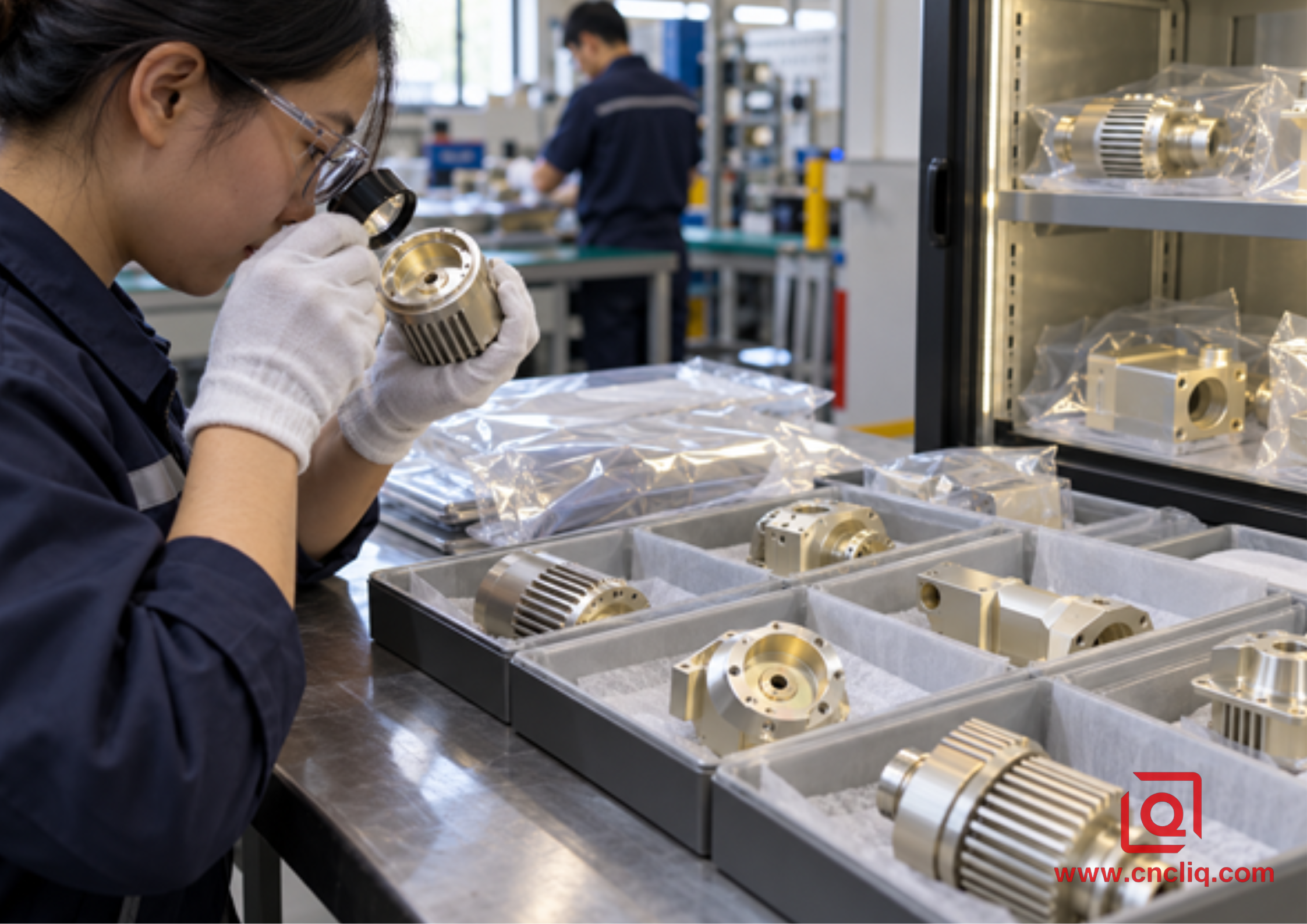
Final visual inspection and separated packaging of conversion-coated telecom components
The following anonymized and sanitized case scenario is based on Liqin’s published custom telecom-part capabilities. It demonstrates a reasonable control plan, not a universal performance claim.
An equipment manufacturer needed a 6061-T6 surge-protection electrode and housing for an outdoor telecom assembly. The current path required low resistance, the exterior needed a painted barrier, and threads and seals could not tolerate uncontrolled buildup. One finish across every surface would compromise function.
The route divided the part by duty. Datums, threads, and the contact face were marked on the drawing. The conductive zone used the specified type and Class 3 function; the exterior used conversion pretreatment under an approved topcoat. Mask boundaries avoided seals, and rack points moved to a nonfunctional face.
First-article approval covered dimensions, appearance, customer-defined electrical performance, records, and packaging. The supplier used 168-hour evidence for the conversion process, while the complete painted assembly followed the customer’s environmental plan.
The scenario fits Liqin’s published 6061-T6 CNC-machined aluminum electrode used in telecom surge protection. A buyer should first color-code the current path, seals, visible faces, and weather-exposed areas on the print. Only then should the finish be selected. That small piece of drawing work is far more useful than asking for “maximum Alodine life.”
Alodine, Anodizing, or a Coating System?
|
Requirement |
Better starting point |
Reason |
|
Minimal dimensional change on tight threads or bores |
Conversion coating |
Thin reaction film with little practical buildup |
|
Low-resistance grounding or EMI interface |
MIL-DTL-5541 Class 3 strategy |
Designed for corrosion protection where low electrical resistance is required |
|
Bare-part abrasion resistance |
Anodizing or another wear finish |
Chem film is not a hard wear layer |
|
Outdoor color and weather barrier |
Qualified primer and topcoat, powder system, or suitable anodize |
Service depends on a complete protective system, not chem film alone |
|
Paint adhesion on aluminum |
Conversion pretreatment under the approved paint |
Provides a controlled bonding surface when properly cleaned and processed |
|
Severe salt, splash, and crevice exposure |
Application-specific multilayer system and validation |
Continuous chloride duty requires more than a 168-hour process-control statement |
The aluminum OEM surface-finishing guide offers a wider DFM comparison, while the article on powder coating versus anodizing aluminum helps teams assess thick organic barriers against integral oxide finishes. Liqin’s surface-treatment product category also shows the types of machined parts and finishing routes that can be coordinated in one sourcing plan.
Build an RFQ That Can Be Quoted Without Guesswork
1、Files come first: attach the latest 2D print and a STEP or IGES model.
2、For material, name the alloy, temper, and starting stock; also say whether receiving expects a certificate.
3、Do not stop at “Alodine.” Give the MIL-DTL-5541 revision and the required type and class.
4、A marked-up view should show coating, masks, allowed touch-up, grounds, seals, and where paint ends.
5、Circle the dimensions and tolerances that receiving will check on the finished part.
6、Spell out the evidence: corrosion, adhesion, resistance, appearance, and the sampling plan, as applicable.
7、Downstream primer, paint, powder, adhesive, cure, or assembly conditions.
8、Tell the shop where the part works. Humidity, salt, heat, cleaning chemicals, rubbing, and the materials it touches can change the answer.
9、Add prototype and annual quantities, shipping destination, packaging expectations, and the COC or inspection reports the receiving team needs.
If you are evaluating custom conversion-coated aluminum parts, send this package through our contact page. Our team can review the finish callout, conductive interfaces, rack points, drainage, inspection evidence, and packaging before quotation. That early review is the fastest way to turn an Alodine coating lifespan question into a buildable specification.
FAQ
1、Does 168 hours of salt spray mean an Alodine coating will last seven days in service?
No. The 168-hour exposure is a controlled qualification and process-verification benchmark under MIL-DTL-5541, not a prediction that field failure occurs after seven days. Real life depends on wet-dry cycling, chloride loading, alloy, damage, geometry, heat, topcoats, galvanic contact, and maintenance. Use the test to compare process conformance, then validate the complete part or coating system for its actual environment.
2、Should Class 1A be chosen whenever service life is the priority?
Not automatically. The first class is used when maximum corrosion protection is the goal; the second is for places where electrical resistance must remain low. Neither label promises a fixed number of months or years. Let the function decide: a contact pad may need Class 3 even though Class 1A sounds tougher, while an outdoor enclosure may need conversion pretreatment under paint instead of either class exposed to weather.
3、How long can an unopened package of Alodine 1200 be kept?
Henkel gives BONDERITE M-CR 1200 AERO up to 24 months in its unopened original package. Once the seal is broken, or when another product or a working tank is involved, that number no longer answers the question. Before use, match the container to its technical data sheet, batch expiry, storage history, and applicable local documentation.
4、May conversion-coated parts wait before the paint operation?
They can, provided the hold time agrees with the approved paint system, customer specification, and cleanliness plan; a generic internet limit is not enough. Place the lot in a dry, clean zone, with a compatible layer between neighboring pieces, then control handling and any source of oil, dust, water, or scuffs. When the allowed window has passed or contamination is in doubt, follow the specified reinspection or reprocessing route before painting.
5、What information is needed to quote conversion-coated CNC aluminum parts?
Provide alloy and temper, 2D and 3D files, annual volume, MIL-DTL-5541 revision, type, class, masked and conductive zones, post-finish tolerances, downstream coatings, service environment, required tests, certificate package, packaging, and destination. These details let the manufacturer plan machining, cleaning, racking, drainage, bath control, inspection, and shipment as one process instead of pricing an ambiguous color request.
Summary
Alodine coating lifespan is not one number. MIL-DTL-5541 uses 168 hours in 5% salt fog as a controlled corrosion benchmark, while ASTM B117 cautions against turning that result straight into field years; chemical shelf life, meanwhile, belongs to a named product and storage condition. Longer service is built through correct type and class, pretreatment suited to the alloy, a controlled bath, careful handling, good drainage, meaningful functional checks, compatible topcoats, and packaging that survives the journey. Put the relevant choices on the print and RFQ, and request evidence proportionate to the application risk.
Contact Information
Company: Ningbo Liqin Industry Co., Ltd.Daily customer maintenance & after-sales support:service@shturl. zhuwanying@cncliq.com
New inquiry, quotation & order discussion:business@shturl. zhouli@chinaliqin.com
Hotline: +86 18757148656
Disclaimer
All technical articles, material specifications, machining recommendations, and surface treatment details published on this blog are for informational and reference purposes only. Please note that general blog insights do not replace signed technical agreements. Because custom parts vary by material heat numbers, machine calibrations, and specific tolerances, binding quality specs are governed solely by your approved CAD drawings, signed contracts, and formal quality plans.
All customer case studies featured on this blog have been thoroughly anonymized and sanitized. The performance metrics, manufacturing workflows, and imagery displayed serve solely to demonstrate our custom machining capabilities and do not represent a single universal standard for all orders.
Liqin Manufacturing Team
Built on 18 years of precision engineering experience, Ningbo Liqin Industry manufactures high-tolerance metal components for demanding global markets. We operate out of a 6,500 m² production hub equipped with over 150 machines, running 4-axis and 5-axis CNC machining, mill-turn machining, cold extrusion, and pressure die casting under one roof. This setup allows us to manage projects seamlessly, taking parts from initial CAD concepts directly to finalized shipments.
We handle quality control with zero compromise. We treat tight tolerances with the engineering discipline they require. Backed by ISO 9001, ISO 13485, and IATF 16949 certifications, our QA engineers run strict IPQC, FQC, and OQC checks on every single production batch. From CMM dimensional mapping and optical profiling to hardness and salt-spray testing, we validate your critical specs upfront—so you receive drop-in ready components with zero assembly headaches or costly line stoppages. On top of manufacturing, you can rely on us for two-hour response times on new RFQs, direct support for prototype sampling, and smooth export shipping across Europe, North America, Asia, and Oceania.
Welcome your inquiries and samples. Visit our website or contact us directly for a competitive quote!