 English



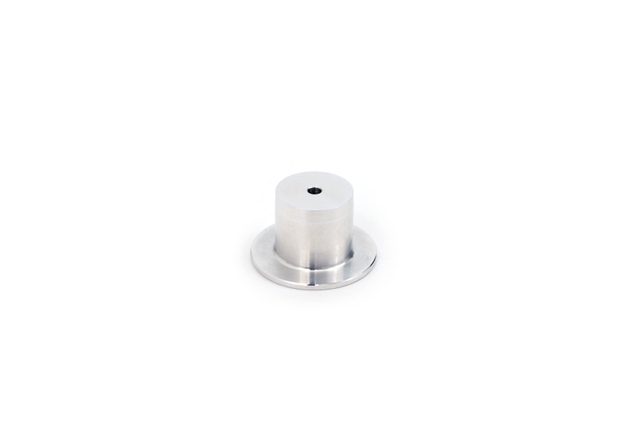
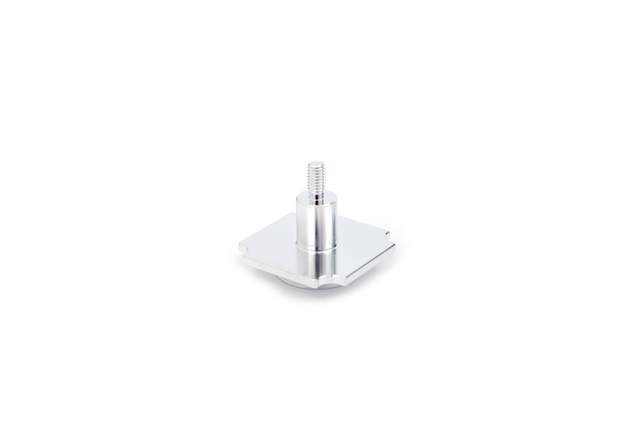
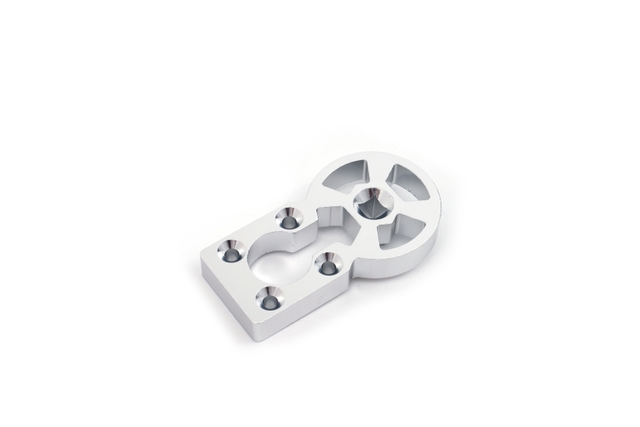
Product Description
| thing | describe |
|---|---|
| Design/Size | According to customer's drawings or samples |
| Material | Aluminum: 6061, 6063, 6082, 7075, 5052, A380, etc.
|
| process | CNC machining, turning, milling, stamping, turning, cutting, etc. |
| Delivery time | Samples usually take 3-7 working days, and mass production will be carried out according to the detailed quantity after sample approval. |
| Surface treatment | Transparent anodizing, color anodizing, chemical coating, brushing, passivation, polishing, chrome plating, sandblasting, laser engraving, zinc plating, black oxide, nickel plating, chrome plating, carburizing, heat treatment, painting |
| Test equipment | Coordinate measuring machine (CMM), 2D measuring instrument, projector, altimeter, micrometer, thread gauge, hardness tester, caliper, pin gauge, salt spray tester, concentricity measuring instrument, spectrometer. |
| Quality Management System | ISO 9001:2015
|
| application | Auto parts, machinery parts, computer parts, medical parts, home appliance parts, electrical parts, electronic product parts, electronic parts, generator parts, alternator parts, generator parts, stationery, power switches, micro switches, construction, merchandise and A/V equipment. |
| File Format | Solidworks, Pro/Engineer, CAD, PDF, JPG, DXF, IGS |
| Package | Inner plastic bag, outer standard carton, or as per customer's requirements |
| Shipping | Sea freight, air freight, international express (DHL, FedEx, TNT, UPS). |
| Serve | The professional foreign trade team provides enthusiastic and fast response services.
|
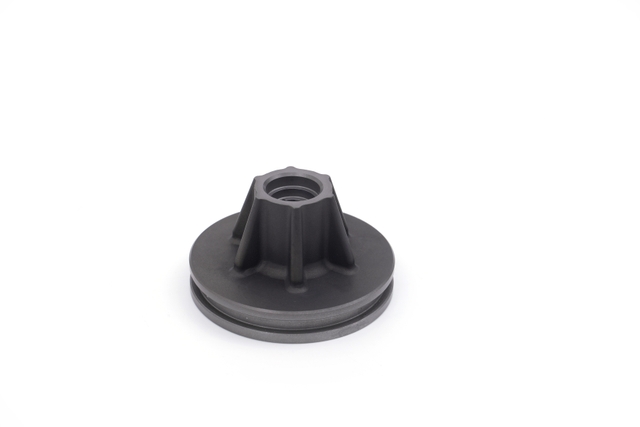
The component is best presented as a custom A380 aluminum servo capstan for aerospace motion-control equipment, with potential adaptation to other compact cable-driven systems. It is not a generic hardware-store pulley. Its value comes from the relationship between the groove, bore, faces, and shaft interface. When these features remain concentric and dimensionally stable, the actuator can position a cable smoothly, reverse direction predictably, and respond with less vibration or lost motion.
Application note: The most likely field is aircraft autopilot or trim-servo actuation, based on the capstan form, cable groove, reinforced hub, and matched servo-component context. Final installation and airworthiness acceptance must always follow the customer drawing, system-level validation, and applicable aviation requirements; this description does not claim standalone certification.
Designed for Compact Flight-Control Actuation
Inside a light-aircraft autopilot servo, the capstan acts as the mechanical bridge between the motor-and-gearbox output and a tensioned control cable. Motor torque enters through the central shaft connection. The ribbed hub spreads that load into the broad circular body, while the outer groove carries the cable around a controlled radius. The arrangement converts rotary servo motion into a repeatable pull on the aircraft control linkage.
This duty rewards low inertia, accurate geometry, and reliable cable seating. A lighter rotating component can follow command changes with less energy, while a consistent groove supports stable tracking and reduces the chance of localized rubbing. The shallow dish helps remove nonfunctional mass, and the radial ribs strengthen the hub-to-rim transition, where torque and cable load meet. These features also make the part relevant to compact trim actuators, unmanned-aircraft control mechanisms, test rigs, and specialized industrial cable-positioning modules when their loads and safety requirements are separately validated.
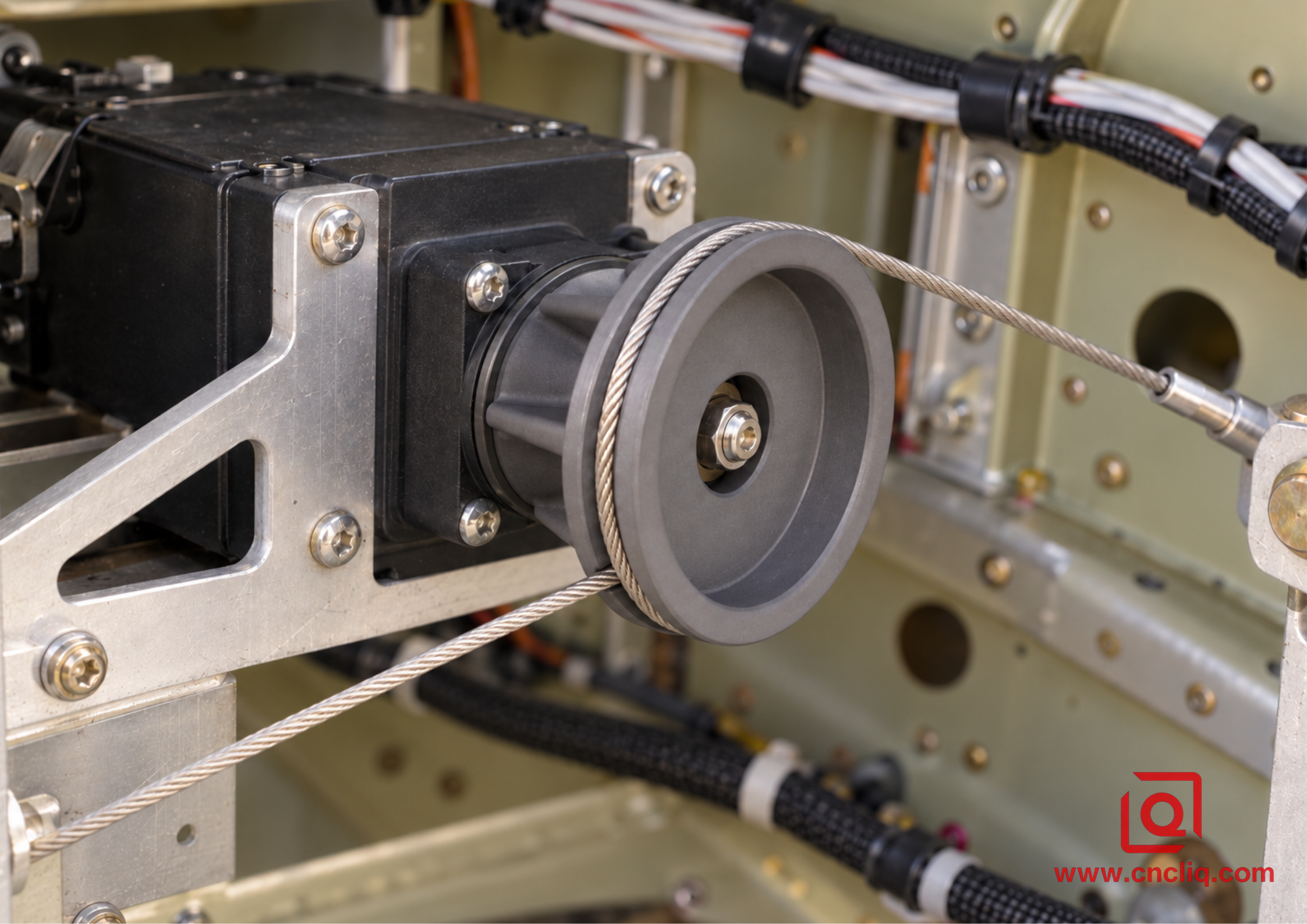
Original generated application image: a compact aluminum capstan installed on an aircraft-style servo with the control cable seated in the peripheral groove.
A380 Aluminum: A Practical Material for Detailed Cast Geometry
A380 is a widely used aluminum-silicon-copper die-casting alloy. It fills detailed tooling well, supports thin ribs and blended transitions, and is generally cooperative during secondary machining. That combination suits a capstan whose shape integrates a dish, a reinforced tapered hub, multiple ribs, and an outer cable groove in one compact body. Liqin’s A380 aluminum die-casting and machinability guide explains why this alloy is often chosen when castability, dimensional repeatability, and efficient finishing must be balanced.
For the end user, the material offers a useful strength-to-weight ratio and good stiffness for a small rotating component. The die-cast route also places material where it contributes most: around the shaft interface, along the reinforcing ribs, and at the rim. Compared with machining the entire form from solid billet, near-net casting can reduce chip waste and repetitive roughing time once production volume justifies dedicated tooling.
A380 should still be specified and controlled as a casting alloy rather than treated like wrought 6061. Gate position, local wall thickness, venting, cooling, and machining allowance influence the finished part. Corrosion protection and appearance should also be selected for the actual service environment. Shot blasting, conversion coating, paint, or other project-specific finishes may be appropriate, while critical bores and mating faces can remain precision machined.
Manufacturing Process
A robust production plan begins with design-for-manufacture review. Engineers check draft, rib thickness, fillet radii, parting-line placement, ejector locations, and the relationship between heavy and thin sections. The objective is to fill the hub and rim cleanly without creating avoidable shrinkage hot spots near the precision bore. More background on this stage is available in the custom aluminum die-casting engineering guide.
1. Material and melt control: The specified A380 charge is verified by lot documentation and, where required, composition testing. Melt temperature, cleanliness, and die condition are controlled before production.
2. High-pressure die casting: Molten alloy rapidly fills the hardened steel cavity, forming the dish, tapered hub, ribs, and most of the rim geometry as a single near-net blank.
3. Trimming and surface preparation: Runners, overflows, and flash are removed. The blank is cleaned and may be shot blasted to create a uniform matte surface and reveal visible casting defects.
4. Precision CNC finishing: The shaft interface, stepped internal bores, reference faces, and cable-groove features are turned or bored from controlled datums. Critical rotary features should be completed in as few clampings as practical to protect concentricity and face relationships.
5. Deburring and cleaning: Edges, bore transitions, and groove boundaries are checked for rolled burrs or loose particles that could interfere with the shaft, fastener, or cable.
6. Inspection and controlled packing: Dimensional records are completed, appearance is checked under consistent lighting, and parts are separated to prevent rim-to-rim impact during transport.
The same cast-plus-CNC logic is used on other rotating or alignment-sensitive parts. Liqin’s precision motor flange and front end cap is a related example in which cast geometry is combined with machining of the interfaces that control assembly and motion.
Quality Control Focus
The supplied inspection documents show that this component is managed as a precision mechanical part rather than accepted only by appearance. Representative drawing-controlled features include an outside diameter near 49.15 mm, an overall height of 27 mm, a precision bore near 12.70 mm, and an outer groove diameter near 45.06 mm. The production inspection plan applies tight tolerances to critical diameters and also checks groove width, depth relationships, flatness, perpendicularity, chamfers, and visual condition.
Critical diameters are checked with micrometers, air gauges, go/no-go gauges, and calibrated calipers as appropriate. A coordinate measuring machine verifies geometric relationships that cannot be judged reliably by a hand tool. First-article inspection covers the complete feature set, while in-process checks at defined intervals help detect tool wear, fixture movement, or thermal drift before a full batch is affected.
Quality assurance should also include casting-specific controls: material traceability, visual screening for cold shuts and cracks, attention to porosity near machined surfaces, and stable datum selection during CNC work. For an aerospace servo application, acceptance should extend beyond the component itself to assembly fit, cable alignment, torque transmission, functional cycling, environmental exposure, and system-level verification.
Application Scenarios
· Aircraft autopilot servos: guiding a tensioned control cable as the servo commands roll or pitch correction.
· Electric trim actuators: transferring controlled rotary motion into a cable-driven trim mechanism.
· Experimental and light-aircraft control systems: custom assemblies developed under the aircraft manufacturer’s approved engineering and test process.
· Unmanned-aircraft or test equipment: compact servo mechanisms that require low rotating mass and repeatable cable travel.
· Specialized industrial cable drives: instrumentation, positioning, or tension-control modules with comparable geometry, after load and safety validation.
Product Advantages and Customer Value
The principal advantage is integration. The A380 aluminum servo capstan combines a cable-running surface, torque-transmitting hub, reinforcing ribs, and lightweight body in one piece. This reduces the number of assembled elements and removes interfaces that could loosen, shift, or accumulate tolerance. The ribbed construction provides stiffness where torque enters the rim, while the open dish keeps mass away from areas that do not need to be solid.
Precision machining adds value exactly where the servo depends on it. A controlled bore supports secure shaft fit; consistent faces help the component sit squarely; and a repeatable groove protects cable tracking. For the OEM, these details can improve assembly consistency, reduce fitting and sorting work, and support smoother functional testing. For sourcing teams, a stable die-cast blank plus targeted CNC finishing creates a scalable route that can serve qualified production more efficiently than full-billet machining.
Customization can cover bore profile, groove geometry, hub height, rib layout, finish, inspection reporting, and packaging. The best result comes from early collaboration: provide the 2D drawing, 3D model, cable specification, shaft interface, load case, finish requirement, and validation plan. Liqin can then align casting design, machining datums, gauging, and production controls around the real assembly function. Visit Liqin precision metal manufacturing to discuss a drawing-based OEM project.
FAQ
1. What is the most likely use of this component?
Its most likely role is a cable capstan on a compact electromechanical servo, especially an aircraft autopilot or trim-control actuator. The peripheral groove guides the cable, the central interface mounts to the servo output shaft, and the ribs carry torque between the hub and rim. The final application must be confirmed by the OEM drawing and system qualification.
2. Why use A380 instead of machining the complete part from billet?
A380 can form the dish, ribs, tapered hub, and rim close to final shape in one casting cycle. Secondary CNC work is then concentrated on the bore, reference faces, and groove features that require precision. At suitable volume, this hybrid route reduces material removal and supports repeatable production. Billet machining may still be preferable for prototypes, frequently changing designs, or requirements that cannot accept die-casting characteristics.
3. How is dimensional consistency controlled?
The process combines first-article inspection, scheduled in-process sampling, calibrated hand gauges, go/no-go gauging, air gauging, and CMM verification. Critical rotating features are referenced from controlled datums and machined with minimal reclamping. Casting appearance, burrs, machined-surface condition, and final cleanliness are also checked before packing.
TEL: +86 187 5714 8656
Email: zhouli@chinaliqin.com
WhatsApp:+86 187 5714 8656
Website:https://www.cncliq.com/