English




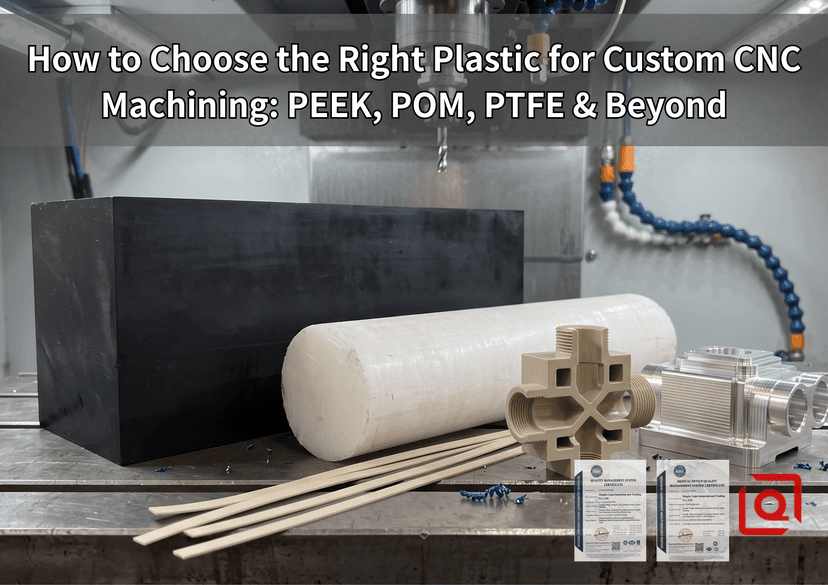
Forget what generic material datasheets hand you. ASTM D648 test specs sound great on paper. But they fall apart the second an 18,000 RPM spindle dumps flood coolant onto a thin-walled housing. Plastic just isn't 6061 aluminum. It has memory. It holds internal stress from the extrusion process. And if you don't control the heat, thermal expansion will blow out your dimensions long before you even worry about burr removal.
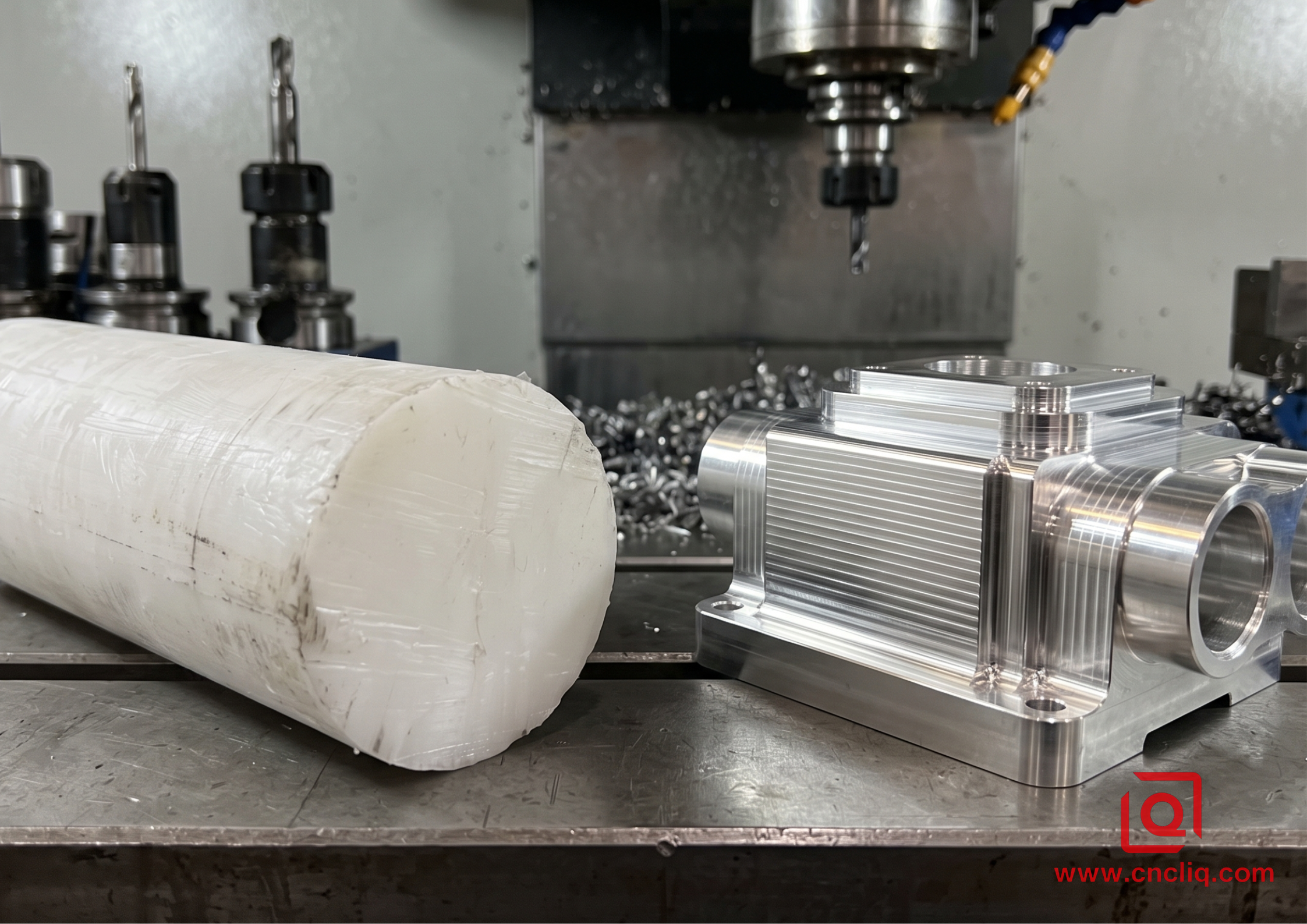
If you're holding tolerances tighter than ±0.025mm, material selection isn't just an engineering decision—it's a scrap rate issue. Pick the wrong stock, and the part will warp as soon as you unclamp the vise.
       TYPICAL THERMAL EXPANSION VS. METALS
+---------------------------------------------------+
| 6061-T6 Aluminum : ~23 µm/m·°C                     |
| POM-C (Acetal)   : ~110 µm/m·°C  (4.7x Aluminum)  |
| PTFE (Teflon)    : ~130 µm/m·°C  (5.6x Aluminum)  |
+---------------------------------------------------+
1. The Big Four: Shop-Floor Reality vs. Datasheet Hype
POM-C (Polyacetal / Delrin)
The workhorse. Excellent machinability, low moisture absorption (<0.2% per ASTM D570), and predictable chip formation. But don't get reckless with feeds.
-
The Catch: Center-line porosity in extruded thick slabs (above 50mm). If you're machining a hydraulic manifold or valve seat, that porous core will leak at 1.5 MPa fluid pressure.
-
Shop Fix: Specify porosity-grade POM-C or switch to cast stock. Drive a 2-flute polished carbide endmill at Vc = 300m/min, with fz = 0.08mm/tooth. Keep depths of cut under 3.0mm per pass to avoid internal stress relaxation.
PEEK (Polyetheretherketone — Unfilled & 30% Glass-Filled)
The nuclear option for aerospace manifolds and semiconductor end-effectors. Continuous service at 260°C, chemical resistance that rivals gold.
-
The Catch: PEEK is abrasive, expensive ($200+/kg), and prone to catastrophic cracking if you feed a tool with a dull hone. Glass-filled (PEEK GF30) destroys uncoated carbide in under twenty minutes of pocket roughing.
-
Shop Fix: Run PCD (Polycrystalline Diamond) or DLC-coated tooling. Never cut virgin PEEK cold. If you don't pre-heat or properly relieve stress, your features will warp instantly upon unclamping.
PTFE (Teflon)
Virtually zero friction, inert up to 260°C, but a total nightmare on a lathe.
-
The Catch: Cold flow under load and an absurd Coefficient of Thermal Expansion (CTE ~ 130 ×10-6/K). Hold a cold PTFE bushing in your hand for two minutes and the body heat raises the outer diameter by half a thou (0.012mm).
-
Shop Fix: Razor-sharp high-rake inserts (15°–20° rake angle). No positive tool pressure. Cryogenic air blast works better than soluble oil, which causes localized swelling.
Nylon 6/6 (PA66)
Tough, wear-resistant, great for gears and wear strips.
-
The Catch: Hygroscopic. It drinks water like a camel. A part machined to nominal tolerance at 30% relative humidity expands by up to 1.5% after a week in ambient factory air.
-
Shop Fix: Over-machine features slightly tight if operating dry, or bake parts at 80°C for 24 hours prior to final critical finish passes.
2. Heat, Stress, and Warpage: The Annealing Rules You Can't Skip
You clamp an extruded POM-C block, rough out a deep cavity, flip it, face the back, and measure it. The bore is out-of-round by 0.08mm. Why? Extrusion stresses.
When plastic stock is extruded at the mill, the outer skin cools faster than the core. This locks in massive hoop stresses. As soon as you remove material, those forces balance out by twisting your part into a potato chip.
EXTRUSION STRESS RELIEF PROFILE (POM-C / PEEK)
Temperature (°C)
  ^
  |          [Ramp Up: 15°C/hr]    [Hold: 1 hr per 10mm wall]
200|                                +-----------------------+
  |                               /                         \
150|                              /                           \  [Ramp Down: 10°C/hr]
  |                             /                             \
 20|---------------------------+                               +------------------> Time
-
Rough Machining: Leave 1.0mm to 1.5mm stock on all surfaces.
-
Intermediate Annealing (Stress Relief):
-
POM-C: Heat to 140°C at 15°C/hr. Hold for 1 hour per 10mm of wall thickness. Cool down inside the oven at <10°C/hr to room temperature.
-
PEEK: Ramp up to 200°C. Hold for 2 hours. Cool down at 10°C/hr.
-
-
Finish Machining: Take light finishing passes (0.15mm DOC) using sharp, uncoated micro-grain carbide tools.
Skip this process on tight-tolerance seals, and your customer will reject the batch at CMM inspection every single time.
3. Tool Geometry, Speeds & Feeds, and Coolant Dynamics
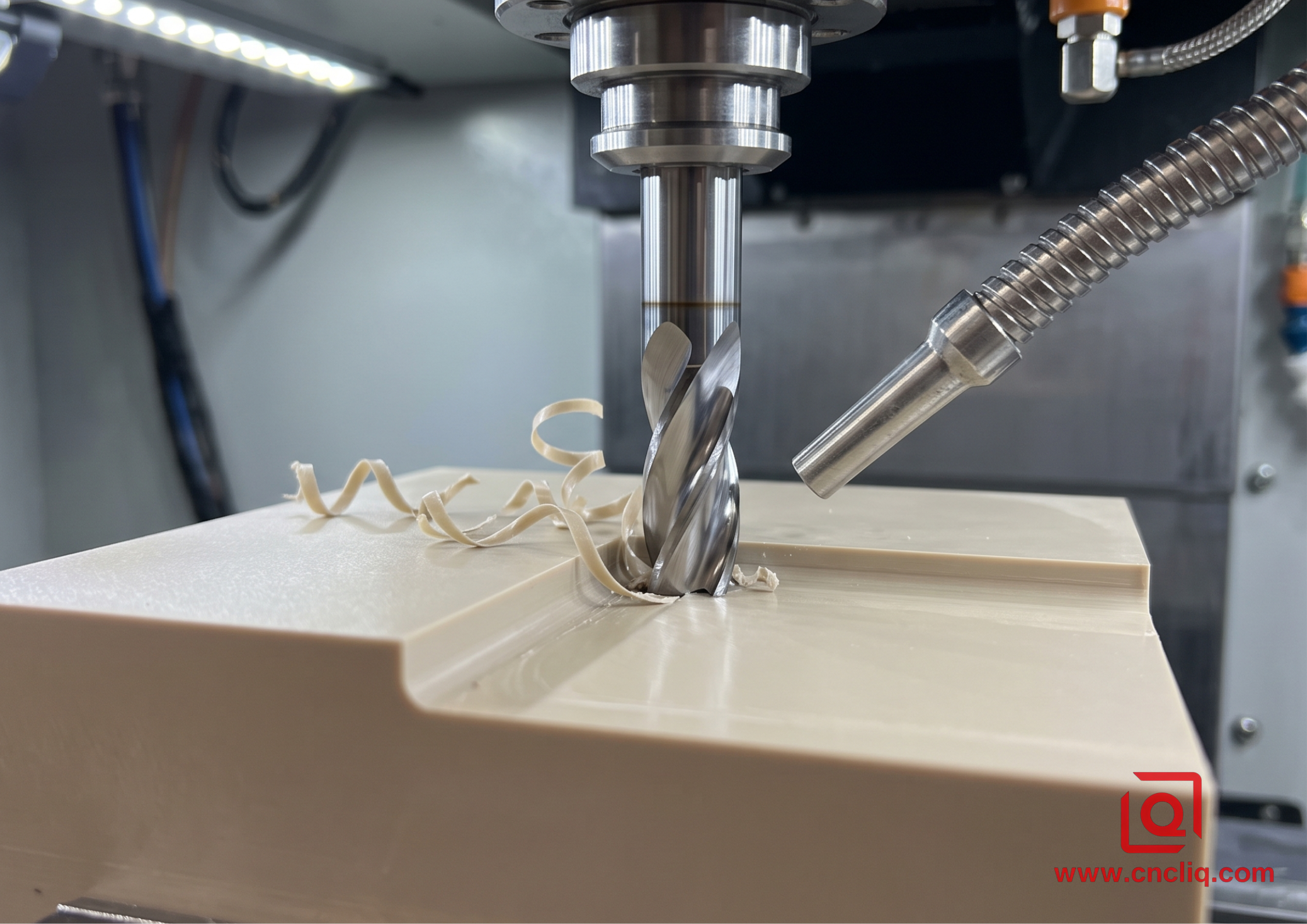
Stop using 4-flute steel endmills on plastics. The chips melt, weld to the flutes, snap the cutter, and ruin the part surface within seconds.
RECOMMENDED CUTTING PARAMETERS FOR ENGINEERING PLASTICS
+-----------+------------------+--------------------+---------------------+----------------------+
| Material  | Speed (Vc m/min) | Feed (fz mm/tooth) | Rake Angle (Radial) | Relief Angle (Axial) |
+-----------+------------------+--------------------+---------------------+----------------------+
| POM-C     | 250 - 450        | 0.05 - 0.12        | 15° - 20°           | 10° - 15°            |
| PEEK (Un) | 150 - 250        | 0.04 - 0.08        | 10° - 15°           | 8° - 12°             |
| PEEK GF30 | 80 - 140         | 0.03 - 0.06        | 5° - 10°            | 6° - 8°              |
| PTFE      | 150 - 300        | 0.05 - 0.10        | 20° - 25°           | 12° - 18°            |
+-----------+------------------+--------------------+---------------------+----------------------+
-
Chipbreakers & Flute Polishing: Use single-flute or 2-flute up-cut routers and endmills with mirror-polished flutes (Ra < 0.1 µm). Plastic chips require ultra-smooth evacuation paths to prevent friction heat buildup.
-
Coolant Management: Compressed air blast with cold-air guns (Vortex tubes) is preferred over water-soluble emulsions for hydrophilic materials like PA66 and PEEK. If liquid coolant is required for heat extraction on heavy roughing, use water-based synthetic fluids, but wash and dry parts immediately to prevent fluid absorption.
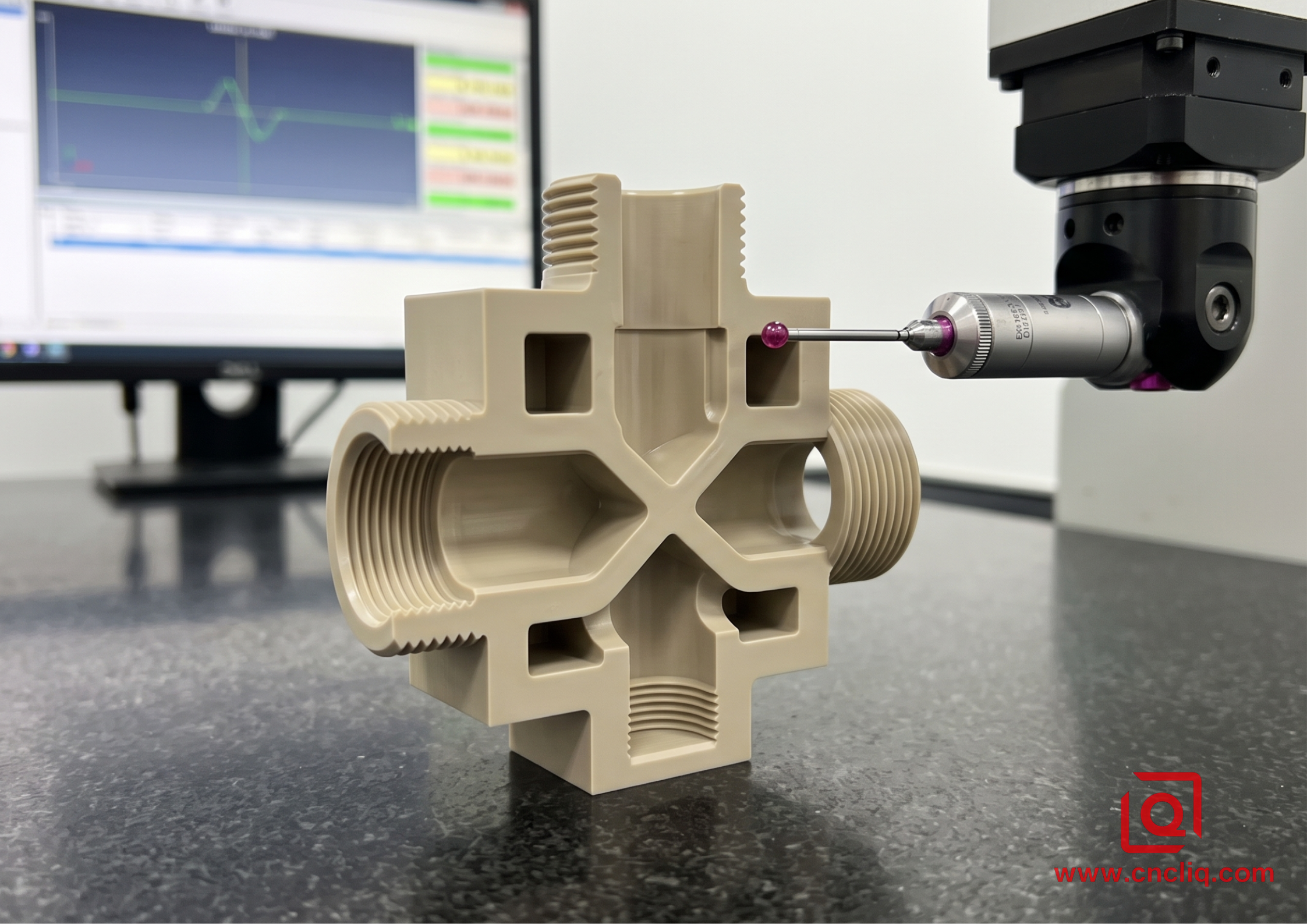
4. Real-World Case Study: Machining a 0.015mm Tolerance PEEK Valve Body
-
The Problem: An offshore medical client required a 5-port manifold block machined from PEEK 450G. Port-to-port concentricity had to sit within 0.015mm, with an internal finish requirement of Ra 0.4 µm—no post-machining polishing allowed due to media contamination risks.
-
Initial Failure: Initial trial runs without stress relief resulted in 0.04mm port drift within 48 hours of machining. Frictional heat from standard 3-flute endmills caused surface smearing inside the ports.
-
The Solution Protocol:
-
Switched to stress-relieved extruded rod stock (ISO 1043 compliant).
-
Rough machined all ports leaving 1.2mm stock.
-
Oven-annealed at 200°C for 4 hours with controlled thermal ramp-down (8℃/hr).
-
Finished bores using single-point PCD boring bars at n = 12,000RPM, Vf= 250mm/min, driven under high-pressure cold air blast (0.6MPa).
-
Final Result: Concentricity held across all 5 ports at 0.009mm, Ra 0.28 µm surface finish achieved straight off the spindle. Passed 100% CMM inspection under 20°C controlled room ambient.
-
FAQs
Q1: Can you machine thin-walled plastic enclosures without warping them out of round?
Absolutely, but if you toss them into a standard steel vise with flat jaws, you’ll crush your tolerances before the end mill even touches the stock. Plastic loves to spring back the second you back off the vise handle.
For thin walls, we skip the standard setup entirely. Instead, we cut custom soft jaws or full-wrap pie jaws that grab the part’s exact contour, spreading clamping force over as much surface area as possible. When cutting, keep your passes light, run high speeds, and use dead-sharp cutters. Skip the flood coolant if it pulls the part around—a steady, clean air blast keeps heat from building up in one spot, so the wall won't bow inward or rip off the fixture.
Q2: Why do my machined POM parts change dimensions several days after leaving the shop?
That is almost always a combination of hidden internal stress and ambient humidity shifts. When raw plastic billets are extruded, they lock in internal tension. Strip away the outer layer during roughing, and those forces gradually relax over 24 to 48 hours, causing subtle twisting. Furthermore, materials like Nylon or lower-grade acetals act like sponges, absorbing ambient air moisture and swelling up. If your parts sit in a humid shipping crate or an unconditioned warehouse, they will grow. To lock in dimension, execute a proper stress-relief bake after roughing and seal finished components in moisture-barrier packaging right off the machine.
Q3: Why should I choose CNC machining over injection molding for plastic parts?
It comes down to volume, speed, and design flexibility.
-
No Upfront Tooling Costs: Injection molding requires steel or aluminum molds costing tens of thousands of dollars. CNC bypasses tooling entirely—just upload CAD files and start cutting.
-
Rapid Prototyping & Iteration: Need to tweak a hole diameter or wall thickness? Update the 3D model and run the next iteration immediately without modifying hard tooling.
-
Thick Sections & Complex Internal Features: Molding thick-walled features causes sink marks and voids; CNC handles massive solid blocks effortlessly.
-
Low-to-Mid Volume Production: For runs from a single prototype up to a few thousand units, CNC machining is dramatically more cost-effective.
Q4: How do you get rid of stubborn burrs on soft plastics like PTFE or PE-HD?
Filing soft, ductile plastic usually just smears the edge, making the burr worse. Forget sandpaper. The secret lies in extreme cutter sharpness, frozen workpieces, or specialized thermal techniques. We run razor-sharp PCD or uncoated micro-grain carbide tools with polished flutes, taking crisp, clean slices rather than rubbing the polymer. For tough, rubbery edges, cryogenic deburring—tumbles the parts with liquid nitrogen—freezes the microscopic burrs so they snap off clean like glass without dulling the main body finish.
Q5: What details do you need in an RFQ to ensure an accurate quote for custom plastic parts?
ESSENTIAL RFQ CHECKLIST FOR CNC PLASTIC PARTS
+---------------------+---------------------------------------------------------------+
| Requirement         | What To Include                                               |
+---------------------+---------------------------------------------------------------+
| 3D & 2D Drawings    | STEP/IGES for geometry + PDF for critical tight tolerances    |
| Material Spec       | Exact polymer grade (e.g., Unfilled PEEK vs. Glass-Filled)    |
| Operating Environment| Working temperatures, chemical exposure, or mating fluids     |
| Quantity & Batching | Prototype count, batch release frequency, or annual volume    |
| Surface & Post-Ops  | Vapor polishing, deburring standards, or special packaging    |
+---------------------+---------------------------------------------------------------+
Providing these specifics upfront prevents guesswork and ensures you get an accurate, buildable quote right from the start.
Summary
Datasheets lie; shop floors tell the truth. Machining engineering polymers like PEEK, POM-C, and PTFE isn't just about spinning cutters faster—it’s an outright brawl against internal residual stress, thermal runaway, and hydro-expansion. Skip the annealing cycle or push a dull endmill into virgin stock, and your tight-tolerance part turns into a twisted piece of scrap before CMM inspection even begins. Master the heat, back off the tool pressure, respect the material memory, and you'll hold sub-thou dimensions every single setup.
Contact Information
Disclaimer
All technical articles, material specifications, machining recommendations, and surface treatment details published on this blog are for informational and reference purposes only. Please note that general blog insights do not replace signed technical agreements. Because custom parts vary by material heat numbers, machine calibrations, and specific tolerances, binding quality specs are governed solely by your approved CAD drawings, signed contracts, and formal quality plans.
All customer case studies featured on this blog have been thoroughly anonymized and sanitized. The performance metrics, manufacturing workflows, and imagery displayed serve solely to demonstrate our custom machining capabilities and do not represent a single universal standard for all orders.
Liqin Manufacturing Team
Built on 18 years of precision engineering experience, Ningbo Liqin Industry manufactures high-tolerance metal components for demanding global markets. We operate out of a 6,500 m² production hub equipped with over 150 machines, running 4-axis and 5-axis CNC machining, mill-turn machining, cold extrusion, and pressure die casting under one roof. This setup allows us to manage projects seamlessly, taking parts from initial CAD concepts directly to finalized shipments.
We handle quality control with zero compromise. We treat tight tolerances with the engineering discipline they require. Backed by ISO 9001, ISO 13485, and IATF 16949 certifications, our QA engineers run strict IPQC, FQC, and OQC checks on every single production batch. From CMM dimensional mapping and optical profiling to hardness and salt-spray testing, we validate your critical specs upfront—so you receive drop-in ready components with zero assembly headaches or costly line stoppages. On top of manufacturing, you can rely on us for two-hour response times on new RFQs, direct support for prototype sampling, and smooth export shipping across Europe, North America, Asia, and Oceania.
Welcome your inquiries and samples. Visit our website or contact us directly for a competitive quote!