 English




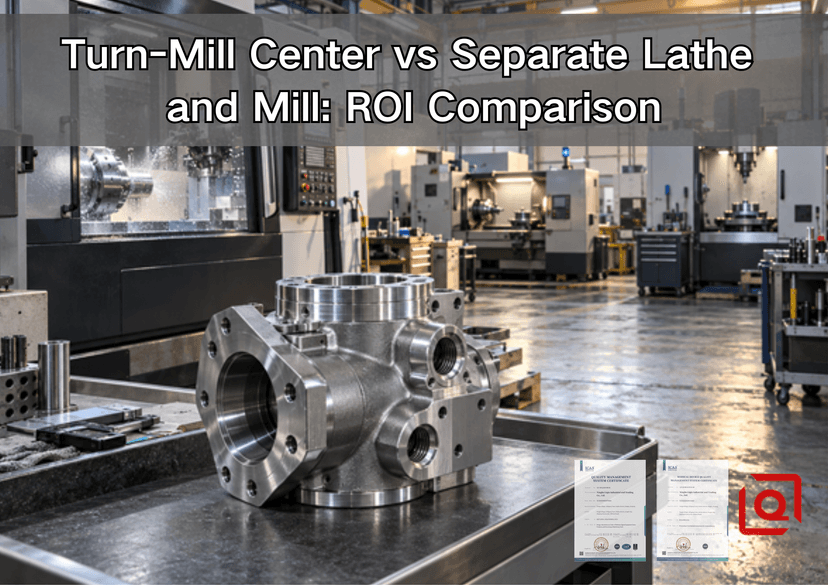
Are you still looking at a turn-mill quote beside two lower machine rates and wondering which number tells the truth? You are not alone. Purchase price shouts from the page. The half hour spent wiping chips from a bore, waiting for a cart, and finding the datum again barely whispers. For one shift, stay with the traveler instead of the spindle. Mark down every release, wash, wait, and fresh pickup.
One enclosure will suit some drawings; two machines will suit others. A round body covered with ports and flats may repay turn-mill capacity every day. Give that machine a plain stepped shaft and its live stations wait for work. A different imbalance appears on a body with acres of stock in one pocket: the machining center may save enough cutting time to pay for the handoff. In the end, count sound parts at the tray.
1. Follow the Part Through Each Route
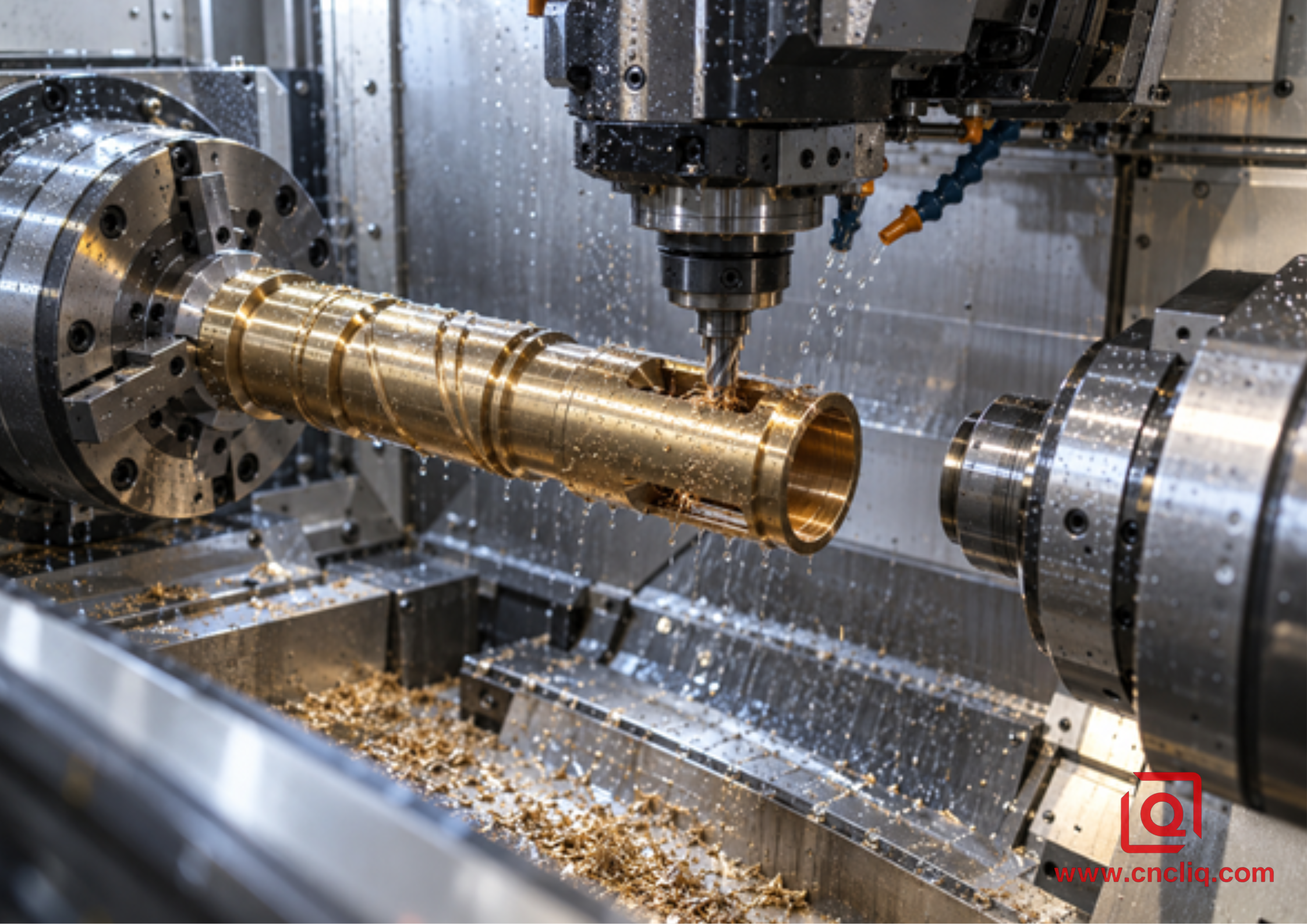
Watch the cycle through the window. The spindle stops at an angle, a live drill enters, and the chuck indexes again. Holes and flats that once queued at a mill are now beside the turning tools. Y travel gets a cutter off center. A fitted B head can tip it. The counter spindle, if the job needs one, takes the cut end for back work. Every option solves a real access problem, but it also creates another collision envelope and another line on the prove-out sheet.
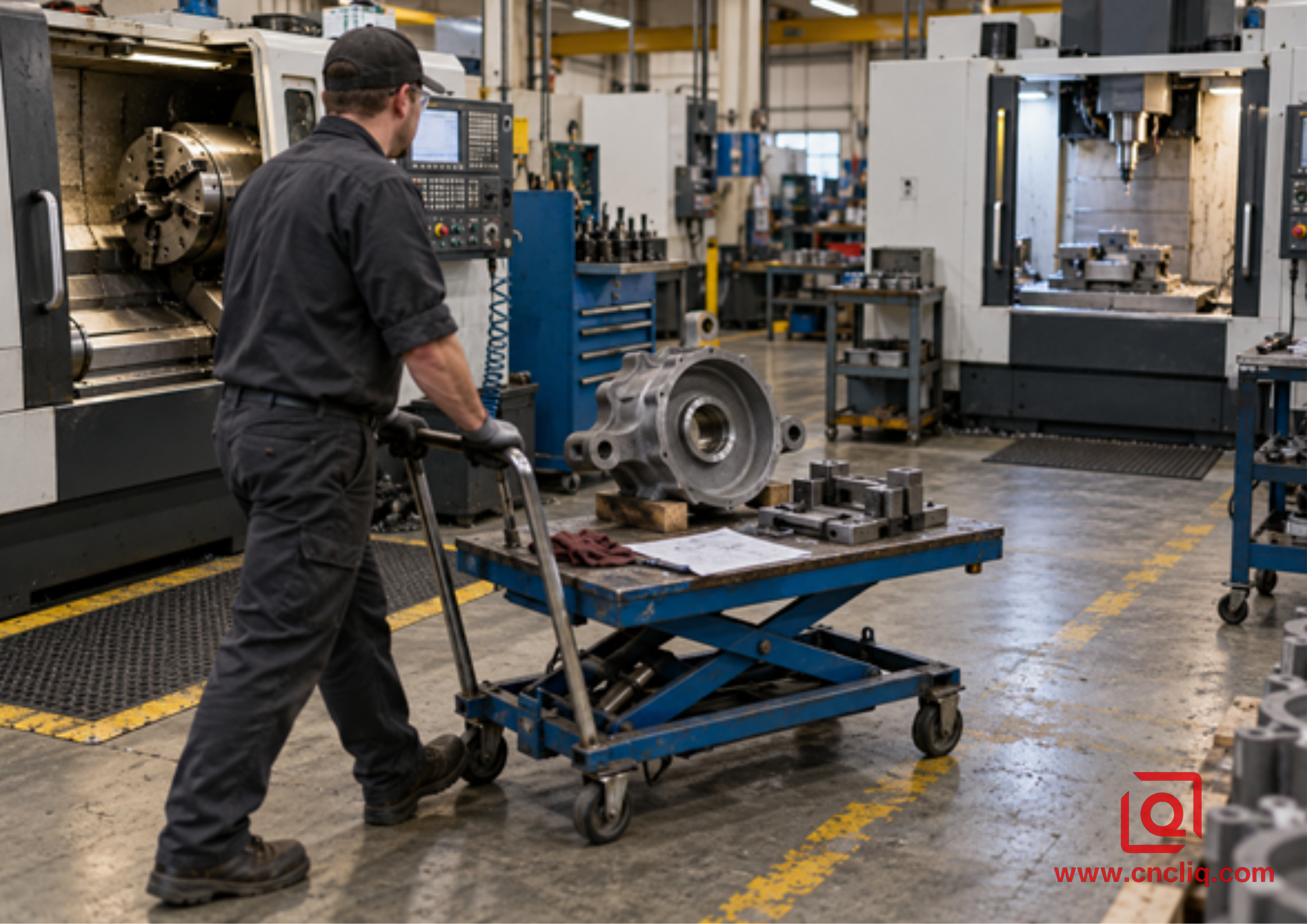
The other route needs little introduction in a job shop. When the final turning pass ends, a hand reaches through the open door, lifts the component out, and cleans it for the mill. There, new workholding must find the location before the cutters can reach the remaining faces. This sequence can be excellent. Wide pockets suit a stout machining center, and the programmer is spared a tangle of synchronized channels.
The awkward part lives between the two machines. Chips hide under a locator. A soft jaw wears. Somebody picks up the wrong face. A thin bore changes shape when a vise closes. Usually there is no spectacular failure. Instead, another gauge comes out, another traveler gets signed, and the batch moves a little later than planned. The total only looks dramatic after a few hundred pieces.
For a capability check, Liqin’s article on live tooling on CNC lathes separates useful driven-tool work from operations better left to a mill. If the print includes an offset slot or an eccentric hole, the guide to Y-axis CNC turning shows why C-axis indexing and true Y travel are not the same thing.
2. A Cheap Hour Can Produce an Expensive Part
Here is a common quoting mistake. The buyer sees a $70 lathe hour beside a $125 turn-mill hour and concludes that the lathe route must cost less. The milling hour has not yet appeared. Neither has the transfer fixture, the second setup, the cart trip, the repeated first article, or the part that comes back because the radial pattern is shifted from the bore.
Draw a boundary around the entire route. Start when released material is ready for production. Stop when an accepted component is ready for its next approved process. Then use one plain calculation:
Total cost per accepted part = total batch route cost ÷ accepted quantity
Notice the last word in the formula. A rejected piece may already contain bar stock, inserts, inspection labor, and even coating. Counting it as output makes the denominator look healthier while the scrap bin tells a different story.
Keep the timing boundary consistent as well. A CAM estimate ends wherever its author decided; the factory clock does not. Suppose the toolpath reads 14 minutes. Loading, probing, washing, and a stubborn chip tangle consume four more. A twin-channel chart has the opposite trap: overlapping bars cannot be added as if they happened one after another. Time the interval between good parts leaving the cell.
Shops do not need home-made definitions for these measures; ISO 22400-2 already supplies the vocabulary. Set matching clock events before comparing availability, performance, or quality. The CAM number remains evidence, but it cannot stand alone.
3. Separate Launch Spending From Batch Cost
List the jaws, posts, training, and installation once. List loading, inspection, scrap, tools, and maintenance wherever they recur. Only then combine the sheets. A shorter lead time is not cash by itself. Conversely, an operator minute is not “soft” when the freed operator is already needed at a loaded cell.
|
Cost or value driver |
Turn-mill center |
Separate lathe and mill |
Evidence worth collecting |
|
Installed investment |
More capital is concentrated in one platform |
Two machines may cost less, or may already be owned |
Current quotations, installation scope, finance rate, residual value |
|
Tools and fixtures |
Special holders, jaws, posts, and simulation are common |
A transfer fixture, extra soft jaws, pallets, and gauges are common |
Itemized launch list rather than one allowance |
|
Setup |
One coordinated setup may replace several releases |
Each machine needs locating, touch-off, and approval |
Measured setup sheets from comparable work |
|
Recurring time |
Operations may overlap, though tool changes and waits can be complex |
Dedicated cuts may be faster; handling remains between them |
A complete part-to-part study |
|
Labor |
One attended or automated cell |
More cleaning, carrying, loading, and re-fixturing |
Hands-on minutes per accepted part |
|
Quality loss |
One datum chain can remove pickup variation |
Every release adds a clamping and locating condition |
Scrap, rework, gauge, and capability records |
|
Work in process |
Parts can leave the enclosure complete |
Batches wait between work centers |
Average WIP and elapsed route time |
|
Space and services |
One large machine with substantial service needs |
Two footprints, staging, and an aisle |
A scaled layout and utility schedule |
|
Downtime exposure |
One fault may stop the whole route |
Work is distributed, but two assets need maintenance |
Uptime history and a recovery plan |
|
Skills |
Multichannel CAM and collision control need experience |
Programs are simpler; two processes must remain aligned |
Programming, prove-out, and training hours |
4. Let the Drawing Choose the Process
The phrase “complex part” is too vague to help. A better question is: which finished feature establishes location for the others, and what happens when the chuck opens?
|
Drawing condition |
Turn-mill is usually attractive when |
Separate machines are usually attractive when |
|
Radial pattern is positioned from a precision bore |
The bore can remain the live datum for the pattern |
A proven bore-locating mandrel already holds capability |
|
Flats, slots, or ports surround a round body |
Several sides can be reached without another loading |
Tolerances are open and indexing is quick |
|
Front and rear work share a tight relationship |
Sub-spindle transfer preserves the controlled chain |
A short second turning operation locates reliably |
|
A broad pocket dominates the minutes |
The milling head has enough torque, travel, and rigidity |
A machining center can remove the stock much faster |
|
The part is a straightforward shaft |
Off-axis details justify driven tools |
Almost every feature is turned |
|
Batches are small and repeat often |
Removed setups outweigh added program effort |
Standard fixtures make changeover quick |
|
Production runs unattended from bar |
Chip control and transfer are proven |
Two automated cells remain continuously loaded |
Only after the print review do we open the machine sheet. Will the bar pass? Follow each torque curve to the intended speed; the headline value may live somewhere else on the graph. Then sketch the stack: chuck, jaw, stock, holder, and cutter, plus the needed Y and B motion and the grip left for the counter spindle. Catalogue maxima seldom occur together on the same job.
B-axis equipment is particularly easy to oversell. It is valuable when an angled port, free-form surface, or access problem truly needs a changing tool angle. For a fixed radial hole, it may only add cost and prove-out work. Liqin’s B-axis multi-tasking guide goes deeper into that distinction.
5. A Reproducible Turn-Mill Center ROI Worksheet
Begin with the money that changes because of the decision:
Incremental investment = installed turn-mill project cost − avoided or recoverable cost of the split route
Next, estimate the yearly difference:
Annual net benefit = labor + fixtures + quality loss + released capacity + inventory carrying cost saved − added maintenance, software, training, and finance cost
Simple payback = incremental investment ÷ annual net benefit
Five-year simple ROI (%) = five-year net benefit × 100 ÷ incremental investment
The whiteboard version is crude on purpose. It does not care whether cash arrives now or next year. Before approval, the finance model can add the production ramp, tax position, working capital, likely resale value, and discounting. All of that rests on the shop study; weak cycle assumptions simply become weak cash flows in a nicer spreadsheet.
A Worked Example, Not a Price Promise
The following US-dollar values are planning inputs only. They are not Liqin prices and they are not presented as an industry average. Replace every line with written supplier quotations and your own production records.
|
Planning item |
Turn-mill project |
Split route or baseline |
Difference used in the model |
|
Equipment, tooling, installation, and launch |
$480,000 |
$370,000 |
$110,000 additional investment |
|
Annual direct labor |
$58,000 |
$100,000 |
$42,000 saved |
|
Annual handling, WIP, and fixture upkeep |
$18,000 |
$30,000 |
$12,000 saved |
|
Annual scrap, rework, and repeated inspection |
$22,000 |
$40,000 |
$18,000 saved |
|
Annual software, maintenance, and skill cost |
$25,000 |
$15,000 |
$10,000 added |
|
Annual net benefit |
|
|
$62,000 |
The expected case repays the extra capital in 1.77 years and reaches about 182% simple ROI at year five, before discounting. Loading remains the uncertain input.
|
Demand case |
Accepted parts per year |
Annual net benefit |
Simple payback |
|
Weak loading |
1,800 |
$25,000 |
4.40 years |
|
Expected mix |
3,600 |
$62,000 |
1.77 years |
|
Strong repeat loading |
6,000 |
$103,000 |
1.07 years |
I would spend less meeting time on the headline than on those three demand rows. With no suitable work, the machine is a costly cabinet full of idle toolholders. Pull actual travelers. Make families by diameter and length, then add alloy, feature pattern, yearly quantity, reorder rhythm, tool burden, and inspection. Does the answer collapse when one forecast program disappears? If so, write that beside the payback figure, not in a footnote.
6. Go to the Machine and Count the Minutes Nobody Quoted
Stand beside the route with a stopwatch and the traveler. Track one part that actually passes inspection. Cutter retracted? Keep timing. Now come the quiet minutes: bore cleanup, finish protection, a missing cart, the mill queue, a wiped nest, another load and datum pickup, the first-piece signature, then burr removal. Include the second walk when something needs correction. The tool may spend only nine minutes in cut while the traveler loses a day.
Repeat the exercise at the turn-mill, starting with bar advance or blank loading. The clock also sees chuck confirmation, tool changes, channel waits, probing, transfer, cutoff, part catching, washing, and that insert replaced every fortieth piece. With two channels, trace the dependent path that ends at part release. Adding both channel bars together invents minutes that never exist at the shipping tray.
Liqin’s turn-mill cycle time optimization guide shows how to sketch this path. After warm-up, collect five settled cycles. The middle result is more believable than the single lap when every event happened to align.
Do not let the quality column become a guess. ISO's page shows ISO 230-2:2014 was confirmed as current in 2025. Its subject is the test method for positioning accuracy and repeatability of NC axes. Useful machine evidence belongs in the capability file; the individual bore, port, and face still wait for part inspection. Unlike a bare axis test, a component feels chuck pressure, cutting load, heat, released stock stress, holder runout, edge wear, burr formation, and measurement uncertainty.
Now picture 2 a.m. The programmer has gone home and a chip nest appears; perhaps the edge dulls, a transfer misses, coolant drops, or the cycle is restarted. The prove-out needs a safe response for each event and a recovery path the operator understands. Without that work, the quoted cycle is a demonstration rather than the night shift.
7. Anonymous Composite Case: A 17-4PH Robotic Wrist Hub
Picture a compact robotic wrist hub in a 480-piece annual family. We have removed the buyer and drawing identity. The numbers are illustrative planning inputs built from ordinary RFQ conditions, not a report of one customer's production outcome.
The hub combined a bearing bore, an external pilot, two forked lugs, six radial threaded ports, a rear internal thread, and small datum pads. The bore was datum A. Port position and fork-face location both referred back to that axis. Nothing on the part was exotic by itself. The difficult bit was maintaining the relationship after the turned blank left the chuck.
The split route used an expanding mandrel for the mill. It was a sound engineering option, not a bad process. Yet the route carried a second fixture qualification, cleaning of the bore before loading, a fresh pickup, and another CMM alignment. The turn-mill proposal kept the bore, pilot, ports, and fork in one primary coordinate chain, then used a sub-spindle for the rear thread.
No one should release this route from a CAD screenshot. Before anyone quoted the hub, the route sheet was checked against the milling-head curve at the working speed. Next came the awkward items: cutter stickout between the lugs, somewhere for chips to leave the fork, safe jaw clearance, and enough length for the sub-spindle to grip. Fork roughing was still the slow, risky cut. Raise annual volume far enough and a machining center may take the work back on removal rate alone.
The planning sheet allowed 2.8 setup hours for the combined route at the expected batch. On the split sheet, the lathe, transfer fixture, mill, and two first-article releases reached 5.5 hours. Walking the traveler exposed another 6.5 minutes on every piece for handling and repeated checks—time absent from both NC programs. The turn-mill hour was dearer, but one fixture and the uncertain datum pickup went away. Rather than trust the spreadsheet, the buyer ordered a small validation lot before releasing the family.
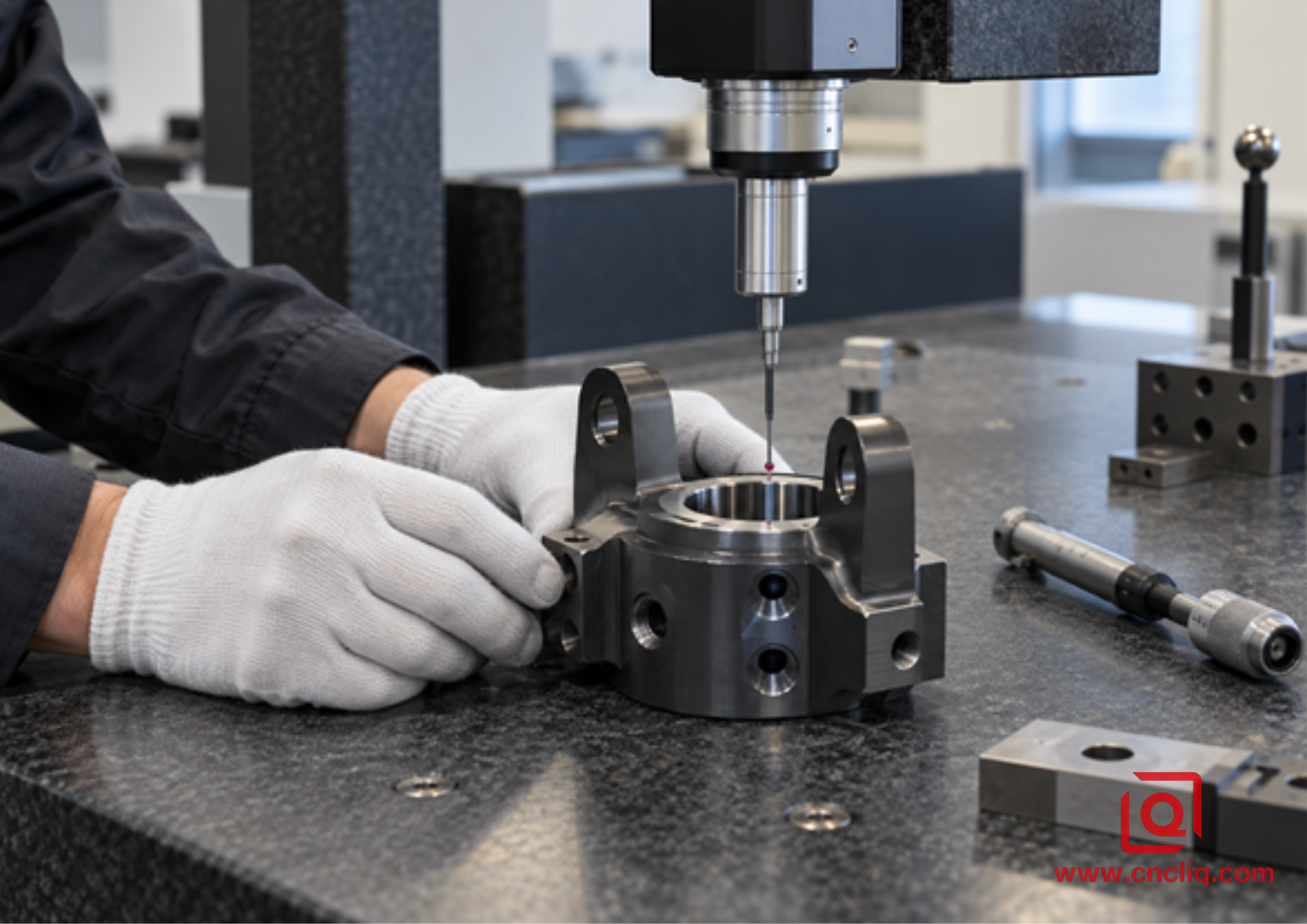
There is a useful, verifiable parallel in Liqin’s published precision motor flange and front end cap. The bearing bore, locating spigot, and end face make concentricity and perpendicularity central to function. Its page describes turning, milling, deburring, and CMM inspection. That is route evidence—not permission to bypass the approved print and control plan on a new component.
8. Cases Where Two Machines Deserve the Work
The split route has an easy win when almost everything is rotational and the only secondary feature is a forgiving hole. It also wins when the live-tool head cannot supply the torque or reach demanded by a deep, wide pocket. A third sound reason is capacity already paid for: an open lathe, an open mill, and a proven fixture that protects the print relationship.
Two assets give a scheduler more pieces to move. A qualified spare only helps when it is actually open, but in that case one failure need not freeze the route. Long and steady runs sometimes reward the unglamorous answer—an automated lathe feeding a quick mill, with each machine repeating its own short cycle.
A sensible factory sends work both ways. A round component with fussy cross-features goes toward turn-mill. The plain shaft stays at the lathe; a housing made mostly of pockets stays at the machining center. Geometry—not enthusiasm for the newest purchase—makes the assignment.
9. Give the Supplier an RFQ That Can Be Quoted Properly
Send the same controlled package to every bidder:
1. Controlled 2D revision, paired with STEP or another neutral 3D model.
2. Full alloy or material designation, condition, incoming form, and certificate expectation.
3. Prototype quantity, first lot, annual demand, repeat schedule, and expected program life.
4. Functional datums and the characteristics that would stop assembly if they drifted.
5. All texture, heat-treatment, coating, masking, burr, edge, cleanliness, and cosmetic notes shown in one place.
6. The records that must arrive with the order, from first article and CMM results to material and finish certificates.
7. Packaging, delivery target, destination, and traceability needs.
Ask for the proposed machine route, number of clampings, setup basis, complete part-to-part cycle boundary, unattended-running assumption, special tools, inspection scope, outside processes, and exclusions. If two quotes still look impossible to compare, Liqin’s guide to comparing CNC factory quotes helps separate unit price from tooling and inspection scope.
Some drawings genuinely sit between a live-tool lathe, a B-axis machine, and a two-machine route. For a route review, send Liqin the model and print, material, expected volumes, and the features that can stop assembly. Our engineers can trace the datums and show the routing assumption inside the quotation. The broader CNC machining services page provides context before you submit the RFQ.
FAQ
1. Does combining the operations guarantee a lower part price?
No. Put a value beside each setup, operator touch, fixture, repeated check, queue, and quality loss that goes away. Compare that sum with the added machine and skill expense. A plain shaft, pocket-heavy housing, or once-a-year order may still carry the lower invoice on dedicated equipment. The fair denominator is the accepted tray, not every blank that entered the chuck.
2. Should every turn-mill proposal use the same payback target?
Not responsibly. Paying cash changes the model; financing changes it another way. A signed five-year order is also very different from an encouraging sales forecast. Add differences in risk and resale value, and a universal target falls apart. Use the measured annual net benefit against added investment, then run the sheet again after reducing the loading. Perfect utilization flatters almost any proposal.
3. What sort of drawing usually gives a turn-mill its best chance?
Begin at the bore or journal and trace the features controlled from that axis. Every radial hole, flat, offset pocket, angled port, or back feature makes the second pickup work harder. If there is nothing off axis, the lathe already has the answer. If broad pockets dominate, look toward the machining center.
4. Which checks make two quotations comparable?
Read the two offers against the RFQ, one line at a time. Do material condition and quantity match? What about finish, inspection, records, packing, and delivery? Request a rough route drawing, then count setups and mark the clock boundary yourself. Ask separately about tools and outside processes. Add back an omitted deburring step, coating protection, or report; the apparent bargain may disappear.
5. Before production release, what should the team put on the table?
Review an approved first article, results tied to drawing datums, surface and burr condition, tool-life behavior, and cycle data from accepted parts over a representative thermal interval. For unattended work, include transfer, ejection, chip, coolant, alarm, and recovery evidence. Freeze the proven program, post, setup, tools, and inspection revision together.
Summary
A turn-mill earns its return on drawings that use its reach and datum control; complexity by itself earns nothing. Walk beside the traveler, cost the accepted tray, question the loading forecast, and keep the functional datum chain intact. Plain turning, heavy milling, an open conventional machine, or the need to schedule steps separately may still send the work down two aisles. Put the observations beside the quotation. The loudest hourly rate is then only one small number in the decision.
Contact Information
Company: Ningbo Liqin Industry Co., Ltd.Daily customer maintenance & after-sales support:service@shturl. zhuwanying@cncliq.com
New inquiry, quotation & order discussion:business@shturl. zhouli@chinaliqin.com
Hotline: +86 18757148656
Disclaimer
All technical articles, material specifications, machining recommendations, and surface treatment details published on this blog are for informational and reference purposes only. Please note that general blog insights do not replace signed technical agreements. Because custom parts vary by material heat numbers, machine calibrations, and specific tolerances, binding quality specs are governed solely by your approved CAD drawings, signed contracts, and formal quality plans.
All customer case studies featured on this blog have been thoroughly anonymized and sanitized. The performance metrics, manufacturing workflows, and imagery displayed serve solely to demonstrate our custom machining capabilities and do not represent a single universal standard for all orders.
Liqin Manufacturing Team
Built on 18 years of precision engineering experience, Ningbo Liqin Industry manufactures high-tolerance metal components for demanding global markets. We operate out of a 6,500 m² production hub equipped with over 150 machines, running 4-axis and 5-axis CNC machining, mill-turn machining, cold extrusion, and pressure die casting under one roof. This setup allows us to manage projects seamlessly, taking parts from initial CAD concepts directly to finalized shipments.
We handle quality control with zero compromise. We treat tight tolerances with the engineering discipline they require. Backed by ISO 9001, ISO 13485, and IATF 16949 certifications, our QA engineers run strict IPQC, FQC, and OQC checks on every single production batch. From CMM dimensional mapping and optical profiling to hardness and salt-spray testing, we validate your critical specs upfront—so you receive drop-in ready components with zero assembly headaches or costly line stoppages. On top of manufacturing, you can rely on us for two-hour response times on new RFQs, direct support for prototype sampling, and smooth export shipping across Europe, North America, Asia, and Oceania.
Welcome your inquiries and samples. Visit our website or contact us directly for a competitive quote!