 English




Are you still wondering whether to keep an aluminum part on a CNC mill or pay for a die? This is where a quotation can mislead even an experienced buyer. The billet option seems harmless during the pilot run. By part 4,000, though, nobody is charmed by that deep pocket. A casting bid can hide the reverse problem. Its unit figure is pleasantly small; the die, trials, machined details, coating, gauges, fallout, and upkeep sit elsewhere.
I would not choose either route from the headline price. I would first put two genuinely finished parts side by side on paper. Same drawing revision. Same coating. Same inspection and delivery point. My worksheet is fairly plain, but it catches several traps hidden by a neat unit-price column. Run it while a radius or datum is still cheap to change.
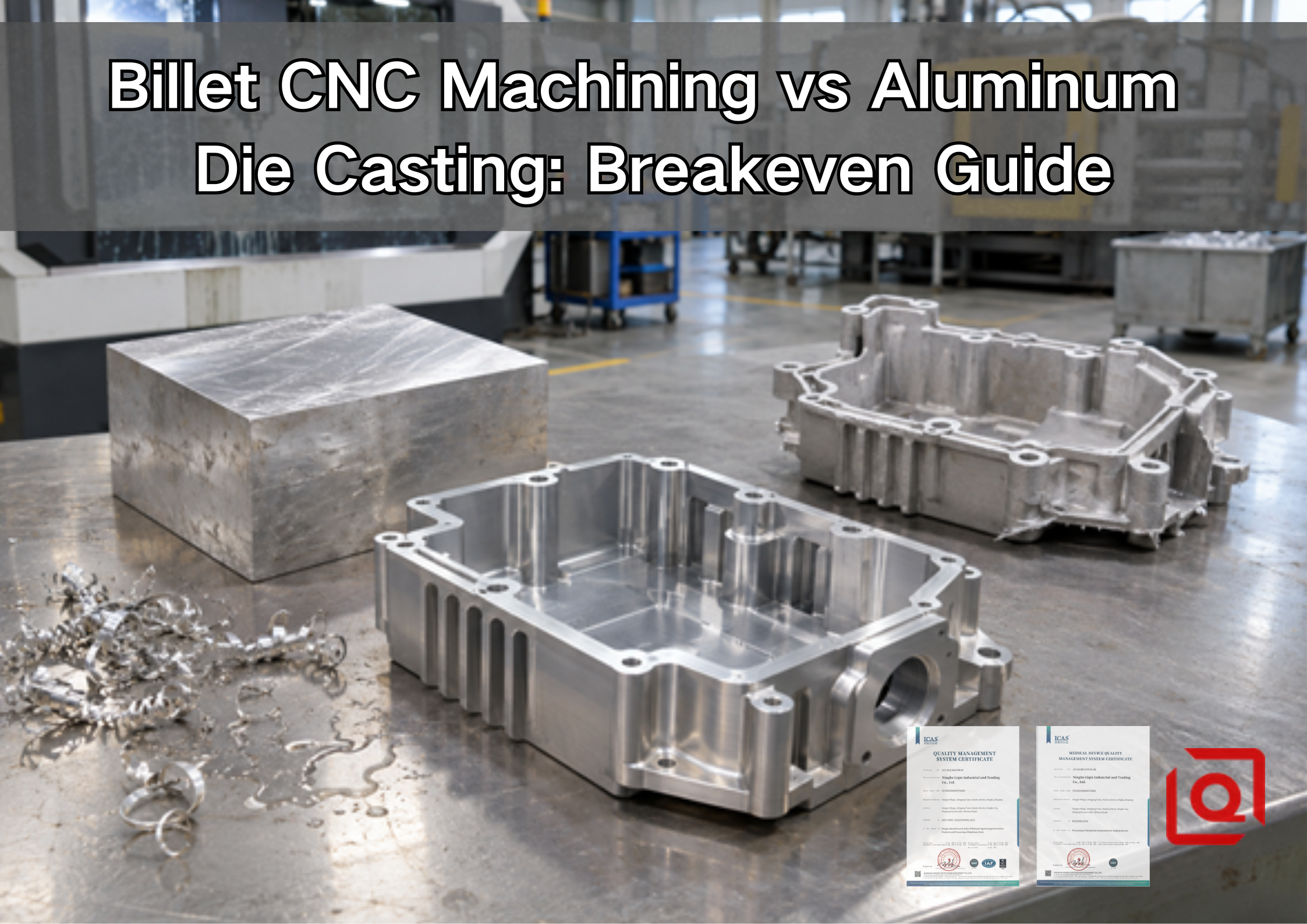
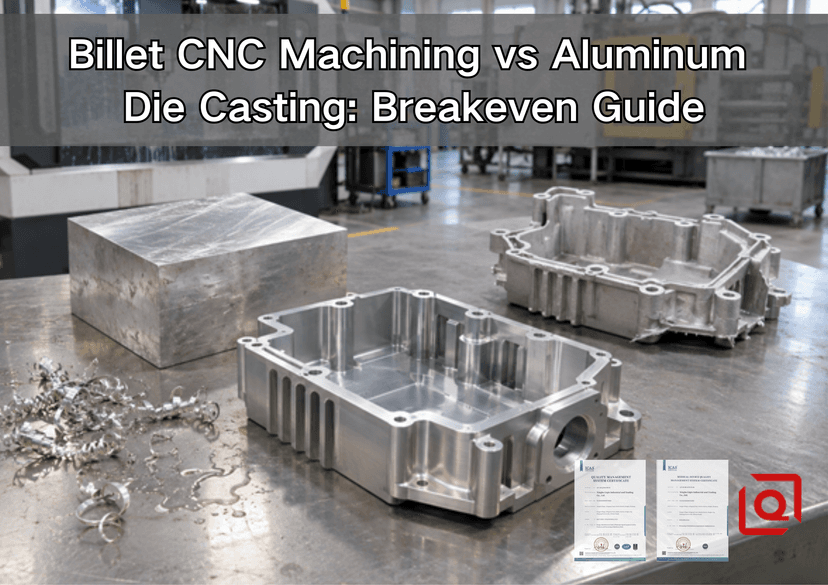
Billet, machined, and die-cast aluminum housings on a factory inspection table
A 30-Second Process Choice
For an early build, my default is the mill. It leaves room for a moving CAD model, a doubtful sales plan, or a firm wrought-grade requirement. HPDC earns a look later, especially when the frozen shape carries ribs, fins, bosses, and a thin shell. Then I divide the cash needed before launch by the saving on each good, shippable component. That number is the first useful threshold.
There is also a mixed process. The press handles the awkward envelope; a cutter visits the seal track, locating faces, bearing seat, and threads. This is a routine shop-floor answer, yet teams miss it when the debate is framed as “all CNC” versus “all cast.”
|
Program condition |
Billet CNC machining |
Aluminum die casting plus CNC |
|
Prototype or design validation |
Strong fit because programming and fixtures are easier to revise |
Usually premature because steel tooling locks the geometry |
|
Uncertain or seasonal demand |
Lower financial commitment |
Tool recovery may fail if the forecast falls |
|
Deep pockets and many precision features |
Direct control, but cycle time can be high |
Casting may save little if most surfaces still need cutting |
|
Thin walls, ribs, bosses, and cooling fins |
Possible, but stock removal and tool reach can dominate cost |
Strong fit when draft, wall flow, and ejection are designed correctly |
|
Wrought 6061 or 7075 requirement |
Natural fit |
Requires a new casting-alloy and property review |
|
Stable high-volume enclosure |
Repeated material and spindle cost |
Tooling can be amortized across many accepted parts |
|
Frequent engineering changes |
A program or jaw revision may be enough |
A small insert change may work; a large change means cutting steel again |
If a vendor names the crossover before opening your STEP file, press pause. “Casting wins at 1,000” sounds decisive, but it says nothing about slides, cavities, tool life, machining time, coating, yield, or whether the forecast is believable. Liqin’s die casting vs CNC machining cost and volume guide covers the wider lifecycle picture. Here, we will use the same idea in a working RFQ calculation.
1. Compare Finished Accepted Parts, Not Incomplete Quotes
I start with the point where the supplier’s responsibility ends. That sounds elementary, yet it is the most common flaw in these comparisons. The machining quote may be for a coated component, bagged and ready for receiving inspection. The casting quote may end at a rough, trimmed blank on a pallet. Comparing them is like pricing a painted car body against bare sheet metal.
My CNC column begins with stock form and the actual purchased envelope. Then come the CAM hours, jaws, setups, spindle time, cutters, bench work, wash, finish, inspection, fallout, packing, and freight basis. Batch pattern matters too. Ten releases of 100 pieces do not carry setup cost in the same way as one release of 1,000, even though the annual total is identical.
The casting column runs well past the press. Up-front entries are die blocks, slides, changeable inserts, trim steel, samples, reports, gauges, and launch approval. Recurring entries are trim, blast, specified impregnation, finish cuts, wash, coating, testing, fallout, packing, and transport. Who pays when an ordinary wear insert is replaced? Where is the die stored during a quiet year? A blank box in the quote is not a free service.
|
Cost area |
Billet quote note |
Casting quote note |
|
NRE |
CAM, fixture, FAI; once or again per release? |
Trial loops, corrections, gauges, approval run; included or extra? |
|
Metal basis |
Purchased stock envelope; chip ratio and credit |
Shot weight versus trimmed mass; return-metal ownership |
|
Equipment time |
Setup count; spindle minutes; attendance |
Cavity count; press cycle; secondary-CNC minutes |
|
Conformance |
Sampling rate; expected fallout; report format |
Named defect zones; test method; sampling rate |
|
Finish |
Pretreatment, masking, coating, final appearance check |
Blast, pretreatment, coat, cosmetic window |
|
Delivery point |
Packed component at named Incoterm |
Outside processing and freight to the identical point |
Watch the denominator. A run might take 1,080 shots to place 1,000 good castings in shipping cartons. The commercial model belongs to those 1,000 usable parts. Dividing the die by shots while buying accepted pieces produces a small, flattering error that grows with the program.
2. Work the Cost Equation, Then Try to Break It
Now for the arithmetic. First I align the currency, drawing revision, program horizon, finish, inspection plan, package, and Incoterm. Leave one out and the screen will still show decimals. They just will not compare like with like.
QBE = (HPDC fixed cost − CNC fixed cost) ÷ (CNC accepted-unit cost − HPDC accepted-unit cost)
Here is a fictional motor-control housing to make the worksheet concrete. Do not reuse its numbers in a sourcing decision. They are teaching values, not a Liqin quote or a market index.
Programming, soft jaws, and the first article put USD 1,400 in the billet fixed-cost cell. The recurring figure beside it is USD 42.00 for a finished piece. Across the page, the proposed die, trim tool, trials, gauges, and qualification total USD 38,000. The caster’s USD 17.50 unit figure already contains trim, the remaining CNC work, coating, testing, the agreed fallout allowance, and packing.
Worked result: 36,600 ÷ 24.50 = 1,493.88 pieces.
The purchasing threshold is therefore 1,494, not 1,493.88. The billet line is lower before the crossing, and the HPDC line is lower after it. That result belongs to this set of inputs only. Excel cannot make customers order, keep an insert alive, or stop process yield from wandering.
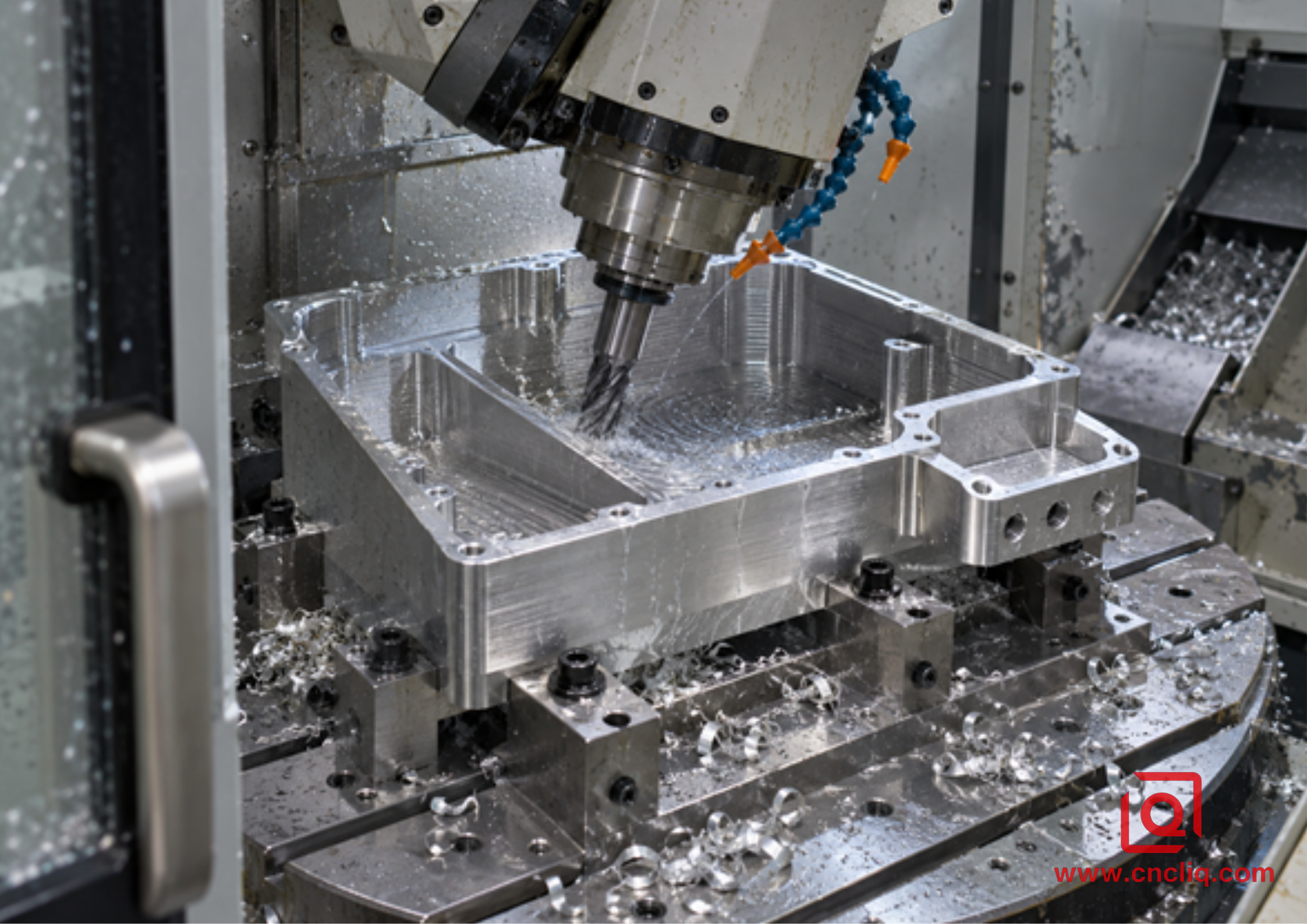
A 5-axis machining center cutting a deep pocket in a solid aluminum billet
Why one breakeven number is not enough
I run the equation three times. First comes the awkward downside number that sales would rather not discuss. Next is the approved base forecast. Last comes the upside case, where the question changes from payback to capacity, die life, maintenance windows, and backup production. If the proposal works only in the optimistic column, it is not a robust tooling decision.
At 700 accepted parts, the CNC model totals USD 30,800 against USD 50,250 for HPDC. At 1,500, the totals almost touch: USD 64,400 for CNC and USD 64,250 for casting. At 4,000, the numbers separate to USD 169,400 and USD 108,000. That middle result matters most. A USD 150 lead is accounting dust on a production launch. One extra sample loop or a modest insert correction swallows it. I want breathing room beyond the crossing before I recommend steel.
If your program is hovering near that zone, the article on when to switch CNC-machined aluminum to die casting shows a staged path. It is much safer than treating next year’s sales forecast as money already in the bank.
3. Volume Does Not Rescue a Part That Is Wrong for the Process
Volume gets most of the attention because it fits neatly in a cell. Geometry is less cooperative. It can veto the entire proposal. In European Aluminium’s cost-design manual, function, shape, and expected quantity are treated together. The factory lesson is plain: large programs can carry heavy tooling; small ones usually cannot.
A large forecast is not a casting wand. Picture a compact block full of cross passages, deep accurate bores, and features on five faces. Add a firm wrought-alloy property requirement. A foundry might produce the outside shape, but the “near-net” blank could return to a machining center for most of the expensive work. Now the program owns a die and a long CNC cycle.
The opposite geometry makes a much better case. A thin envelope, curved walls, repeated ribs, cable clips, bosses, or several small brackets that can become one body all give the die useful work to do. The North American Die Casting Association’s 2024 Product Specification Standards span tooling, alloys, tolerances, GD&T, design, quality, and commercial practice. That broad scope is telling. Moving from billet to HPDC is not a purchasing substitution. It is a fresh design and qualification project.
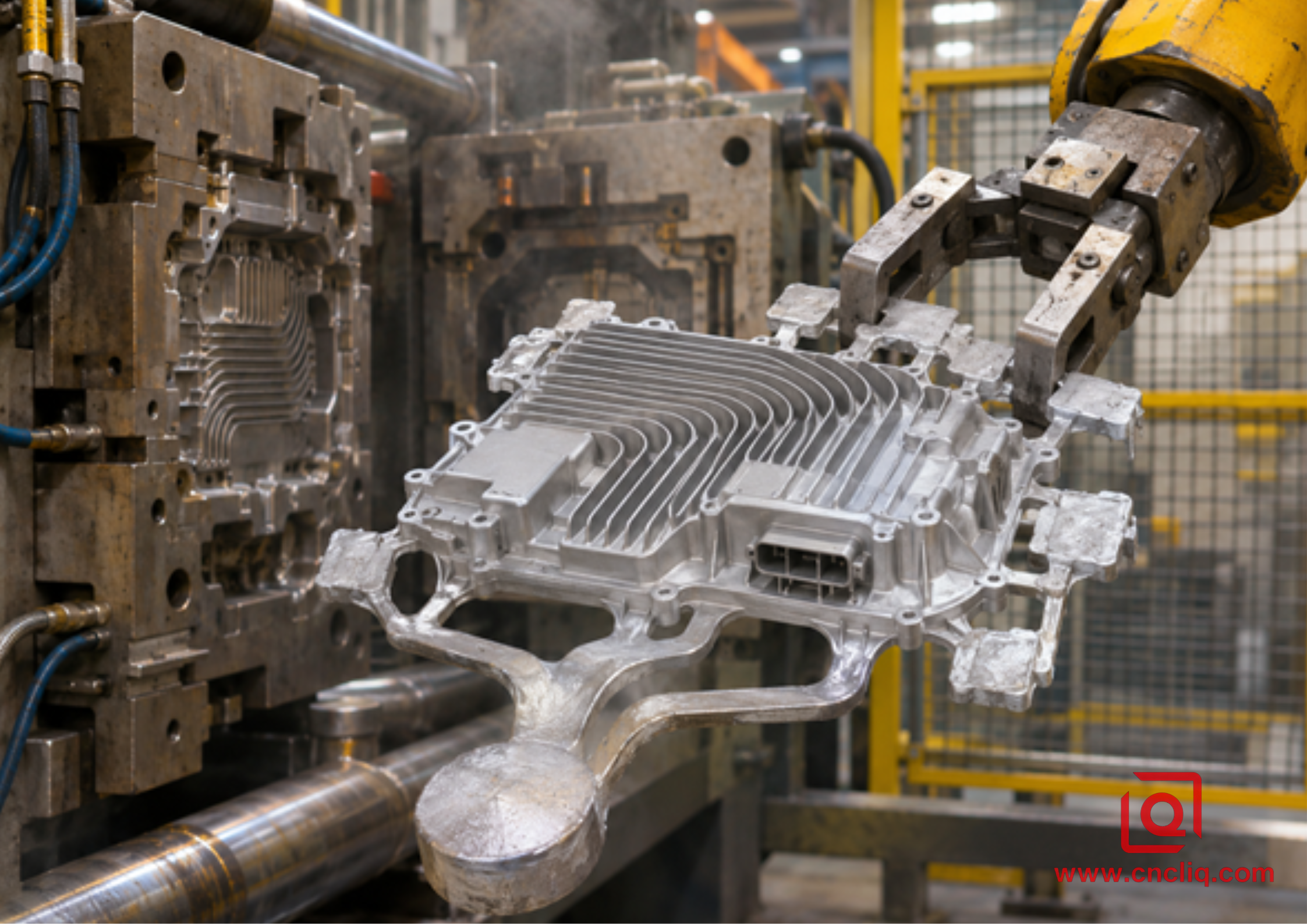
A robot holds a freshly ejected aluminum die casting with runners and overflows attached
4. Reset the Design Before Asking for a Die-Cast Price
Sending a billet-machined model to a foundry and requesting “the same part in casting” usually produces an expensive and fragile proposal. CNC and HPDC want different geometry.
For billet machining, large internal radii, reachable features, fewer setups, rational pocket depth, and tiered tolerances reduce spindle time. Blanket precision is costly. A nonfunctional cover surface rarely needs the same profile control as a bearing seat. Liqin’s seven DFM principles for reducing aluminum CNC milling cost give a practical way to clean the CNC baseline before comparing it with casting. This matters because a badly designed CNC part can make HPDC look better than it really is.
On the casting sketch, I begin at the parting line and follow the metal path. Where is draft needed? Which ribs feed cleanly? Where can gas escape, and where will the overflows, ejectors, and gates leave evidence? A thick pad beside a thin wall is not a harmless shape change; the two zones cool on different schedules. Deep side features are another warning because a slide brings steel, wear, and maintenance with it. Moving one port closer to the parting line can save more than weeks of bargaining over cents.
Before tool release, I color the model by operation. Grey stays as-cast. Blue gets cut. Other colors mark trim, coating, masking, and inspection. I also mark where the raw casting will locate and where the later CNC fixture will locate. Cleanup stock belongs on the seal face or bore that needs it, not as a thick blanket over the whole body. Excess stock costs minutes and may cut through the denser surface into less predictable material below.
5. Reopen Three Notes Before the Route Changes
Take a familiar prototype print with 6061-T6 in its material box. When the route changes, I circle that note for review. The billet began as wrought stock; metal entering a pressure die faces a different processing job. The Aluminum Association’s nomenclature gives the shorthand: 6xxx, wrought, magnesium-silicon, heat-treatable. It explains the prototype choice but does not nominate an HPDC alloy. Beside the material note I jot heat, load, environment, and life. The production choice must answer all four.
Two coupons go under one lamp: anodized 6061 and the proposed casting. Their appearance may disagree even after a similar bath. We sign off a boundary sample and record color range, texture, pretreatment, masks, and cosmetic zones before the tool order. If the production print changes to powder coat, e-coat, or conversion coating, that is an engineering decision—not a failure to copy the anodized prototype.
Each inspection tool gets one job. I put the housing on a CMM to check the bore, face, datum, and position. Subsurface porosity is outside that machine’s view. A sealed box therefore goes to pressure decay, where the agreed pressure and hold time answer the leak question directly. Add radiography only where the risk and the named zone support it. ASTM E505-22 is the reference-radiograph standard for discontinuities in aluminum and magnesium die castings. One standard number cannot finish the acceptance plan. The drawing still needs the zone and technique; the quality plan needs sampling, severity, and disposition.
Work backward from failure. For a control box, a sensible dimensional plan plus leak testing may be enough. A loaded structural node is a different job; process records, cut sections, mechanical coupons, or focused nondestructive checks may deserve a place. Ordering every available test for every component does not automatically reduce risk. It certainly increases the quality bill.
6. Give Each Process the Surfaces It Handles Well
My operation map makes the mixed route visible. Grey spreads across the shell and its ribs, bosses, fins, and outside curves; that territory belongs to the die. Small blue islands remain for cutting. They are the bearing seat, gasket track, dowel holes, ports, threads, and mounting datums. The result is less aluminum in the chip bin without surrendering control of the assembly interfaces.
Now think about the fixture. Draft, flash, ejector witness, and parting-line movement make a casting sit differently from a square billet. I look for a stable 3-2-1 location scheme and contacts that will still exist on the next shot. Those pads should be agreed with the toolmaker. If the machining team sees the plan only when T1 arrives, the preferred datum may already be under flash or on a moving insert.
Liqin’s Precision Aluminum Light Housing shows the split in a real product type. HPDC creates the cavity, cooling form, and bosses. CNC follows on the sealing faces and threaded details. The page illustrates a route, not a tolerance shortcut: another enclosure still needs its own drawing, tests, and process plan.
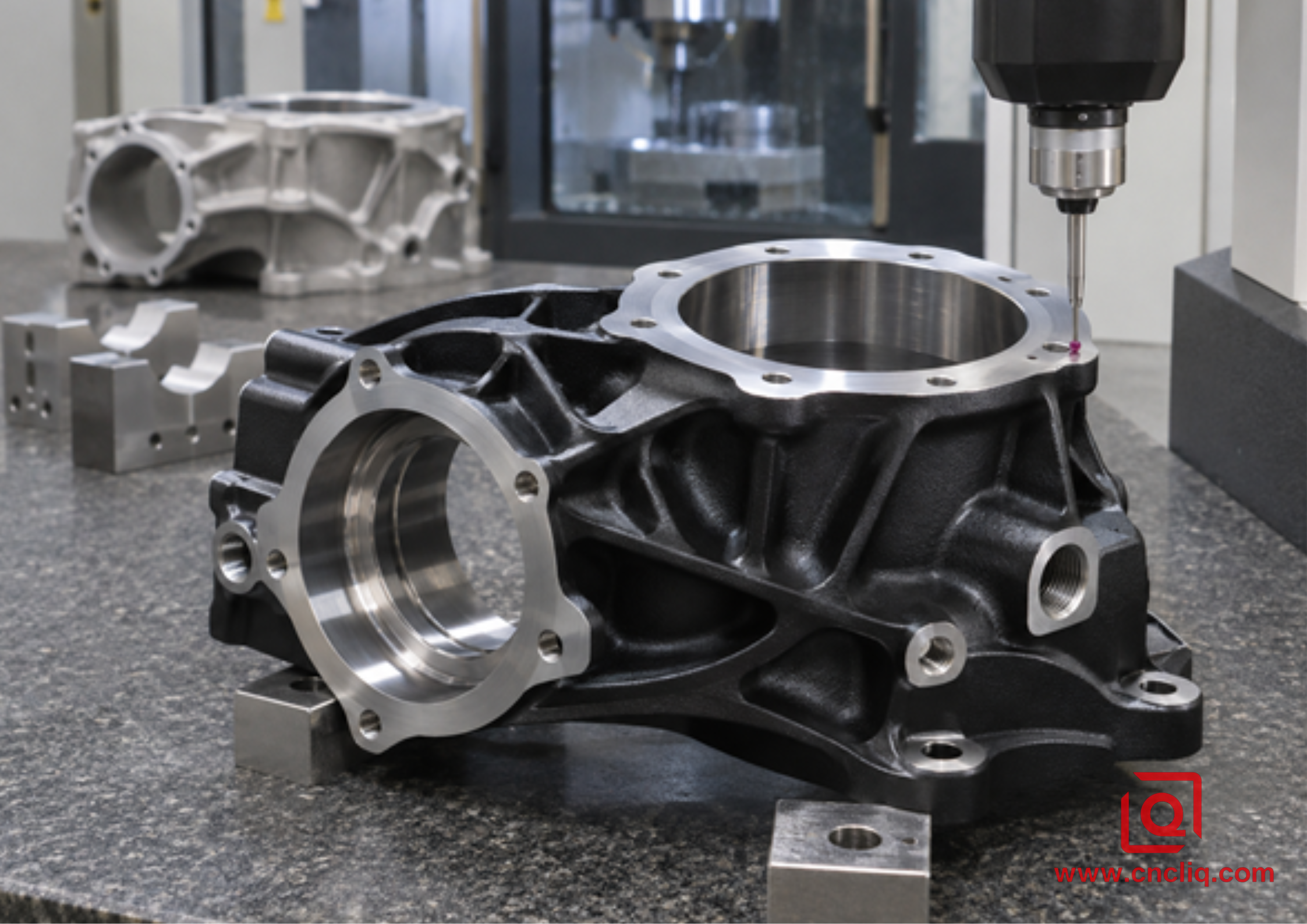
A CMM checks a machined bore and sealing face on a coated die-cast aluminum housing
7. Servo-Housing Case: Prototype First, Tool Second
This case omits the customer identity and prices, and its commercial figures are normalized. Use it to follow the decision sequence, not to forecast a different drawing. The component housed an industrial servo drive. A power board sat inside, surrounded by cooling ribs, a gasketed lid, two connector openings, and a bearing register. We started in 6061 billet because the board and both connectors were still moving.
At the prototype stage, billet was the correct choice. The team could change ports through CAM and soft-jaw revisions without cutting production steel. It also gave direct control of the gasket face and bearing register. The weakness appeared in the forecasted production model: deep cavity roughing, multiple side operations, and a large buy-to-fly ratio remained in every part.
The first casting proposal was rejected even though its piece price looked low. It copied the billet geometry, used two costly slides, carried thick local sections around the bearing area, and still required extensive machining. The project team then separated functional and nonfunctional geometry.
1. The die took over the outer heat sink, cable bosses, screw towers, and main cavity.
2. The mill kept the bearing register, gasket face, connector pads, and critical threads.
3. One connector moved toward the split. That small edit removed a slide.
4. The product team froze the mechanical envelope before tool approval, while a removable connector insert preserved one limited future option.
5. The quotation was rebuilt around accepted, coated, leak-tested parts rather than trimmed castings.
With the revised supplier figures, the crossover finally sat inside a lifetime volume the customer was prepared to defend. Billet remained in use for validation and later service spares. The HPDC tool was released only when the interface drawing, demand case, coating standard, leak method, and ownership terms were signed. We guarded the launch date first. Repeat cost came after that gate.
8. Price the Same Part, Not Two Sets of Assumptions
An incomplete package does not produce a cheap quote. It produces assumptions, and each supplier makes different ones.
1. Send the native 3D model together with a controlled drawing. On that drawing: revision, datums, CTQs, tolerances, roughness, and inspection notes.
2. State prototype quantity, first production release, annual demand, credible lifetime demand, and the expected release pattern. Separate committed volume from an upside forecast.
3. Define the performance and the applicable material specification. “Match 6061” is not a casting instruction.
4. State the finish and its acceptance window: color, masking, cosmetic zones, corrosion test, plus whether dimensions apply before or after coating.
5. Name each functional test and its pass condition. That may cover leak, pressure, heat, load, cleanliness, or assembly.
6. Request two prices that stop at the same finished, accepted, packed component. Show NRE and per-part spend apart.
7. Record the tool owner and storage location. Cover maintenance, wear inserts, design changes, assumed life, and a long production pause.
8. Before release, ask the DFM review to show the split, gates, slides, ejectors, cleanup stock, machining datums, coating allowance, and inspection concept.
Send Liqin the STEP file, controlled print, release quantities, lifetime demand, material or performance need, finish, and CTQ notes. We will line up three routes—billet, HPDC, and the combined process—at one finished-part endpoint. Request Liqin’s review and quotation while the model can still move. A port shift in CAD is a small edit. The same change in tool steel or a hard fixture is not.
FAQ
1. What calculation should I run on my drawing?
No fixed part count travels from one drawing to the next. Subtract the CNC launch cost from the casting launch cost, then divide by the saving on one finished accepted piece. A simple tool facing a very long milling cycle can pay back early. Slides, a long finish cut, strict tests, or shaky yield move it the other way. I would run the calculation at a downside, base, and upside lifetime demand before approving steel.
2. Can the casting keep the prototype’s 6061-T6 note?
Not by copying the callout. The prototype began as wrought stock. I split the review in two: die filling first, service duty second. The service sheet covers strength, fatigue, heat, corrosion, sealing, coating, and regulation. Alloy choice and validation follow. The released print should record production reality, not preserve the first prototype out of habit.
3. Which volume should carry the tool cost?
Use credible accepted volume over the program life for the strategic calculation, then lay the cash out by year. Timing can spoil an attractive five-year total if year one is weak or the design changes early. Show the die as a separate cash item. Add maintenance and possible replacement. For the downside case, enter only the demand that a commercial owner is prepared to sign off.
4. If HPDC is near-net, why put the part back on a mill?
“Near-net” does not mean ready for assembly on every surface. Give the die the large, awkward shapes. Then send only the bearing seat, seal face, dowel, thread, gasket track, and key datum past the cutter. On a good hybrid print, the machining symbols look like a few islands. They do not cover the casting like a second skin.
5. What must travel with the RFQ?
Attach the controlled model and print. Add CTQs, material or performance needs, finish, test limits, quantities, forecast, release pattern, and delivery term. Name the endpoint as a finished, accepted, packed part, and keep NRE outside the repeat price. A vague package can make the smallest number look clever simply because several operations are absent.
Summary
If demand is uncertain, the design still moves, or a wrought grade is essential, keep making chips. Reopen the HPDC discussion after the geometry settles and the saving on each shippable part can pay back the launch. Quote the same endpoint on both sides. Challenge the forecast. Challenge yield too. And when the part is mostly a cast shape with a handful of precise interfaces, give it a short CNC finish instead of forcing one process to do both jobs badly.
Contact Information
Company: Ningbo Liqin Industry Co., Ltd.Daily customer maintenance & after-sales support:service@shturl. zhuwanying@cncliq.com
New inquiry, quotation & order discussion:business@shturl. zhouli@chinaliqin.com
Hotline: +86 18757148656
Disclaimer
All technical articles, material specifications, machining recommendations, and surface treatment details published on this blog are for informational and reference purposes only. Please note that general blog insights do not replace signed technical agreements. Because custom parts vary by material heat numbers, machine calibrations, and specific tolerances, binding quality specs are governed solely by your approved CAD drawings, signed contracts, and formal quality plans.
All customer case studies featured on this blog have been thoroughly anonymized and sanitized. The performance metrics, manufacturing workflows, and imagery displayed serve solely to demonstrate our custom machining capabilities and do not represent a single universal standard for all orders.
Liqin Manufacturing Team
Built on 18 years of precision engineering experience, Ningbo Liqin Industry manufactures high-tolerance metal components for demanding global markets. We operate out of a 6,500 m² production hub equipped with over 150 machines, running 4-axis and 5-axis CNC machining, mill-turn machining, cold extrusion, and pressure die casting under one roof. This setup allows us to manage projects seamlessly, taking parts from initial CAD concepts directly to finalized shipments.
We handle quality control with zero compromise. We treat tight tolerances with the engineering discipline they require. Backed by ISO 9001, ISO 13485, and IATF 16949 certifications, our QA engineers run strict IPQC, FQC, and OQC checks on every single production batch. From CMM dimensional mapping and optical profiling to hardness and salt-spray testing, we validate your critical specs upfront—so you receive drop-in ready components with zero assembly headaches or costly line stoppages. On top of manufacturing, you can rely on us for two-hour response times on new RFQs, direct support for prototype sampling, and smooth export shipping across Europe, North America, Asia, and Oceania.
Welcome your inquiries and samples. Visit our website or contact us directly for a competitive quote!