English




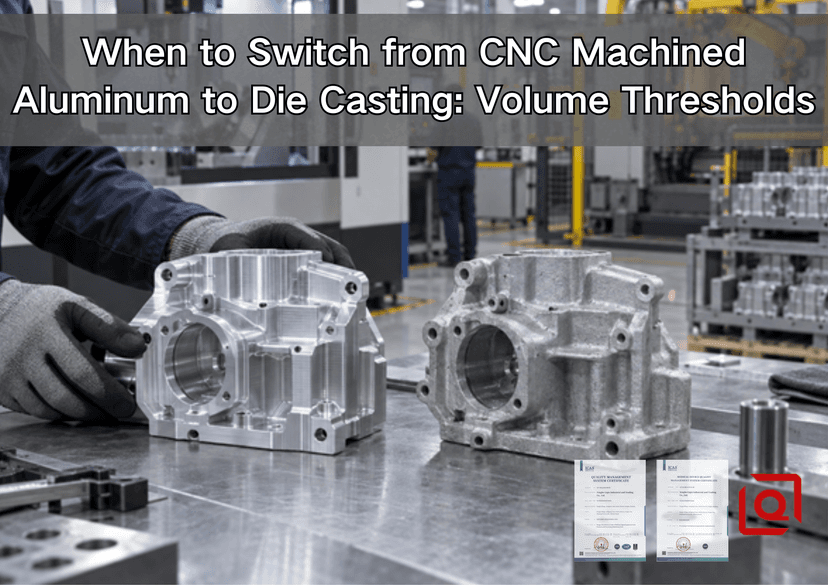
Are you still debating whether the next aluminum housing should stay on a CNC machining center or move into a die-casting tool? The wrong timing can hurt in either direction. Switch too early and a design revision can turn an expensive steel die into scrap. Switch too late and every purchase order keeps paying for billet, chips, spindle hours, cutters, setups, and inspection that a near-net casting could have avoided. This guide shows engineers and sourcing teams how to locate a realistic volume threshold, test it against shop-floor risks, and build a safer path from machined prototypes to die-cast production.
The short answer is simple: there is no universal “switch at 1,000 parts” rule. For many aluminum housings, 500–5,000 accepted parts is the zone in which a serious CNC-versus-die-casting study becomes worthwhile. The actual crossover can sit below or far above that band. Tool complexity, CNC cycle time, alloy requirements, design maturity, casting yield, secondary machining, surface finish, and forecast confidence move the answer.
Start with a threshold range, not a magic number
Volume is a trigger for analysis, not a verdict. A compact, easy-to-machine plate may remain economical on CNC equipment at quantities that would justify casting a deep, ribbed enclosure. Conversely, a large housing that begins as an expensive billet and loses most of its mass as chips may justify high-pressure die casting (HPDC) surprisingly early—provided the geometry and specification are truly castable.
Use the following bands as a first screening tool, then replace them with supplier-specific quotations.
|
Expected accepted volume |
Practical starting position |
What should happen next |
|
1–100 parts |
CNC machining normally leads |
Validate fit, function, loading, sealing, thermal behavior, and the drawing. Avoid freezing production tooling. |
|
100–500 parts |
CNC usually remains lower risk |
Improve workholding, stock choice, toolpaths, and inspection. Begin recording actual cycle time and scrap. |
|
500–2,000 parts |
Formal crossover study |
Quote CNC, HPDC, and cast-plus-CNC routes at the same finished condition. Review design stability and casting DFM. |
|
2,000–10,000 parts |
HPDC becomes increasingly credible |
Run tooling-payback and cash-flow scenarios. Confirm alloy, porosity controls, post-machining, finish, and tool ownership. |
|
More than 10,000 parts |
HPDC or a hybrid route often deserves priority |
Validate capacity, die life assumptions, preventive maintenance, quality evidence, and backup planning. CNC may still win for special requirements. |
These are decision bands, not quoted production limits. Liqin’s existing complete CNC machining versus die casting cost and volume guide explains the broad lifecycle-cost comparison. This article goes one level deeper: it focuses on when a program is ready to cross the threshold and how to avoid a false break-even.
Why CNC cost and die-casting cost behave differently
CNC machining has a relatively light fixed-cost burden. A supplier prepares the CAM program, cutters, soft jaws or fixtures, setup sheets, and inspection plan. After that, each accepted part continues to consume aluminum stock, spindle time, tool life, coolant, handling, deburring, and measurement capacity. Batch size can improve setup allocation and purchasing efficiency, but it does not make the cutting time disappear.
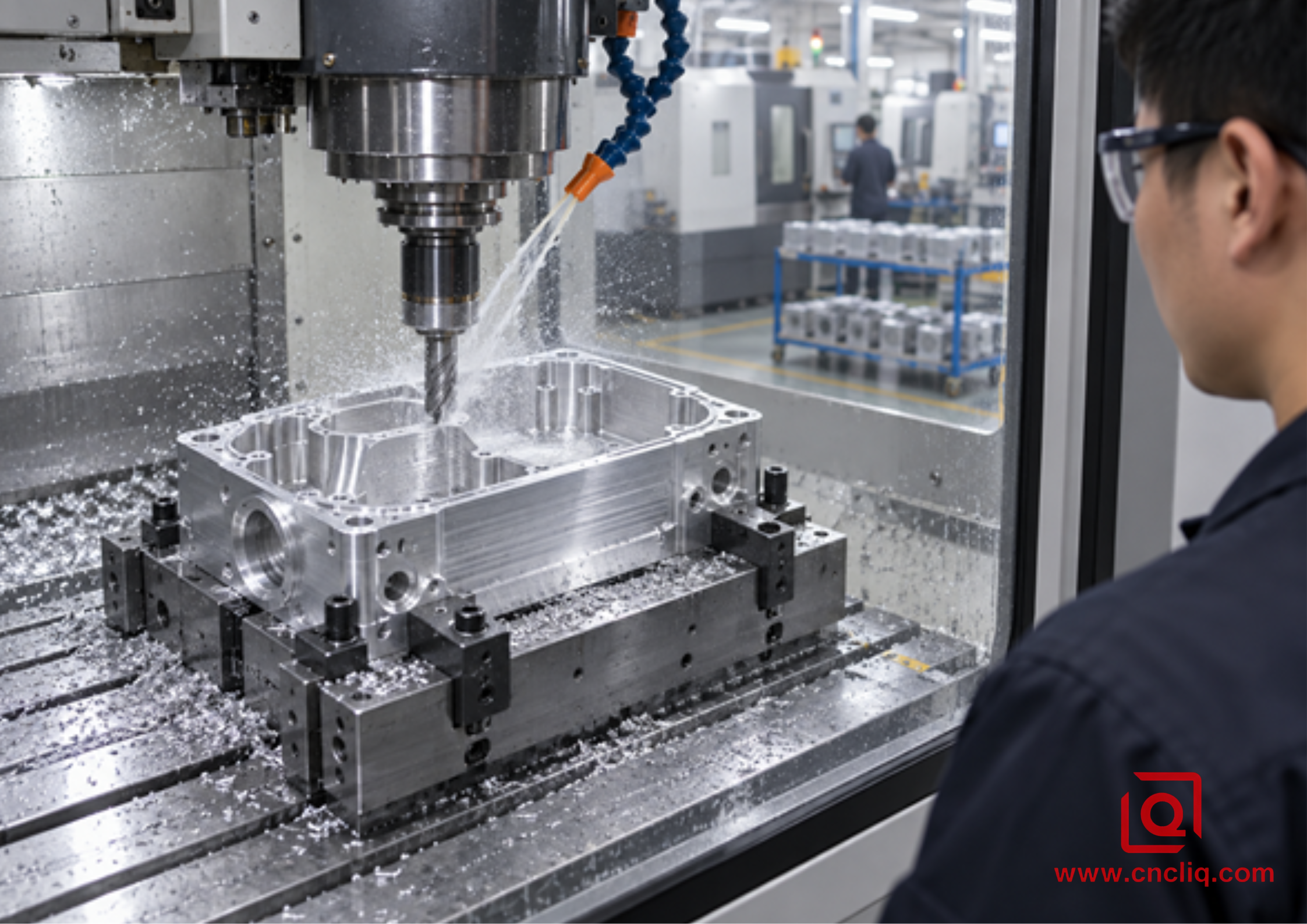
CNC machining removes material from billet in every production cycle, preserving design flexibility but continuing to consume spindle time.
HPDC reverses the pattern. Tool design, simulation, die steel, cavity and slide machining, heat treatment, trim tooling, tryout, sampling, correction, and qualification create a much larger initial commitment. Once the cell is stable, however, the die forms walls, ribs, bosses, and exterior contours repeatedly. The raw casting may be inexpensive per shot, but the shipped part can still require trimming, shot blasting, impregnation, leak testing, coating, and precision CNC machining.
This distinction matters because buyers often compare a complete CNC part with an unfinished casting. That comparison is invalid. Both quotations must end at the same acceptance point: finished alloy condition, secondary machining completed, coating applied, critical features inspected, scrap and yield accounted for, packed, and ready for assembly.
Calculate break-even with accepted-part economics
Use two lifecycle-cost equations over the same production horizon:
CNC total cost = CNC NRE + (CNC landed cost per accepted part × accepted quantity)
HPDC total cost = die, launch, and qualification cost + tool-maintenance reserve + (finished HPDC landed cost per accepted part × accepted quantity)
If the CNC variable cost is higher, the first-pass crossover is:
Break-even quantity = (HPDC fixed cost + maintenance reserve − CNC fixed cost) ÷ (CNC unit cost − finished HPDC unit cost)
Consider a hypothetical industrial controller housing. This is a teaching example, not a Liqin quotation or a market benchmark.
|
Cost input |
CNC route |
HPDC + secondary CNC route |
|
Programming, fixtures, or launch NRE |
$900 |
Included below |
|
Die, trim tool, sampling, and qualification |
$0 |
$42,000 |
|
Planned maintenance reserve for the evaluated program |
$0 |
$4,500 |
|
Finished landed cost per accepted part |
$58.00 |
$19.50 |
The first-pass crossover is ($42,000 + $4,500 − $900) ÷ ($58.00 − $19.50) = 1,184 accepted parts, rounded up. At 1,200 parts, the two modeled totals are close. At 5,000 parts, the fixed tooling is spread much further and HPDC may have a clear advantage. At 600 parts, CNC remains lower in this example.
But do not release steel at part 1,185 automatically. The formula assumes the drawing is stable, the quoted casting yield is achieved, secondary machining is correctly scoped, and the forecast becomes real orders. Change any one of those assumptions and the threshold moves.
Run a sensitivity table before approving the die
A single forecast creates false confidence. Calculate at least 3 demand cases and make the commercial risk visible.
|
Scenario |
Accepted lifetime demand |
Program condition |
Likely decision in the example above |
|
Confirmed case |
800 parts |
Only released purchase orders are counted |
Keep CNC; tooling has not paid back. |
|
Most-likely case |
2,500 parts |
Design is frozen and customer demand is supported |
HPDC + CNC deserves validation. |
|
Upside case |
10,000 parts |
Sales forecast is achieved over several releases |
HPDC economics strengthen, subject to quality and capacity. |
Stress the weak inputs: a 15% casting-cost increase, one paid die revision, lower yield, or releases of only 300 parts. A robust decision should survive a reasonable downside case; if HPDC wins only in the upside forecast, the program is not ready.
Cash timing matters: CNC expense follows releases, while a production die pulls capital forward. Compare program cost and cash exposure, not only amortized unit price.
Apply 5 engineering gates before volume can authorize a switch
Gate 1: Is the design genuinely stable?
The drawing should have passed functional testing, assembly trials, and realistic environmental validation. Interfaces that may still move—connector positions, sealing paths, wall layouts, mounting bosses, and thermal features—should not be trapped in hardened steel without a deliberate insert strategy. CNC is forgiving because many revisions remain programming or fixture changes. A casting revision can involve welding and re-cutting, a new insert, new slides, or a replacement die.
The NADCA 2024 Product Specification Standards cover tooling, alloy properties, standard and precision tolerances, GD&T, design guidance, and quality provisions. That scope is a useful reminder: a production casting is a controlled system, not just a different way to copy the prototype.
Gate 2: Can the part exploit die casting?
HPDC earns its keep when the die replaces repeated material removal with near-net geometry. Thin walls, ribs, bosses, integrated mounting features, and complex outer forms can be strong candidates. A part that remains a thick block with deep machining on every face may not capture enough casting value.
The conversion normally requires intentional DFM: reasonably uniform walls, radiused transitions, suitable draft, a workable parting strategy, locations for ejector pins, and a plan for metal flow, venting, and cooling. NADCA’s die-design guidance highlights metal flow, venting, thermal balance, and ejection as core design considerations. For a Liqin-specific overview, see the custom aluminum die casting OEM playbook.
Gate 3: Can a casting alloy satisfy the real requirement?
A machined 6061-T6 prototype and an A380-family die casting are not metallurgically interchangeable. Wrought and casting alloys differ in chemistry, condition, elongation, thermal response, corrosion behavior, coating response, and the way properties vary through a real part. The Aluminum Association describes 6xxx wrought alloys as heat-treatable, formable, weldable materials with moderately high strength and excellent corrosion resistance; 6061 is widely used within that family. A casting alloy must be evaluated against the application rather than accepted as a purchasing substitution.
Before switching, engineering should recheck static load, fatigue, impact, temperature, thermal conductivity, galvanic exposure, joining, sealing, cosmetic finish, and any regulatory requirement. If the specification truly depends on wrought-stock properties or a premium anodized appearance, CNC may remain the safer production route even at high volume. For casting-focused material selection, Liqin’s A380 aluminum die casting guide provides a useful internal reference.
Gate 4: Which features must still be machined?
The strongest production plan often divides the work. Let the die create the broad envelope; let CNC protect the functional interfaces. Bearing bores, gasket tracks, threaded ports, locating holes, precision datums, connector faces, and sealing lands are common candidates for secondary machining.
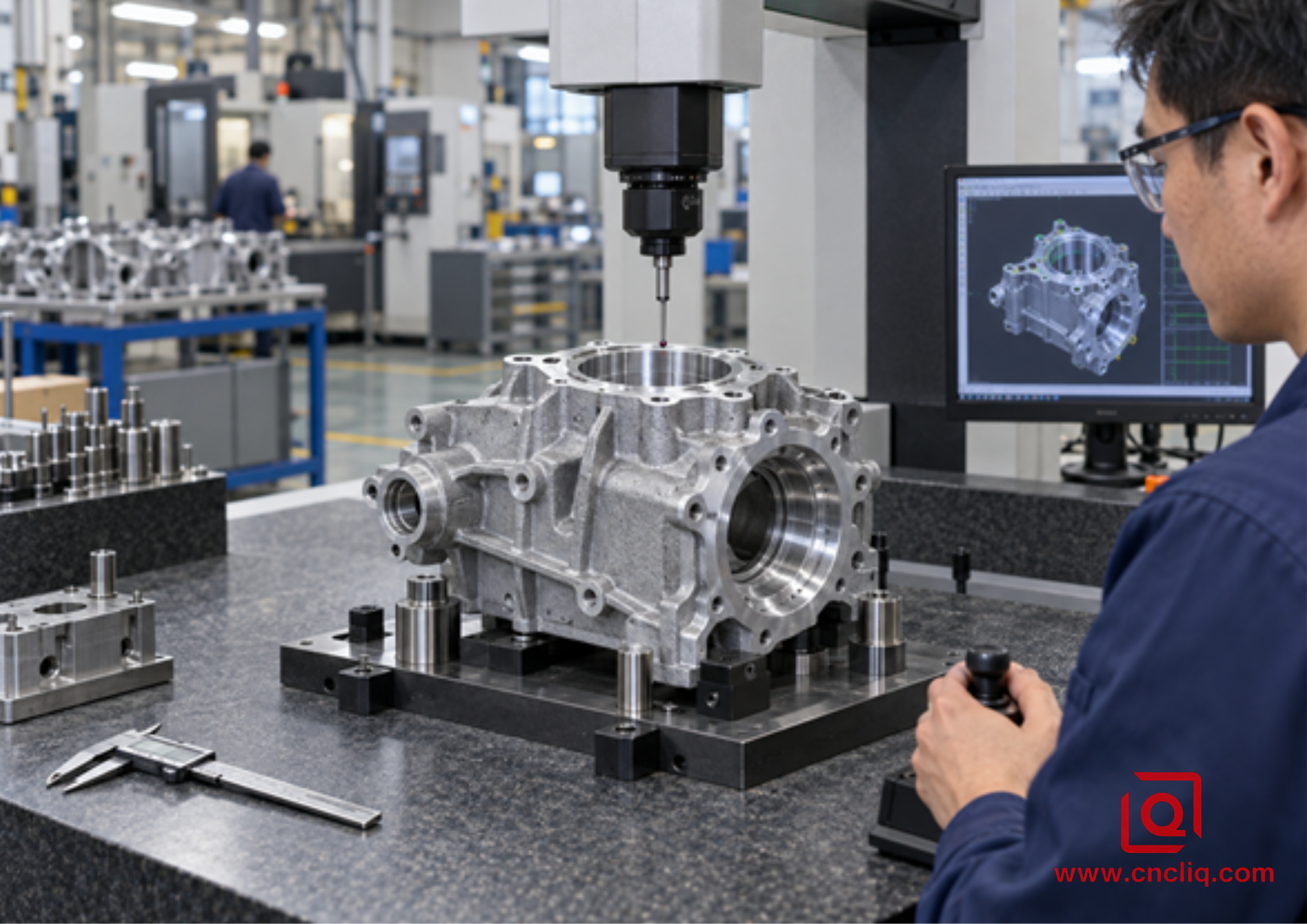
A hybrid route casts the housing envelope, machines critical interfaces, and verifies functional features by CMM.
This hybrid route only saves money when machining is concentrated. Mark every surface that can remain as-cast. Apply tight tolerances only where the assembly needs them. Define controlled machining stock, stable fixture pads, datum targets, and the inspection relationship between cast and machined features. Liqin’s guide to CNC machining tolerance and cost explains why blanket ±0.01 mm requirements can change the entire process plan.
Gate 5: Can the supply chain launch and sustain the process?
Tooling approval is not the end. Confirm the casting machine range, cavity strategy, trim process, melt and temperature controls, secondary machining capacity, measurement method, packaging, preventive maintenance, and contingency plan. Define who owns the die, where it is stored, how shot and maintenance records are reported, who approves repairs, and what happens at end of life or supplier transfer.
The U.S. Department of Energy’s 2004 final report, Energy Consumption of Die Casting Operations, measured melting, holding, casting-cell, and downstream activity. Its practical sourcing lesson is that machine cycle time alone does not represent the full process. A credible quotation should describe the whole route and its expected yield.
When CNC should stay—even after the spreadsheet says “cast”
Keep CNC machining when demand is volatile, annual volume is frequently overstated, or the product may be discontinued before the die pays back. CNC also deserves priority when engineering changes remain likely, delivery must start before tooling can be qualified, low porosity is essential but the casting route has not been proven, or the required alloy and temper cannot be responsibly replaced.
Warning signs include extensive internal channels, precision features on unrelated datums, long gaps between releases, premium decorative anodizing, or unpredictable service-part demand. High lifetime volume alone does not create a continuous HPDC schedule.
Do not overlook a third process. Depending on geometry, extrusion, forging, cold extrusion, gravity casting, or a preformed blank plus CNC may reduce material removal without the full commitment of HPDC. Liqin’s cold extrusion versus die casting and CNC guide is relevant for axisymmetric or cup-like aluminum parts.
When die casting deserves an earlier look
Move the study forward when a part has a stable design, a credible multiyear forecast, a high buy-to-fly ratio, long CNC cycle time, deep pocketing, many integrated ribs or bosses, or several assembled pieces that could become one casting. A part family may also justify common tooling concepts or modular inserts, though each proposal must be engineered and quoted.
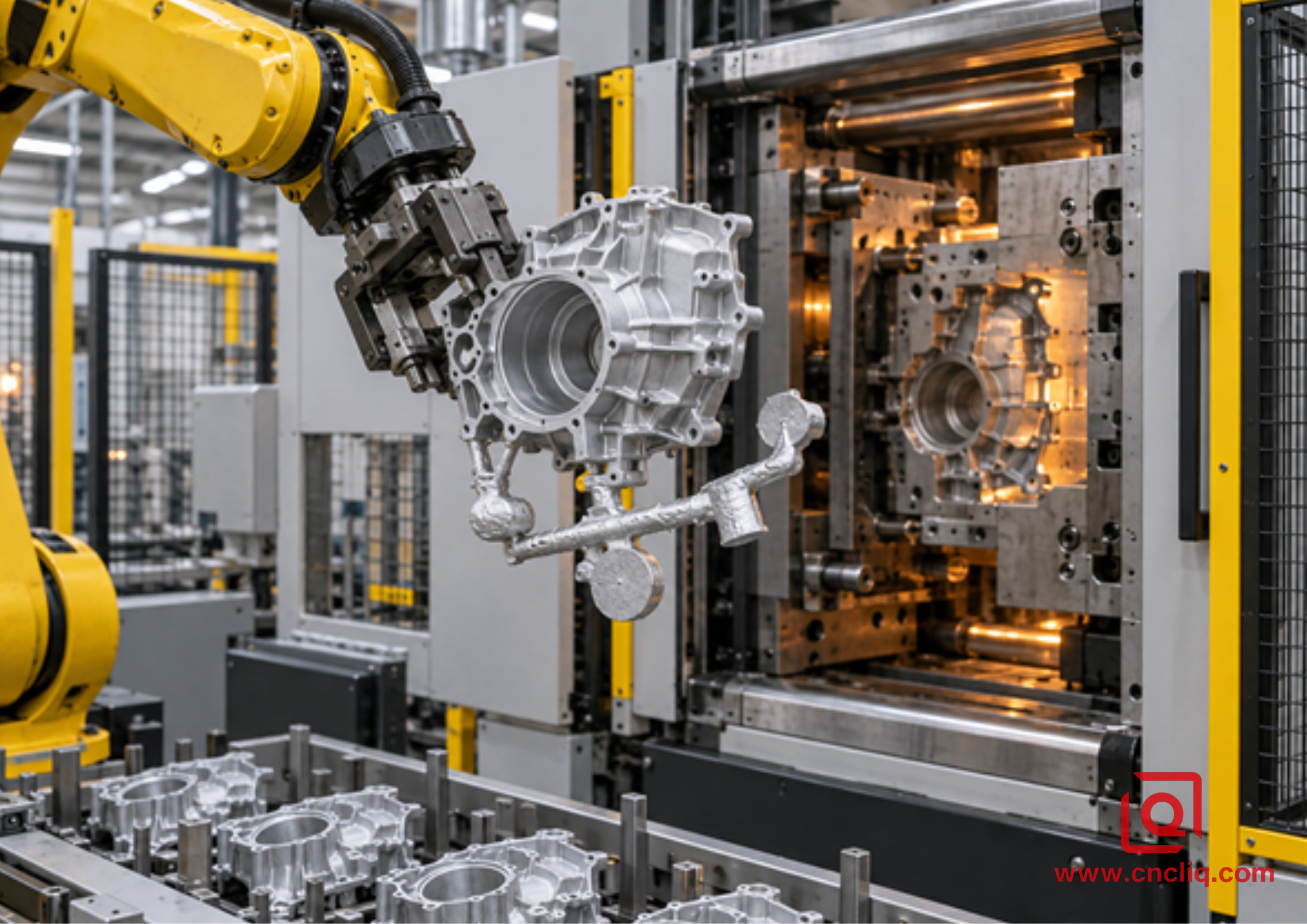
Robotic extraction of a near-net aluminum casting: the runner and overflow remain visible before trimming and secondary machining.
Thermal housings, motor covers, lighting enclosures, gearbox covers, and electronic control bodies often contain the kind of exterior complexity that HPDC forms efficiently. However, pressure-tight or high-integrity applications require a specific porosity-control and validation plan. “Die cast” is not, by itself, a leak-tightness specification.
Anonymous customer case: moving an industrial drive housing in 2 stages
An anonymized industrial automation customer had a compact aluminum drive housing originally machined from billet for verification builds. The part combined a broad cavity, external cooling ribs, 4 mounting bosses, a bearing bore, a gasket face, and several threaded holes. This scenario is representative of Liqin’s custom machining and die-casting capabilities; the commercial inputs and dimensions below are sanitized, and the outcome is presented as a realistic process example rather than a universal performance claim.
During the first stage, the customer kept CNC machining for pilot builds. Assembly testing exposed a connector-location change and a revised gasket path—exactly the kind of late movement that would have made an early die expensive. Engineers then froze the interfaces and divided the drawing into 3 groups: near-net cast geometry, precision-machined features, and cosmetic nonfunctional surfaces.
During the second stage, the die formed the envelope, ribs, and bosses; CNC finished the bearing bore, locating face, gasket track, and threads from defined fixture pads. The control plan covered first-article mapping, critical-feature checks, coating verification, and a project-specific sealing test. Purchasing compared 3 demand levels using finished accepted-part cost.
The decision was not “casting is always cheaper.” It was “the design is now stable, the geometry removes enough recurring CNC work, and the most-likely demand can pay back a controlled hybrid route.” Liqin’s published precision motor flange/front end cap demonstrates the same verified manufacturing logic: a die-cast aluminum body retains its coated exterior while critical bearing and locating interfaces receive precision machining. No unlisted customer volume or savings claim is inferred from that product page.
A practical migration plan from CNC to HPDC
1. Capture the CNC baseline. Record accepted-part cycle time, stock cost, tool consumption, setup allocation, scrap, inspection, finishing, packaging, and delivery performance. Estimated machining time is weaker than observed production data.
2. Freeze the functional specification. Identify critical-to-function dimensions, datums, sealing features, finish zones, load paths, and alloy requirements. Remove unnecessary precision from nonfunctional surfaces.
3. Request casting DFM before final tooling quotation. Review wall transitions, draft, radii, ribs, bosses, parting line, sliders, ejection, gates, overflows, vents, and machining allowance.
4. Quote 3 routes at the same acceptance point. Ask for CNC, HPDC, and HPDC-plus-CNC when all are feasible. The casting quote must include secondary operations and expected accepted yield.
5. Build the threshold model. Use fixed cost, finished variable cost, maintenance reserve, and accepted quantity. Calculate confirmed, most-likely, and upside cases.
6. Prototype with the final process in mind. A machined prototype can validate fit and many functions, but it does not reproduce casting porosity, skin, microstructure, residual stress, or every coating response. Plan casting trials and qualification accordingly.
7. Approve samples against a written control plan. Align drawing revision, material certification, first-article report, CMM scope, gauges, coating evidence, leak or pressure tests, and cosmetic acceptance.
8. Ramp in controlled releases. Verify stable process capability and assembly performance before depending on maximum forecast capacity.
9. Keep commercial ownership clear. Document tool ownership, storage, maintenance, change control, repair approval, production records, and end-of-program handling.
If you want a route comparison, send Liqin the 3D STEP model, controlled 2D drawing, target alloy or performance requirement, surface finish, first release, annual forecast, expected program life, and the features that cannot move. Ask for separate assumptions for CNC machining, die casting, and the hybrid route. That information allows engineers to return a useful DFM review instead of a misleading piece price. You can also review the aluminum OEM CNC-versus-HPDC decision matrix before submitting your RFQ, then contact Liqin for a project-specific quotation.
FAQs
1. What is the typical volume threshold for switching from CNC-machined aluminum to die casting?
There is no universal threshold, but 500–5,000 accepted parts is a useful band in which many housing projects deserve a formal comparison. A heavily pocketed, stable enclosure may cross over earlier, while a simple part, uncertain forecast, demanding wrought-alloy requirement, or machining-heavy casting may cross later. Use supplier-specific fixed and finished unit costs, then test confirmed, most-likely, and upside demand.
2. Should I compare CNC unit price with the raw die-casting price?
No. Compare both routes at the same assembly-ready condition. The die-cast figure must include tooling allocation, qualification, trimming, deburring, secondary CNC machining, impregnation or testing where required, surface treatment, inspection, expected yield, packaging, and freight. A low as-cast number beside a finished CNC price hides the operations that determine real landed cost.
3. Can the same 6061-T6 CNC design move directly to A380 die casting?
Usually not without engineering review. The alloy system changes, and the geometry may need more uniform walls, radii, draft, a parting strategy, ejection provisions, and revised tolerances. Mechanical, thermal, corrosion, joining, sealing, and finishing requirements must be checked against the proposed casting alloy and actual process; a matching shape does not prove equivalent performance.
4. Which features normally need CNC machining after aluminum die casting?
Critical bearing bores, sealing lands, gasket tracks, locating datums, close-fit holes, threaded ports, connector faces, and precision mounting planes are common secondary-machining targets. The economical approach is to machine only what function requires, locate from stable cast or prepared datum features, and leave noncritical ribs, walls, bosses, and exterior contours as-cast wherever the drawing allows.
5. What should I send for an accurate CNC-versus-die-casting quotation?
Provide a 3D CAD model, revision-controlled 2D drawing, alloy or performance requirements, finish, critical features, inspection and testing needs, first-order quantity, annual demand, program life, release pattern, packaging, and delivery location. Mark which features are frozen and which may change. Request a transparent cost stack, DFM feedback, expected yield basis, tooling terms, and separate prices for finished accepted parts.
Summary
Switch from CNC-machined aluminum to die casting only when 3 conditions meet: the design is stable, the geometry can capture near-net casting value, and credible accepted-part demand repays tooling after secondary machining and risk are included. Use 500–5,000 parts as an analysis zone, not a promise; calculate your own crossover, stress-test the forecast, and consider a hybrid route that casts the envelope while machining the interfaces that control fit, sealing, and motion.
Contact Information
Company: Ningbo Liqin Industry Co., Ltd.
Daily customer maintenance & after-sales support:service@shturl. zhuwanying@cncliq.com
New inquiry, quotation & order discussion:business@shturl. zhouli@chinaliqin.com
Hotline: +86 18757148656
Disclaimer
All technical articles, material specifications, machining recommendations, and surface treatment details published on this blog are for informational and reference purposes only. Please note that general blog insights do not replace signed technical agreements. Because custom parts vary by material heat numbers, machine calibrations, and specific tolerances, binding quality specs are governed solely by your approved CAD drawings, signed contracts, and formal quality plans.
All customer case studies featured on this blog have been thoroughly anonymized and sanitized. The performance metrics, manufacturing workflows, and imagery displayed serve solely to demonstrate our custom machining capabilities and do not represent a single universal standard for all orders.
Liqin Manufacturing Team
Built on 18 years of precision engineering experience, Ningbo Liqin Industry manufactures high-tolerance metal components for demanding global markets. We operate out of a 6,500 m² production hub equipped with over 150 machines, running 4-axis and 5-axis CNC machining, mill-turn machining, cold extrusion, and pressure die casting under one roof. This setup allows us to manage projects seamlessly, taking parts from initial CAD concepts directly to finalized shipments.
We handle quality control with zero compromise. We treat tight tolerances with the engineering discipline they require. Backed by ISO 9001, ISO 13485, and IATF 16949 certifications, our QA engineers run strict IPQC, FQC, and OQC checks on every single production batch. From CMM dimensional mapping and optical profiling to hardness and salt-spray testing, we validate your critical specs upfront—so you receive drop-in ready components with zero assembly headaches or costly line stoppages. On top of manufacturing, you can rely on us for two-hour response times on new RFQs, direct support for prototype sampling, and smooth export shipping across Europe, North America, Asia, and Oceania.
Welcome your inquiries and samples. Visit our website or contact us directly for a competitive quote!