 English



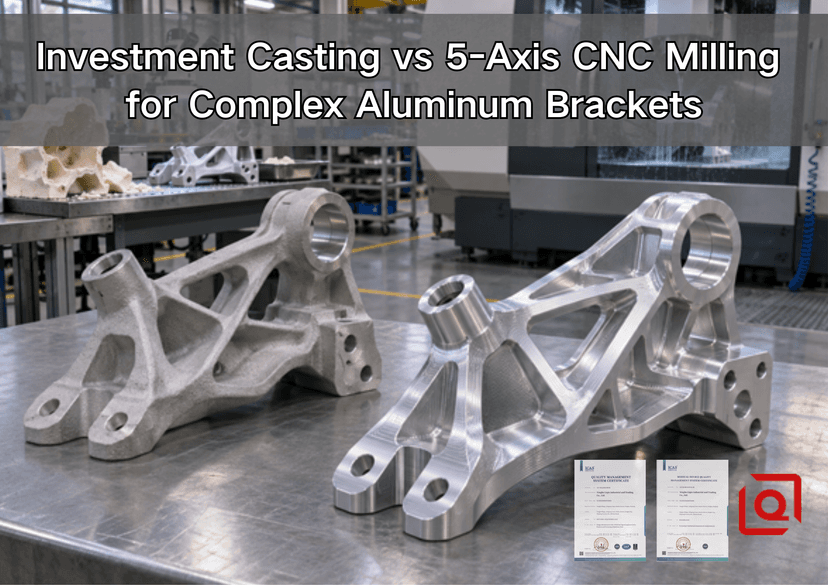
Are you still unsure whether a complex aluminum bracket should be investment cast or cut from billet? The drawing may show the same ribs, angled bores and mounting pads either way, yet the two routes carry very different risks. One commits money to patterns, shell making and foundry control. The other pays for stock, programming and spindle time on every piece. Choose by unit price alone and a cheap-looking process can become the expensive one after machining, inspection and rejected parts are included.
This guide approaches the decision from the shop floor. It explains where investment casting earns its place, when 5-Axis CNC Milling is the safer commercial choice, why many production brackets use both, and what an RFQ must contain before a supplier can compare them honestly.
Quick Answer: Which Route Usually Fits?
|
Project condition |
Stronger starting route |
Reason to investigate first |
|
Prototype, bridge build or design still changing |
5-axis milling from wrought plate or billet |
No production pattern tool; CAD revisions can normally be handled through CAM and fixture updates |
|
Stable repeat demand with near-net ribs, pockets and hard-to-reach contours |
Investment casting |
Shape is formed close to final geometry, reducing repeated stock removal |
|
Cross-face datums, angled bores and machined pads dominate acceptance |
5-axis milling |
Related features can often remain in one datum structure and one main setup |
|
Hidden cavities, re-entrant forms or part consolidation drive the design |
Investment casting |
Ceramic or soluble cores may create geometry that a cutter cannot reach |
|
Cast body needs accurate bores, threads or mounting faces |
Cast, then CNC finish |
Each process handles the work it controls best |
|
Forecast is uncertain or engineering changes are likely |
CNC first; reassess later |
Tooling amortization is useless if the program ends or changes early |
There is no universal break-even quantity. Part size, alloy, bought-to-finished mass, pattern method, shell yield, machining hours, inspection and forecast confidence move the answer. Compare accepted, assembly-ready parts at the same delivery point.
1. The Two Processes Create Complexity in Opposite Ways
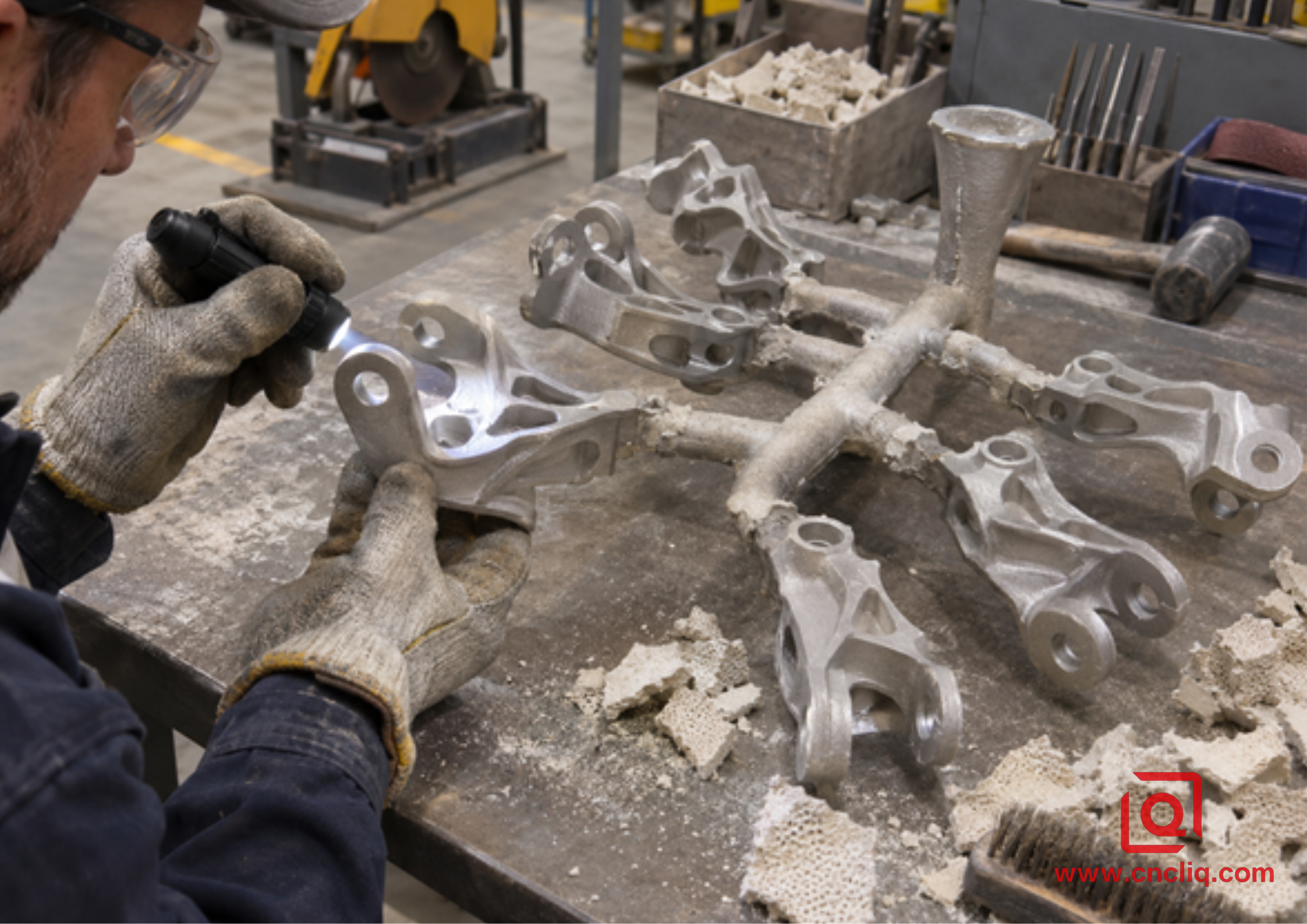
Investment casting, also called lost-wax casting, begins with a sacrificial pattern. Wax patterns are assembled to a feed system, repeatedly coated with ceramic slurry and refractory particles, dried, dewaxed and fired. Molten aluminum fills the shell. After cooling, the shell is removed, gates are cut away, surfaces are cleaned, heat treatment is completed where specified, and the casting is inspected. The method can reproduce organic ribs, curved transitions and some internal features without cutting all of that shape from solid stock.
The freedom is not free. Metal must flow through gates before it freezes, while thick and thin sections cool at different rates. Shrinkage, gas, inclusions and local hot spots must be controlled. Gate witness areas remain after cutoff, and critical surfaces often need machining stock. The drawing therefore needs agreed feed zones, transitions, cores, datum pads and machining allowances.
ASTM B618/B618M-25 is the current ASTM specification for aluminum-alloy investment castings. Its scope is for general-purpose applications and expressly notes that highly loaded or safety-critical parts may require additional integrity requirements. It also addresses chemistry, tensile testing, heat treatment and foundry control, including radiographic or other approved examination while the process is being established. That is a useful reminder: a material callout by itself does not define an acceptable structural casting.
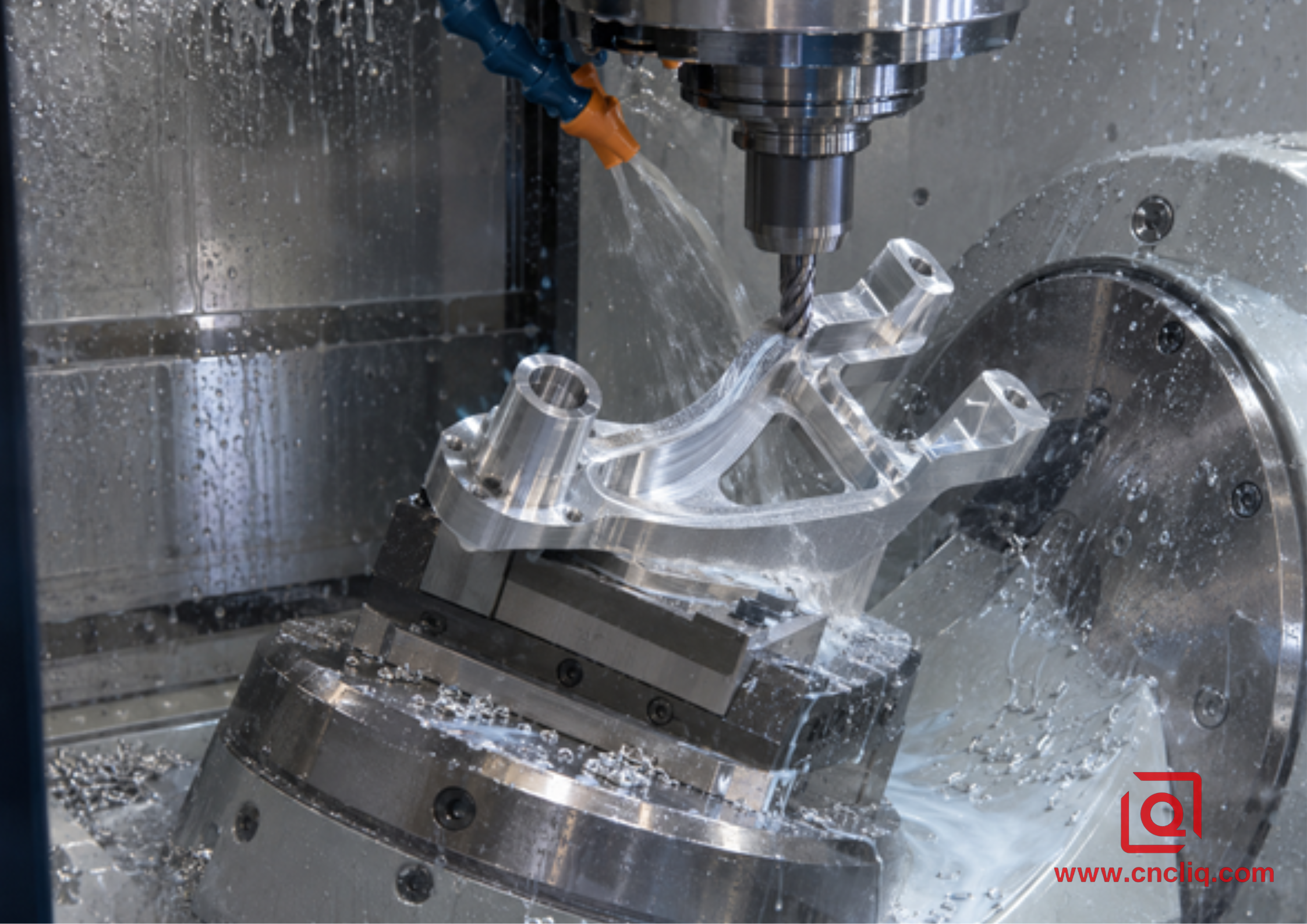
5-Axis CNC Milling starts from solid wrought stock and removes what the bracket does not need. In indexed 3+2 work, the rotary axes position the part, lock, and let three linear axes cut. In simultaneous work, rotary and linear axes move together so the cutter can follow changing surface normals or keep a better tool attitude along a contoured wall. Liqin's guide to 3+2 positional versus continuous 5-axis machining explains why five available axes do not mean that all five must move during every cut.
The milling route avoids a wax-pattern production tool, but not engineering. The programmer still manages tool reach, holder clearance, rotary limits, workholding, residual stress, chips and collision simulation. If every feature is planar at a fixed angle, 3+2 may be faster and easier to prove than simultaneous motion.
2. Geometry: Form What Cutters Cannot Reach, Cut What Datums Must Control
Investment casting becomes attractive when geometry is expensive to carve from a block. Swept ribs can follow load paths. Bosses can emerge from several planes. Pockets may curve around a central body, and separate fabricated pieces may be consolidated into one near-net component. With a suitable core system, the process can also form internal passages or re-entrant features that no rotating cutter can enter.
Shape freedom still has limits. A slender wall may misrun or distort; a heavy boss feeding a thin web may cool unevenly; a hidden core must be supported and removed. Gradual section transitions help metal flow and deserve a foundry review.
Machining has the opposite boundary. If a tool and holder can reach a surface without collision, the shop can usually develop a route. Five-axis orientation permits shorter, stiffer tools on angled faces and deep open pockets. What it cannot do is cut a sealed internal cavity. Tiny internal corner radii also demand tiny cutters, which add deflection, slow the cycle and create fragile tool life.
For a complex bracket, highlight the features that talk to the assembly: dowel bores, bearing seats, bolt-pattern position, mating-pad profile and the relationship between angled interfaces. Those surfaces deserve a coherent datum scheme. Cosmetic relief pockets and nonfunctional ribs do not need the same tolerance budget.
The related 3-axis versus 5-axis setup and cost guide is useful when the bracket is mostly prismatic. A flat gusset with two machined faces may be cheaper on a three-axis mill. A robotic wrist bracket with pads and holes on four orientations may justify 5-axis because it replaces transfers, not because the machine name sounds more advanced.
3. Material Is Part of the Process Decision
The word “aluminum” is not an RFQ specification. Investment casting uses registered casting alloys selected for fluidity, solidification behavior, heat treatment and service requirements. Billet machining commonly uses wrought plate or bar such as 6061-T6/T651 or 7075-T6/T651. Those are different material families with different product standards and property sets; a cast alloy should never be presented as a drop-in substitute for wrought 7075 merely because both parts look silver.
For machined brackets, 6061 is a practical baseline when strength, corrosion resistance, machinability and anodizing response must be balanced. 7075 is considered when loads require higher strength, although protection, joining and finishing still need review. The Aluminum Association identifies 6xxx alloys as heat-treatable magnesium-silicon materials and notes the aircraft use of 7050 and 7075. Design values must come from the specified product form, temper, thickness and standard.
For casting, specify the exact registered alloy and condition in consultation with the foundry. ASTM B618/B618M is the relevant starting specification for aluminum investment castings, but the drawing must still state required properties, inspection class and acceptance criteria. A safety-critical bracket may need process qualification, coupon testing, radiography or other nondestructive examination beyond a general-purpose purchase specification.
If you are comparing wrought grades for a machined route, see Liqin's 6061, 7075 and 5052 CNC milling guide. For a product example of tight aluminum interfaces and controlled secondary finishing, the industrial aluminum enclosure hinge shows the type of multi-surface part whose function depends on relationships between bores, pads and visible surfaces.
4. Tolerance and Surface Finish: Separate As-Cast from Machined
A common purchasing mistake is to place the same tight title-block tolerance over every feature and ask casting and machining suppliers to quote it. That does not create two comparable offers. It creates two different sets of hidden assumptions.
The Investment Casting Institute cites a commonly used capability reference near ±0.005 inch per linear inch for investment casting, while stressing that alloy, feature size, geometry and process control matter. Treat that figure as an early design reference, not a guaranteed blanket tolerance. ISO 8062-3:2023 provides a formal framework for general dimensional and geometrical tolerances and machining allowances on castings. The supplier and customer still need to agree which grade and which individual controls apply.
On the drawing, distinguish three surface types:
1. As-cast surfaces that only need the agreed casting tolerance and finish.
2. Datum pads or reference targets used to locate the casting for secondary machining and inspection.
3. Fully machined functional features such as bores, threaded holes, sealing faces and close-fit mounting pads.
Machining can hold tighter local control on accessible features, but no responsible shop should promise one number for the entire bracket. A short bore in a rigid boss behaves differently from a thin pad across a long open frame. Tool access, fixture stiffness, stock removal, thermal state and measurement uncertainty all enter the result.
Surface treatment must be planned at the same time. Anodizing changes the interface condition and can affect dimensions on bores, threads and fits. Decide whether a feature is masked, machined after coating, or sized for the approved coating build. Liqin's article on holding tight CNC tolerances with Type III hardcoat expands on allowance, masking and inspection questions.
5. Cost: Build the Whole Route, Not a Piece-Price Myth
Investment casting shifts cost toward the front of the program. Pattern tooling, gating development, shell trials, first-article work and process qualification arrive before repeat production settles. Once the route is stable, near-net geometry may reduce purchased metal and machine time per bracket. The saving is strongest when a large proportion of a billet would otherwise become chips or when several pieces can be consolidated.
Five-axis machining has lower fixed commitment but repeated variable cost. Every bracket consumes billet, machine time, tools, coolant, handling and inspection. Programming and fixture preparation are front-loaded, yet there is no production pattern die to amortize. That makes machining commercially resilient when quantities are small, releases are irregular or revisions remain likely.
A fair model uses accepted parts, not gross pours or machine starts:
1. Casting route total = pattern and qualification cost + accepted casting cost + cutoff and finishing + heat treatment + secondary machining + inspection + surface treatment + packaging + expected scrap and rework.
2. CNC route total = stock + programming and fixture cost + accepted machine cycle + tools + deburring + inspection + surface treatment + packaging + expected scrap and rework.
3. Hybrid route total = near-net casting route + only the CNC operations required for functional interfaces.
The crossover quantity is where the total-cost lines meet, but forecast risk matters. A forecast of 5,000 pieces does not justify tooling if only 500 are likely. Include engineering changes, tool ownership, maintenance, pattern replacement and recovery if the process drifts. Liqin's die casting versus CNC cost and volume guide uses the same accepted-part logic for another casting process.
6. Quality Planning: The Inspection Route Should Follow the Datum Route
For a billet bracket, quality planning begins with material identity, stock condition and the relationship between the first machining datum and final interfaces. First-piece and in-process checks should follow features exposed to tool wear, heat or unclamping movement.
For an investment casting, inspection starts earlier. Chemical composition, heat-treatment condition and lot traceability matter, but so do foundry-specific risks. Visual examination can find obvious surface conditions. Radiography can reveal certain internal discontinuities. Dye penetrant may identify surface-breaking indications. None of these methods is universal, and acceptance levels must be defined by the drawing, purchase specification and service risk.
After secondary machining, a CMM can relate pads, profiles and holes to functional datums. Bore gauges, thread gauges and roughness instruments suit other characteristics. State which features are measured before coating, after coating or both.
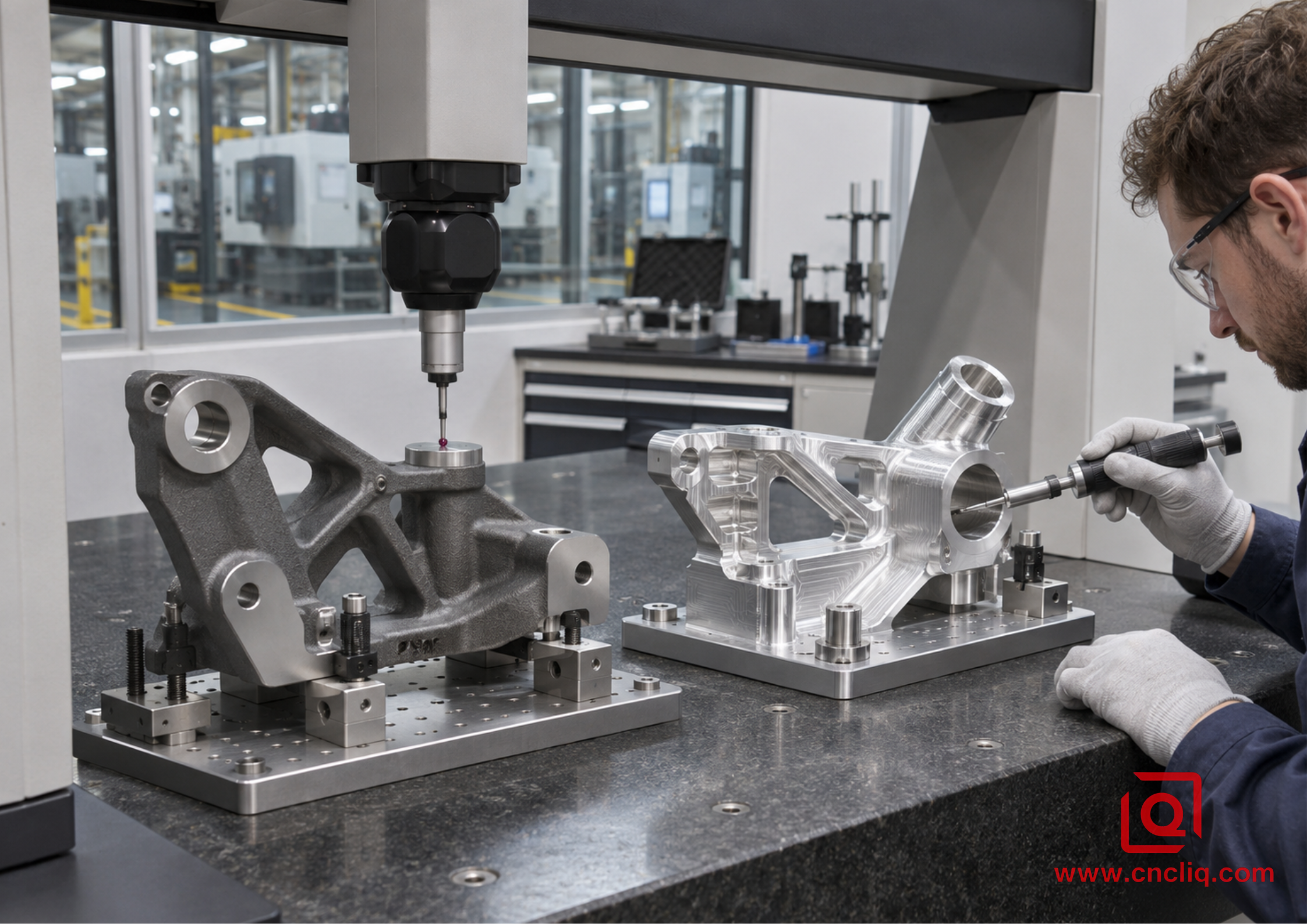
For comparison quotes, ask each supplier to return the same evidence package: material certificate, process route, first-article scope, critical-feature report, special-process certificate and any required nondestructive examination. Liqin's flameproof gas-detector enclosure is a relevant product example because its value lies in controlled bores, shoulders, threads, surface treatment and inspection rather than in the outside shape alone.
7. Anonymized Composite Case: A Robotic End-Effector Bracket
The following case is a sanitized composite created from common RFQ conditions; dimensions and commercial details are illustrative rather than a claim about one identifiable customer.
An automation-equipment buyer needed a palm-sized bracket joining a servo reducer to an angled tool flange. The first release was 24 pieces for validation, followed by a possible annual demand of 1,200. The model used two sweeping ribs, a central pocket, three angled cable-clearance windows and mounting faces on four orientations. Two dowel bores and the output-flange pilot controlled assembly. The design team initially asked for one price for investment casting and one for 5-axis machining.
The first review found that the design was not stable. Cable routing might move, the flange angle was still under test, and the buyer had not released a final fatigue load case. Pattern tooling at that stage would have turned ordinary development changes into tool rework. The pilot build therefore used 6061-T651 billet and 5-Axis CNC Milling. The main bores and angled mounting pads stayed tied to one setup, while a simple second operation removed the holding tab.
The production review did not simply copy the prototype. Engineers separated the drawing into functional machined features and shape-only material. The ribs were blended, heavy junctions were softened, local machining allowance was added around the pilot and dowel bosses, and three fixture pads were introduced for a future cast blank. The team also removed a cosmetic pocket that would have required an awkward core but added no structural value.
The commercial decision remained gated. The first 24 parts would validate assembly, cable clearance and loading. If the geometry froze and firm releases supported tooling, the supplier would quote an investment-cast blank with CNC-finished interfaces. If demand stayed irregular, billet machining would continue. This avoided pretending that one process had to win for the entire product life.
The case illustrates a useful rule: prototype the function with the least irreversible commitment, then redesign the production blank around verified loads and stable interfaces. A casting conversion is an engineering project, not a purchasing shortcut.
8. A Practical Selection Workflow for Engineers and Buyers
1. Mark every critical-to-function feature. Identify datums, load paths, joints, dowels, bearing seats, threaded interfaces and cosmetic zones.
2. Separate shape from precision. Decide what may remain as-cast and what must be machined.
3. Confirm material family. Do not compare a wrought alloy and a cast alloy as though the designation alone guarantees equivalent performance.
4. Test tool and core access. Ask whether a cutter can enter, whether a ceramic core can be supported, and how the feature will be inspected.
5. State development status. A frozen drawing and a moving prototype deserve different commercial routes.
6. Build three cost stacks. Compare casting, CNC and hybrid at the same assembly-ready acceptance point.
7. Define quality evidence. Include material records, first article, dimensional reporting, surface treatment and nondestructive examination where risk requires it.
8. Review supply risk. Consider tool ownership, capacity, maintenance, alternate routes, change control and realistic forecast confidence.
9. Run a joint DFM call before release. Ten focused minutes on datums, ribs, cores, allowances and inspection can prevent weeks of correction.
9. What to Send for a Quotable Comparison
An accurate process comparison needs more than a STEP file. Send the matching 2D drawing, alloy and condition, prototype quantity, annual and lifetime forecast, expected release size, surface treatment, critical features, inspection requirements and target delivery date. State whether the design is frozen and identify any likely changes.
For casting, add expected machining stock, acceptable gate zones, radiography or penetrant requirements, heat-treatment condition and any casting-tolerance standard. For machining, identify allowable holding tabs, cosmetic faces, stock-form restrictions and whether indexed or simultaneous five-axis work is acceptable. If a supplier recommends a different alloy or process, require the proposal and its property basis in writing.
When you request a quote from Liqin, include one sentence about what the bracket does and which interface cannot fail. Our engineers can then compare billet machining, a near-net blank plus CNC finishing, or another available route against the real function. Send the package through the contact page for DFM feedback and a project-specific quotation.
FAQ
1. Is investment casting always cheaper than 5-axis CNC milling at higher volume?
No. Higher volume helps spread pattern and qualification cost, but geometry, alloy, casting yield, secondary machining, inspection and forecast certainty decide the crossover. A stable near-net bracket with heavy billet waste may favor casting; a compact bracket with short cycles, changing demand or many precision surfaces may remain economical on CNC. Compare accepted, finished parts and include the cost of design changes and tooling maintenance.
2. Can investment casting hold the same tolerances as a CNC-machined bracket?
Not as a blanket statement. Investment casting can produce accurate repeatable near-net geometry, while CNC generally gives tighter local control on accessible functional features. Use an agreed casting tolerance framework such as ISO 8062-3, then machine bores, threads, datums and mating pads that need closer control. The drawing should separate as-cast and machined requirements instead of applying one title-block tolerance everywhere.
3. Which aluminum alloy should I choose for a complex bracket?
Choose from the load case, environment, product form, joining method, finish and governing standard. Wrought 6061 and 7075 are common machining choices, while investment casting requires a registered cast alloy suited to the foundry route. They are not automatic substitutes. Provide loads and service conditions, then confirm properties for the specified temper, thickness and standard with the design authority and supplier.
4. When does a hybrid cast-and-machine route make sense?
It makes sense when the bracket's broad shape, ribs or internal form benefit from near-net casting but a smaller set of interfaces needs machining precision. The cast blank should include controlled datum pads and machining allowance at those interfaces. A hybrid route is often more robust than forcing the foundry to hold machining-level requirements or forcing a mill to remove most of an expensive billet.
5. What information produces the most reliable comparison quote?
Send matching 3D and 2D files, exact material and condition, critical features, finish, prototype and production quantities, annual forecast, inspection records, delivery target and design status. For casting, include gate restrictions, machining allowance and nondestructive examination. For CNC, identify cosmetic faces and holding limitations. Ask bidders to show tooling, setup, processing, secondary operations and quality scope separately.
Summary
Investment casting is strongest when a stable complex bracket benefits from near-net ribs, consolidated geometry or features that cutters cannot reach. 5-axis milling is strongest when the design is changing, quantities are uncertain, wrought material is required, or cross-face precision dominates acceptance. Many mature programs use both: cast the efficient envelope, machine the interfaces that control assembly, and inspect from functional datums. The right answer comes from a shared DFM review and an accepted-part cost model, not from a universal quantity threshold.
Contact Information
Company: Ningbo Liqin Industry Co., Ltd.
Daily customer maintenance & after-sales support:service@shturl. zhuwanying@cncliq.com
New inquiry, quotation & order discussion:business@shturl. zhouli@chinaliqin.com
Hotline: +86 18757148656
Disclaimer
All technical articles, material specifications, machining recommendations, and surface treatment details published on this blog are for informational and reference purposes only. Please note that general blog insights do not replace signed technical agreements. Because custom parts vary by material heat numbers, machine calibrations, and specific tolerances, binding quality specs are governed solely by your approved CAD drawings, signed contracts, and formal quality plans.
All customer case studies featured on this blog have been thoroughly anonymized and sanitized. The performance metrics, manufacturing workflows, and imagery displayed serve solely to demonstrate our custom machining capabilities and do not represent a single universal standard for all orders.
Liqin Manufacturing Team
Built on 18 years of precision engineering experience, Ningbo Liqin Industry manufactures high-tolerance metal components for demanding global markets. We operate out of a 6,500 m² production hub equipped with over 150 machines, running 4-axis and 5-axis CNC machining, mill-turn machining, cold extrusion, and pressure die casting under one roof. This setup allows us to manage projects seamlessly, taking parts from initial CAD concepts directly to finalized shipments.
We handle quality control with zero compromise. We treat tight tolerances with the engineering discipline they require. Backed by ISO 9001, ISO 13485, and IATF 16949 certifications, our QA engineers run strict IPQC, FQC, and OQC checks on every single production batch. From CMM dimensional mapping and optical profiling to hardness and salt-spray testing, we validate your critical specs upfront—so you receive drop-in ready components with zero assembly headaches or costly line stoppages. On top of manufacturing, you can rely on us for two-hour response times on new RFQs, direct support for prototype sampling, and smooth export shipping across Europe, North America, Asia, and Oceania.
Welcome your inquiries and samples. Visit our website or contact us directly for a competitive quote!