English




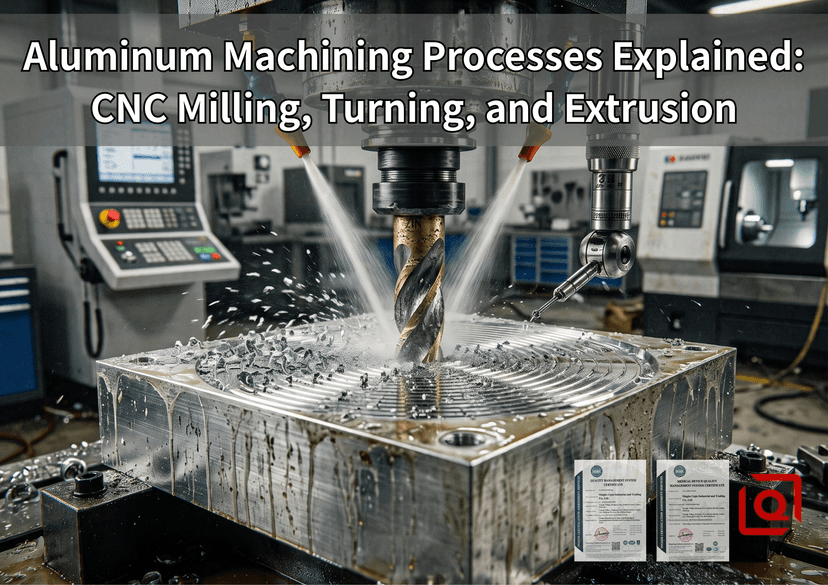
Billet geometry lies to you. You set up a 6061-T6 bar thinking it’s stress-relieved per AMS-QQ-A-250/11, lock down the hydraulic vise to 25 bar, rip through it with a 3-flute uncoated carbide end mill at 12,000 RPM, and watch the part bow 0.35 mm as soon as the jaws release. Welcome to shop floor reality.
Aluminum machining isn’t just about converting CAD into G-code; it’s an aggressive negotiation with residual stress, thermal expansion coefficients (α=23×10-6/K), workpiece elasticity, and built-up edge (BUE) formation. Below is how we dial in multi-axis CNC milling, precision turning, and extrusion post-machining inside our facility without scrapping $40,000 aircraft-grade billet runs.
Shop Floor Empirical Rule #104:
Never trust raw bar stock straight off the truck. If your wall thickness drops below 1.8 mm, pre-stretch raw stock (T651 temper) or execute a roughing thermal stress relief cycle at 175°C for 3 hours followed by still-air cooling. Otherwise, springback will destroy your ISO 2768-mH tolerances every single time.
1. 3-Axis & 5-Axis CNC Milling: Feeds, Speeds, and Tool Engagement Realities
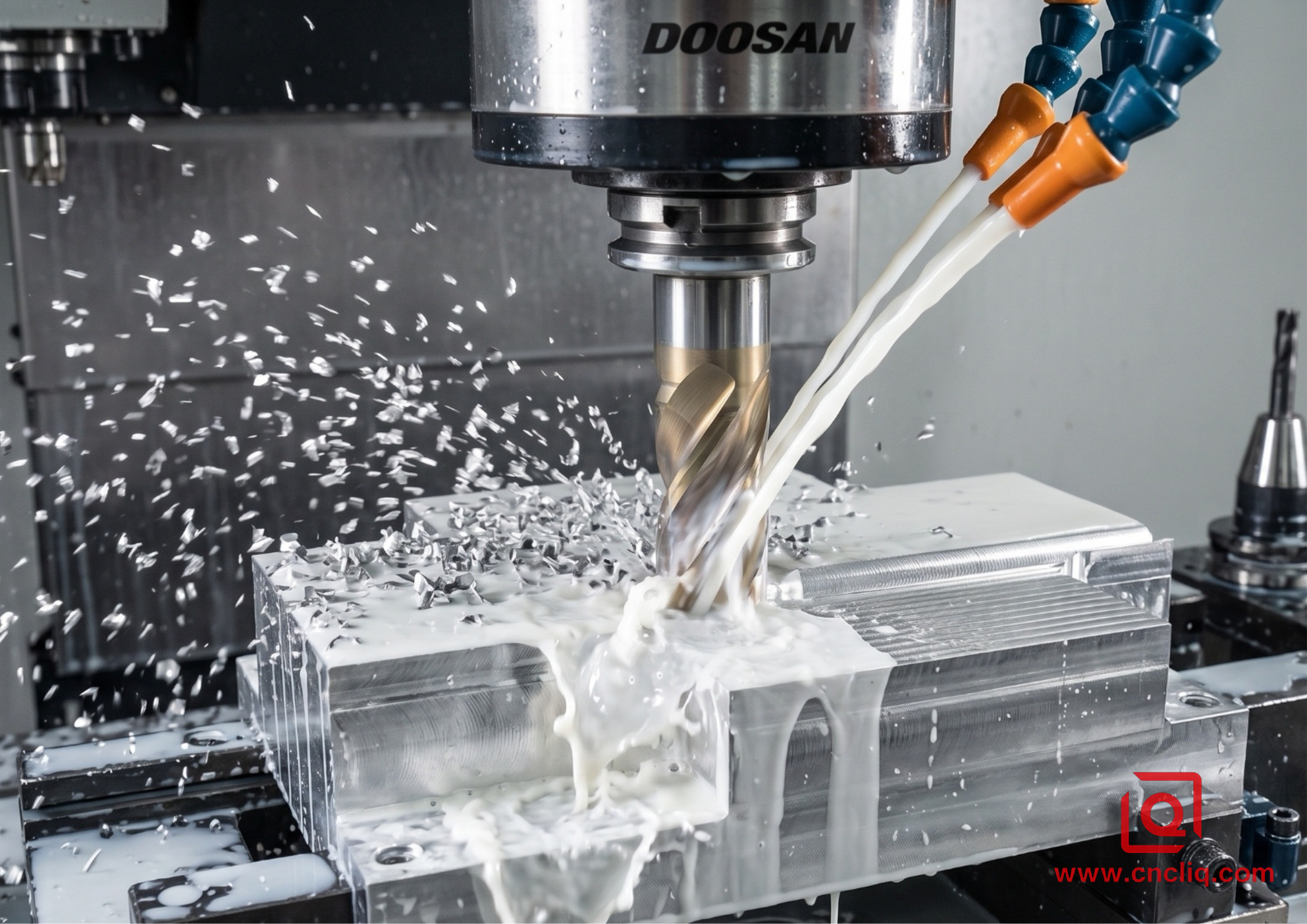
High-speed machining (HSM) of aluminum demands strict chip load discipline. Dial in your trochoidal paths. When milling 7075-T651 structural brackets, stop plunging straight down—Z-axis plunge is a recipe for chip packing and cutter snap. Ramp in at 2.5° to 4° max using a helical interpolation path.
Run a 12mm 3-flute ZrN-coated solid carbide end mill (35° helix angle). Spin at 14,500 RPM (Vc≈546m/min), feed per tooth fz=0.08mm/tooth, achieving a table feed rate Vf=3,480mm/min. Radial depth of cut (ae) shouldn't exceed 25% of cutter diameter (3.0mm) while axial depth (ap) punches down to 1.5×D(18mm).
Why ZrN over TiAlN? Simple: TiAlN contains aluminum. Under dry or mist cutting friction, chemical affinity causes micro-welding between the tool substrate and the chips, generating BUE in less than 45 seconds of continuous cutting. ZrN or DLC (Diamond-Like Carbon) coatings eliminate material friction transfer completely.
G00 X0 Y0 Z50.0 M03 S14500
G01 Z2.0 F1200 M08 (Thru-spindle coolant engaged @ 70 bar, 8% emulsion concentration)
G02 X15.0 Y0.0 Z-3.0 I7.5 J0.0 F800 (Helical entry, 3.5 deg ramp angle)
G01 X100.0 F3480 (Linear adaptive trochoidal roughing pass)
Watch coolant concentration. Dropping below 6% oil emulsion leads directly to chip galling inside deep pockets ($>3D$). Keep refractometer readings strictly at 8%–10% using a semi-synthetic water-soluble fluid. Maintain coolant pressure at minimum 30 bar—preferably 70 bar thru-spindle—to blast chips clear of the pocket. Recutting an aluminum chip reduces surface finish from Ra 0.8μm to Ra 3.2μm instantly and spikes spindle load by 18%.
2. Precision CNC Turning & Turn-Mill Synergy
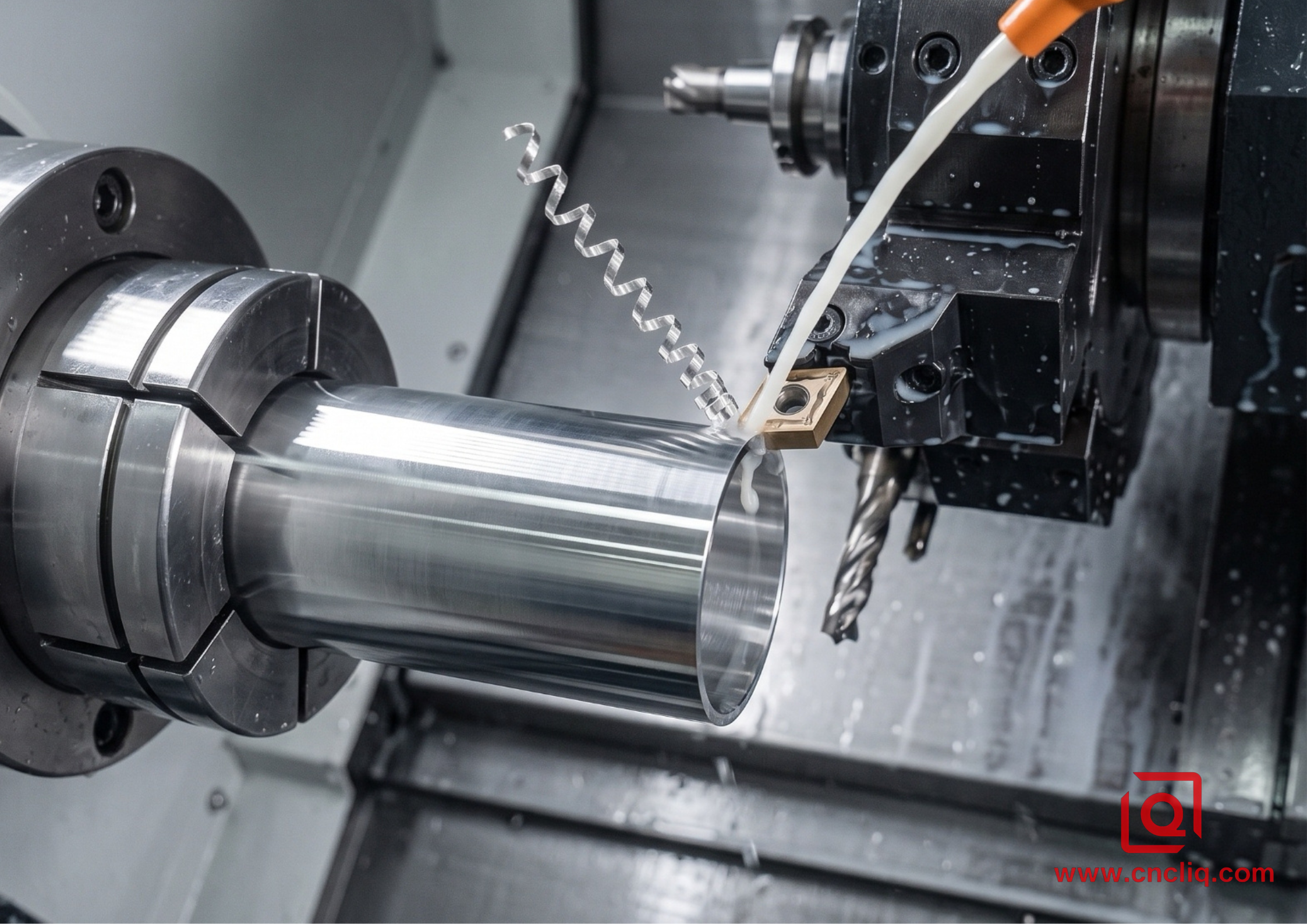
Turning 2024-T3 or 6082-T6 rounds requires brutal chip breaking strategies. Continuous stringy chips wrapping around the turret will mar turned diameters and trigger emergency stops. Use polished VCGT 160404-AK ground inserts with a high-rake 22° top face and a 0.4mm nose radius.
| Process Parameter | 6061-T6 (General Structural) | 7075-T651 (Aerospace High-Strength) | 2024-T3 (High Fatigue Resistance) |
| Cutting Speed (Vc) | 650 – 900 m/min | 500 – 750 m/min | 450 – 650 m/min |
| Feed Rate (f) | 0.15 – 0.35 mm/rev | 0.12 – 0.28 mm/rev | 0.10 – 0.22 mm/rev |
| Depth of Cut (ap) | 1.0 – 4.5 mm | 0.8 – 3.5 mm | 0.5 – 3.0 mm |
| Recommended Insert Type | Uncoated Polished Ground Carbide | DLC Coated / Micro-grain Carbide | PCD (Polycrystalline Diamond) tipped |
| Achievable Roughness | Ra 0.4 - 0.8μm | Ra 0.2 - 0.6μm | Ra 0.1 - 0.4μm |
When turning thin-walled tubular components (e.g., wall thickness <1.2mm for drive shafts), standard 3-jaw chuck pressure deforms the cylinder into a trilobe shape. Upon unclamping, your roundness tolerance of 0.010mm spikes to 0.065mm total indicator reading (TIR).
Remedy: Switch to custom pie-collet sleeves, reduce hydraulic clamping pressure to 8–12 bar, and execute a two-stage skim cut. Rough at Vc = 400m/min, unclamp the jaw to release elastic strain, reclamp at 5 bar, and execute a light finishing pass (ap= 0.12mm, f = 0.08mm/rev).
3. Post-Extrusion Machining: Handling Distortion & Datum Alignment
Machining extruded 6063-T6 or 6005A profiles presents unique headaches. Architectural or structural extrusions carry severe longitudinal twist and bow tolerances governed by EN 755-9 / ASTM B221. If you locate off an unmachined extruded surface using rigid pins, your machined hole pattern will drift by over 1.2 mm across a 1,500 mm span.
-
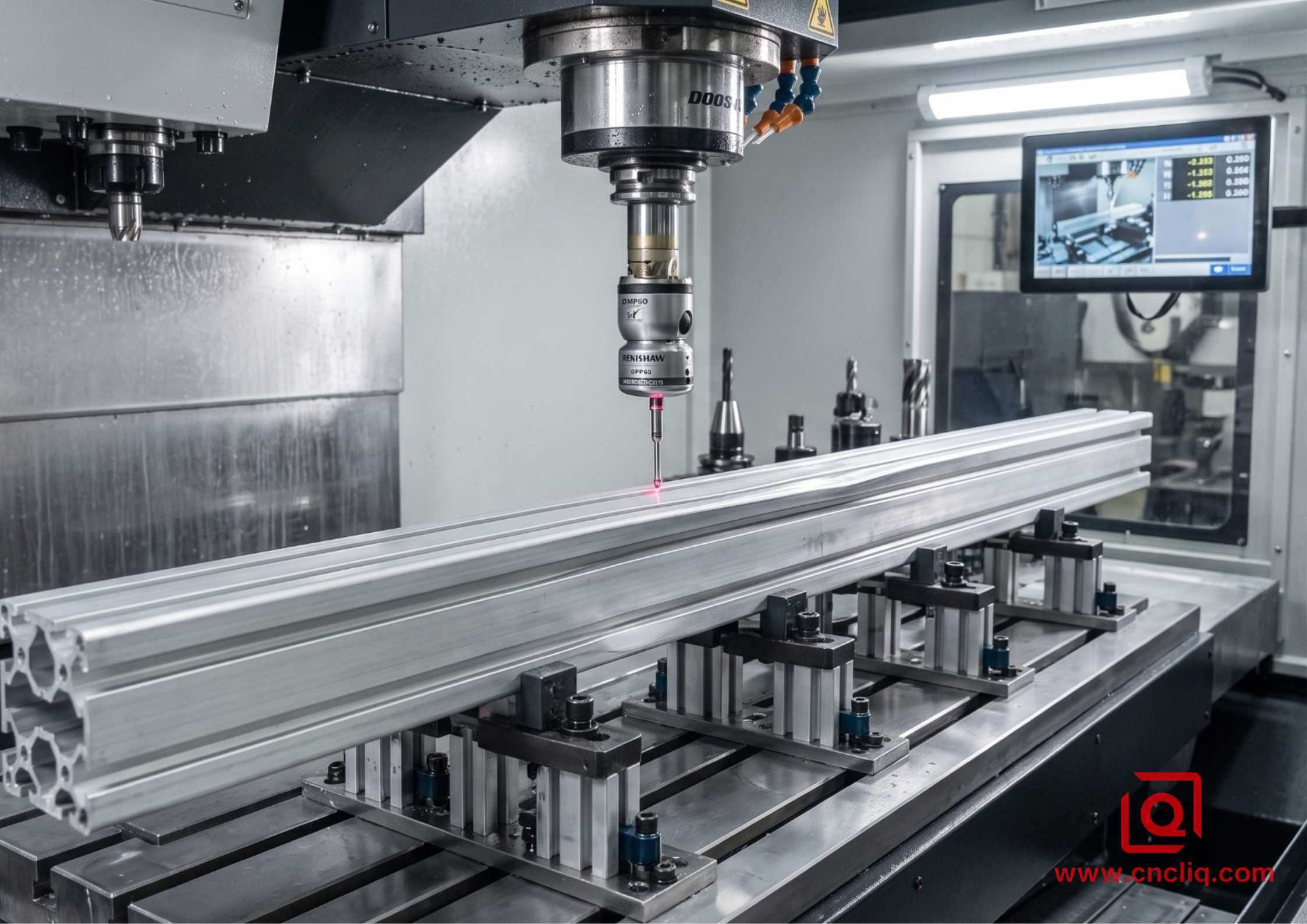
Floating Probe Strategy: Never trust raw extruded datums. Use a touch probe (e.g., Renishaw OMP60) to capture 5 points along the profile length. Compute a dynamic work coordinate system (WCS) rotation in macro variable space before running the spindle.
-
Clamping Stress Isolation: Extrusions contain frozen-in thermal stresses from quench tanks. Milling deep slots (>50% cross-section) causes the profile to snap inward or outward. Mill slots symmetrically from opposing sides, or sequence cuts to alternate between top and bottom faces to equalize stress relief.
-
Tap Fluid Selection: Threading 6063-T6 with form taps (roll taps) yields cleaner threads (Class 6H) than cut taps, but requires precise hole sizing. For M6x1 threads, drill to ∅5.55mm±0.02mm. Lubricate exclusively with neat heavy ester oil—emulsion water content leads to thread galling and tap seizure.
FAQs
Q1: Why do our thin-walled aluminum parts (<1.5mm) warp even when using T651 stress-relieved stock?
A: T651 temper relieves stress from raw mill rolling, but high-speed machining itself introduces secondary mechanical and thermal stress. If you use aggressive tool paths with excessive engagement on one side, localized frictional heat (≥160℃) triggers micro-structural distortion.
Shop Solution: Implement symmetrical stock removal—rough both sides evenly leaving 0.3mm finishing stock, unclamp to relax stress, and finish with high-speed, low-engagement trochoidal paths. Always maintain flood coolant flow at ≥8% emulsion to keep temperatures below 60℃.
Q2: How do we prevent Built-Up Edge (BUE) when high-speed milling 6061-T6 dry or with minimal lubrication (MQL)?
A: Aluminum has a high chemical affinity for iron and cobalt in carbide tools. Dry friction generates severe micro-welding at the cutting zone.
Shop Solution: Never use TiAlN or TiN coated tools (as aluminum content in TiAlN accelerates chip sticking). Switch exclusively to Uncoated Polished Carbide, ZrN (Zirconium Nitride), or DLC (Diamond-Like Carbon) coatings with mirror-polished flutes (Ra<0.1μm). Pair this with an alcohol-based or ester-oil MQL mist directed strictly at the tool-chip interface.
Q3: What causes severe thread galling when form-tapping M4-M8 holes in 6063-T6 aluminum extrusions?
A: Form tapping relies on plastic deformation rather than cutting. 6063-T6 has high ductility, but incorrect hole sizing causes excessive torque, tool friction, and material tearing.
Shop Solution: Hold pre-tap hole tolerance within ±0.015mm (e.g., ∅5.55mm for M6x1). Ditch water-soluble coolants during tapping—use neat, high-viscosity synthetic ester tapping oil. Ensure the tap runs on a rigid synchronized tapping cycle to prevent axial force overload.
Q4: How do we maintain 0.010mm hole position tolerances across a 2,000mm extruded aluminum profile without multi-fixture stack-up errors?
A: Extrusions inherently suffer from longitudinal twist and bow (per EN 755-9/ASTM B221). Mechanical pin-locating against raw extruded surfaces guarantees cumulative tolerance drift.
Shop Solution: Use dynamic probing (e.g., Renishaw OMP60). Probe 5 key points on the profile before machining, calculate the 3D angular rotation and spatial translation in the CNC controller, and apply a dynamic Work Coordinate System (WCS) rotation in macro variables. Never rely on rigid physical stop pins for long profile datums.
Q5: Should we choose 6061-T6 or 7075-T651 for structural components requiring Type III Hard Anodizing?
A: Both alloys accept Type III Hardcoat Anodizing, but 7075-T651 contains 5.1%–6.1% Zinc and higher Copper content, which increases bath resistance, requires higher voltage, and results in a slightly darker/greyer oxide film with marginally lower corrosion resistance than 6061-T6.
Shop Solution: If mechanical strength is priority (tensile strength ≥570MPa), select 7075-T651 but specify a sealed hard-coat anodize (thickness 35–50μm). If corrosion resistance, weldability, and cost-efficiency dominate, stick to 6061-T6 (tensile strength ≥310MPa).
Summary
Precision aluminum machining requires balancing cutter thermodynamics, chip kinematics, and stress relief to consistently hit Ra<0.4μm finishes and ISO 2768-mH tolerances. From defeating 6061/7075 springback with two-stage clamping and thermal stress relief, to preventing BUE using ZrN-coated tools with 70-bar coolant blasting, every micron counts. By replacing rigid mechanical datums on extrusions with dynamic probing and enforcing strict chip-load discipline, engineers can eliminate thermal drift and turn high-risk billet runs into repeatable, aerospace-grade production.
Equipped with over 100 advanced 5-axis machining centers and strict ISO 9001:2015 quality controls, Ningbo Liqin Industrial & Trading Co., Ltd. has the engineering expertise to overcome these complex machining challenges and deliver your most demanding aluminum parts with rapid 24-hour lead times. Don't let residual stress or tight tolerances stall your production—upload your CAD files today to get a free DFM assessment and an instant quote from our senior engineering team!
Contact Information
Disclaimer
The technical parameters, tolerances, and machining data provided in this article are for informational and educational purposes only. Manufacturing outcomes may vary based on specific machine rigidity, tool wear, workpiece heat treatment batches, and shop environment conditions; Ningbo Liqin Industrial & Trading Co., Ltd. makes no express warranties regarding third-party implementation. Buyers and engineers should verify design specifications and conduct initial trial cuts prior to full-scale production.
Liqin Manufacturing Team
We are Ningbo Liqin Industrial & Trading Co., Ltd.,a professional manufacturer with over 18 years of experience in high-precision custom metal parts. We specialize in CNC machining, forging, die casting, and cold extrusion processes, serving industries such as automotive, medical, aerospace, electronics, and more. Our factory covers an area of 6,500 square meters and is equipped with 150+ advanced machines, including:
- CNC machining centers (4-axis, 5-axis)
- CNC lathes and turning-milling complexes
- Cold extrusion equipment (250T–650T)
- Die casting machines
We adhere to ISO9001, ISO13485: 2016, and IATF16949: 2016 standards, implementing end-to-end quality management: In-process quality control (IPQC), final quality control (FQC), outgoing quality control (OQC). CMM, projectors, hardness testers, and salt spray test equipment. Our products are exported to North America, Europe, Asia, and Oceania. We offer:
- One-stop service from design to delivery
- Quick response within 2 hours for quotes and technical support
- Custom solutions based on your drawings or samples
Welcome your inquiries and samples. Visit our website or contact us directly for a competitive quote!