English




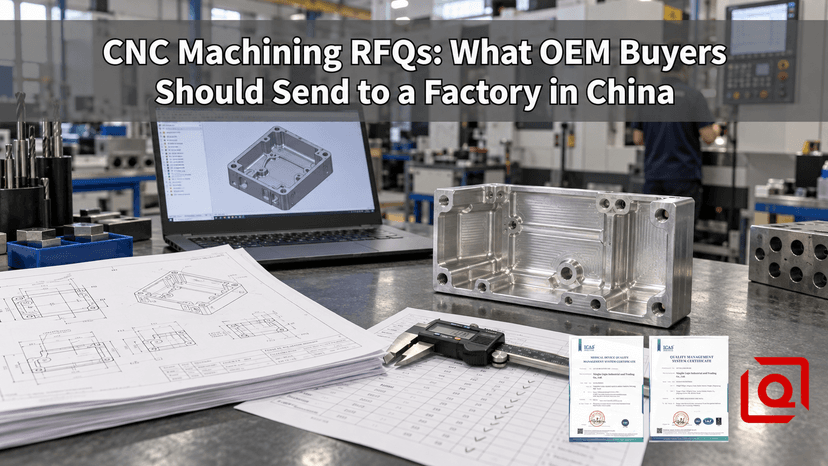
A STEP file landed in our inbox one Monday morning. The email said, “Please quote 100 pieces, best price.” That was the whole message.
The model opened. Nothing was obviously impossible to machine. Even so, a dependable price was still out of reach. Which aluminum grade did the designer want? Was the model released, or was it an early revision? The part had several bores, but no drawing told us which ones actually located the assembly. We also knew nothing about the finish, inspection paperwork, packing method, destination, or future demand.
Yes, a supplier could put a number on that job. It would be a number built on guesses.
This is the awkward truth about CNC machining RFQs: two factories can study the same model and quote two quite different projects without realizing it. One assumes ordinary commercial tolerances; the other budgets for CMM inspection. One includes anodizing and individual wrapping; the other prices bare parts in a shared carton. Comparing those unit prices tells the buyer very little.
A useful RFQ gives each supplier the same starting line. It does not have to be a thick manual. It simply needs to answer the questions that shape material, setups, tooling, inspection, finishing, packing, and delivery.
The short checklist
Before sending an inquiry, check that the package contains:
• a current 2D drawing and usable 3D solid model;
• part number, revision, units, and drawing status;
• exact material grade and condition;
• prototype quantity, first order, usual release size, and annual estimate;
• functional datums, fits, critical features, and surface requirements;
• coating, heat treatment, marking, assembly, or other secondary work;
• inspection records and certificates required with the shipment;
• packaging and labeling instructions;
• destination, requested arrival date, and delivery term; and
• the price breaks, lead-time information, assumptions, and exclusions wanted in the quotation.
Send one controlled file package
File control is usually the first quiet test of a new RFQ. Imagine opening a folder that contains a Rev. C drawing, a Rev. B model, two sketches and a subfolder called “latest.” The estimator cannot safely choose the controlling version from modification dates. Work stops while somebody writes an email.
Put the part number and revision in every filename. For a multi-part inquiry, include a one-page index with the filename, part number, revision, quantity, target date, and whether each file is controlling or reference-only. Remove obsolete copies before sending the package.
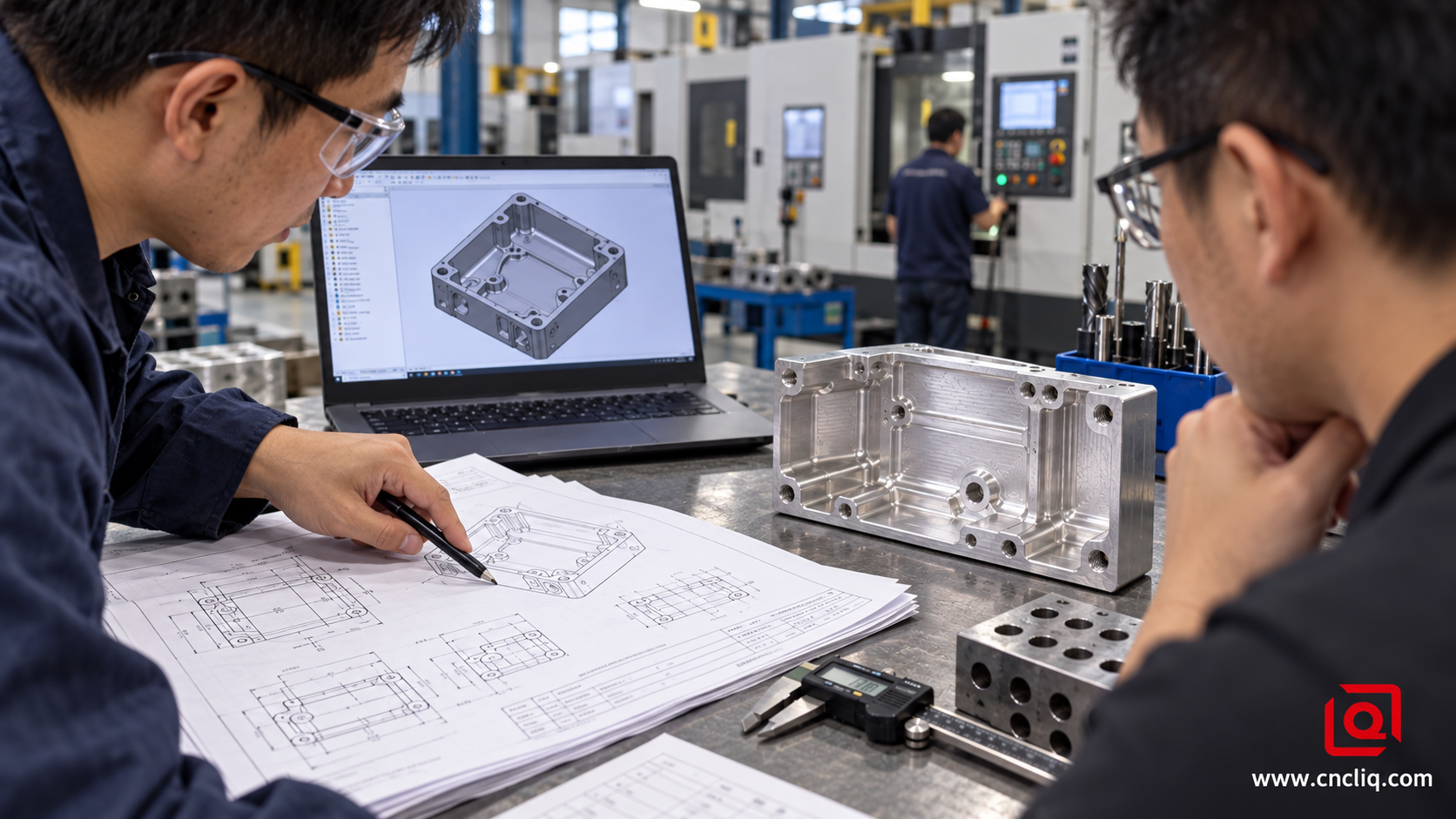
A searchable PDF drawing and a solid STEP file make a practical pair. The model lets a process engineer rotate the part, cut sections, look into deep pockets, and check tool approach. The drawing carries requirements that a shape alone cannot express: datums, GD&T, thread classes, surface texture, edge notes, coating instructions, inspection needs, and revision history.
Before I start an estimate, I compare the model with the drawing. A mismatch is not something I want to “interpret.” The buyer needs to name the governing file. In a model-based workflow, that means identifying the controlled model, its revision, the embedded manufacturing information, and the standard being used. ASME Y14.5 remains the familiar language for GD&T; the official ASME Y14.5 reference is the sensible source when a note is open to debate.
Is an unreleased drawing acceptable for quotation?
It is, provided everyone knows its status. Mark the files “concept,” “preliminary,” “quotation only,” or “released.” List the decisions still open. If the factory may suggest materials, tolerances, finishes, or process changes, invite those suggestions explicitly.
Early DFM review can save a redesign later, but the price should be labeled as a budgetary estimate. Before a purchase order, unresolved points need to be closed or recorded as agreed assumptions.
Explain what the part does
A drawing describes a component; it does not always explain the component. On the shop floor, that missing context matters.
Consider a wide, flat face on a housing. Is it simply convenient stock, or does a gasket seal against it? Will a customer see it, or will adhesive cover it? The CAD file cannot answer. The same problem appears with a pair of similar holes: one may clear a bolt while its neighbor locates the entire assembly. A short application note tells the machinist which relationship deserves attention.
Two or three sentences are often enough. Note which features control fit, motion, alignment, sealing, heat transfer, electrical contact, appearance, or safety. A marked assembly view is useful too; label it as reference if it is not a controlled production document.
Do not mark everything “critical.” A needlessly tight title-block tolerance pushes extra finishing and inspection onto features that add no value. Instead, identify the functional relationships. That gives the process engineer freedom to build a stable, economical route around them.
For angled holes, deep cavities, or tight relationships across several faces, the factory may consider 5-axis machining in one setup. The geometry and datum scheme should drive that choice, not the idea that the most advanced machine is automatically the best answer.
Name the material precisely
“Aluminum” is not a material specification. Neither is “stainless steel.” State the grade and, where relevant, the temper, delivery condition, hardness, heat treatment, or governing customer specification.
If a regional equivalent is acceptable, define the approval route. A clear note might say, “Equivalent material may be proposed, subject to written buyer approval before production.” That invites a useful alternative without authorizing a quiet substitution.
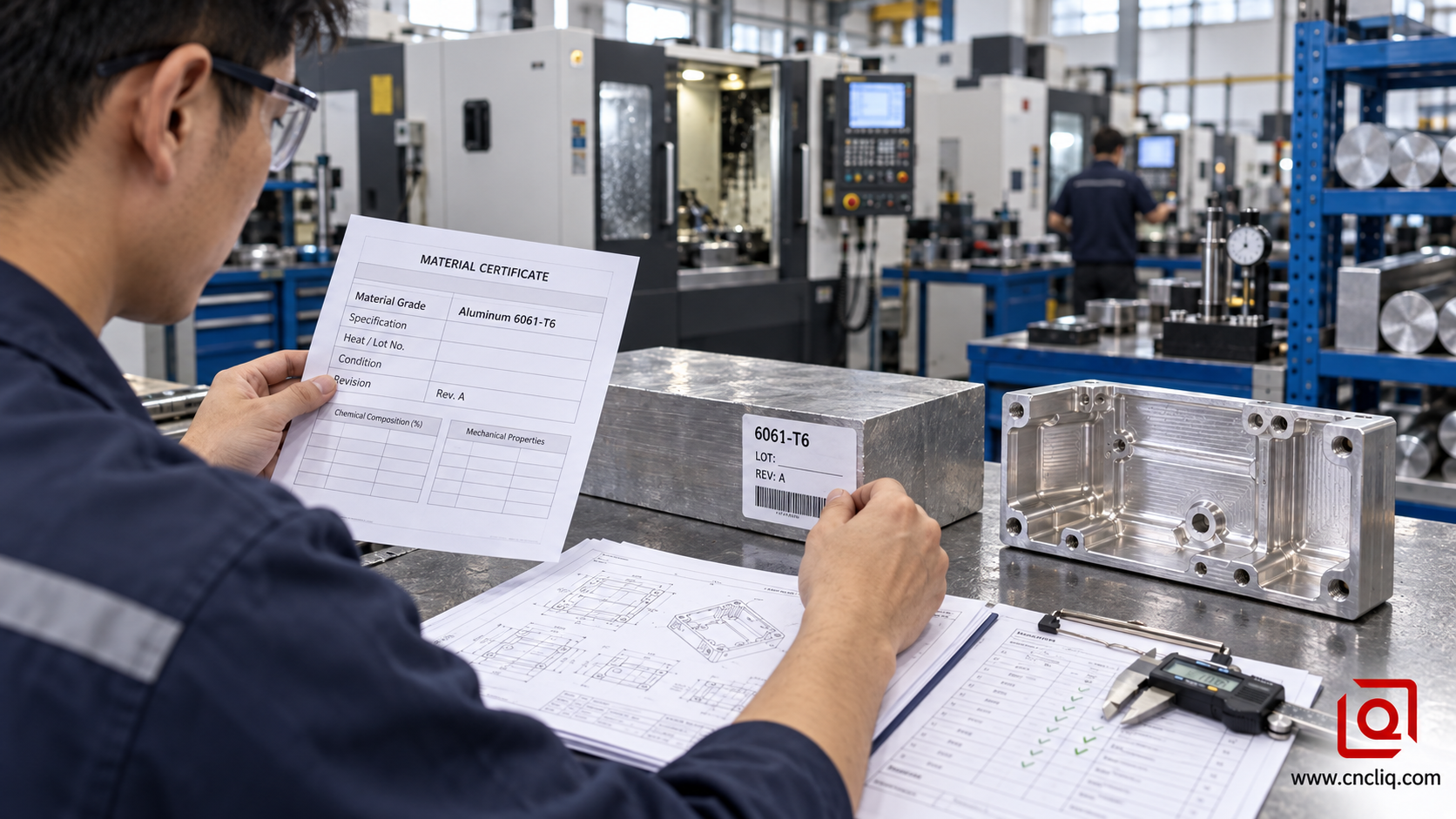
Also identify the evidence that must follow the parts. Do you require a generic material certificate, a mill certificate linked to incoming stock, or lot traceability that continues through finished packing? These are different levels of work.
Material affects more than billet price. It changes stock availability, tool wear, distortion risk, surface finish, corrosion behavior, heat-treatment response, and coating compatibility. Buyers choosing between common aluminum grades can review Liqin’s guide to 6061 versus 7075 aluminum for OEM machining.
Separate samples from production demand
“Quantity: 10” could describe a maintenance order, an engineering trial, or the first build of a product expected to use thousands of parts. Those situations do not deserve the same manufacturing plan.
For a prototype, standard tools, flexible workholding and more manual inspection may be sensible. Repeated releases may justify a dedicated fixture, preset tooling, planned in-process checks, or a larger stock purchase. Tell the factory the sample quantity, first production batch, normal release size, ordering frequency, realistic annual demand, and any price breaks you want.
Nobody expects an early forecast to be exact. Write “planning estimate” beside it and move on. I would also ask for tooling and one-time engineering charges on separate lines. Otherwise a buyer sees an expensive prototype, a cheaper production part, and no clear point at which the saving actually begins.
If the process will change after approval, ask what changes. A good supplier should be able to explain why a fixture becomes worthwhile, which inspection steps are retained, and whether the production drawing must differ from the prototype issue.
Let tolerances follow function
Tolerances shape real decisions: machine selection, clamping, cutting sequence, tool reach, temperature control, inspection frequency, and gauge choice. A tight position between bores may require both to be completed in one setup. A close fit may need an allowance before anodizing. A thin wall may move as residual stress is released.
Before sending the RFQ, look for familiar trouble spots:
1. Model and drawing nominal sizes do not agree.
2. Datums are missing or unrelated to assembly function.
3. Thread notes omit class, engagement, or full-thread depth.
4. Fine surface roughness is applied to the entire part.
5. The general tolerance is tighter than the product needs.
6. A coating note does not say whether dimensions apply before or after treatment.
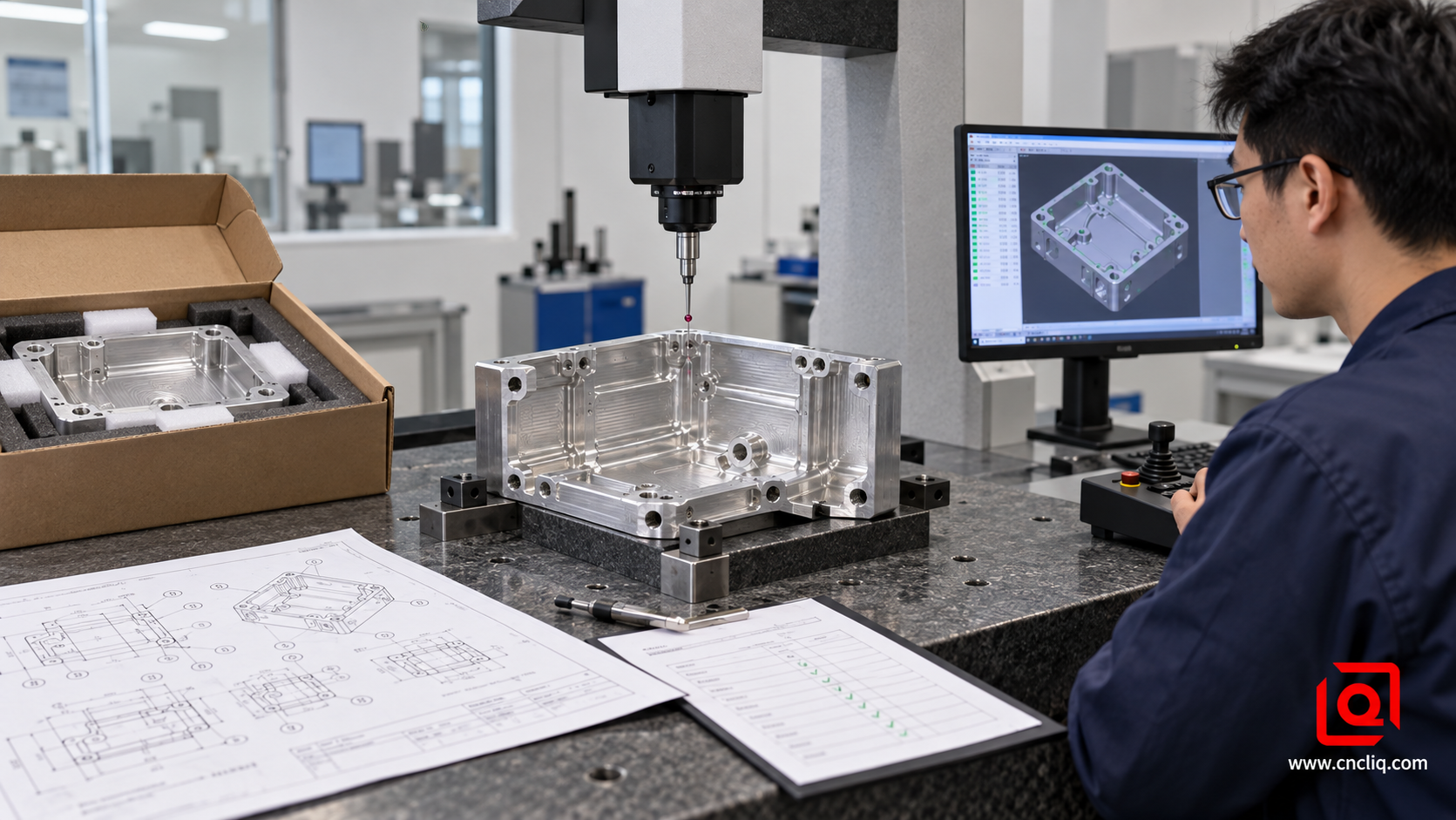
For every critical feature, the dimensional rule and inspection approach should tell the same story. Ask how a difficult requirement will be verified. A CMM is valuable for profiles, positions, and complex datum structures, but it is not the universal answer. A plug gauge, thread gauge, micrometer, height gauge, or functional fixture can be better for a simple feature.
The factory’s planned measurement method should support the acceptance decision. Liqin’s article on CMM inspection for custom aluminum machining gives buyers more background on complex dimensional checks.
Include finishing at the beginning
Ask for the finished component, not merely the metal-cutting portion. The RFQ should include anodizing, plating, passivation, heat treatment, grinding, polishing, blasting, painting, powder coating, laser marking, cleaning, hardware installation, assembly, or special packing where required.
Put the finish specification in the RFQ, including color, texture, thickness, masking, and the faces people will see. There is one question I ask early: are the critical sizes required before treatment or after it? Anodizing can close a small bore or tighten a thread. Heat treatment can pull a thin part out of shape. A masked pad, meanwhile, may need a second trip to the machine. None of that belongs in a last-minute note.
“Perfect appearance” sounds demanding but is almost impossible to inspect consistently. A usable cosmetic note identifies the visible faces, viewing distance, lighting, approved reference sample, allowed marks, and surfaces needing individual protection.
Put inspection paperwork into the price
Inspection paperwork is real work. I have seen an order described as “standard inspection” turn into a ballooned drawing, a CMM report on every feature, material traceability, and three certificates after the price was accepted. The metal did not change; the job did.
Tell the estimator what must arrive with the parts. It may be a first-article report on one piece, selected dimensions on five pieces, raw CMM data, a PPAP file, a certificate of conformity, or a lot history retained for years. If your company has its own report form, send the blank template with the RFQ. The sample count matters as much as the name of the report.
A calibration label does not settle every measurement argument either. How is the part held? Which surfaces simulate the datums? At what temperature? What uncertainty is acceptable? When a supplied mating component or a functional gauge decides acceptance, put that fact in the inquiry rather than revealing it after samples are complete.
Treat packaging and delivery as engineering inputs
“Ship ASAP” leaves too much unanswered. Give an arrival date and a destination. For an overseas order, write the Incoterm together with the named place; “FOB” on its own is incomplete. I also want to know whether the buyer expects freight, insurance, duty, tax, export packing, or staged releases inside the quoted figure.
Packing sounds commercial until a polished face rubs against another polished face for a week at sea. Then it becomes an engineering problem. Fine threads may need caps. Black-anodized panels may need film and individual bags. A corrosion-sensitive batch might need desiccant, while a mixed kit needs trays and position labels. Send an existing packaging standard, or at least describe what must not touch, scratch, rust, bend, or get mixed.
The cheapest time to settle those details is before the quotation. The most expensive time is after a perfect part reaches the assembly line with a transit mark across its visible face.
Compare scope before comparing price
Send every shortlisted shop the same revision, then ask them to return prices in the same shape. My comparison sheet has separate lines for material, finish, tooling, unit prices, sample lead time, production lead time, reports, packing, and delivery terms. I also record quote validity, payment terms, assumptions, exceptions, and proposed alternatives.
This small bit of bookkeeping prevents a familiar mistake. Supplier A includes anodizing, a material certificate, dimensional reports, and export cartons. Supplier B excludes all four and appears cheaper. Once the missing work is added, the ranking may reverse.
Read the questions as carefully as the prices. An estimator who notices a weak datum or asks about coating allowance is not necessarily causing trouble. Quite often, that person is the only one who actually opened the drawing at full size. Silence is convenient during sourcing; it can be painfully expensive during production.
An anonymized example: aluminum lighting lid
Liqin’s catalog shows a marine-grade aluminum explosion-proof lighting top lid. For a comparable custom lid, the RFQ should explain the mating enclosure, seal, locating holes, threads, aluminum condition, finish, hardware, reports, packing, quantity, and buyer-controlled safety requirements. If stock form or surface process may change, say which functional and regulatory boundaries may not. The public page does not disclose customer results or production statistics, so none are assumed here.
Buyers of housings, lids, bases, and related components can review Liqin’s CNC machining and metal-manufacturing services before sending controlled project files.
A short RFQ email that works
The covering email should help the estimator navigate the package, not rewrite the drawing. Six short lines usually do the job. Start with the project and application. List the part numbers, revisions, PDF drawings, and models. Add prototype and production quantities. Name the material, finish, reports, marking, and packing. Give the destination and arrival date. Finally, say how you want prices, tooling, lead times, exceptions, and DFM comments returned.
Write down undecided points. For example: “Coating color remains open. Use black anodizing as the quotation basis and show the cost or lead-time effect of alternatives.” That sentence is far better than letting every supplier make a different private assumption.
If the package is ready, send the drawings and requirements to Liqin for an engineering review and quotation.
FAQs
Can a CNC factory quote from a 3D model only?
A model can support a rough estimate, but it often leaves the acceptance rules invisible. The drawing usually tells us about datums, GD&T, threads, texture, finish, and inspection. In a model-based workflow, identify the controlled revision and embedded manufacturing data. Until those rules are agreed, regard the price as an early budget.
Which CAD files should I send?
Send a searchable PDF and a STEP or STP solid model. That pair opens reliably in most quoting workflows. Native CAD is welcome when software versions are compatible. A DXF can help with a laser-cut profile, but it does not replace the notes and tolerances on the full drawing. Check the units and revision one last time before attaching anything.
May I request a quote before every detail is final?
Yes. Designers ask for early prices all the time. Send the newest files, your likely material and volume, the features that matter, the probable finish, and the intended delivery window. Mark what is undecided. The supplier can price a stated set of assumptions now, then refresh the quote when the drawing is released.
Why does the supplier ask for annual demand?
Because ten trial pieces and ten pieces from a 5,000-part program are different jobs. The second case may justify a fixture, preset tools, a stock agreement, or a dedicated gauge. A forecast does not have to be a promise. Even a rough range helps the process engineer avoid optimizing the wrong quantity.
What should I check when comparing Chinese CNC quotations?
First check that the offers refer to the same revision and quantity. Then compare material condition, finish, reports, packing, and delivery basis line by line. Keep tooling separate. Note the Incoterm and named place, payment terms, validity, lead time, capacity assumptions, exclusions, and technical exceptions. If something necessary is absent, the lowest unit price is only the least complete number.
Contact Information
Disclaimer
All technical articles, material specifications, machining recommendations, and surface treatment details published on this blog are for informational and reference purposes only. Please note that general blog insights do not replace signed technical agreements. Because custom parts vary by material heat numbers, machine calibrations, and specific tolerances, binding quality specs are governed solely by your approved CAD drawings, signed contracts, and formal quality plans.
All customer case studies featured on this blog have been thoroughly anonymized and sanitized.The performance metrics, manufacturing workflows, and imagery displayed serve solely to demonstrate our custom machining capabilities and do not represent a single universal standard for all orders.
Liqin Manufacturing Team
Built on 18 years of precision engineering experience, Ningbo Liqin Industry manufactures high-tolerance metal components for demanding global markets. We operate out of a 6,500 m² production hub equipped with over 150 machines, running 4-axis and 5-axis CNC machining, mill-turn machining, cold extrusion, and pressure die casting under one roof. This setup allows us to manage projects seamlessly, taking parts from initial CAD concepts directly to finalized shipments.
We handle quality control with zero compromise. We treat tight tolerances with the engineering discipline they require. Backed by ISO 9001, ISO 13485, and IATF 16949 certifications, our QA engineers run strict IPQC, FQC, and OQC checks on every single production batch. From CMM dimensional mapping and optical profiling to hardness and salt-spray testing, we validate your critical specs upfront—so you receive drop-in ready components with zero assembly headaches or costly line stoppages.On top of manufacturing, you can rely on us for two-hour response times on new RFQs, direct support for prototype sampling, and smooth export shipping across Europe, North America, Asia, and Oceania.
Welcome your inquiries and samples.Visit our website or contact us directly for a competitive quote!