 English



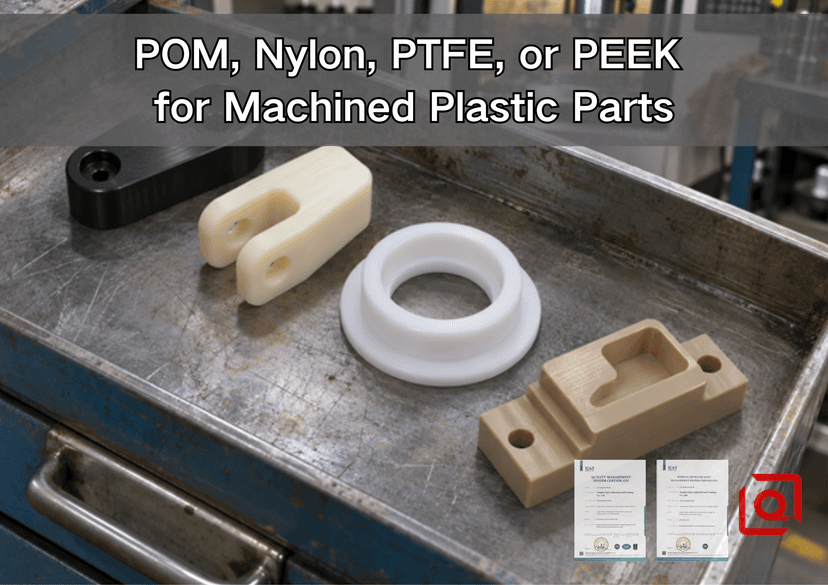
Have you ever approved a plastic prototype that slid smoothly on the bench, only to find that production parts bind after a washdown, loosen around a bolt, or go out of round when the fixture opens? The drawing may be the same. The part is now seeing a different combination of moisture, heat, load, and support. If you are choosing a material for a guide, bushing, valve seat, or custom insulator, this guide will help you narrow the options and send a machinist enough information to quote the part you actually need.
Start with POM for an ordinary sliding part with a close fit, nylon for a wear part that takes repeated knocks, PTFE for a supported seat exposed to aggressive media, and PEEK for a loaded part whose service conditions exceed what the other candidates can reasonably handle. Treat those as starting points. The stock grade, mating surface, load duration, and way the part is measured can change the decision. For custom CNC plastic machining, the fastest shortlist usually comes from identifying the failure that would stop the machine or send a shipment back.
Compare the four materials by how the part can fail
A smooth first movement tells you little about how a component will behave after repeated cycles. A low-friction polymer can still wear in a dusty track. A good-looking seat can lose sealing force under constant compression. Begin by naming the surface that does the work and the change you can least afford. That makes the table below a decision tool for your specific drawing.
|
Material |
Good first applications |
What to verify before approval |
|
POM, or acetal |
Bushings, locator blocks, and compact sliding guides with close fits |
Actual grade, hot and cold running clearance, and compatibility with cleaners |
|
Nylon, or polyamide |
Rollers, replaceable wear strips, and guides that take intermittent impacts |
Moisture condition for inspection, space to swell, and wear against the mating surface |
|
PTFE |
Supported valve seats, backup rings, and low-friction contact faces in chemical service |
Creep under sustained load, extrusion gaps, and distortion after unclamping |
|
PEEK |
Loaded guides, precision carriers, and insulators in demanding thermal or chemical service |
Performance of the exact grade at service temperature, stock availability, and cost |
One useful check is to describe the application without any material names. “A roller that takes occasional hits and can tolerate some side play” points to a different solution from “a guide that must locate a shaft after repeated cleaning and warm-up.” If both parts start with the same general material callout, each may be cheap to quote and expensive to qualify. Liqin’s guide to choosing engineering plastics for CNC machining provides additional background on grade selection and how the materials behave during cutting.
POM for close-fitting guides, bushings, and spacers
POM stands for polyoxymethylene. You may know it as acetal. For a dry-running guide or a small turned bushing working at moderate temperatures, acetal is often a useful first sample. It combines relatively low moisture uptake with enough stiffness to locate a mating piece and generally machines cleanly with a sharp cutting edge. The material line on the drawing should distinguish POM-C, a copolymer, from POM-H, a homopolymer. Delrin is a brand of acetal homopolymer. If a brand or grade is part of your qualification, put that requirement in the drawing or purchase specification and state whether alternatives need approval.
When a bushing fits tightly in a housing, inspect the bore in the state that matters. Installing the bushing may change its internal diameter, particularly when the wall is thin. A bore that passes as a free part can grab the shaft after assembly. Share the shaft and housing limits with the shop and agree on whether the acceptance check applies to the loose bushing, an installed part, or both. Liqin’s precision stainless steel stepped shaft shows how a mating journal, locating shoulder, and retaining feature can sit on the same component. Call out the shaft journal finish and diameter alongside the bushing requirements. For a sliding block, specify the faces that locate the part in its track and give the nonfunctional outside faces more latitude. If cleaners contact the POM, give the supplier their names, concentrations, temperature, and contact time.
A simple thermal expansion check
Ensinger lists a representative longitudinal coefficient of linear thermal expansion of 130 µm/m per °C between 23 and 60 °C for its natural TECAFORM AH POM-C stock in its engineering plastics stock shapes data guide. Using that coefficient, a free 100 mm span taken from 23 to 33 °C grows by about 0.13 mm. That is an estimate for the stated grade and direction. In assembly, the housing can expand too, and restraint or uneven heating can alter the result. The calculation is a quick way to see when a drawing’s room-temperature clearance needs a separate service check.
Nylon for impact and replaceable wear surfaces
Nylon is a family of polyamides. PA6, PA66, cast nylon, and filled bearing grades give a design engineer different choices for stock size, impact behavior, and sliding wear. Think of a guide at a conveyor transfer where a misaligned carrier can hit the leading edge. A replaceable nylon insert gives you a surface to evaluate for wear and for the occasional hit. Give the prototype a useful lead-in and allow the support behind the insert to carry the load. Then test with the real counterpart and any dirt, cleaning residue, or lubricant the machine sees.
Moisture is the issue to address early. In the same Ensinger stock shapes guide, the ISO 62 figures after 24 and 96 hours in water at 23 °C are 0.2% and 0.4% for natural TECAMID 66 and 0.05% and 0.1% for natural TECAFORM AH. These are mass gains in that test. To predict a running gap, measure the actual part or use grade-specific dimensional data. Water uptake can also affect the mechanical response of nylon. If the part sees a humid area or frequent washdowns, agree on the inspection state, how samples will be conditioned, and how the installed clearance will be checked after exposure. Keeping a sample for a service trial can be more informative than taking several extra readings on the day the stock is cut.
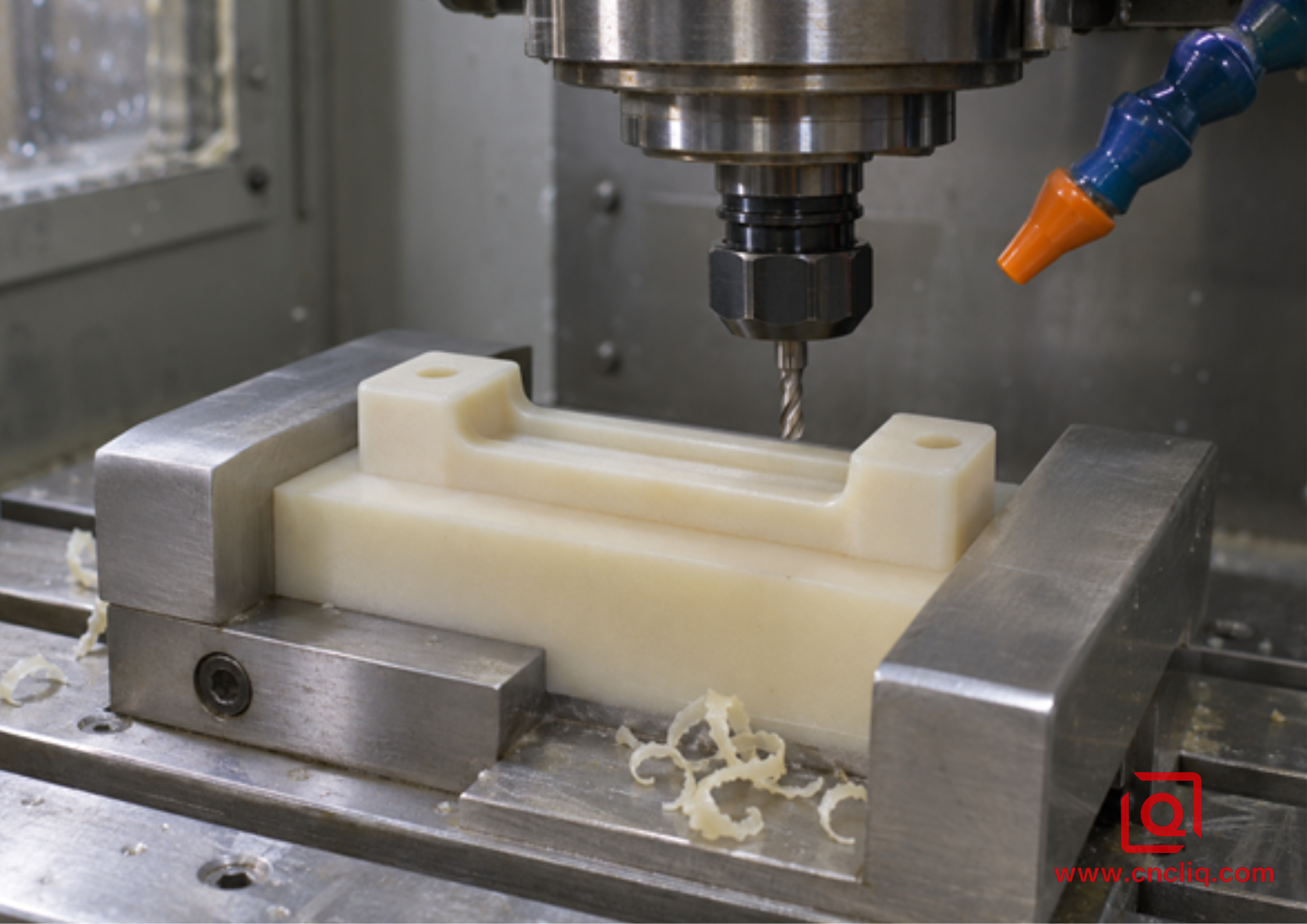
A machinist can support a long nylon guide on the mounting face and spread the clamp load so the part does not bow while the slot is cut. Sharp cutters and room for chips to escape help control rubbing. If the slot dimension is critical, measure it after the guide has been released and has reached the agreed inspection condition. A slotted mounting feature can also give a long guide room to move, provided the assembly still has a defined locating point and the expected loads allow it.
PTFE for supported sealing and chemical-contact parts
PTFE stands for polytetrafluoroethylene. Its low friction can help a valve or mechanism release smoothly, and its chemical resistance makes it a candidate for many wetted parts. For a seat, start with the fluid and the sealing conditions. What is in the stream? What is the highest temperature during cleaning? How long does the assembly stay compressed or pressurized between cycles? The grade supplier needs the media and exposure details to assess suitability, especially for a filled PTFE where the filler can change chemical compatibility and wear.
Creep, sometimes called cold flow in this context, is the gradual change in shape under a sustained load. A PTFE seat may seal during a short bench test and lose contact pressure after it has been compressed for a longer period. An unsupported lip can also move into a clearance gap. Give the machinist the seat pocket geometry and the expected loading. A broad backing shoulder, an appropriate gap, and a drawing that distinguishes the seal face from clearance features help both sides agree on what to control. The shop can then assess workholding that supports the seat without squeezing it out of round and agree on low-force inspection where needed.
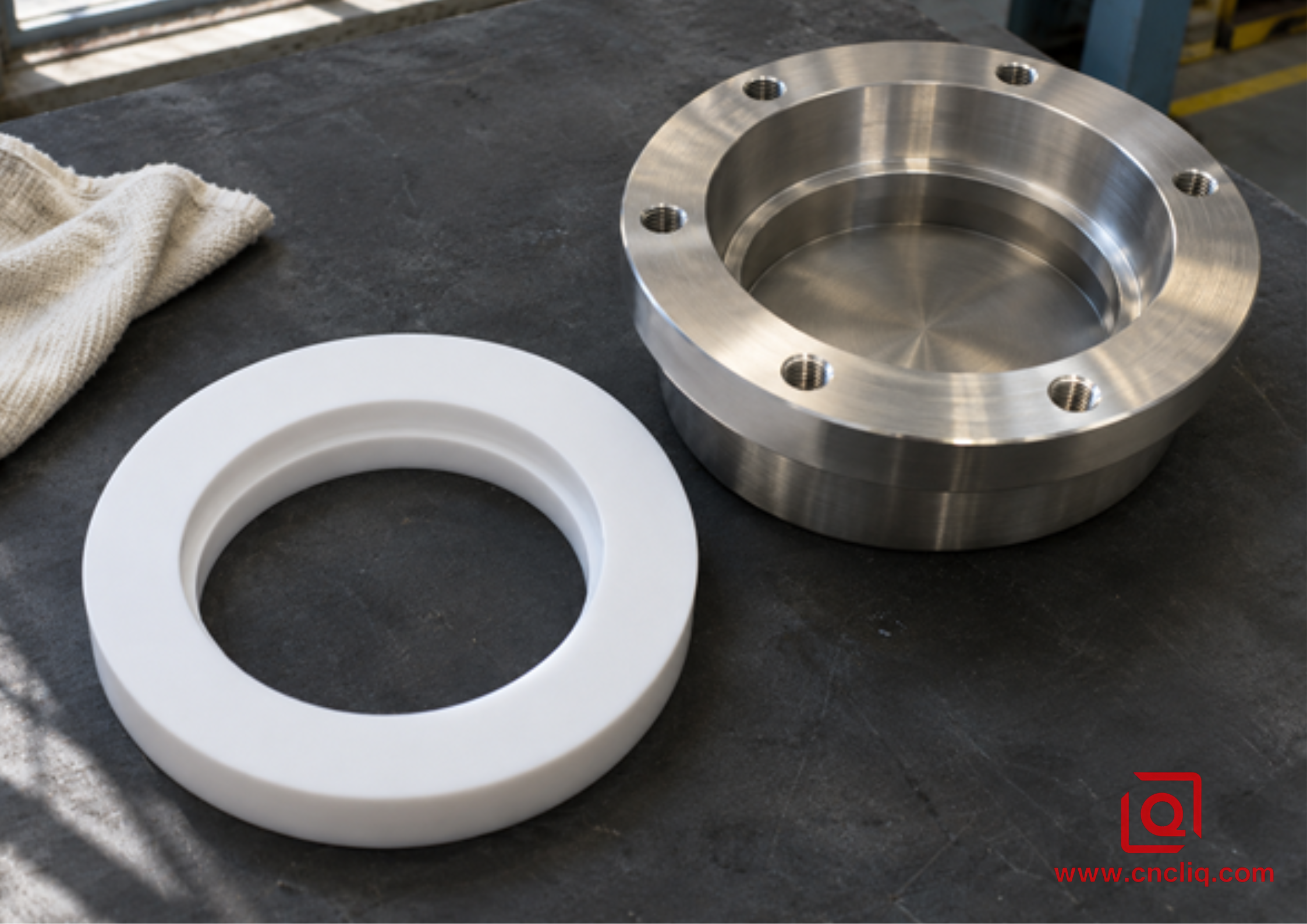
If you are sourcing both pieces of a polymer-to-metal interface, include both drawings or a section through the assembly. A machined metal shoulder may carry the preload while the polymer provides the contact surface. On a valve seat project, show the pocket depth and backing shoulder dimensions, and identify the finish on the surface that touches the seal. Those details let the shop quote to the actual sealing stack. They also help the buyer identify which piece to remeasure if a seal passes on the bench but leaks after assembly.
PEEK for loaded parts in demanding service
PEEK stands for polyether ether ketone. It is worth evaluating when the application combines heat, sustained mechanical load, dimensional requirements, or chemical exposure that rules out simpler candidates. Good examples include a precision carrier near a heated process or a guide that must stay aligned through repeated warming and cooling. PEEK is also available in unfilled, glass-filled, carbon-filled, and wear grades. A filler may improve stiffness or change thermal expansion, but it can also change how the part wears against a shaft, how the tool edge holds up, and whether a part meets an electrical insulation requirement.
Victrex’s PEEK polymers technical brochure lists 143 °C for the glass transition temperature and 343 °C for the melting point of its unfilled 450G polymer. The same source reports typical tensile stress at break of 100 MPa at 23 °C and 18 MPa at 175 °C in its specified tests. The comparison illustrates why a hot loaded part needs more than a melting point on a datasheet. Obtain temperature-dependent data for the specific machined stock where available and verify critical deflection or retention on a representative part. A resin test specimen and an extruded block with a deep milled pocket can behave differently.
PEEK stock can drive the quote when a tall boss forces the shop to start from a thick billet. Ask whether moving the boss, reducing excess height, using a more suitable stock section, or making a replaceable contact insert would reduce stock consumption. Keep the comparison tied to assembly and inspection costs. A common material may be economical when fit and wear are easy to verify. A higher-cost grade may make commercial sense when qualification shows it preserves function over a service interval that would otherwise require repeated maintenance.
Make the drawing match the machining and inspection plan
Separate machine movement from part movement
A dimension can change at several points between the first cut and installation. Clamping can squeeze a thin ring. Cutting can heat a pocket wall. Removing material from one side can release stress and move the remaining shape. A pocketed plate that lies flat on a vacuum fixture can lift when the fixture is released. Those changes call for different fixes. Liqin’s article on thermal deformation and dimensional stability in plastic machining explores the effects of stock condition and workholding. It helps to compare readings after roughing, after unclamping, and after the part reaches the agreed condition. When roughing reveals movement, a thin finishing allowance and a revised support strategy can be more effective than chasing a tool offset.
Plan tool access and workholding together. If a corner radius can increase, the shop may be able to use a shorter, stiffer cutter. On a thin locating tab, leave support close to the cut where practical. On a narrow turned ring, consider broad contact in the jaws and a method for checking the bore after release. For design changes that can cut setup and inspection time, see Liqin’s field guide to tolerances and cost for custom plastic CNC parts.
Agree on the acceptance condition
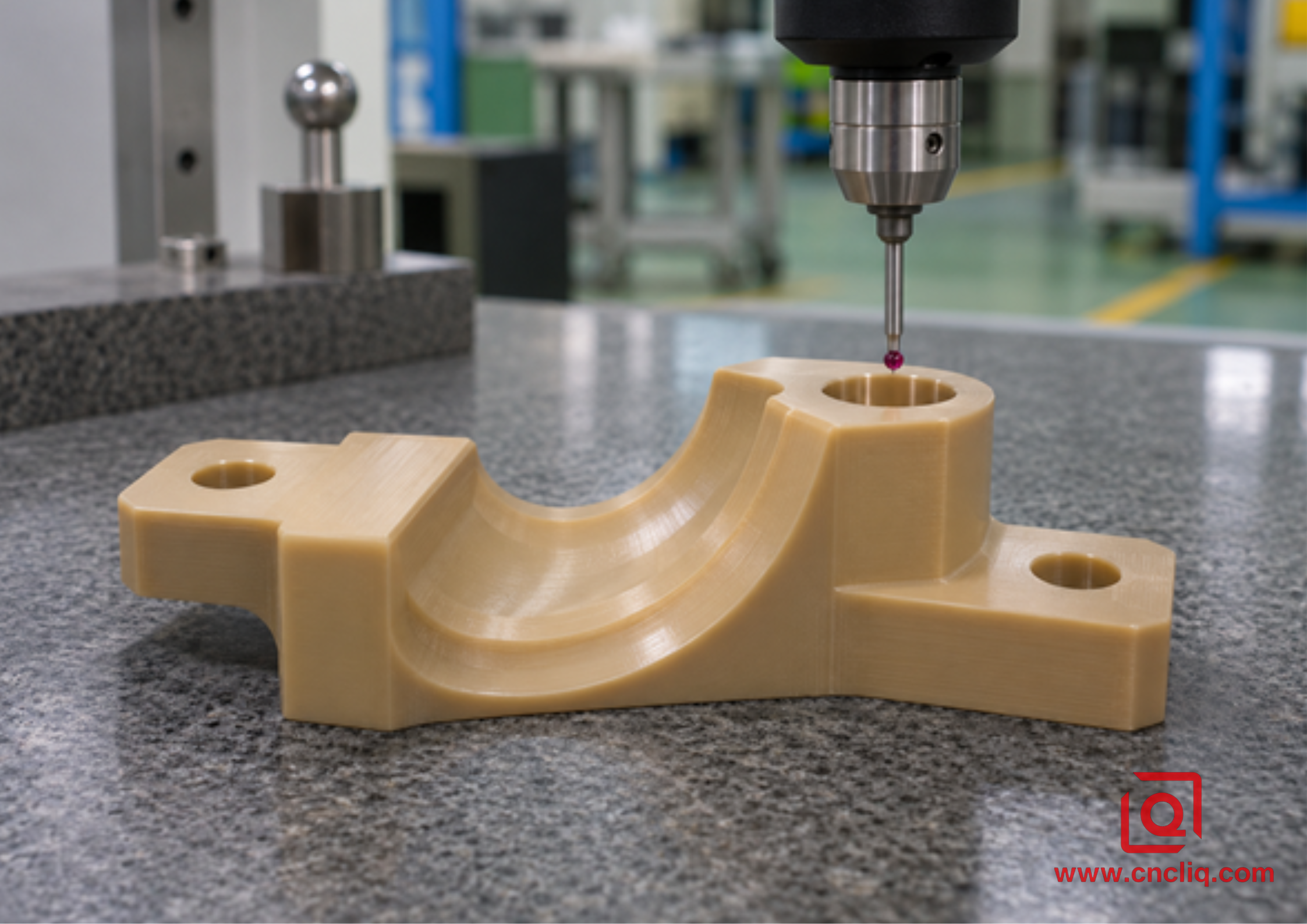
Mark the surfaces and axes that establish the part in assembly. Put the close tolerance on the feature that controls fit, sealing, position, or travel. State the inspection condition if temperature, moisture, or fixture support affects the result. A compliant part can deflect under a micrometer spindle or on a CMM fixture, so agree on how it will be supported and measured. If a first article needs to be checked against mating hardware, arrange samples of that hardware or a suitable functional gauge before the job starts. The agreed condition makes measurements at the shop and at incoming inspection easier to reconcile.
Anonymous customer scenario for a packaging line guide
Drawing on its published custom machining capabilities, Liqin uses this illustrative, anonymized sourcing scenario to show how it would review a replaceable guide on a packaging line. The maintenance team needs the guide to locate a moving carrier. Its leading edge occasionally takes an impact, and a steel bracket fixes one end. Warm cleaning cycles are followed by a humid restart. The team can tolerate cosmetic marks on the outside, but binding at startup would stop the line. The guide slot and the bracket interface therefore control the decision.
The first review would compare an acetal grade with a suitable nylon grade against the actual cleaning chemistry and service temperature. Nylon is worth a wear and impact trial if the guide can accommodate dimensional movement. Acetal is a candidate if the locating gap needs to stay closer to its inspected condition and compatibility checks out. If the temperature and load data eliminate those candidates, Liqin would review a suitable PEEK grade before pricing a production run. PTFE could be evaluated for a supported contact insert if low friction is important and the surrounding structure can maintain the shape and clearance under load.
The proposed route would rough the guide from stock, release it to check movement, then finish the mounting face and slot using a supported setup. The first article would be measured off the fixture at the agreed condition. The buyer would then check installed clearance and free travel before and after repeated cleaning and restart cycles using the actual carrier. A useful pilot compares the force needed to move the carrier, the fit at restart, and visible wear at the leading edge. These would be agreed test criteria for the scenario. Liqin’s guide to moving from a plastic prototype to low-volume machining covers the production planning questions that follow a pilot.
What to send for a custom CNC plastic machining quote
Send a STEP model and a dimensioned PDF with the same revision. Highlight the features that determine fit. If you can share an assembly view, include the mating shaft, housing, or track with its own tolerance. On the material line, state the grade, filler, and any documentation you need. If the grade is open, give the shop the freedom to compare options against an explicit duty cycle. Include the peak and steady temperatures, the cleaning fluids or process media, the type and duration of the load, and whether the part runs dry or lubricated.
Give the prototype quantity, release quantity, and expected repeat demand separately. State which measurements need a report, whether an installed check is required, and how the parts should be packed when surfaces or moisture condition matter. For a useful comparison of custom CNC plastic machining quotes, ask each supplier to quote the same grade and inspection scope and to separate any approved alternate. Stock size, fixture work, finish passes, deburring, and the number of features that need documented inspection can each change the unit price.
If your drawing allows two grades, ask Liqin to quote the baseline and the alternate using the same acceptance checks. Use the custom precision manufacturing inquiry link to submit the files and describe the failure you want to avoid. A note as simple as “the slot must slide freely after a hot wash and overnight cooling” helps an engineer review the drawing in the right order.
FAQ
1、What is a good starting material for a precision machined plastic bushing?
POM is a good starting point for many plain bushings in moderate service because it machines cleanly and takes up relatively little moisture. Review the actual shaft finish, housing fit, temperature, and load before releasing the material. For a press-fit bushing, ask for the installed bore or running clearance to be checked, especially if the wall is thin.
2、When should I choose nylon over POM for a wear guide?
Trial nylon when the guide sees repeated impacts or abrasive service and can accommodate dimensional changes from humidity. Compare the actual grades against the same mating surface, under the same load and contamination conditions. If the guide also controls a close locating gap, include hot and humid operation in the trial and check clearance after exposure.
3、Can a machined PTFE valve seat hold its shape under constant compression?
A supported PTFE seat can be a suitable candidate, but long-term creep can change its shape and contact pressure. Review the grade, backing shoulder, extrusion clearance, temperature, and sustained load together. Define a functional test with the actual housing and representative pressure and hold time so the initial fit and longer-term seal performance can both be assessed.
4、Is PEEK worth the extra cost for a high-temperature plastic part?
It can be when the exact grade meets the required stiffness, wear, or stability in service and a lower-cost material cannot. Ask for temperature-dependent data and verify the critical function on a pilot part. If only one surface needs the higher performance, a small replaceable insert may let the assembly use less PEEK.
5、What affects lead time for custom CNC plastic machining?
Lead time depends on the availability of the approved stock shape, grade, and size, along with fixture work and inspection. A repeat release using approved stock and tooling is easier to plan than a first article that needs special material or conditioning. Share the delivery date, quantities, and critical checks up front so the supplier can assess the schedule against the actual scope.
Summary
Shortlist POM for close-fitting parts in moderate service, nylon for tough wear parts with room for moisture-related movement, PTFE for supported low-friction or chemical-contact features, and PEEK for grades that can carry the required load in more demanding conditions. Check the material in the assembly and in its real operating environment. At RFQ, provide the grade, drawings, mating dimensions, quantities, and inspection condition so the quote reflects how the part must perform.
Contact Information
Company: Ningbo Liqin Industry Co., Ltd.
New inquiry, quotation & order discussion:zhouli@chinaliqin.com
Daily customer maintenance & after-sales support:zhuwanying@cncliq.com
Hotline: +86 18757148656
Disclaimer
All technical articles, material specifications, machining recommendations, and surface treatment details published on this blog are for informational and reference purposes only. Please note that general blog insights do not replace signed technical agreements. Because custom parts vary by material heat numbers, machine calibrations, and specific tolerances, binding quality specs are governed solely by your approved CAD drawings, signed contracts, and formal quality plans.
All customer case studies featured on this blog have been thoroughly anonymized and sanitized. The performance metrics, manufacturing workflows, and imagery displayed serve solely to demonstrate our custom machining capabilities and do not represent a single universal standard for all orders.
Liqin Manufacturing Team
Built on 19 years of precision engineering experience, Ningbo Liqin Industry manufactures high-tolerance metal components for demanding global markets. We operate out of a 6,500 m² production hub equipped with over 150 machines, running 4-axis and 5-axis CNC machining, mill-turn machining, cold extrusion, and pressure die casting under one roof. This setup allows us to manage projects seamlessly, taking parts from initial CAD concepts directly to finalized shipments.
We handle quality control with zero compromise. We treat tight tolerances with the engineering discipline they require. Backed by ISO 9001, ISO 13485, and IATF 16949 certifications, our QA engineers run strict IPQC, FQC, and OQC checks on every single production batch. From CMM dimensional mapping and optical profiling to hardness and salt-spray testing, we validate your critical specs upfront—so you receive drop-in ready components with zero assembly headaches or costly line stoppages. On top of manufacturing, you can rely on us for two-hour response times on new RFQs, direct support for prototype sampling, and smooth export shipping across Europe, North America, Asia, and Oceania.
Welcome your inquiries and samples. Visit our website or contact us directly for a competitive quote!