English




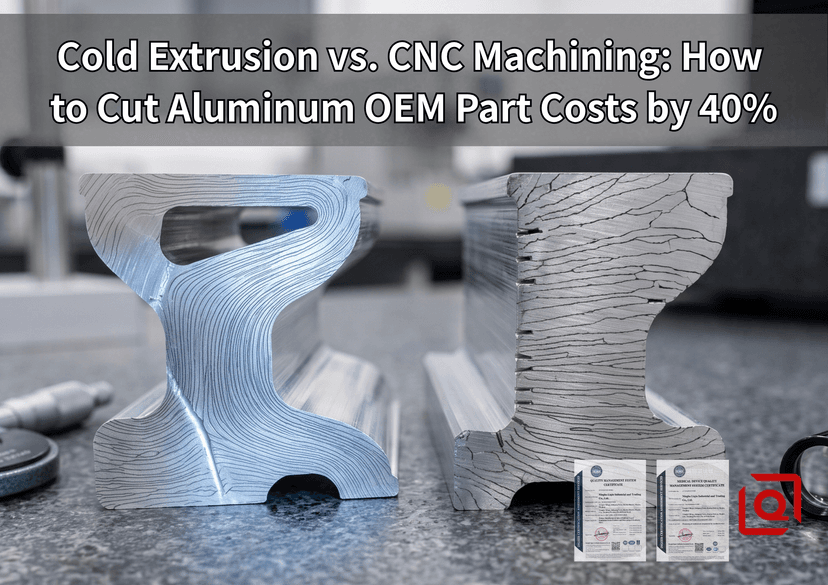
Watching solid aluminum bar stock get turned into 90% scrap is hard to stomach. Cycle times hit 12 minutes. Deep-pocket chatter eats through end mills at a brutal pace. Material yield drops under 15%.
Milling is tough to beat for low-volume prototypes. But once your yearly blanket orders pass 5,000 units, making that much swarf just burns through cash. Cold extrusion reshapes the metal plastically at ambient shop temperatures. You use near-net billets, stroke a hydraulic or mechanical press once or twice, and hold tight wall geometries without producing barrels of scrap.
Let us break down where the actual unit-cost tipping point sits, how continuous grain alignment changes fatigue life, and how hybrid production routes—combining cold extrusion preforms with fast CNC secondary ops—deliver dimensional tolerances that satisfy demanding quality teams.
1. Material Yield: The Core Driver of Part Economics
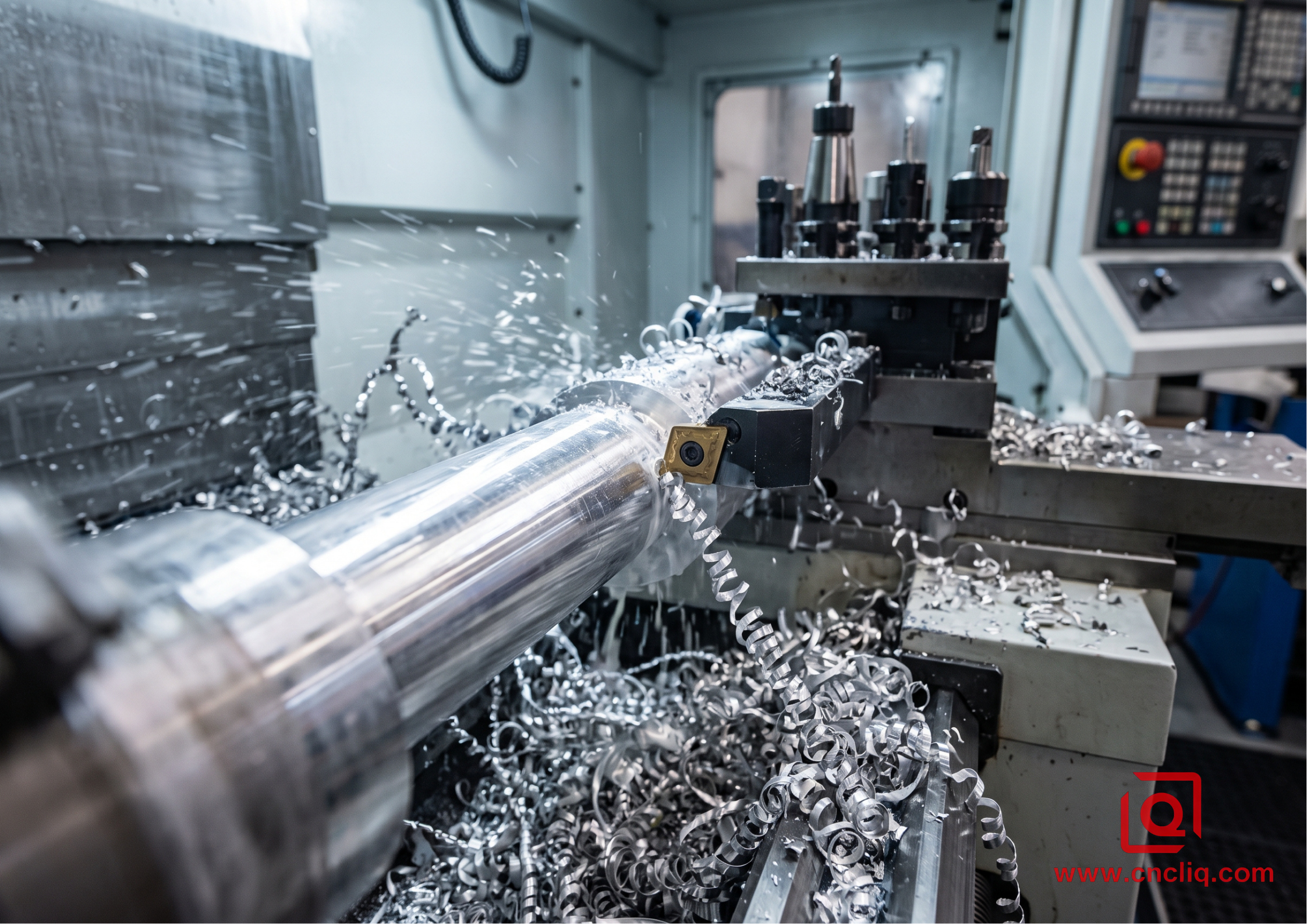
In mechanical manufacturing, cycle time matters, but raw billet utilization dictates the base piece-part cost.
CNC Machining Path:
Raw Cylindrical Billet (1.20 kg) ──> Heavy Cavity Roughing (82.5% Swarf) ──> Finished Flanged Sleeve (0.21 kg)

Cold Extrusion Path:
Sheared Slug (0.23 kg) ──> Backward Impact Extrusion (91.3% Yield) ──> Near-Net Shell ──> Light CNC Trim (0.21 kg)
Consider a flanged hydraulic sensor sleeve with an outer diameter of 52 mm, an internal bore of 38 mm, and an axial depth of 115 mm.
Material Waste Profile (Annual Volume: 20,000 Pcs):

CNC Billet Path:
24,000 kg Raw Billet Purchased
19,800 kg Aluminum Scrap Generated (82.5%)

Cold Extrusion Path:
4,600 kg Raw Slugs Purchased
400 kg Trim Scrap (8.7%)
Machining this geometry from solid AL6061-T6 bar requires purchasing a 1.20 kg blank per piece. By the time the roughing tool clears the core and the face grooving tool defines the flange seat, the finished part weighs just 0.21 kg. You turned 0.99 kg of premium aircraft-grade aluminum into low-value chips. Even factoring in scrap buyback credit, chip recovery yields only a fraction of raw billet procurement cost per metric ton.
Cold extrusion flips this ratio. You crop a precision cold-heading quality slug weighing 0.23 kg directly from coiled wire or saw-cut extruded rod.
1. Crop slug to precise volume (tolerance: +/-0.5 g)
2. Anneal to O-temper state (approx. 415°C soak)
3. Apply zinc phosphate conversion coating + reactive soap lubricant
4. Backward strike in carbide die under 450-ton mechanical toggle press
5.Eject near-net sleeve with bottom web intact
Material utilization immediately jumps from 17.5% up to 91.3%. On an annual production run of 20,000 units, you eliminate nearly 20 metric tons of wasted raw aluminum purchases.
2. Process Dynamics and Mechanical Integrity
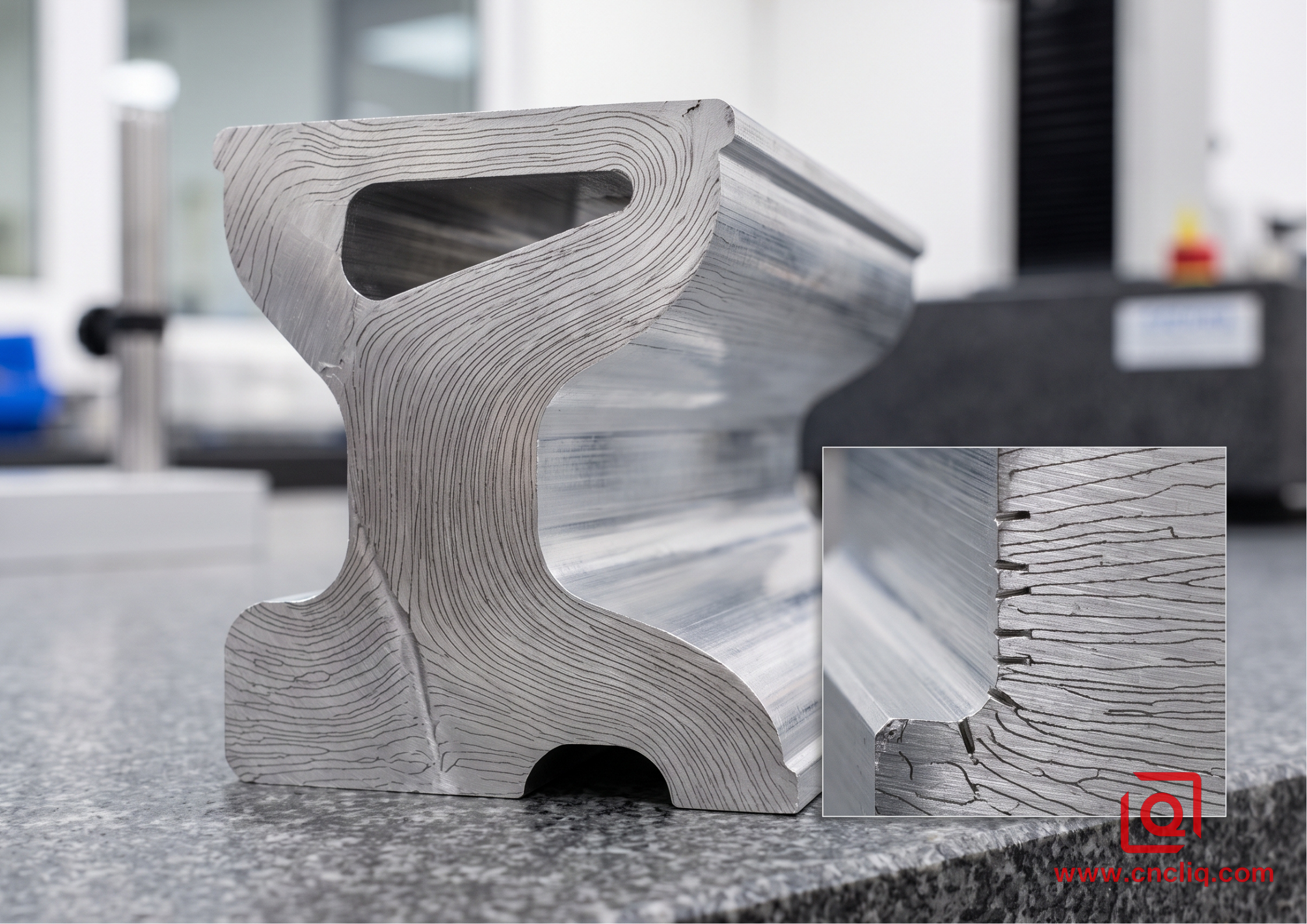
Beyond raw billet savings, cold forming alters the metallurgical behavior of the alloy.
When an end mill cuts across an aluminum extrusion profile, it severs the longitudinal grain boundary lines established during initial mill rolling. This creates micro-notches along machined transitions. Under dynamic pressure cycling, those broken grain lines act as stress concentration zones.
Grain Flow Comparison:

CNC Machined Cavity:
─ ─ ─ ─ ─ ─ ─ ─ ─ ─ ─ ─ ─ ─ (Continuous Bar Grain)
═══ Cut Surface (Severed Grains) ═════════════════
  ↓ Internal Bore Cavity (Micro-notches along cut lines)

Cold Extruded Cavity:
╭─────────────────────────╮ (Grain lines deform plastically)
│ ╭─────────────────────╮ │
│ │ ╭─────────────────╮ │ │ (Follows contour unbroken around fillet)
│ │ │                 │ │ │
Cold extrusion forces metal to yield through hardened D2 or carbide tooling inserts. Instead of cutting across the grain, the microstructural flow lines wrap tightly around every inside radius, tracing the finished profile without tearing.
Tensile & Hardness Evolution (AL6061):

As-Annealed Slug (O-Temper):
• Tensile Strength: 125 MPa
• Hardness: ~45 HBW

Post-Cold Extrusion (Severe Plastic Deformation / Work Hardened):
• Tensile Strength: 240 MPa
• Yield Strength: 215 MPa

Post-Secondary T6 Heat Treatment (Solutionize + Age):
• Tensile Strength: 310 MPa
• Yield Strength: 275 MPa
• Hardness: 95 HBW
Work hardening naturally raises as-formed tensile values.Pure 1050/1070 and work-hardening 5052 pick up plenty of rigidity straight off the die—no secondary solution steps required, making them ideal for thermal heat sinks. If a drawing calls out 6061 instead, send parts through a continuous mesh-belt furnace for standard solutionizing and artificial aging. That dials in the full T6 temper to meet ASTM B221.
3. Engineering Parameter Comparison
Evaluating whether a part belongs on a lathe spindle or under an extrusion punch requires matching geometric tolerances against cycle throughput:
| Parameter / Feature | Pure CNC Machining (Turning/Milling) | Pure Cold Extrusion (Backward/Forward) | Hybrid Route (Extrude + Light CNC Trim) |
| Material Utilization | 15% – 35% typical on hollows | 90% – 96% | 85% – 92% |
| Primary Cycle Time | 4 – 15 minutes per part | 1.5 – 3.5 seconds per stroke | 2 seconds stroke + 35 seconds CNC finish |
| Surface Roughness (Ra) | Ra 0.8 to 1.6 μm (requires fine pass) | Ra 0.2 to 0.6 μm (burnished by die) | Ra 0.4 μm bore / Ra 0.8 μm threads |
| Dimensional Tolerance | ±0.010 to ±0.025 mm | ±0.040 to ±0.080 mm | ±0.012 mm on critical seats |
| Wall Thickness Limit | Can cut thin walls down to 0.5 mm | Minimum 1.2 mm (alloy dependent) | 0.8 mm via secondary boring |
| Internal Undercuts | Straightforward via multi-axis tools | Impossible without split/collapsible dies | Form blank, machine undercuts |
| Tooling Upfront Cost | $0 dedicated hard dies (fixture only) | $3,500 – $12,000 (punch/die set) | $3,500 – $8,000 (simplified tooling) |
| Economical Volume Break | 1 to 2,500 pcs | > 5,000 pcs per year | > 3,000 pcs per year |
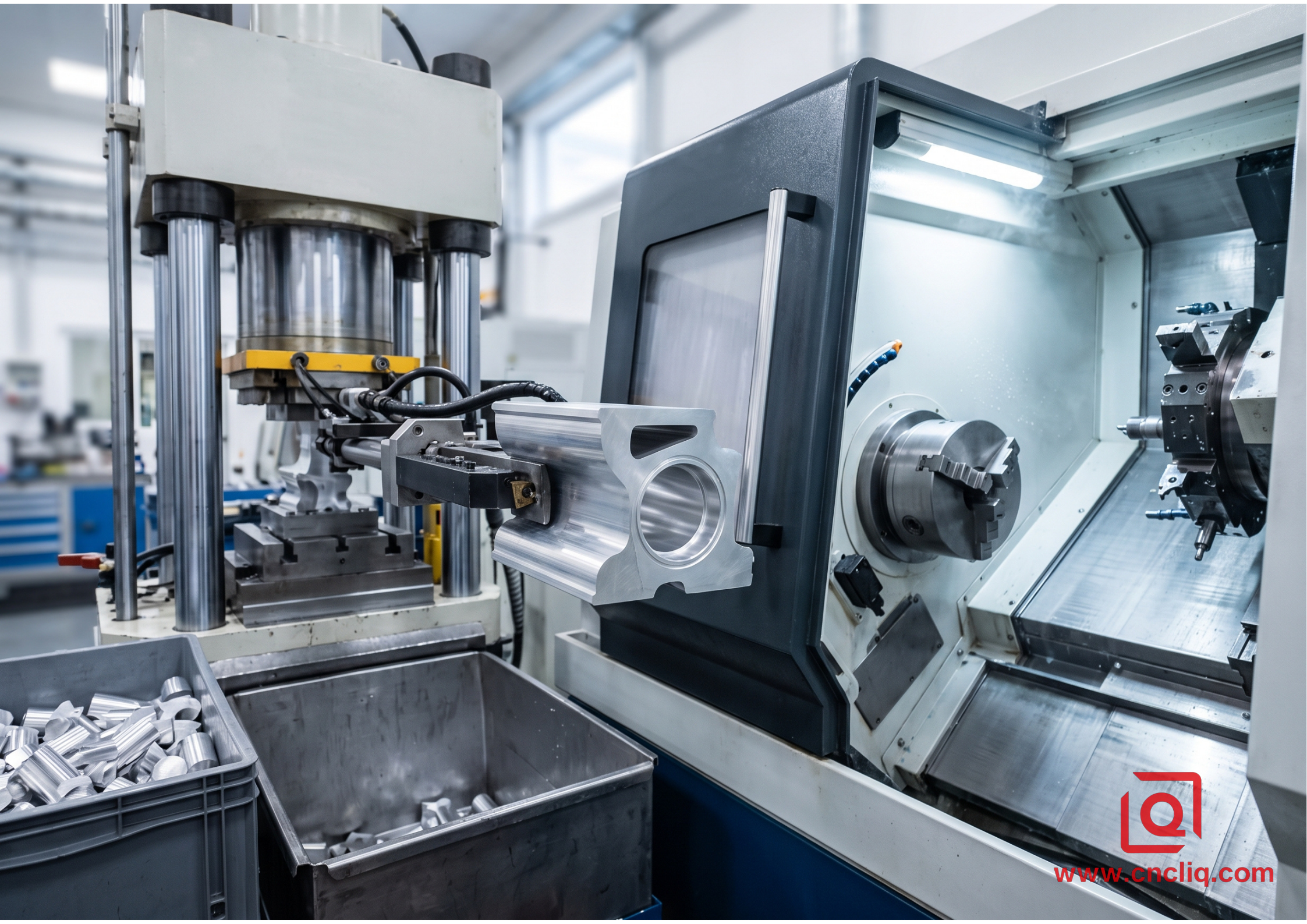
4. When CNC Still Wins (and When to Walk Away)
Cold extrusion is not a universal replacement for subtractive cutting.Geometry dictates the threshold.
Go / No-Go Decision Path:

Is the annual volume > 3,000 units?
  ├── NO  ──> Stick to Pure CNC Machining
  └── YES ──> Is the part symmetrical, tubular,or can-shaped?
                ├── NO  ──> CNC Machining (or High-Pressure Die Casting)
                └── YES ──> Does it require internal undercuts or cross-holes?
                              ├── NO  ──> Pure Cold Extrusion
                              └── YES ──> Hybrid Route (Extrude Blank + CNC Finish)
Cold Extrusion Sweet Spots:
• Deep-drawn cylindrical shells, blind-hole canisters, fluid ports
• Symmetrical stepped shafts, pinions,splined starter sleeves
• High-fin thermal pin arrays and LED electronics enclosures
• Thin-bottom, tall-wall battery housing sleeves

Pure CNC Sweet Spots:
• Asymmetrical structural brackets with varying draft planes
• Low-volume pilot runs under 2,000 units where NRE mold tooling cannot amortize
• Complex manifolds with internal cross-drilled intersecting fluid passages
• Ultra-thin walls under 0.6 mm unsupported along long axial spans
5.Field Production Case: High-Pressure Aluminum Valve Shell
Component Overview:
• Application: Industrial Pneumatic Actuator Chamber
• Material: AL6061 (Final Spec: T6 Temper per AMS 4027)
• Production Batch: 40,000 units annually (shipped in 10,000-pc quarterly calls)
• Critical Features:
  - Internal Bore: 42.00 mm (+0.03/-0.00 mm)
  - Axial Depth: 94.00 mm
  - M48x1.5 Internal Metric Thread
  - Bottom Seal Ring Groove (Ra 0.4 µm)
--->! --->!
Cost Breakdown Comparison (Per Part):

CNC Machined from Solid Bar:
├── Raw Billet (AL6061 Extruded Bar, 1.45 kg @ $3.80/kg): $5.51
├── CNC Lathe + Mill Time (8.5 minutes @ $55/hour shop rate): $7.79
├── Scrap Buyback Offset (1.18 kg chips @ $1.40/kg): -$1.65
└── Surface Prep & Washing: $0.45
──────────────────────────────┄
TOTAL UNIT COST: $12.10

Cold Extrusion + CNC Hybrid Approach:
├── Sheared Slug (AL6061 Wire, 0.31 kg @ $3.95/kg): $1.22
├── Extrusion Press Stroke (Hydraulic, single hit): $0.42
├── Anneal + T6 Heat Treatment Batch Cost: $0.65
├── Secondary CNC Finishing (Thread + Groove, 42 seconds): $0.64
├── Tooling Amortization ($6,800 over 40,000 pcs): $0.17
└── Surface Prep & Washing: $0.45
───────────────────────────────────────────────────────────
TOTAL UNIT COST: $3.55

Total Savings per Unit: $8.55 (70.6% cost reduction on high-volume runs)
The Engineering Problem
A fluid-power systems client had sourced this component via 4-axis turning centers for 3 years. The design featured a 94 mm deep cavity with a 42 mm inner bore, ending on a flat internal bottom surface that seated a dynamic seal.
Producing the part from solid 60 mm bar stock generated two chronic shop-floor issues:
-
Boring deep bores at a 2.2:1 L/D ratio set off high-frequency chatter across the back wall. Roughness degraded to Ra 1.8 μm, blowing past the customer’s Ra 0.4 μm seal callout unless we threw in an extra micro-honing op.
-
Each piece tied up the machine for 8.5 minutes. Twin-spindle turn-mill centers ran 2 full shifts yet capped out right at 3,200 pieces monthly, creating backlogs the moment volume surged.
Shop Floor Implementation Steps for Hybrid Production:

Step 1: Cold Shear Slug
Crop AL6061 cold-heading rod to length 32.5 mm, weight 310 g. Maintain flat end faces to prevent punch wandering during impact.

Step 2: Spheroidize Anneal & Coat
Load slugs into atmospheric basket furnace. Heat to 415°C, soak for 2.5 hours, then furnace-cool to drop hardness below 48 HBW. Apply a thin sodium stearate soap barrier over a chemical micro-etch to withstand extreme unit pressure without tool galling.

Step 3: Backward Impact Extrusion
Stroke on a 600-ton hydraulic press utilizing a mirror-polished tungsten carbide (grade CD-650) punch tip. The aluminum back-extrudes upward along the punch shank in 2.2 seconds.The hardened punch burnishes the inner diameter to a consistent Ra 0.3 μm finish directly out of the die cavity.

Step 4: Solution Heat Treatment & T6 Age
Rinse parts in an alkaline degreasing tank to clear residual lubricant.Solutionize at 530°C for 60 minutes, rapid water quench within 8 seconds, followed by artificial precipitation aging at 175°C for 8 hours to restore full T6 mechanical hardness (95 HBW minimum).

Step 5: Secondary CNC Precision Threading
Clamp on the cold-formed outer diameter using custom soft jaws. Single-point chase the M48x1.5 internal thread, face the top rim to final overall length, and cut the external retention groove. Cycle time on the lathe drops to 42 seconds.
Results and Verification
The bottom seal bore surface roughness cleared inspection at Ra 0.28 to 0.35 μm, eliminating the secondary honing setup entirely.
Slamming the backward punch down in one hit sizes the entire inner cavity, locking bore-to-OD runout well inside 0.035 mm across the board.
Material yield jumped from 18.6% to 88.7%. The piece-part manufacturing cost dropped from $12.10 down to $3.55.The client recovered the dedicated tooling charge of $6,800 within the first 800 parts shipped on their initial purchase order.
6.How to Design for Cold Extrusion (DFM Rules of Thumb)
If you want to switch an existing turned part over to high-rate cold forming without blowing time on tool rework,freeze these DFM rules into your solid models up front:
Key Dimensional Ratios:

       │◄── Bore ID (d) ──►│
       ┌───┐             ┌───┐  ▲
       │   │             │   │  │
       │   │             │   │  │ Extrusion Depth (H)
       │   │             │   │  │ Max Ratio: H/d <= 4 (for 6061)
       │   │             │   │  ▼ Max Ratio: H/d <= 6 (for 1070)
       └───┴─────────────┴───┘
       ▲                     ▲
       └── Wall Thickness (t)┘
       Rule: Keep 't' uniform (+/- 10%)
-
Respect L/D Ceilings: On structural grades like 6061 or 6082, cap the backward extrusion depth-to-diameter ratio at 4:1. High-purity, ductile stock (1050, 1070, 3003) lets you push past 6:1 before the punch risks buckling under load.
-
Smooth Out Wall-to-Floor Steps: Steer clear of hard thickness jumps between heavy bases and thin side walls. A sudden change in cross section pinches the metal flow, driving tonnage through the roof and snapping punches from rapid fatigue. Keep your inside corner fillets at R 1.0 to 1.5 mm minimum.
-
Bottom Thickness vs. Wall Thickness: Design the finished bottom floor thickness to be at least 1.2x to 1.5x the vertical wall thickness.If the bottom floor is too thin relative to the extruded sleeve wall, the punch face experiences massive tensile rebound stresses during tool extraction, warping the base.
-
Specify Hybrid Geometries Intelligently: Do not attempt to cold-form internal threads, cross-holes, narrow snap-ring grooves, or extreme outer undercuts. Form the thick, heavy-walled, high-volume hollow core on the press. Leave thread chasing, port drilling, and final critical O-ring seat skim cuts to a secondary CNC lathe operation.
FAQs
Q1: Which aluminum grades beat out CNC machining for cold extrusion?
A: Pure 1050 and 1070—along with 3003—flow exceptionally well. You can smash out deep-finned heat sinks or tall battery cans in one pass with zero intermediate anneals. Need genuine mechanical strength? Lean toward 6061 or 6082. Run an O-temper soak at 415°C prior to hitting the press. Afterward, age out to T6 per AMS 4027/ASTM B221, which nails down the required 310 MPa tensile strength. Ultra-hard alloys like 7075 just spike forming loads and wreck your dies fast. For those, plain CNC milling or warm/hot forging is the only sensible call.
Q2: What are the real lead times and tooling costs for a cold extrusion die package?
A: A single-station carbide punch and cavity setup runs roughly $3,500 to $8,000 for standard stepped or cylindrical profiles, pushing near $12,000 once you step into multi-stage progressive dies. Tool build—wire EDM, vacuum hardening H13/DC53 blocks, and mirror-lapping CD-650 carbide punches—takes 18 to 25 working days. Once we dial the die in on the press, full First Article Inspection (FAI) reports backed by complete CMM data go out within 5 business days.
Q3: How does the surface finish on a cold formed aluminum bore stack up against CNC machining?
A: Cold forming gives you an as-struck internal bore between Ra 0.2 μm and Ra 0.6 μm because the mirror-polished carbide punch burnishes the wall under massive tonnage. Conventional turning or milling tops out around Ra 0.8 μm to Ra 1.6 μm, which means throwing in secondary diamond burnishing or micro-honing operations just to seat dynamic hydraulic or pneumatic O-rings without leaks.
Q4: Can you run standard or hard-coat anodize directly over cold extruded aluminum?
A: Yes, but only if your pre-wash setup is locked down. Heavy forming takes extreme-pressure zinc phosphate and sodium stearate soaps to fight galling under 450 to 600 tons of load.Before dropping parts into standard MIL-A-8625 Type II or Type III hard-coat tanks, run an ultrasonic alkaline degrease followed by an acid micro-etch. That strips embedded lube right off the surface. Once properly prepped, the dense, work-hardened grain actually produces a cleaner, tighter oxide build than any casting could ever match.
Q5: Where is the true cost crossover point between cold extrusion and CNC machining?
A: You break even right around 3,000 to 5,000 parts a year. Below 2,000 pieces, tooling costs ($3,500 to $8,000) along with setup wipe out whatever you save on raw stock. In that volume band, keeping the job on a mill or lathe simply costs less. Past 5,000 units annually, 85% to 92% material yield combined with 2 to 3 second cycle times cuts unit costs by 30% to 70%, paying off the tooling investment inside the first 800 to 1,200 parts out the door.
Ready to Evaluate Your Part Geometry?
If your team is currently buying CNC turned or milled aluminum housings at volumes exceeding 3,000 units per year, you are likely overpaying for scrap metal generation and machine cycle time.
Review your current drawings for cylindrical, tubular, or symmetrical hollow parts. Transitioning to a near-net cold extruded preform paired with targeted CNC secondary operations preserves structural performance, refines internal grain flow, and strips away unnecessary unit costs.
Contact Information
Disclaimer
All technical articles, material specifications, machining recommendations, and surface treatment details published on this blog are for informational and reference purposes only. Please note that general blog insights do not replace signed technical agreements. Because custom parts vary by material heat numbers, machine calibrations, and specific tolerances, binding quality specs are governed solely by your approved CAD drawings, signed contracts, and formal quality plans.
All customer case studies featured on this blog have been thoroughly anonymized and sanitized. The performance metrics, manufacturing workflows, and imagery displayed serve solely to demonstrate our custom machining capabilities and do not represent a single universal standard for all orders.
Liqin Manufacturing Team
Built on 18 years of precision engineering experience, Ningbo Liqin Industry manufactures high-tolerance metal components for demanding global markets. We operate out of a 6,500 m² production hub equipped with over 150 machines, running 4-axis and 5-axis CNC machining, mill-turn machining, cold extrusion, and pressure die casting under one roof. This setup allows us to manage projects seamlessly, taking parts from initial CAD concepts directly to finalized shipments.
We handle quality control with zero compromise. We treat tight tolerances with the engineering discipline they require. Backed by ISO 9001, ISO 13485, and IATF 16949 certifications, our QA engineers run strict IPQC, FQC, and OQC checks on every single production batch. From CMM dimensional mapping and optical profiling to hardness and salt-spray testing, we validate your critical specs upfront—so you receive drop-in ready components with zero assembly headaches or costly line stoppages.On top of manufacturing, you can rely on us for two-hour response times on new RFQs, direct support for prototype sampling, and smooth export shipping across Europe, North America, Asia, and Oceania.
Welcome your inquiries and samples. Visit our website or contact us directly for a competitive quote!