English




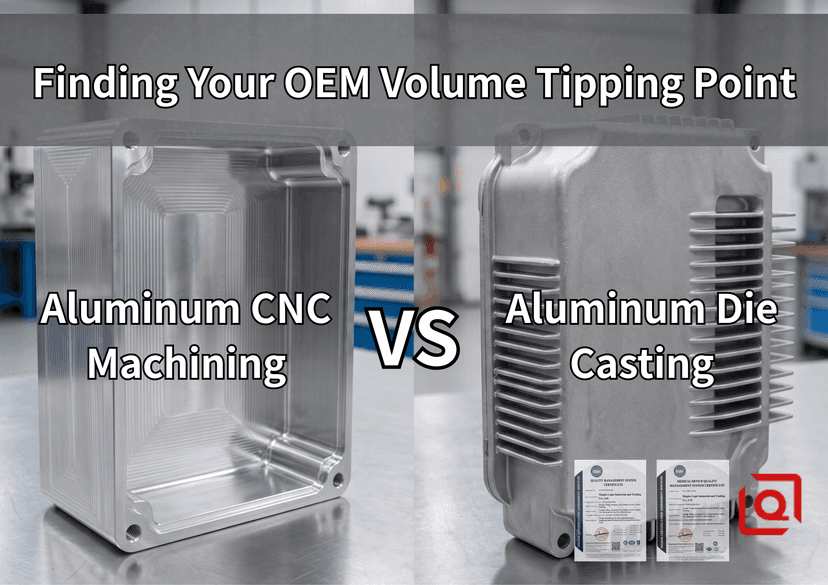
Every hardware engineering team hits the exact same crossroads when moving from functional prototypes to pilot runs. Hogging your aluminum parts out of solid billet works great for prototypes, but stick with full CNC hog-outs at volume and your piece price will bleed you dry. On the flip side, diving straight into high-pressure die casting ties up serious capital in hard molds before the geometry is completely frozen.
Cut steel too early, and tweaking just 1 mounting boss or thinning a heatsink rib triggers a 3-week shutdown alongside brutal tool modifications. Stay with pure billet machining too long, and spindle run time, raw aluminum waste, and cutter wear will drain your production budget.
Finding your volume tipping point is rarely just a clean math problem on a spreadsheet. It boils down to 4 critical bottlenecks: wall transitions, internal porosity, cosmetic finish, and post-cast machining cleanup. Let's break down those shop-floor compromises so you know the exact production threshold to swap processes.
1. The Cost Dynamic: Tooling Amortization vs. Spindle Time
The financial comparison between billet machining and die casting rests on two opposing cost curves:
-
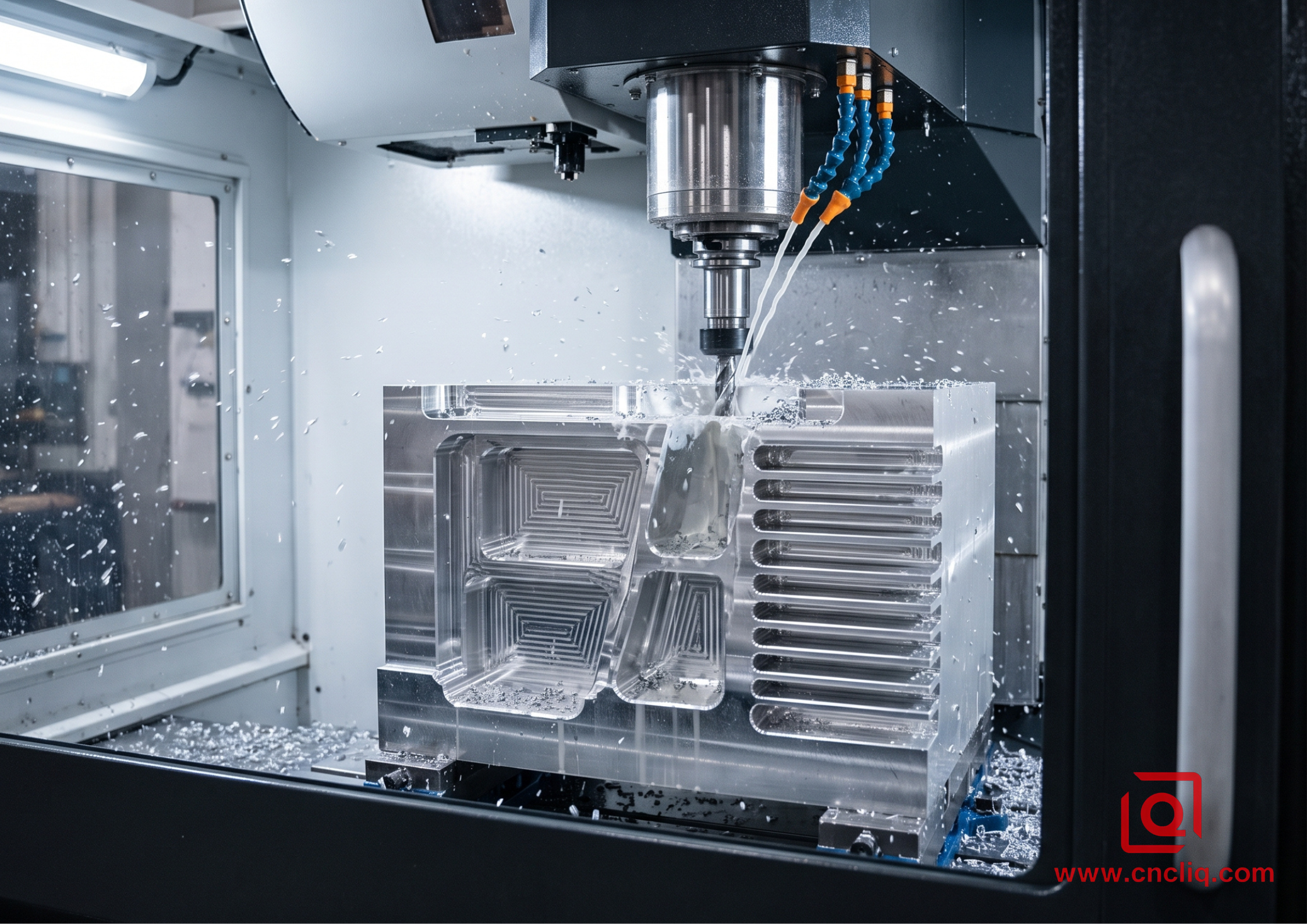
CNC Machining: Little to no upfront tooling investment, but high unit prices driven by machining cycle time, raw stock removal, and cutter wear.
-
Die Casting: High upfront tooling cost (20,000 USD to 60,000 USD or more depending on mold size, moving slides, and cavity count), low piece prices, and very fast cycle times.
In OEM supply chains, the baseline economic formula is:
Total Manufacturing Cost = Upfront Tooling and Fixture NRE + (Raw Material Blank Cost + Machine Cycle Run Cost + Secondary CNC Clean-up + Surface Finishing Cost) * Total Production Quantity
On real shop floors, the cost-break line between hogging out 6061 billet and spinning up a cold-chamber die caster lands right around 1,500 to 3,000 pieces a year.
Why such a wide spread? Feature layout calls the shots. If a housing forces you to gut massive cavities out of bar stock—turning 78% of a 2.4 kg 6061-T6 block into chips just for 1 530 g finished shell—spindle time bleeds your budget. You burn 25 to 40 minutes of machine time per unit, piling up scrap swarf. But when the part already runs uniform 2.5 mm walls with draft-friendly ribs, tooling drops a near-net shape every 35-second shot.
2. Core Manufacturing & Material Comparison
Skip quoting purely on raw unit rates—you need to weigh real-world tolerances, yield strength, and surface prep where chips actually fly:
| Feature & Specification | Precision CNC Machining | High-Pressure Die Casting (HPDC) + CNC |
| Typical OEM Alloys | 6061-T6, 7075-T651, 5052-H32 | A380, ADC12, AlSi10Mg |
| Upfront Tooling Cost | 500 USD to 2,000 USD for custom fixtures | 20,000 USD to 60,000 USD for H13 steel dies |
| First-Article Lead Time | 1 to 2 weeks | 6 to 8 weeks (tool build + T1 sampling) |
| As-Formed Tolerances | ISO 2768-m (down to ±0.010 mm on critical fits) | As-cast: ±0.2 mm; Post-CNC features: ±0.015 mm |
| Minimum Safe Wall | 0.8 mm (requires dampening to stop chatter) | 1.5 mm to 2.0 mm (thinner sections risk misruns) |
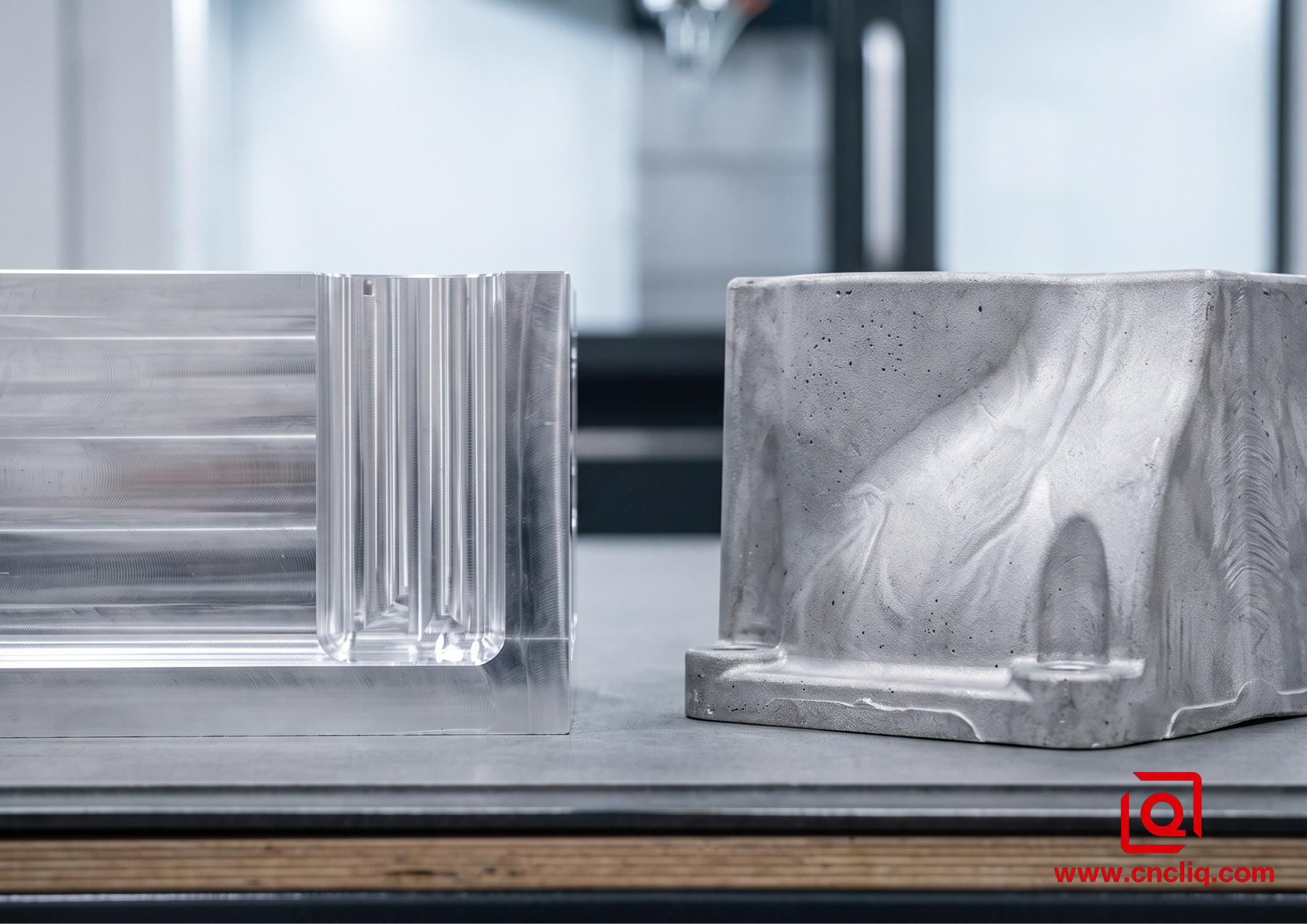
| Internal Metal Structure | 100% dense wrought stock (zero porosity) | Rapid-chill skin with potential core microporosity |
| Color Anodizing Response | Clean, vibrant, cosmetic-grade finish | Dull or blotchy gray due to alloy silicon content |
| Tensile Yield Strength | 276 MPa (for 6061-T6) | 160 MPa (for A380 / ADC12) |
| Elongation at Break | 12% to 17% (high ductile impact resistance) | 2.5% to 3.5% (brittle under heavy shock loads) |
3. Key Engineering Trade-offs on the Shop Floor
Structural Integrity and Core Density
Extruded and rolled 6061-T6 gives you aligned grain flow with a rock-solid 276 MPa yield strength end-to-end. You can drill deep fluid circuits, hog deep pockets, or thread tap anywhere on the block without clipping a single hidden gas pocket.
By comparison, cast A380 carries 8.5% to 11.5% silicon purely to push molten aluminum through restrictive tool gates at 40 m/s. Once that melt smacks against chilly H13 dies, the outside freezes into a dense 0.5 mm skin. The catch? The thicker core solidifies at a crawl, leaving behind micro-shrinkage and trapped gas. If you plan to cut deep O-ring grooves or high-pressure ports into a raw casting, you risk breaking through that skin into porous metal.
Why Castings Still Need CNC Post-Machining
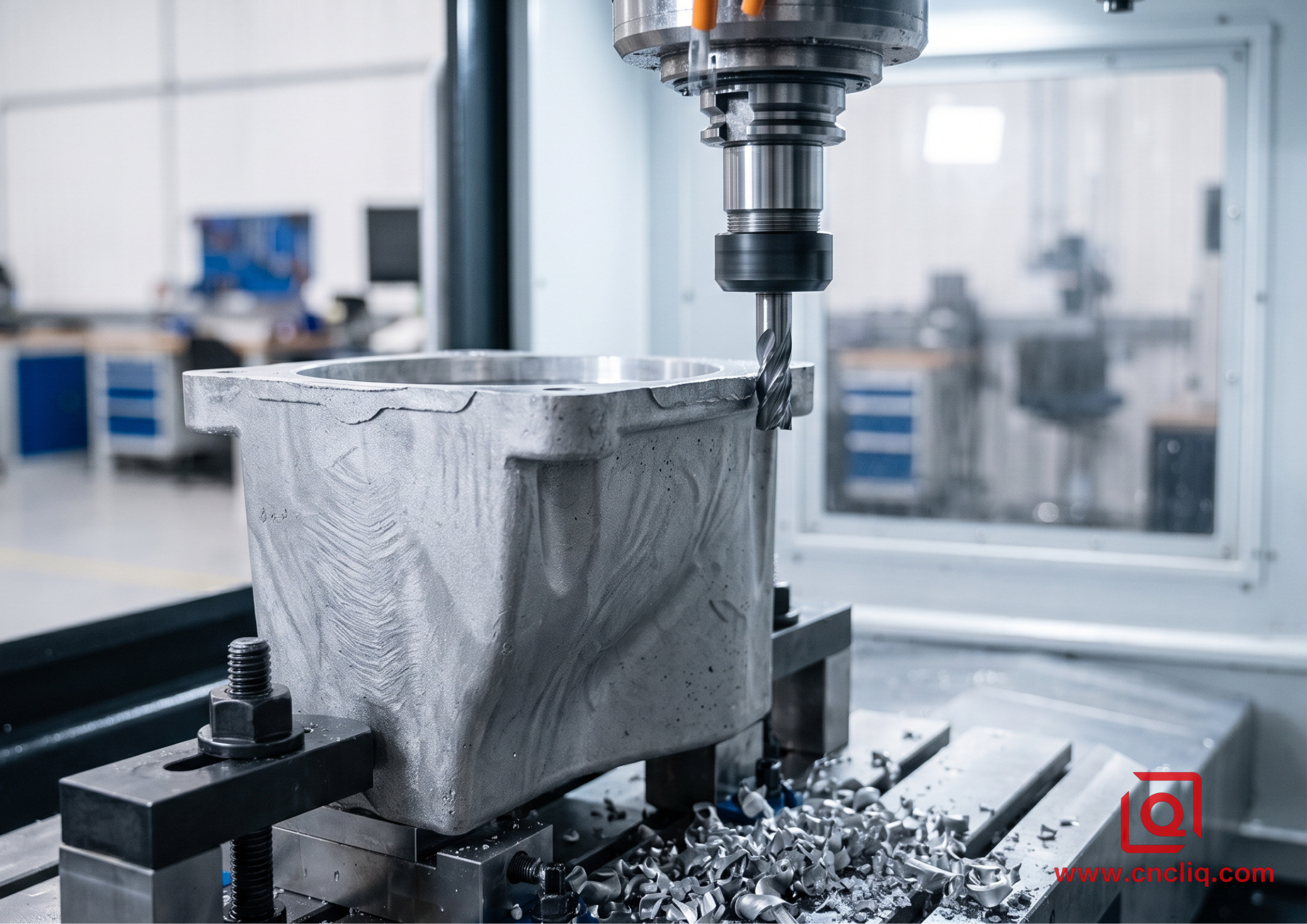
A lot of buyers assume stamping out die castings kills off CNC machining entirely. That is a myth—volume manufacturing runs on a 2-step hybrid setup.
The die spits out 90% of the blank geometry in seconds, but sliding core pins simply cannot hold true for tapped M3 or M4 threads, tight H7 bearing bores, or dead-flat O-ring mating surfaces right out of the tool. The standard workflow uses die casting for 80% of bulk geometry, followed by a quick secondary CNC pass to:
-
Trim parting line flash and gate runners.
-
Skim precision reference faces and sealing surfaces to ensure strict flatness.
-
Bore tight-tolerance bearing pockets to ISO H7 limits (+0.012 mm / -0.000 mm).
-
Drill and tap mounting holes with clean, durable thread profiles.
Surface Finish: Type II Anodize vs. Powder Coat
If a drawing calls for a flawless Type II cosmetic anodize—think bead-blasted satin clear, crisp cobalt, or rich jet black—hogging from 6000-series bar is your only viable path.
Cast aluminum relies on heavy silicon to keep the melt moving. Drop those parts into an acid anodizing tank, and that silicon reacts into nasty insoluble soot, turning the surface dull, blotchy, and grey. Once you commit to high-pressure casting, lock in your surface spec around tough powder coats, 2-pack liquid paints, or heavy-duty E-coat dips instead.
Tooling Life and Thermal Fatigue
When evaluating tooling amortizations, factor in tool wear. A solid CNC setup uses modular soft jaws and standard vices with minimal maintenance. In contrast, an H13 steel die casting mold undergoes violent thermal cycling. Every 40 seconds, the cavity experiences thermal shock from molten aluminum at 680 degrees Celsius followed by water cooling lines. Over 50,000 to 100,000 shots, heat checking cracks develop on thin core pins, requiring preventive tooling maintenance and cavity polishing.
4. Quality Control and In-Process Inspection
Quality inspection differs significantly between billet CNC parts and cast components:
-
Coordinate Metrology (CMM): On billet parts, every probe hit ties back to clean, freshly milled reference planes. With cast blanks, your inspection program has to pull alignment from cast datum targets—using strict 3-2-1 tooling points—to balance out parting-line mismatch and typical cooling shrink (around 0.4% to 0.6% on ADC12).
-
Sub-Surface Porosity Verification: Wrought 6061 plates contain zero internal voids. Cast parts intended for pressure sealing require periodic X-ray inspection on thick boss sections, along with hydrostatic testing at 0.5 MPa to 1.0 MPa.
-
Thread Durability: In 6061-T6, tapped threads provide high shear strength. In cast A380, high-torque joints benefit from stainless steel wire inserts (Helicoil) to prevent thread stripping over time.
5. Practical Decision Guide for OEM Buyers
Stick with 100% CNC Machining If:
-
Your design is still evolving: Mounting locations, wall thicknesses, or features might change over the next two quarters based on customer field feedback.
-
Annual runs stay below 1,500 units: Low production quantities will not amortize tooling investments quickly enough within your fiscal ROI targets.
-
Class A decorative anodizing is required: You need consistent metallic luster, bead-blast textures, and exact optical color matching.
-
Extreme structural ductility is needed: The part must withstand heavy drop impacts, cyclical mechanical fatigue, or high tensile loads without cracking.
-
Hermetic leak tightness under extreme pressure is mandatory: The component operates in high-vacuum or hydraulic circuits above 1.5 MPa.
Move to Die Casting + CNC Finishing If:
-
The CAD model is frozen: No further engineering revisions or geometry changes are scheduled for the next 12 to 18 months.
-
Annual demand exceeds 2,500 units: Tooling amortization drops your effective unit cost substantially below billet machining.
-
The part features deep cooling fins or thin walls: Complex geometric features that waste spindle time during bulk milling are formed in 30 seconds in a die mold.
-
Powder coating or painting is acceptable: The application does not rely on clear decorative chemical anodizing.
-
Lead time allows 6 to 8 weeks for tooling: You have built mold manufacturing, flow simulation, T1 tryouts, and CMM inspection correlation into your master launch schedule.
FAQs
Q1: Can we machine prototypes from 6061 and jump straight into A380 die casting without reworking the CAD model?
A: Almost never without tweaks. Your outer envelope might match, but dies demand draft features that 3-axis mills do not care about. You must draft vertical ribs by 1.0 to 2.0 degrees, balance nominal walls around 2.0 mm to 3.5 mm to dodge sink marks, and fillet sharp corners to at least R1.5 mm. Baking those DFM details into your first 6061 run spares you massive mold retrofits down the road.
Q2: Does cast porosity kill pressure seals on housings, and what is the fix on the floor?
A: Ramming molten alloy into dies under extreme gate velocity always traps gas, leaving spongy micro-voids inside thick walls. You can ignore this on a simple bracket, but when holding fluid circuits, vacuum, or shop air above 0.4 MPa, vacuum impregnation is your standard playbook. Submerging finished parts in anaerobic monomer under negative pressure draws sealant deep into internal pathways, polymerizing into an airtight plug.
Q3: Why won't high-pressure cast aluminum take bright decorative anodize?
A: Smelters dose A380 and ADC12 with 8.5% to 11.5% silicon to let the melt shoot into tight ribs without freezing short. Dip that cast part into a sulfuric anodize line, and the bath cannot dissolve the silicon phase—it gets left behind as stubborn black soot, ruining the face with a cloudy, blotched lead finish. If your drawing specifies Class A cosmetic color (like bead-blasted silver, clear red, or deep blue), stick with 6000-series bar CNC, or switch your casting coating spec over to powder coat or 2-pack polyurethane paint.
Q4: Will tapped threads and bearing press-fits survive in cast parts like they do in billet 6061-T6?
A: Castings like A380 simply do not match the sheer toughness and yield of 6061 billet, meaning fine internal pitches (M3 or M4 especially) blow out fast under aggressive torquing or repeat maintenance. On critical load lugs, we press in threaded brass bushings or run stainless wire inserts. When drawings call out tight H7 bearing pockets (+0.012 mm / -0.000 mm), we choke the mold core pins down 1.0 mm to 1.5 mm on diameter, leaving meat for a fast ream or precision boring pass to true up circularity and clearance.
Q5: When annual volume sits in limbo between 800 and 1,800 units, which route keeps us out of trouble?
A: Floating in that 800 to 1,800 unit gray zone makes billet or custom extrusion milling your safest bet. You dodge sinking 25,000 to 45,000 USD into hard tooling and keep full freedom to shift hole patterns or bore sizes between production runs. Do not drop capital on custom molds until your design is frozen and recurring volume reliably clears 2,500 units a year.
Summary
Do not treat CNC cutting and high-pressure casting as bitter rivals. The most profitable OEM play links them in a 2-phase pipeline: lean on solid billet hog-outs out of the gate to nail critical fits, verify assembly jigs, and ship pilot units without losing days to lead times. Once CAD models freeze and release quantities ramp, cut hard steel molds backed by secondary machining passes to protect your per-unit spread and crank out volume reliably.
Contact Information
Disclaimer
All technical articles, material specifications, machining recommendations, and surface treatment details published on this blog are for informational and reference purposes only. Please note that general blog insights do not replace signed technical agreements. Because custom parts vary by material heat numbers, machine calibrations, and specific tolerances, binding quality specs are governed solely by your approved CAD drawings, signed contracts, and formal quality plans.
All customer case studies featured on this blog have been thoroughly anonymized and sanitized. The performance metrics, manufacturing workflows, and imagery displayed serve solely to demonstrate our custom machining capabilities and do not represent a single universal standard for all orders.
Liqin Manufacturing Team
Built on 18 years of precision engineering experience, Ningbo Liqin Industry manufactures high-tolerance metal components for demanding global markets. We operate out of a 6,500 m² production hub equipped with over 150 machines, running 4-axis and 5-axis CNC machining, mill-turn machining, cold extrusion, and pressure die casting under one roof. This setup allows us to manage projects seamlessly, taking parts from initial CAD concepts directly to finalized shipments.
We handle quality control with zero compromise. We treat tight tolerances with the engineering discipline they require. Backed by ISO 9001, ISO 13485, and IATF 16949 certifications, our QA engineers run strict IPQC, FQC, and OQC checks on every single production batch. From CMM dimensional mapping and optical profiling to hardness and salt-spray testing, we validate your critical specs upfront—so you receive drop-in ready components with zero assembly headaches or costly line stoppages. On top of manufacturing, you can rely on us for two-hour response times on new RFQs, direct support for prototype sampling, and smooth export shipping across Europe, North America, Asia, and Oceania.
Welcome your inquiries and samples. Visit our website or contact us directly for a competitive quote!