English




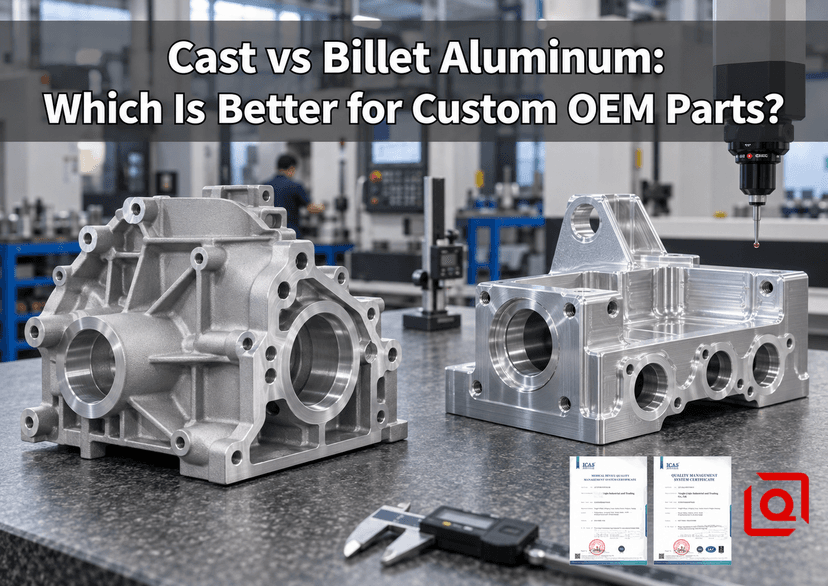
Here is where I start: if the print is still moving, the lot is modest, or several datums must agree, I keep the die off the bench and machine billet. Casting starts to earn its keep after demand settles, especially when the model is crowded with ribs, bosses, and empty space that would otherwise become chips. A housing with cast ribs but milled sealing faces is not a halfway measure. In many production jobs it is the cleanest route. A label does not make a premium part. The better route is the one that protects function, lead time, and total landed cost.
A buyer once asked me a version of this question that gets straight to the real problem: “If billet is stronger, why does almost every engine housing start as a casting?” Because strength is only one line on the drawing. A housing may need thin cooling fins, internal passages, low piece cost, and six machined interfaces. Carving all of that from a solid block can be accurate, but it can also fill the chip conveyor while the machine spends most of its cycle removing material the customer never needed.
The reverse mistake happens too. A team approves a die because the production forecast looks healthy. Three design revisions later, a bolt pattern has moved, an O-ring groove is wider, and a connector boss needs another three millimeters of clearance. Now the cheap process is tied to expensive steel tooling. The choice between cast vs billet aluminum for custom OEM parts should happen before the quote is reduced to one piece price.
This guide takes the practical route. We will compare metallurgy, tolerances, surface finish, tooling, design changes, inspection, and the questions that should appear in an RFQ. If you are also weighing extrusion, the related aluminum OEM process comparison places CNC machining, extrusion, and die casting in the same decision frame.
What “Cast” and “Billet” Actually Mean
Cast aluminum parts are formed when molten alloy fills a mold or die and solidifies. Walk through two foundries and the word casting can mean very different work: sand, permanent mold, low pressure, or a fast HPDC cell. Those routes do not leave the same skin or internal condition. Put only “cast aluminum” on an RFQ and five shops may quote five different answers.
On a billet job, saw-cut plate, bar, or an extruded block goes into the fixture and the unneeded metal comes off as chips. Marketing has stretched the word billet until it tells a buyer very little. It does not name an alloy, a temper, a property guarantee, or even one specific stock form. “Machined from 6061-T651 plate with mill certificate” is useful. “Made from aircraft-grade billet” is not enough for purchasing or quality planning.
The distinction matters because cast and wrought alloys use different designation families. The Aluminum Association maintains systems for both wrought and cast products, while ASM International publishes separate property references for wrought alloys and aluminum castings. Do not compare a generic billet number against a generic cast number. Compare the exact alloy, temper, process, wall section, and acceptance criteria.
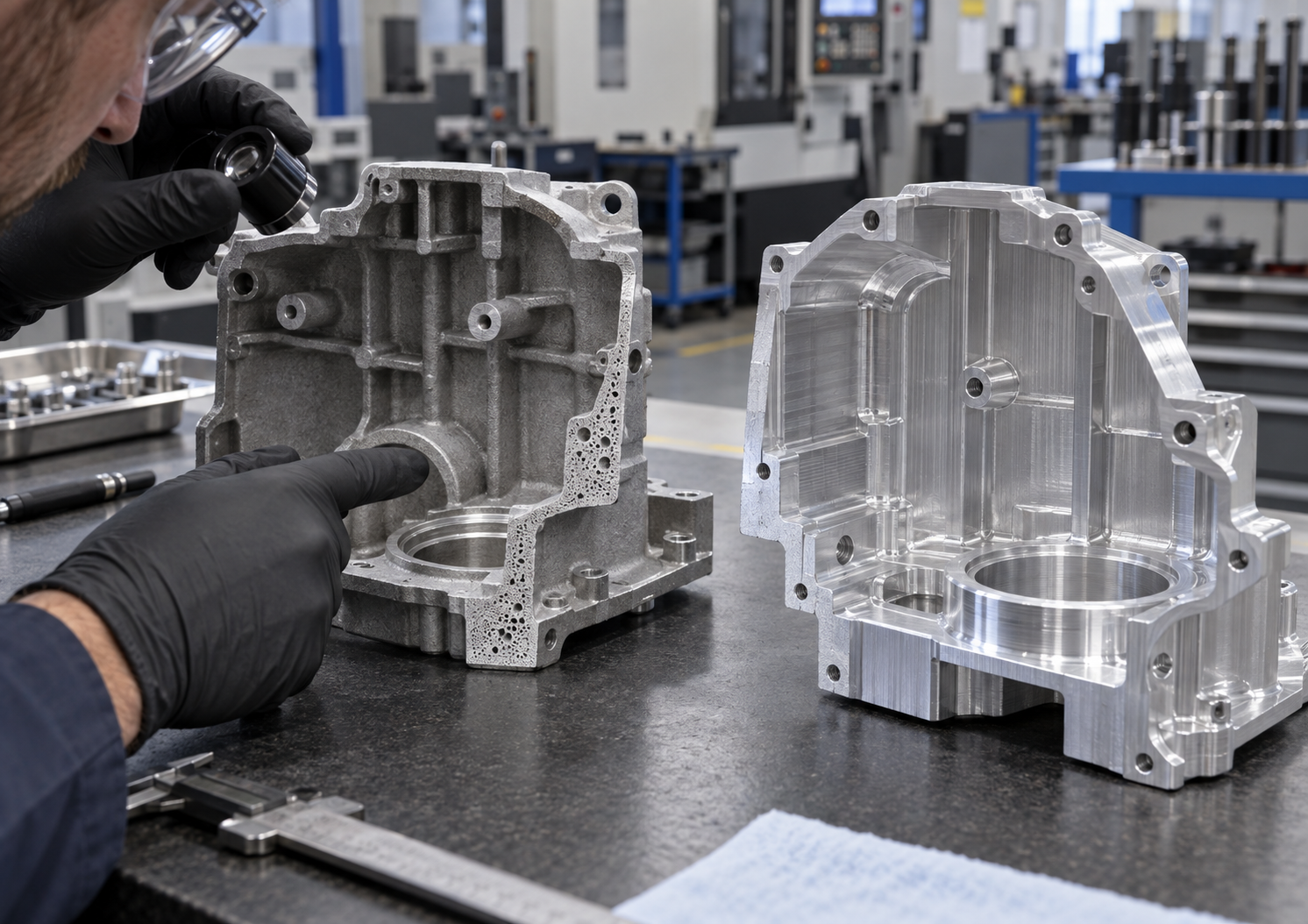
Cast and billet routes leave different shop-floor signatures; the inspection plan must follow the route.
Cast vs Billet Aluminum: Side-by-Side OEM Decision Table
|
Decision factor |
Cast aluminum |
Billet-machined aluminum |
|
Upfront commitment |
Dedicated tooling can dominate early cost, especially for HPDC. |
No production mold; fixtures, programming, and setup are still required. |
|
Best geometry |
Thin ribs, bosses, organic outer forms, and near-net housings. |
Prismatic parts, precise pockets, bores, ports, and frequently revised features. |
|
Volume behavior |
Piece economics usually improve as stable volume spreads tooling cost. |
Fast to start; cycle time and raw stock removal remain in every unit. |
|
Mechanical consistency |
Depends on alloy, fill, solidification, section thickness, porosity control, and heat treatment. |
Wrought stock is generally more uniform, but residual stress and grain direction still matter. |
|
Tight features |
Critical datums and fits often need secondary machining. |
CNC establishes tight features directly, provided setups and distortion are controlled. |
|
Design changes |
Changes may require die rework or replacement. |
Many changes can be handled through CAD, CAM, and fixture revisions. |
|
Surface appearance |
As-cast texture; cosmetic finish depends on alloy and coating route. |
Crisp machined appearance; wrought alloys commonly give more predictable decorative anodizing. |
|
Main process risks |
Gas or shrinkage porosity, cold shuts, flash, parting-line mismatch, ejector witness, and distortion. |
Warping after heavy stock removal, chatter, tool deflection, burrs, and setup-to-setup datum drift. |
|
Typical winning use |
Stable, repeat-volume enclosure or housing with ribs and bosses. |
Prototype, low-volume precision component, manifold, bracket, or evolving design. |
This table is a screening tool, not a substitute for the drawing. A pressure-tight body, a fatigue-loaded arm, and an electronics cover can land in different columns even at the same annual volume.
Which Is Stronger: Cast or Billet Aluminum?
Put a common die-casting alloy beside a suitable wrought grade and the wrought stock will often give the designer more strength, elongation, and fatigue margin, with less lot-to-lot surprise. That is the basis of billet’s reputation. The reason is not that CNC cutting adds strength. The advantage comes from the starting material and its prior thermomechanical processing, plus the absence of casting defects in a well-supplied wrought product.
But “billet is stronger” is not a complete engineering decision. Alloy and temper can outweigh the process label. A cast ribbed housing may be stiffer as a finished shape than a poorly designed billet shell of the same mass. Premium casting processes, heat treatment, vacuum control, local section design, and inspection can also move casting performance significantly. ASM’s aluminum references treat composition, microstructure, casting route, heat treatment, and quality assurance as connected variables for exactly this reason.
Use billet when the load case leaves little room for hidden variation
Billet is a sensible starting point for a prototype or low-volume part facing high cyclic load, impact, a highly stressed thread, or a pressure boundary that will be opened by deep machining. The purchase order can be blunt: name the wrought alloy and temper, state plate or bar, ask for the mill record, and flag grain direction only where the load case needs it. For a closer look at shop behavior among common grades, see the 6061, 7075, and 5052 machining comparison.
Use casting when shape efficiency matters more than maximum material properties
Casting can put metal around bosses, corners, ribs, and bearing supports without cutting a large rectangular envelope down to a hollow shell. For a protective enclosure, lighting body, motor cover, or structural carrier, that shape freedom can lower mass and cost together. The job is to select a suitable casting process and build defect controls around the real failure modes. NADCA notes that high-integrity structural die-casting variants are used where minimized gas porosity is required. “Die cast” alone does not define integrity.
Accuracy: The Drawing Decides Where CNC Must Enter
A casting can repeat complex form efficiently, yet the as-cast surface is not the place to assume a bearing fit, a flat gasket land, or a precise dowel relationship. Draft is needed to release the part from the die. The parting line introduces its own variation. Ejection, cooling, and trimming can move the part. Those facts do not make casting inaccurate; they tell you which features should be designed for secondary machining.
In a strong hybrid datum plan, the casting includes stable locating pads in one die half. The first CNC operation establishes a primary machined datum. Later bores, faces, and holes reference that datum rather than an irregular outer skin. Stock allowance must be enough to clean up normal casting variation, but not so generous that the cutter opens deeper porosity or wastes cycle time.
Billet machining removes the mold variables, not every variable. A deep pocket can release residual stress and turn a flat plate into a shallow bow. Long tools move under cutting pressure. A second setup can shift the relationship between two bores. For complex five-sided work, reducing manual re-clamping through multi-axis CNC milling may protect true position better than chasing a tighter machine tolerance on each isolated feature.
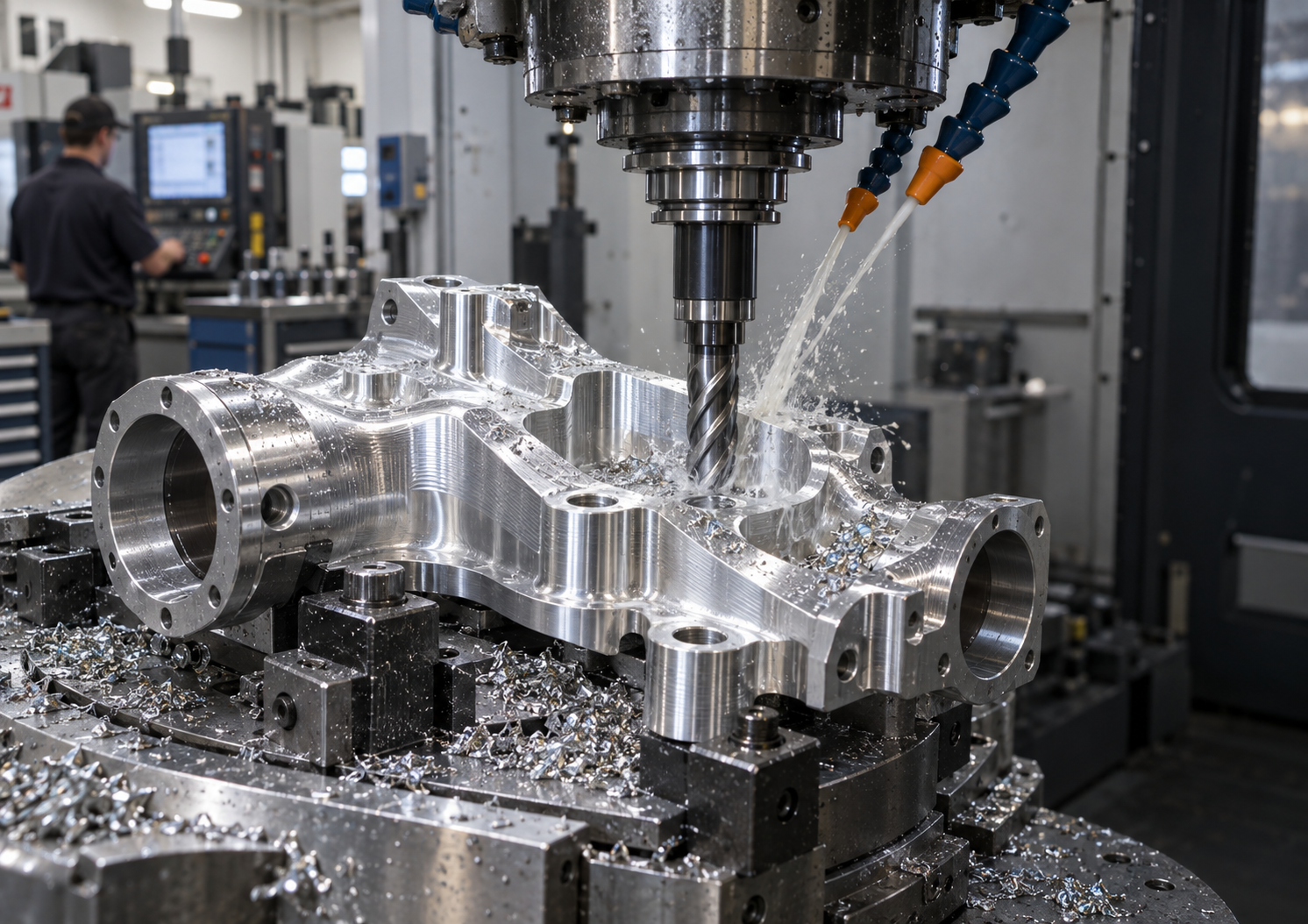
Billet machining starts quickly and handles revisions well, but workholding, stress release, and chip evacuation still control the result.
Cost: Compare Program Cost, Not Just Piece Price
The honest cost question is not “Which process is cheaper?” It is “Which process costs less across this program, at this revision level, with this inspection burden?” A useful quotation lets you see where the money goes. I want the die, stock, setup, spindle time, finishing, inspection, and packing broken out, with tool upkeep stated rather than buried. That makes the break-even point visible.
|
Cost driver |
Question to ask before choosing |
|
Forecast and order pattern |
Is annual demand stable, or is the forecast still a sales estimate? Are releases monthly or one large batch? |
|
Design maturity |
How many interface dimensions may change after prototype testing? |
|
Material yield |
How much of the purchased stock becomes the part, and how are chips or runners recovered? |
|
Secondary operations |
Which faces, bores, threads, inserts, leak tests, coatings, and markings remain after forming? |
|
Quality cost |
Which risk really needs evidence: a leak, a hidden void, a drifting datum, or a bad thread? Price the matching check, not a blanket test list. |
|
Tool ownership |
Put die ownership on paper. Name the storage location, upkeep responsibility, and the person allowed to approve a cut to the steel. |
|
Failure exposure |
What happens to assembly cost if a hidden defect appears only after final machining or coating? |
Billet generally wins the cash-flow argument early because a program can move from approved CAD to machining without waiting for a production die. Casting usually wins only after the geometry and volume are stable enough to amortize tooling and reduce recurring cycle time. There is no universal quantity where the lines cross. Part size, stock removal, cavity count, die life, alloy, machining content, and inspection can move the answer by a wide margin. A useful supplier should show the assumptions behind its break-even calculation.
Need a process comparison, not a one-line guess? For a useful comparison, send Liqin the controlled drawing and STEP model first. Add the first lot, the yearly forecast, the finish, and the few dimensions that can stop your assembly. Then ask us to price the sensible routes beside one another, including a billet bridge run if the production die is not ready. The numbers are easier to defend, and nobody has to explain later why steel was cut while the connector was still moving.
Alloy and Finish: Do Not Copy-Paste One Specification Across Both Routes
In daily RFQs I see 6061 and 7075 on wrought stock, while A380, ADC12, and A356 turn up on casting prints. I would not swap one of those names for another without reopening the design review. A warm outdoor enclosure, a polished bracket, and a pressure body pull the alloy choice in different directions. Load is only one part of that conversation. Ask for the material record, then tell the supplier which line on it matters to your part. Sometimes it is chemistry; elsewhere it is hardness, conductivity, or the heat-treatment trail.
Finishing exposes another practical difference. A machined wrought alloy often supports a clean, consistent anodized appearance when material lot, pretreatment, rack contact, and coating growth are controlled. High-silicon casting alloys can show a darker or less uniform anodized appearance. That may be acceptable on an internal housing. For a customer-facing cosmetic surface, powder coating, painting, e-coating, or another approved system may be more predictable. The related aluminum machining and surface-treatment workflow explains why coating allowance belongs on the drawing before final sizing.
Do not forget threads and bores after coating. Decide which surfaces remain masked, which are machined after coating, and which dimensions apply before or after finish. A beautifully coated part that binds during assembly is still a rejected part.
Geometry Rules That Push a Part Toward Casting
Many thin ribs, cooling fins, and bosses are distributed around a three-dimensional shell.
The solid billet envelope is much larger than the finished part, creating low material yield and long roughing cycles.
The outer form includes curves and local reinforcement that are easy to mold but expensive to reach with cutters.
Annual demand is stable enough to support a production tool and documented maintenance plan.
If the gasket face, two bores, and six threads carry the assembly, machine those after casting and leave the rest alone.
If those points sound familiar, review the custom aluminum die-casting OEM guide before releasing the model. A casting-ready design needs sensible draft, fillets, wall transitions, ejector strategy, runner and overflow space, and machining targets. Simply sending a billet-shaped CAD model to a foundry does not produce an economical casting.
Geometry Rules That Push a Part Toward Billet
The design is a prototype, bridge run, spare part, or lower-volume custom component.
Bolt patterns, ports, or mating interfaces may move after functional testing.
The component carries demanding cyclic or impact loads and the material specification favors wrought stock.
Tight positional relationships cover several faces and can benefit from one multi-axis setup.
Cosmetic machined detail or predictable anodizing is part of the product value.
The part is compact enough that stock removal does not dominate unit cost.
Billet-friendly does not mean “machine everything aggressively in one pass.” A stable route may rough symmetrically, release the part, allow stress to equalize, then finish with lighter clamping. Tool access, internal radii, pocket depth, and inspection access should be reviewed at DFM. The aluminum CNC milling DFM guide expands on those practical limits.
The Hybrid Route: Cast the Shape, Machine the Function
This is often the answer that gets missed in a “cast versus billet” search. Many serious OEM components are neither left as-cast nor cut entirely from solid. The casting creates the material-efficient body. CNC machining then controls what the assembly actually touches: gasket tracks, connector faces, valve bores, bearing seats, thread forms, and datums.
The sequence should be planned as one process, not thrown over a wall between two vendors. Casting datums must support machining. The machining fixture must tolerate normal blank variation without squeezing a thin wall out of shape. Inspection must separate as-cast acceptance from final CTQ acceptance. If leak performance matters, the team should agree on when the leak test occurs and whether machining can expose subsurface porosity.
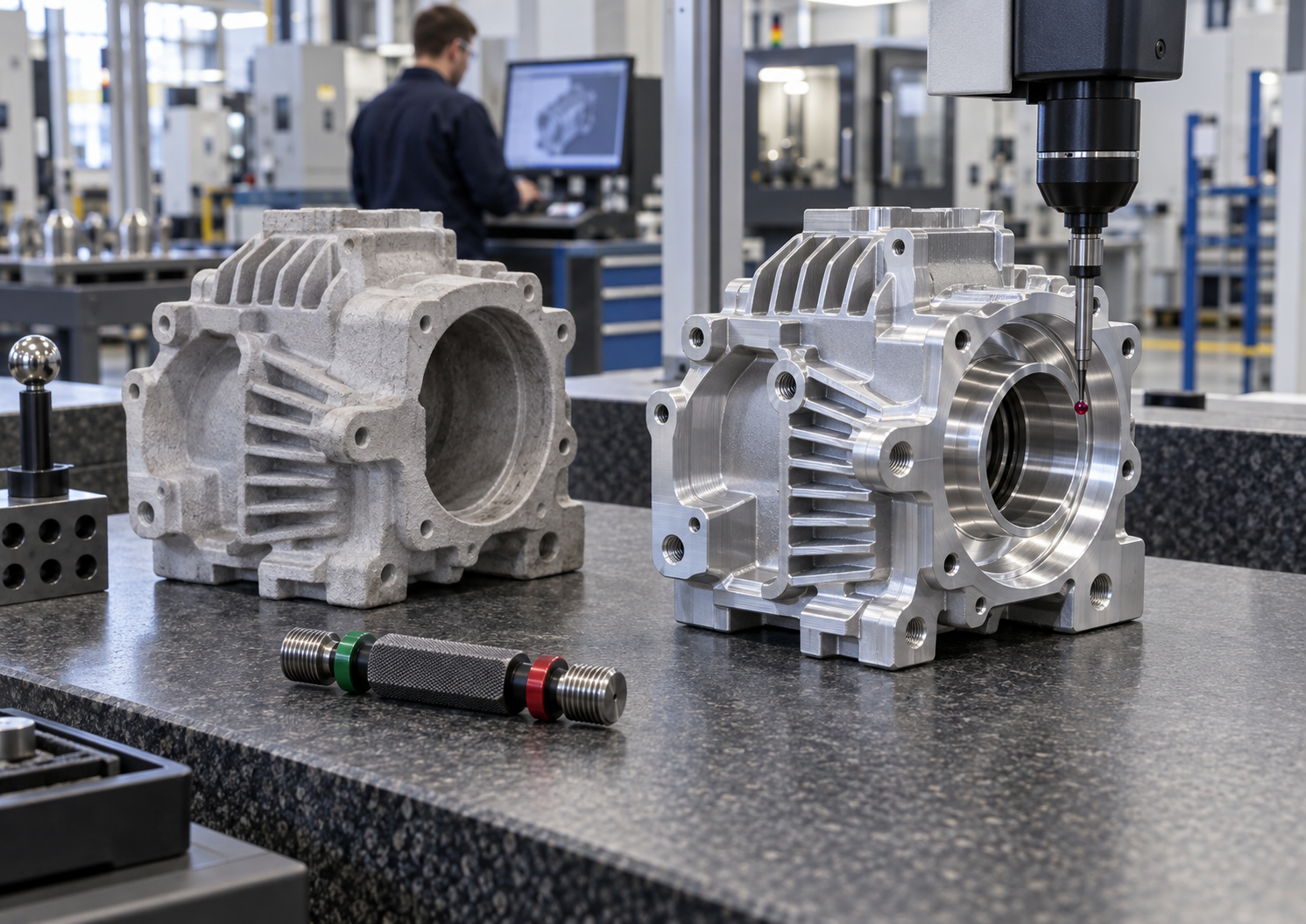
A practical hybrid route: near-net casting for form and speed, CNC finishing and inspection for functional interfaces.
Verified Existing Product Case: Die-Cast Aluminum Light Housing
A published Liqin product provides a useful, verifiable example of the hybrid route: the Precision Aluminum Light Housing. The product page identifies a high-pressure die-cast body followed by CNC machining on critical sealing faces, the perimeter gasket track, and threaded mounting holes. Its exterior uses dense cooling fins, while the interior carries many mounting features. That is geometry a near-net blank handles far more naturally than a large solid block.
The manufacturing challenge is not merely creating the outer shape. The published case lists a long, thin-finned housing, a nominal 4.6 mm wall, a matrix of 104 micro blind holes with stated depths of 2.75 mm and 2.30 mm, and several thread sizes. The page describes mold-flow work for runner design, multi-point pneumatic clamping during machining, a two-stage face-milling approach, first-article CMM inspection, periodic in-process checks, and 100% thread-gauge verification. Those are the controls that turn a casting into an assembly-ready OEM component.
The lesson reaches beyond lighting: cast the structural form, machine the assembly interfaces, and specify a check for each CTQ. The published values belong to that product and its approved quality plan, not to every future order.
A Nine-Question Selection Method for Your Next RFQ
What must the part survive? Define static load, cyclic load, shock, temperature, corrosion, pressure, and expected life.
Which dimensions make the assembly work? Mark CTQs, datums, fits, sealing lands, threads, and inspection method.
How mature is the design? Separate frozen interfaces from features still likely to change.
What is the real demand curve? Provide prototype quantity, first production batch, annual volume, and release pattern.
How much stock would billet machining remove? Compare the starting envelope with finished mass and cycle estimate.
Can the geometry be cast cleanly? Review draft, wall consistency, fillets, flow path, parting line, ejectors, and machining pads.
Which defects matter functionally? Tie porosity, flatness, appearance, burrs, and surface finish to a test or acceptance rule.
What happens after forming? Include heat treatment, machining, inserts, cleaning, coating, marking, leak testing, and packaging.
What evidence travels with the batch? Request certificates, FAI or PPAP level if applicable, control plan, capability data, and final inspection reports.
This keeps the RFQ anchored in function. A bare casting and an inspected, coated, leak-tested component are not comparable offers.
Quality Checks by Manufacturing Route
|
Stage |
Cast or cast-plus-CNC focus |
Billet CNC focus |
|
Incoming material |
Alloy chemistry, melt and heat-treatment records as required. |
Alloy, temper, product form, heat or lot traceability, stock condition. |
|
First article |
Parting line, draft, wall section, distortion, machining stock, CTQs. |
Datum strategy, setup relationships, distortion after release, CTQs. |
|
In-process |
Shot consistency, die temperature and condition, flash, trim, fixture location, tool wear. |
Tool life, runout, probing results, clamp control, thermal drift, burrs. |
|
Defect detection |
Visual and dimensional checks plus leak, density, X-ray, or CT where risk justifies it. |
Dimensional inspection plus surface, material, and NDT requirements where the design calls for them. |
|
Final acceptance |
Machined CTQs, threads, coating, cleanliness, leak performance, traceability. |
Machined CTQs, finish thickness, cleanliness, appearance, traceability. |
The Aluminum Association separates casting geometry and finish from metallurgical requirements. An OEM control plan should give both sides their own evidence.
What to Send for a Fast, Useful Quote
Send the STEP model, controlled 2D drawing, material, finish, CTQs, quantities, launch date, and required quality records. Call out pressure tightness and cosmetic surfaces early, and mark the geometry that can still move during DFM.
For confidential programs, request an NDA before sharing sensitive files. For the quote itself, ask for separate options: billet prototype, production casting plus CNC, and any intermediate route the supplier believes is viable. Liqin’s custom aluminum parts category and die-casting capability category show the material and process scope already available on the site.
Ready to compare cast vs billet aluminum for your part? Upload the drawing through the contact page. Mark the three dimensions you cannot compromise on and include your expected annual quantity. Liqin’s engineering team can review manufacturability, identify the risky features, and return a quotation built around the complete process rather than an optimistic base price.
FAQ
1. Is billet aluminum always stronger than cast aluminum?
No. Billet-machined parts often start with wrought alloys that provide higher and more consistent mechanical properties than common die-casting alloys, but the exact answer depends on alloy, temper, stock direction, casting process, heat treatment, geometry, and defect control. Compare certified properties and the actual load case instead of treating billet as a grade.
2. At what production volume does aluminum casting become cheaper than billet CNC machining?
There is no reliable universal crossover quantity. A small, simple part may remain economical to machine at substantial volume, while a large hollow housing can justify tooling much earlier. Request a cost model that includes die cost, expected tool life, cavity count, stock yield, CNC cycle, secondary operations, inspection, finishing, and forecast stability.
3. Can cast aluminum parts hold tight CNC tolerances?
Yes, when the critical features are deliberately finish-machined and the datum and fixture plan accounts for casting variation. The drawing should separate as-cast dimensions from machined CTQs, provide machining stock, define datums, and state whether tolerances apply before or after coating. Tight values should be confirmed through DFM and the signed quality plan.
4. Which route is better for anodized cosmetic parts?
Machined wrought alloys often produce a more predictable decorative anodized appearance. High-silicon casting alloys may anodize darker or less uniformly, so powder coating, e-coating, or painting may be preferable for visible cast surfaces. Always approve the finish on production-representative material rather than relying on a generic color chip.
5. Can we prototype in billet and switch to die casting later?
Yes, and that staged route can reduce early tooling risk, but the billet prototype should not be copied blindly into a die. Before production tooling, redesign for draft, wall consistency, fillets, parting line, ejectors, runner and overflow needs, machining pads, and casting tolerances, then revalidate function because the alloy and material structure may change.
Summary
Choose billet aluminum when you need fast design changes, lower upfront commitment, predictable wrought-stock properties, or tight multi-face machining in prototypes and controlled volumes; choose casting when stable demand and complex near-net geometry justify tooling; and choose casting plus CNC when a part needs both efficient shape creation and precise functional interfaces. The winning OEM decision comes from the exact alloy, load case, CTQs, finish, volume curve, and inspection plan—not from the word billet or cast alone.
Contact Information
Company: Ningbo Liqin Industry Co., Ltd.
Daily customer maintenance & after-sales support:service@shturl. zhuwanying@cncliq.com
New inquiry, quotation & order discussion:business@shturl. zhouli@chinaliqin.com
Hotline: +86 18757148656
Disclaimer
All technical articles, material specifications, machining recommendations, and surface treatment details published on this blog are for informational and reference purposes only. Please note that general blog insights do not replace signed technical agreements. Because custom parts vary by material heat numbers, machine calibrations, and specific tolerances, binding quality specs are governed solely by your approved CAD drawings, signed contracts, and formal quality plans.
All customer case studies featured on this blog have been thoroughly anonymized and sanitized. The performance metrics, manufacturing workflows, and imagery displayed serve solely to demonstrate our custom machining capabilities and do not represent a single universal standard for all orders.
Liqin Manufacturing Team
Built on 18 years of precision engineering experience, Ningbo Liqin Industry manufactures high-tolerance metal components for demanding global markets. We operate out of a 6,500 m² production hub equipped with over 150 machines, running 4-axis and 5-axis CNC machining, mill-turn machining, cold extrusion, and pressure die casting under one roof. This setup allows us to manage projects seamlessly, taking parts from initial CAD concepts directly to finalized shipments.
We handle quality control with zero compromise. We treat tight tolerances with the engineering discipline they require. Backed by ISO 9001, ISO 13485, and IATF 16949 certifications, our QA engineers run strict IPQC, FQC, and OQC checks on every single production batch. From CMM dimensional mapping and optical profiling to hardness and salt-spray testing, we validate your critical specs upfront—so you receive drop-in ready components with zero assembly headaches or costly line stoppages. On top of manufacturing, you can rely on us for two-hour response times on new RFQs, direct support for prototype sampling, and smooth export shipping across Europe, North America, Asia, and Oceania.
Welcome your inquiries and samples. Visit our website or contact us directly for a competitive quote!