English




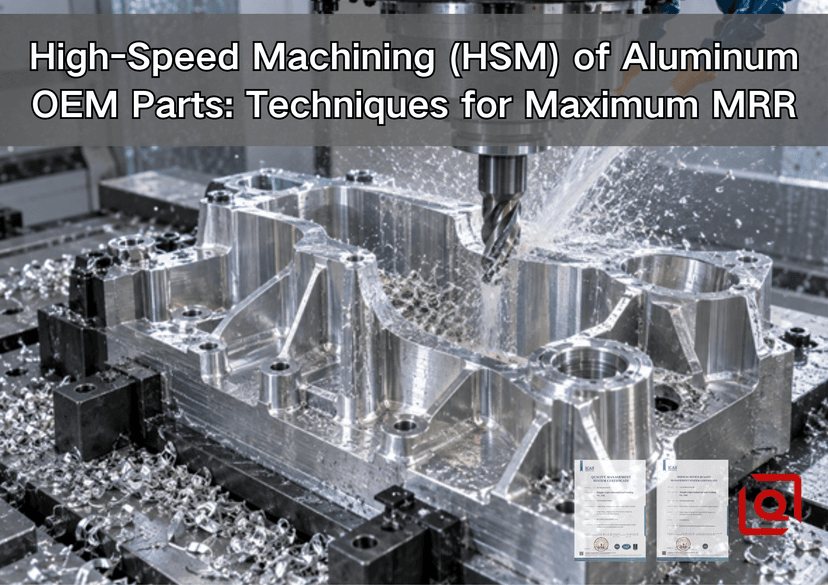
Are you still pushing spindle speed higher, yet seeing packed flutes, noisy corners, unstable thin walls, or a cycle time that refuses to improve? This guide explains how to raise material removal rate (MRR) without turning an aluminum OEM part into an expensive trial. It is for engineers, buyers, and production teams who need practical answers: which variables matter, how to calculate MRR, where high-speed machining actually gains time, and what a machining supplier needs to quote the job responsibly.
Quick answer: maximum usable MRR is not the largest number a cutter can produce for a few seconds. It is the highest repeatable removal rate that the spindle, holder, tool, CAM path, fixture, coolant delivery, stock condition, and inspection plan can sustain while the part still meets the drawing. Stable MRR beats spectacular MRR.
1. What HSM Means for Aluminum OEM Work
High-speed machining is often described as high RPM and high feed. That is incomplete. On the shop floor, HSM is a coordinated method that keeps cutter engagement predictable, maintains useful chip thickness, carries heat away in chips, and lets the machine move through corners without violent load changes. Aluminum accepts high surface speeds, but its ductility also encourages built-up edge (BUE) when a dull edge rubs or chips recirculate.
For an OEM buyer, the real output is a controlled mix of cycle time, part conformance, tool life, and process capability. A program may look fast in a straight line and still lose time when the control slows at every short segment, when an operator repeatedly clears chips, or when a distorted part needs rework. HSM therefore belongs in the same discussion as alloy temper, stock form, feature geometry, datum strategy, surface treatment, and inspection.
MRR is simple to calculate, but easy to misuse
For milling, MRR (cm³/min) = axial depth ap (mm) × radial width ae (mm) × table feed vf (mm/min) / 1,000. Table feed is vf = fz × n × zc, where fz is feed per tooth, n is spindle speed, and zc is the number of effective teeth. These standard relationships are published in the Sandvik Coromant metric milling formula guide.
Example: a 12 mm, 3-flute cutter runs at 15,000 RPM with 0.08 mm/tooth. Table feed is 3,600 mm/min. At 18 mm axial engagement and 1.2 mm radial engagement, theoretical MRR is 77.76 cm³/min. The math is correct, but it does not prove the machine can hold 3,600 mm/min through small radii, the holder can resist pullout, or coolant can remove the chip volume.
|
Metric |
What it tells you |
What it cannot prove |
|
RPM |
Tool rotational speed |
Correct chip thickness, balance, or power |
|
Table feed |
Commanded travel |
Feed maintained in short moves and corners |
|
MRR |
Nominal volume removed per minute |
Tool life, stability, finish, or scrap risk |
|
Cycle time |
Programmed machining duration |
Loading, inspection, chip clearing, and rework |
2. Start With the Part and Stock, Not the Speed Slider
Aluminum is not one machining behavior. A 6061-T651 plate, a high-strength 7075-T651 billet, a more adhesive 5052 part, and a cast housing respond differently to tool pressure, heat, and clamping. Before CAM programming, lock down alloy, temper, stock form, material-certificate requirement, and the amount of stock to remove. If a drawing simply says “aluminum,” a responsible supplier should ask for clarification.
Our comparison of CNC milling 6061, 7075, and 5052 aluminum explains the selection trade-offs. For the most common 6061 grade, see the dedicated 6061 feeds, speeds, and tooling guide. ASTM B209 applies to aluminum and aluminum-alloy sheet and plate, while ASTM B221 covers extruded bars, rods, wire, profiles, and tubes; the required specification depends on the ordered stock form and contract.
Deep pocketing removes a large share of a billet and may release residual stress. That is separate from cutting heat. For thin floors, long walls, or strict free-state flatness, plan balanced stock removal, controlled clamping, a roughing allowance, and a separate finishing stage. T651 stress-relieved stock can be helpful where its grade, size, and certification fit, but it cannot rescue a poor process.
3. Match Machine, Holder, and Tool to the Intended MRR
The cutter catalog is only one boundary. The real ceiling may be spindle power at target RPM, low-speed torque, maximum feed, axis acceleration, control look-ahead, holder grip, runout, fixture stiffness, or coolant flow. Review the whole chain before increasing MRR.
|
Element |
Question |
Warning sign |
|
Spindle |
Is power available at the target RPM, and is the assembly balanced? |
Load spikes, heat, speed droop, vibration |
|
Control and axes |
Can commanded feed survive short segments and tight arcs? |
Fast straight cuts but slow pocket corners |
|
Holder |
Are runout and gripping force controlled? |
Uneven flute wear, chatter, pullout |
|
Fixture |
Does it support the cut without distorting the released part? |
Wall movement, datum shift, flatness failure |
|
Coolant or air |
Can chips leave faster than they are created? |
Recutting, scratches, BUE, packed flutes |
Tool geometry for aluminum
A sharp carbide tool with positive geometry and generous polished flute space is a common starting point. Two flutes offer excellent chip space for slotting and smaller tools. Three flutes often balance chip clearance, core strength, and feed capability for roughing and profiling. More flutes can work in stable, well-evacuated cuts, but flute count must not outrun chip space.
Uncoated polished carbide, ZrN, and suitable DLC options are commonly considered, subject to the exact toolmaker's guidance. Never choose a coating by color or by its success in steel. Edge geometry, polish, substrate, alloy, coolant method, and surface speed work together. Keep stick-out only as long as the feature needs; avoidable overhang can erase the value of a faster program.
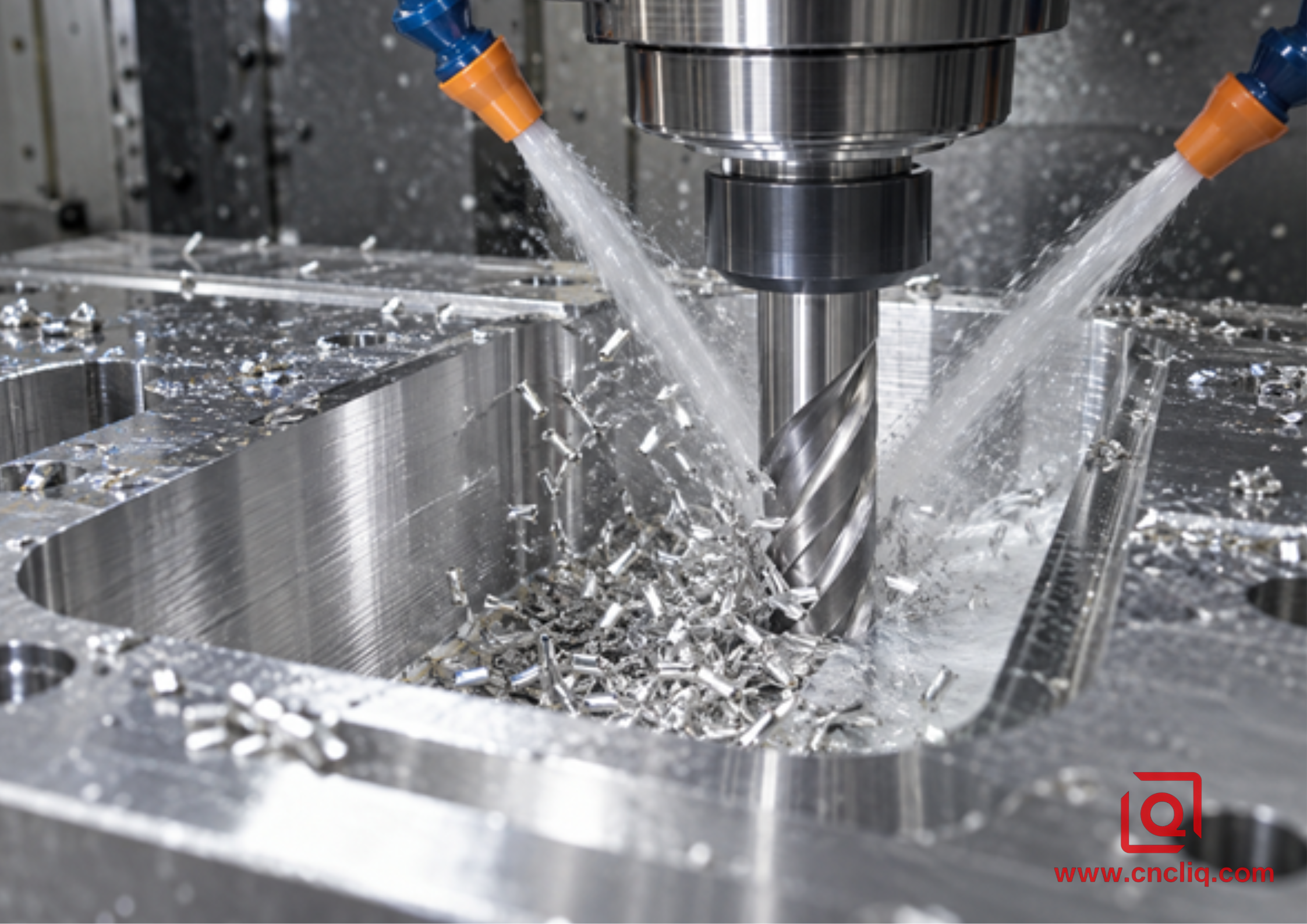
High MRR is sustainable only when chips leave the cutting zone before the next tooth arrives.
4. Use Constant-Engagement Paths Instead of Shock Loading
Traditional pocketing can drive a tool from a light side cut into near-full engagement at a corner. The resulting chip-thickness and force spike is exactly what HSM should avoid. Dynamic, adaptive, or trochoidal strategies use smaller radial engagement, longer axial engagement, and smooth motion that limits changes in engagement angle. CAM names differ; the goal is predictable load.
The smallest stepover is not automatically the fastest. Very light radial engagement can create chip-thinning effects, require feed correction, and add path length. On a machine with modest acceleration, thousands of short moves may never reach programmed feed. Measure the real cycle, not only the CAM estimate. Large open areas may favor a suitable indexable cutter; deep pockets and complex walls may favor a solid tool with controlled engagement.
Entry and linking moves matter. Use a controlled helix or validated ramp when the cutter supports it. Avoid abrupt plunges with non-center-cutting tools, needless retracts, sharp reversals, and wall dwell. Apply corner smoothing or a practical minimum radius so the control can preserve motion without gouging.
Complex parts may benefit from shorter tools and fewer reclamps on a multi-axis platform. Our multi-axis guide for complex aluminum OEM parts explains when access and datum control justify it. Simpler geometry may still be cheaper and more stable on a rigid 3-axis setup; the comparison in choosing a CNC process for custom aluminum OEM manufacturing helps frame that choice.
5. Treat Chip Evacuation as a Production Constraint
Aluminum chips are light, numerous, and capable of welding to an edge. A chip trapped in a deep pocket may be cut again. Recutting marks the wall, adds heat, changes effective edge geometry, and starts BUE. A process that creates chips faster than the machine removes them has exceeded its practical MRR.
Aim coolant or air at the cutting zone and the chip's exit route, not merely at the holder. Deep cavities may require through-tool delivery or carefully placed nozzles. Filtration matters because aluminum surfaces are easily damaged by recirculated debris. The NIST-hosted “Machining of Aluminum and Aluminum Alloys” reference notes the value of continuous cutting-fluid filtration and discusses mist application for certain aluminum operations. Flood coolant, MQL, air blast, or through-tool delivery must follow machine safety provisions, tool guidance, feature depth, alloy behavior, and local controls.
Read the chips. Bright, separate chips and a clean edge suggest proper shearing. Smear on a flute, powdery debris, darkened chips, changing sound, or chips remaining in the cavity are reasons to stop. Do not hide an evacuation problem by reducing feed while leaving RPM high; chip thickness may fall until the edge rubs.
6. Build a Safe Window, Then Raise MRR Deliberately
Begin with the cutter manufacturer's data for the exact tool, alloy, engagement, and coolant condition. Confirm holder limits, balance rating, spindle power curve, maximum RPM, and machine motion. Validate on representative stock and geometry. The sequence below is a development method, not universal cutting data.
|
Step |
Action |
Record |
|
Baseline |
Use conservative supplier data and a short, rigid setup. |
RPM, feed/tooth, ap, ae, load, sound, chips, life |
|
Stabilize |
Correct corners, entry, links, and evacuation first. |
Load trace and actual feed over the full path |
|
Increase |
Raise one main variable in controlled increments. |
MRR, wall condition, size, free-state flatness |
|
Find boundary |
Identify power, vibration, evacuation, deflection, heat, or motion limit. |
First failure precursor and safe margin |
|
Lock process |
Document limits, tool-change criteria, coolant, offsets, and inspection. |
First article and repeatability across parts |
Change one major lever at a time. If feed, radial width, axial depth, and RPM move together, nobody can explain why the result improved or failed. Mature processes track spindle load, tool life by time or distance, offset history, chip form, surface appearance, and measured critical-to-quality features (CTQs). That record turns shop knowledge into a repeatable control plan.
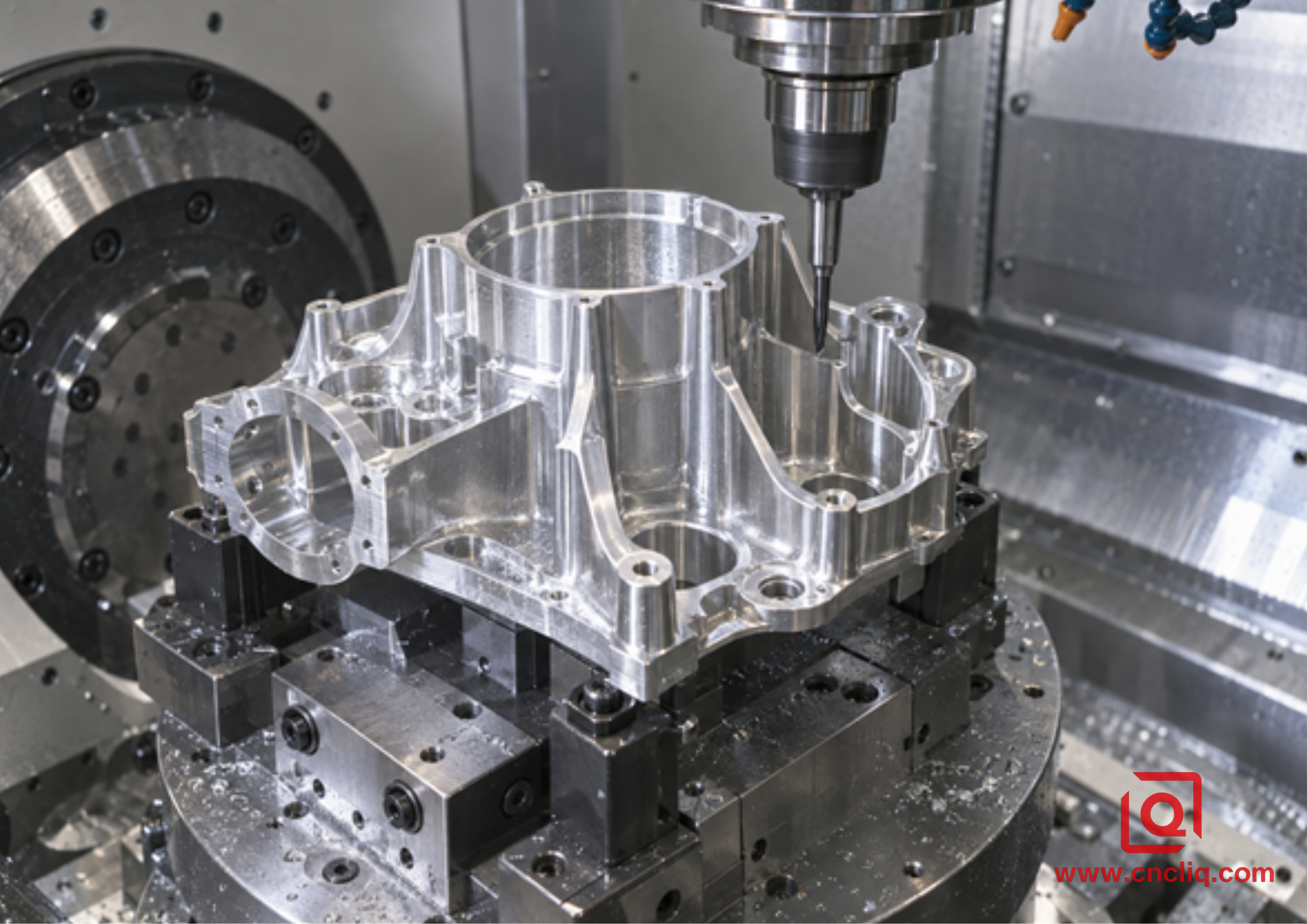
Thin walls often set the real MRR limit because part stiffness changes as stock disappears.
7. Protect Thin Walls, Datums, and Surface Requirements
A billet becomes less rigid during roughing. A wall that was supported early may behave like a spring near the end. Tool pressure bends it away; after the tool leaves, it returns and size changes. Heat, residual stress, and clamp distortion add different errors. For critical geometry, separate roughing and finishing, leave a consistent allowance, and verify datums after heavy removal when risk requires it.
Useful tactics include balanced sequencing on opposing features, sacrificial support, avoiding a heavy final pass, a sharp short-reach finisher, and inspection after temperature stabilizes. Five-axis access may shorten the tool and reduce reclamping, but it cannot cancel residual stress or poor workholding.
Plan finishing before roughing. Anodizing, coating, sealing faces, and bearing fits may need different allowances or masking. See our OEM guide to finishing CNC-milled aluminum parts. For a multi-port body, the example of a custom CNC-machined aluminum manifold shows why cross-holes, sealing surfaces, deburring, cleaning, and inspection must be planned together.
8. Anonymous Composite Case: Compact Fluid-Control Body
Case status: this is an anonymized composite example created from common custom-machining conditions. It is not a single customer's production record or a universal result.
An industrial automation buyer requested an aluminum fluid-control body with intersecting ports, two deep pockets, a sealing face, threaded connections, and several positional CTQs. The early process used wide engagement and repeated retracts. It made acceptable first pieces, but corner load rose sharply, chips stayed in the deeper cavity, and the sealing face sometimes showed recut marks.
The revised route confirmed stock and datums, then separated controlled roughing, semi-finishing, and finishing. A short aluminum-specific cutter used constant engagement in the main pockets. Coolant nozzles aimed at the chip exit. The programmer smoothed corners, removed unnecessary air moves, and reserved bores plus the sealing face for stable finishing tools. Inspection followed unclamping so fixture force could not hide movement.
For illustration, consider a validated change from 12 mm × 1.0 mm × 3,000 mm/min to 18 mm × 1.2 mm × 3,600 mm/min. Calculated MRR rises from 36.00 cm³/min to 77.76 cm³/min, a 116% theoretical increase. It is not a promised production gain: drilling, acceleration, tool changes, inspection, and handling remain. The useful result is that the higher rate is connected to constant engagement, proven evacuation, separate finishing, and measured CTQs.
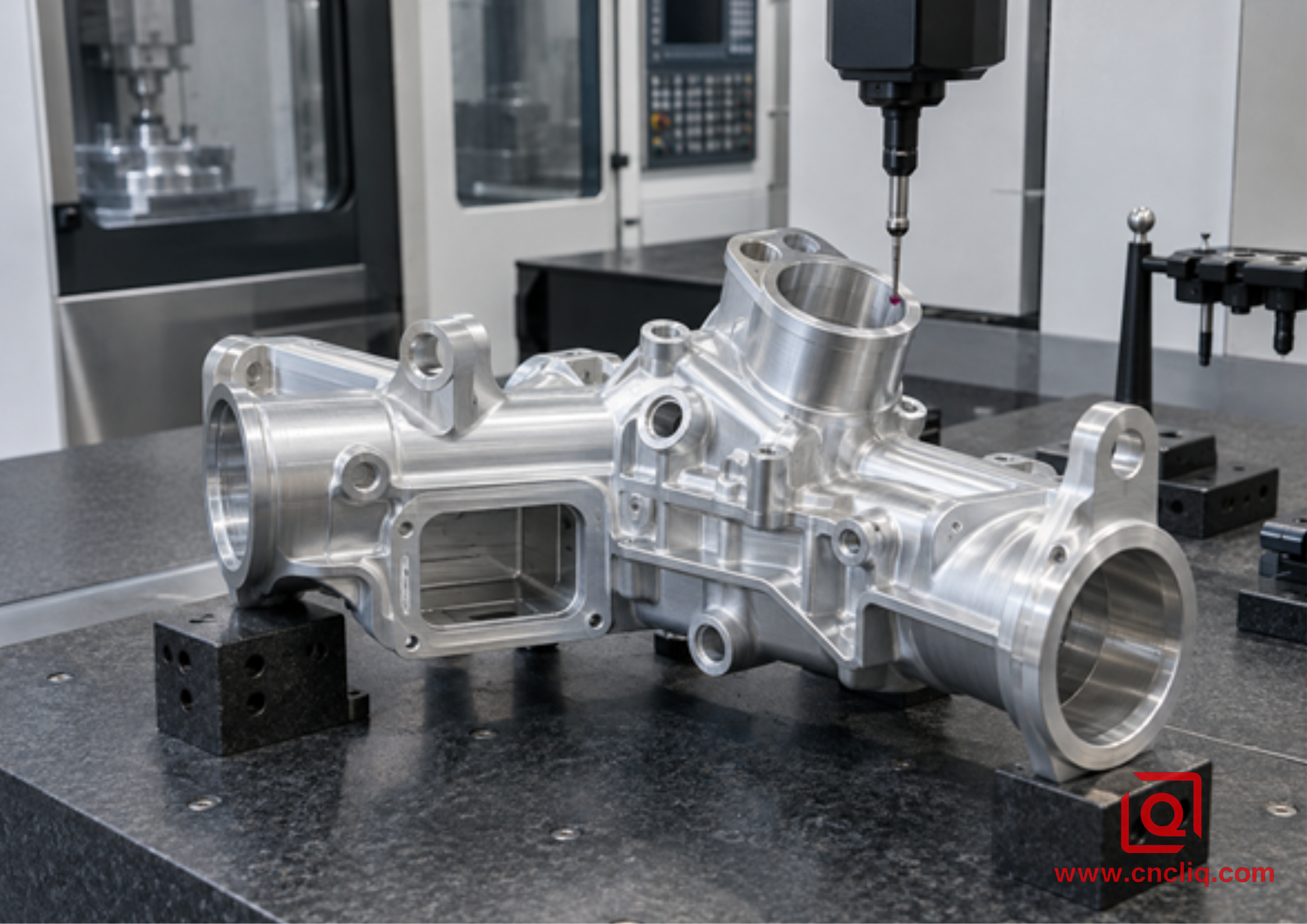
A high-output roughing process earns its value only after free-state dimensions pass inspection.
The 6061-T6 cold-extruded and precision-machined lightning-arrester housing illustrates another path: near-net forming can reduce the volume that later CNC operations must remove. In repeat production, maximum effective MRR sometimes comes from a better blank, not a harder-working end mill.
9. What to Send for a Fast, Useful HSM Quote
A supplier cannot optimize cycle time from a screenshot. Send the native 3D model and a controlled 2D drawing with datums, tolerances, GD&T, threads, surface finish, and inspection requirements. Include alloy and temper, certification, annual volume, batch size, finishing, cosmetic zones, assembly function, target delivery, packaging, and cleanliness needs.
Flag dimensions that truly drive function. Blanket tight tolerances force slower finishing and extra inspection on features that may not affect assembly. If the design is flexible, request DFM feedback on radii, pocket depth, walls, tool access, datums, and whether billet, extrusion, cold extrusion, die casting, or another blank fits the volume. Our aluminum OEM machining cost and DFM guide explains those trade-offs.
Planning a new aluminum OEM part? Send your STEP/IGES model, PDF drawing, alloy and temper, quantity, finishing requirement, and CTQ list. Liqin's team can review access, stock, fixture logic, inspection, and the practical route to higher MRR before quotation. Request a manufacturing review and competitive quote.
FAQ
1. Is HSM simply the highest possible spindle RPM?
No. HSM combines suitable surface speed, feed per tooth, stable engagement, machine motion, rigid workholding, balanced tooling, and chip evacuation. RPM without proportional feed can make the edge rub, while commanded feed may never be reached in short moves. The target is a repeatable window that protects the drawing, not the largest screen value.
2. Which aluminum alloy is best for maximum MRR?
There is no universal winner because function and stock condition come first. 6061-T6/T651 is widely used and predictable; 7075-T651 serves higher-strength applications and needs its own validated window. 5052 is valuable for forming and corrosion performance but may behave more adhesively. Confirm grade, temper, stock form, geometry, certification, and finish before quoting cycle time.
3. Should I use 2-flute or 3-flute end mills?
Two flutes give generous chip space and suit slotting, small diameters, or difficult evacuation. Three flutes can raise feed capacity while keeping useful flute volume and are common for profiling and pocket roughing. The choice depends on diameter, engagement, pocket depth, coolant, holder rigidity, spindle power, and the toolmaker's tested data.
4. How can a buyer compare supplier MRR claims?
Ask for MRR inputs, cutter size and flute count, alloy and temper, engagement, spindle and feed limits, actual cycle time, tool-life rule, and the inspected features that define success. Compare conforming-part output rather than a short cutting demonstration. A credible supplier should explain the limiting factor and how first-article, in-process, and final checks control CTQs.
5. What information is needed for an accurate quote?
Provide a 3D model, controlled 2D drawing, grade and temper, quantity and batch size, annual demand, surface treatment, cosmetic needs, material certification, CTQs, inspection documents, packaging, and destination. Mark undecided requirements as open items. Clear functional priorities let a supplier propose realistic radii, tolerances, setups, stock form, and an MRR that survives production.
Summary
Maximum MRR in aluminum OEM machining comes from a balanced system: verified stock, sharp aluminum-specific tooling, controlled runout and stick-out, constant engagement, adequate spindle and axis capability, strong chip evacuation, rigid low-distortion workholding, and separate finishing and inspection plans. Calculate MRR, but judge the process by repeatable conforming parts. Complete CAD, drawing, material, volume, finishing, and CTQ information lets a supplier improve throughput without trading away stability or reliability.
Contact Information
Company: Ningbo Liqin Industry Co., Ltd.
Daily customer maintenance & after-sales support:service@shturl. zhuwanying@cncliq.com
New inquiry, quotation & order discussion:business@shturl. zhouli@chinaliqin.com
Hotline: +86 18757148656
Disclaimer
All technical articles, material specifications, machining recommendations, and surface treatment details published on this blog are for informational and reference purposes only. Please note that general blog insights do not replace signed technical agreements. Because custom parts vary by material heat numbers, machine calibrations, and specific tolerances, binding quality specs are governed solely by your approved CAD drawings, signed contracts, and formal quality plans.
All customer case studies featured on this blog have been thoroughly anonymized and sanitized. The performance metrics, manufacturing workflows, and imagery displayed serve solely to demonstrate our custom machining capabilities and do not represent a single universal standard for all orders.
Liqin Manufacturing Team
Built on 18 years of precision engineering experience, Ningbo Liqin Industry manufactures high-tolerance metal components for demanding global markets. We operate out of a 6,500 m² production hub equipped with over 150 machines, running 4-axis and 5-axis CNC machining, mill-turn machining, cold extrusion, and pressure die casting under one roof. This setup allows us to manage projects seamlessly, taking parts from initial CAD concepts directly to finalized shipments.
We handle quality control with zero compromise. We treat tight tolerances with the engineering discipline they require. Backed by ISO 9001, ISO 13485, and IATF 16949 certifications, our QA engineers run strict IPQC, FQC, and OQC checks on every single production batch. From CMM dimensional mapping and optical profiling to hardness and salt-spray testing, we validate your critical specs upfront—so you receive drop-in ready components with zero assembly headaches or costly line stoppages. On top of manufacturing, you can rely on us for two-hour response times on new RFQs, direct support for prototype sampling, and smooth export shipping across Europe, North America, Asia, and Oceania.
Welcome your inquiries and samples. Visit our website or contact us directly for a competitive quote!